

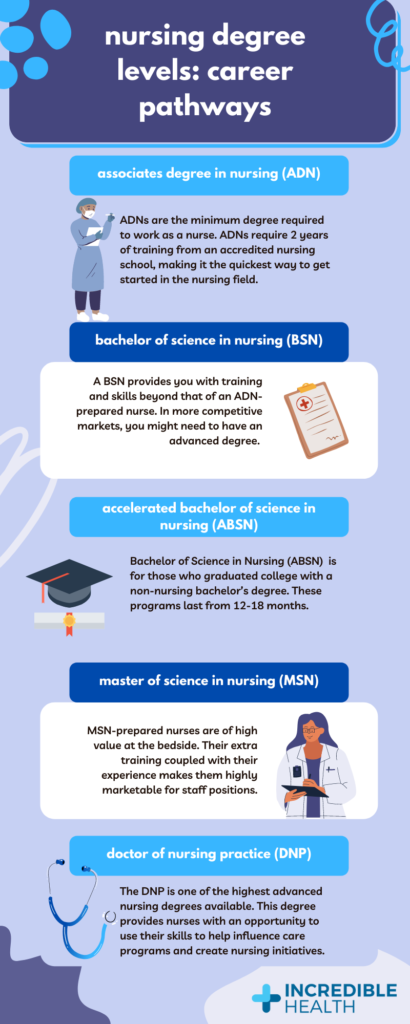
Nursing degrees come in all sorts of flavors and sizes. And nursing schools offer many paths toward that degree, whether it be an associate’s or master’s diploma.
Read on to learn about the path you can take in your nursing career:
- Associate Degree in Nursing (ADN)
- Bachelor of Science in Nursing (BSN)
- Master of Science in Nursing (MSN)
- Doctor of Nursing Practice (DNP)
Associate Degree in Nursing
Many nursing candidates opt for a two-year Associate Degree in Nursing (ADN) when they first begin their nursing journeys. ADNs are the quickest way to get started in the nursing field if you are eager to strap on a stethoscope and get to work.
It is the minimum degree required to work as a nurse. ADNs require two years of training from an accredited nursing school. Nurses who earn their ADN must then sit for the NCLEX exam to earn their license to practice.
If you are an ADN-prepared nurse and are not looking to further your education, you should consider maximizing your experiences by obtaining professional certifications (see below). This will help make your resume stand out.
If you have an ADN degree, it is strongly suggested you go back to school and earn at least a Bachelor of Science in Nursing (BSN). Without at least a BSN, you may face barriers to career advancement and leadership opportunities. There is good news! There are ADN to BSN bridge programs that can be completed in 12-18 months.
For more information visit Associate Degree in Nursing.
Get job matches in your area + answers to all your nursing career questions

Bachelor of Science in Nursing
A BSN provides you with training and skills beyond that of an ADN-prepared nurse.
BSN-prepared nurses have an advantage when it comes to seeking employment. Healthcare organizations have pushed for nurses to get their BSN and schools have increased their capacity to keep up with the demand.
A BSN is a nursing degree that will be a big help in securing an interview. You may be considered before an ADN-prepared nurse but your BSN won’t get you far beyond that. If you are looking to get into a leadership position you will need to further your education to be competitive for most jobs.
If you’re looking to work in a rural area, a BSN would probably suffice. In more competitive markets, you might need to have an advanced degree to even apply for a job. There is a BSN to MSN bridge program that will help speed up the process of obtaining an advanced degree.
The BSN to MSN takes about two years to complete. Another option is the Accelerated Bachelor of Science in Nursing (ABSN) which is for those who graduated college with a non-nursing bachelor’s degree. These students can graduate with a Bachelor of Science in Nursing in just 12-18 months.
For more information visit Bachelor of Science in Nursing and Accelerated Bachelor of Science in Nursing.
Master of Science in Nursing
MSN-prepared nurses are more common than you might expect. Many nurses get their MSN and decide they don’t want the added responsibility that comes with leadership positions, or to work full-time, so they stay with direct patient care. MSN-prepared nurses are of high value at the bedside. Their extra training coupled with their experience makes them highly marketable for staff positions.
There are programs that offer RN to MSN bridge programs that allow you to finish your master’s degree in about two years. Another option is the fast-track nursing program that allows students with a non-nursing bachelor’s degree to complete their MSN within three years.
If you have an MSN and are looking to move into a leadership position, be prepared a competitive process. Your level of education will stand out but given the level of competition and the fact that fewer leadership jobs exist, you will want to utilize other skills during the hiring process to get the job.
For more information visit Master of Science in Nursing.
Doctor of Nursing Practice
The DNP is one of the highest advanced nursing degrees available. Many nurses with DNP degrees choose to work in administrative or other leadership positions within the healthcare sector. Others use their degree to pursue various nurse practitioner roles. This degree provides nurses with an opportunity to use their skills to help influence care programs and create nursing initiatives.
Nurses who have earned their DNPs can choose to become advanced practice registered nurses (APRN) in order to have the opportunity to work directly with patients. They often perform duties such as managing and evaluating patient treatment and after-care.
Earning a doctoral degree may seem intimidating but there are programs that make school less daunting. There is a BSN-DNP bridge program that takes about three to four years to finish. Another option is the direct entry DNP program for those who graduated college with a non-nursing bachelor’s degree. This program takes about four to four and a half years to complete.
For more information visit Doctor of Nursing Practice or Doctor of Nurse Anesthesia Practice (DNAP).
Certifications
One way to stand out is to obtain certifications. They demonstrate a level of commitment to the profession which can make your resume stand out to a hiring manager. Another reason to consider earning a certification is to maximize your experiences. Professional certifications are a great option regardless of your level of education.
Continuing education
Another way to stand out is to complete continuing education classes. Learning more about your specific specialty and staying current on nursing best practices is important for all nurses.
Learn more about degrees and education
Your nursing education doesn’t come in a one-size fits all package. There are numerous paths and steps you can take to get your RN, MSN, DNP or Ph.D.! Learn about them in our guides below.
About nursing school
- Guide for Nursing School Clinicals
- How Much is Nursing School?
- How Long Is Nursing School?
- HESI Exam
- TEAS Exam
- Letters of Recommendation
- Online Associate Degree in Nursing (ADN)
Degree comparisons
Degree transitions
Get job matches in your area + answers to all your nursing career questions
Nursing school resources by state
N
New York
O
Ohio
P
R
S
T
U
V
W
Washington, D.C.
Wyoming