• Skip to main content
  • Skip to primary sidebar
  • Skip to footer

Incredible Health

Empowering healthcare professionals to find and do their best work.

  • Healthcare professionals
        • For nurses

        • How it works for nurses
        • See job matches
        • Direct Connect
        • Salary for nurses
        • Resume Wizard
        • Career Advocates
        • Advice community
        • Career growth
        • Nurse blog
        • For techs

        • How it works for techs
        • Salary for techs
        • Tech blog
        • Annual reports

        • 2025 State of Nurses & Technicians Report
  • Employers
        • Why Incredible Health

        • Employer overview
        • Lyn AI Interview Agent
        • The Marketplace
        • Get started

        • Book a demo
        • Resources

        • Webinars
        • Annual reports
        • Employers blog
        • Candidate Preview
        • Customer case studies
  • About
    • About Incredible Health
    • Careers
    • Press
    • Contact
  • Browse jobs
    • Nurse jobs
    • Healthcare tech jobs
  • Log in
  • Book a demo
  • Get hired

Blog

Watch: 5 Ways Hospitals are Using Incredible Health’s New AI to Hire Nurses Faster

Jan 10 2024

We have implemented generative AI across our platform recently. These new generative AI features dramatically expand opportunities for nurses and speed up the hiring process for both hospitals and nurses. 

  • “Resume Wizard” for automatic resume creation – Incredible Health’s Resume Wizard allows nurses to quickly build a high-quality resume optimized to match them with the best hospitals and roles that meet their criteria. More than 30% of nurses start their job searches without a quality resume. Resume Wizard enables nurses to generate an impactful resume via the Incredible Health mobile app in less than 5 minutes at no cost.
  • Customized recruiter outreach messages – The nurse shortage makes for a hyper-competitive job market but healthcare organizations often struggle to differentiate themselves in communications to prospective talent, particularly at the scale required to fill staffing gaps. Incredible Health now leverages generative AI to help health systems instantly create highly customized messages to nurse candidates, highlighting meaningful details about hospital benefits, perks, and other differentiating factors of their organization. Since implementing this feature, interview request accept rates from nurses increased by 20%.
  • Faster processing of resumes – Incredible Health now uses generative AI to instantly process resumes and applications, including verifying key specialties and skills, matching open positions within specialties to relevant applications immediately. The result is nurses get in front of employers faster, reducing the wait time for a response from days to seconds. 
Written by Danny Li
Read more from Danny

Medical care costs are up 30% in the past decade—here’s what it means for Americans

Jan 04 2024

Written by: Jill Jaracz, Data Work By Paxtyn Merten, Data Work By Emma Rubin

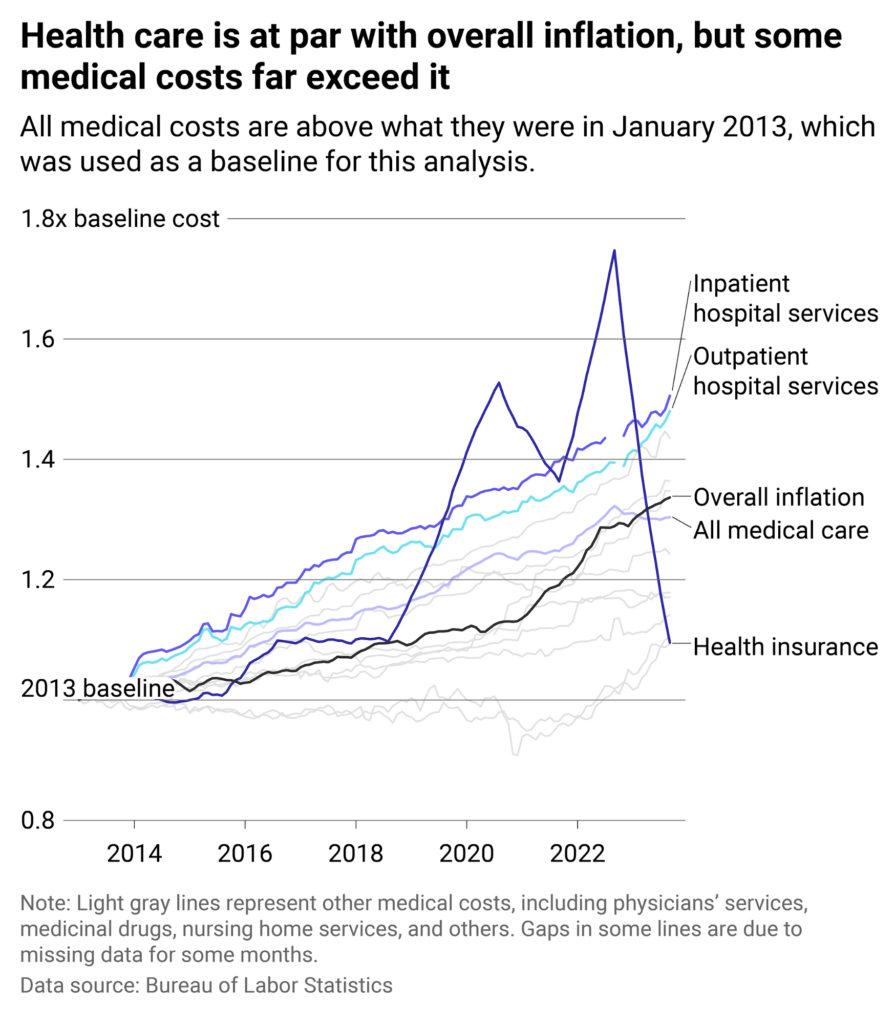
Inflation is cooling off, but prices are still high—especially for medical care. Medical inflation is far outpacing increased costs for other goods, and that’s having a direct effect on Americans’ health. According to Gallup, about 2 in 5 Americans (38%) delayed medical treatment due to costs in 2022, an increase of 12 percentage points from 2021 and the highest share since 2001. Due to costs, those with serious conditions were more apt to put off care.

Incredible Health analyzed the increasing costs of medical care and its contributing factors, referencing Bureau of Labor Statistics data.

Rising health care costs are partly due to an aging population. According to the Peter G. Peterson Foundation, 13% of people in the U.S. in 2010 were aged 65 and older; by 2021, 16% were 65 and up. By 2030, 1 in 5 people will be a senior citizen. Comparatively, this age group spends the most on health care, which means overall costs are expected to increase. Other factors also contribute to higher prices, including expensive new technology, more administrative costs, and hospital consolidation.

Americans may be spending more on health care, but they’re not getting the improved health they might think they’re paying for. Compared with other nations, the U.S. spends more money per capita on health care, but Americans continue to have a lower life expectancy and higher rates of obesity, diabetes, and infant mortality.


PER DIEM NURSING JOBS IN THE UNITED STATES

Quickly find over 22,400 full-time, part-time, and per diem nursing jobs near me across the United States.


How various health care costs have changed in 10 years

Inflation metrics for health insurance trail other metrics because people register for insurance plans before they get health care. Plan costs are set for the year, so if costs run higher, health insurers must absorb them until they can adjust insurance prices.

Consumers can expect insurance prices to rise more than usual in 2024, as Mercer forecasts a 5.4% premium increase, up from the typical 3% to 4% increase. Additionally, a Peterson-KFF Health System Tracker analysis found that plans available through Affordable Care Act marketplaces will likely have a 6% increase. Other factors to consider include inflation, which has affected the cost of medical supplies, and staffing shortages at hospitals and health care systems, which have prompted higher wages. Not to mention more medical claims and higher prescription drug prices will also increase plan prices.

According to the Kaiser Family Foundation, 3 in 5 adults take at least one prescription drug, and 1 in 4 have four or more prescriptions. Price increases quickly become a pain point, particularly for people who are uninsured.

Pharmaceutical manufacturers make drug price adjustments twice yearly, in January and July, according to the Office of Health Policy in the Office of the Assistant Secretary for Planning and Evaluation for the Department of Health and Human Services. During those months in 2022, manufacturers increased prices more than usual on more drugs. January’s increase affected 3,239 drugs, with an average increase of nearly $150 per drug; in July, 601 drugs had higher prices, with an average of $250 per drug. Ativan, a drug used to treat anxiety, had a 7.9% increase, from $37.65 to $40.62 per pill. Greenstone’s Fluconazole, used to treat fungal infections, jumped nearly 1,101%, from $2 to $28 per pill.

When prices jump, affordability decreases. According to KFF, nearly 2 in 5 of those with four or more prescriptions have trouble paying for them. Three in 10 adults cut medication costs by skipping doses, cutting pills in half, not filling prescriptions, or opting for over-the-counter medication, bypassing their prescription drugs altogether.

Consolidation within the industry has also led to higher prices. Kaiser looked at an analysis of several types of hospital mergers and found that less competition typically led to higher prices for insurers. When hospital consolidation resulted in just one option within a 15-mile radius, prices were 12% higher than in markets with four or more hospitals nearby. In more consolidated markets, private insurers have less power to rein in providers’ prices.


NURSE PAY RANGE FOR YOU

Get a free nurse salary estimate based on your location, nursing specialty and education level to see what other nurses like you are getting paid.


Story editing by Jeff Inglis. Copy editing by Paris Close. Photo selection by Clarese Moller.

Header image: mrmohock // Shutterstock

Written by Incredible Health Staff

At Incredible Health, it's a team effort to achieve our vision: Help healthcare professionals live better lives. Many are licensed practitioners themselves; others are simply passionate writers and leaders dedicated to providing valuable resources to nurses.

Read more from Incredible Health

How health care spending varies by occupation

Jan 03 2024

Written by: Natalie P. McNeal, Data Work By Emma Rubin

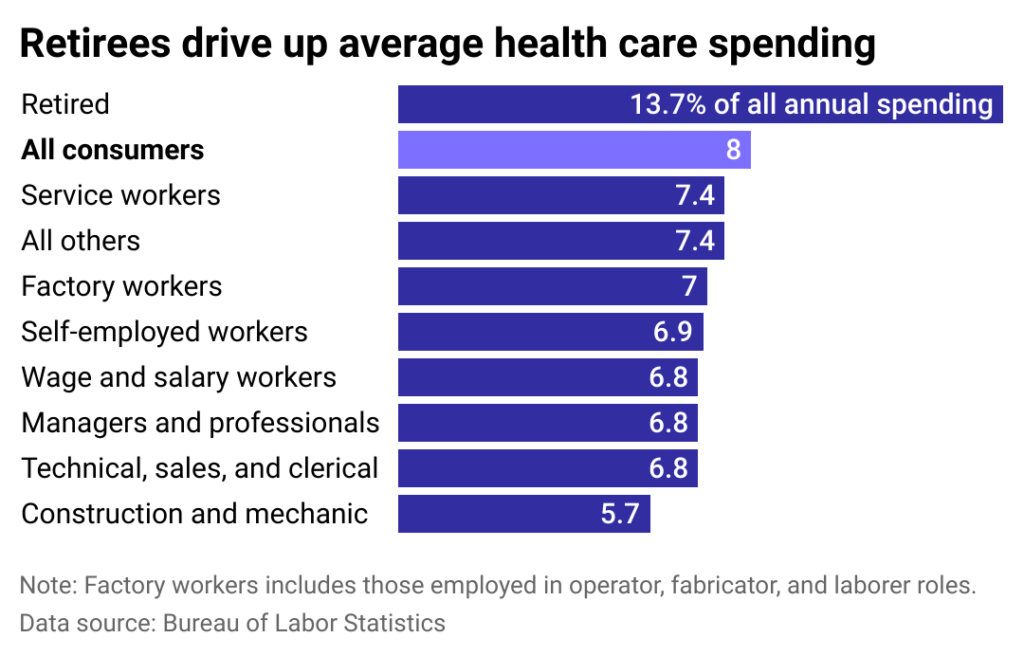
The American health care story is essentially a tale of the “haves” and “have-mores.” Managers and professionals, as well as all wage and salary workers, pay 6.8% of their income toward health expenses, including prescription drugs, health insurance, medical services, and medical supplies. Construction workers and mechanics, however, despite their physically rigorous professions, spend less of their household budgets on their health at 5.7%.

To get these numbers, Incredible Health used data from the Bureau of Labor Statistics to examine health care spending across different work sectors.

It may seem that spending more on health expenses may be a bad thing. But health care only works when you can use it. Workers in careers with the best, employer-sponsored health insurance and with the best benefits packages of sick days, personal leave, and salary appear to spend more because they utilize health care more—and can afford to do so. Meanwhile, the oldest Americans, retirees, spend double (nearly 14%) what the average worker does on expenses related to health care.

Regardless of your station in life, premiums for employer-sponsored insurance family plans are going up, and in some cases, workers are shouldering more of that cost.

This rising cost of healthcare is a significant factor influencing some skilled professionals to move abroad and pursue remote work opportunities. As expats, the international health insurance cost is often cheaper than what they were paying before, further reducing their financial burden


PER DIEM NURSING JOBS IN THE UNITED STATES

Quickly find over 22,400 full-time, part-time, and per diem nursing jobs near me across the United States.


Health care makes up less than 8% of overall spending for most people

It shouldn’t come as a surprise that retirees are spending the most on health care. In 2023, a 65-year-old single person may need $157,500 in after-tax savings to pay for retirement health care costs, according to a Fidelity Retiree Health Care Cost Estimate. The average 65-year-old retired couple may need $315,000.


RECEIVE ADVICE FROM THE NURSING COMMUNITY

Easily find expert nursing advice and answers to medical questions from nurses like you.


Outside of Medicare and insurance, people can plan for retirement health expenses by opening a health savings account. Commonly referred to as an HSA, these accounts allow workers to put aside pre-tax money to spend on qualified medical expenses. The untaxed dollars may lower out-of-pocket health care costs such as copays, deductibles, and coinsurance.

Another way to plan for health care expenses is by purchasing long-term care insurance. While it has some shortfalls—and it is not a substitute for health care—it can cover expenses that health insurance will not. Services such as hiring help for bathing, dressing, or care for Alzheimer’s disease may be covered by long-term care insurance.


NURSE PAY RANGE FOR YOU

Get a free nurse salary estimate based on your location, nursing specialty and education level to see what other nurses like you are getting paid.


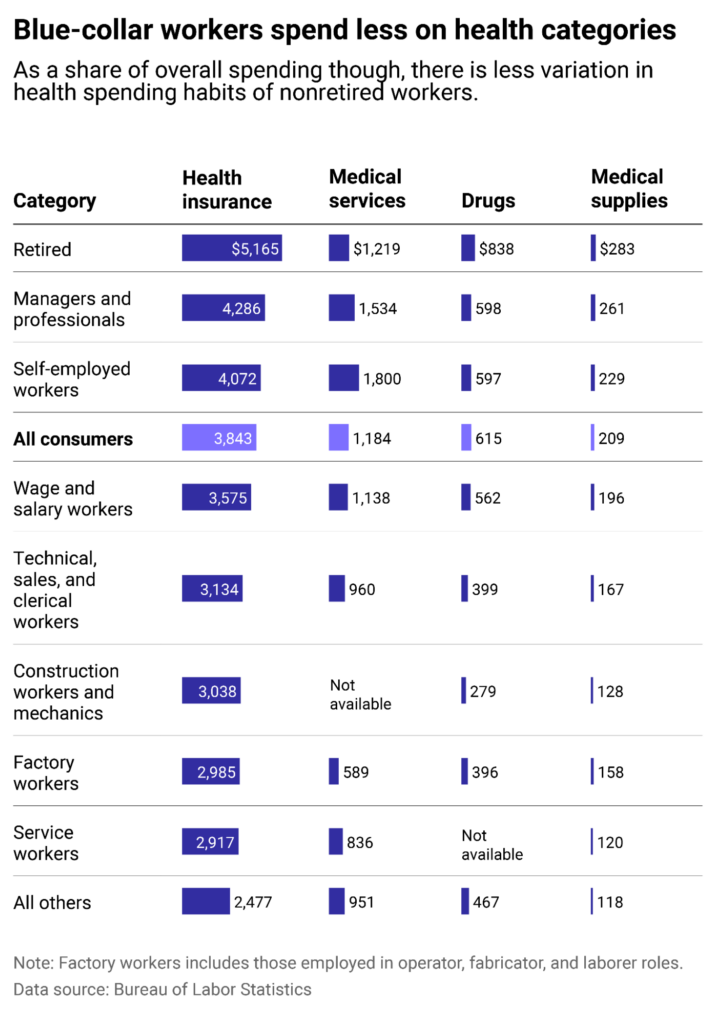
Insurance is the most expensive health expense

Blue-collar workers spend fewer dollars per year on health expenses. However, it’s vitally important for blue-collar workers to still have adequate health care, pay, and sick days because they tend to work longer and have worse health conditions than white-collar workers, according to a 2011 Columbia University study.

Adults who don’t have adequate—or any—health insurance are three times more likely to say they haven’t visited a health clinic or medical doctor in a year, according to a KFF report, The Uninsured and the ACA: A Primer – Key Facts about Health Insurance and the Uninsured amidst Changes to the Affordable Care Act.

One way small businesses can navigate these challenges is by exploring tailored health coverage options that fit their budgets and workforce needs. Access to small business health insurance in NY not only helps employers provide adequate care for their teams but also ensures that workers can afford routine check-ups and necessary treatments. This approach can bridge the gap for employees in sectors like construction or retail, where health benefits are often limited.

Those stats may explain the plight of construction workers. Fewer than 43% of construction workers in the South are offered health insurance by their employer, according to the Build a Better South: Construction Working Conditions in the Southern U.S. study by the Workers Defense Project, an organization that helps low-wage, immigrant construction workers in the construction industry. What’s more, 78% lacked paid sick time, the study found, making it harder to even leave work to see a doctor without risking a cut in pay. Affordability may also be a factor; even though more than 80% of the workers in the Build a Better South study reported working overtime, 36% struggled to pay for essentials such as food or rent.

According to the KFF report, “19% of uninsured adults said they delayed or did not get a needed prescription drug due to cost, compared to 14% with public coverage and 6% with private coverage.”

Story editing by Ashleigh Graf. Copy editing by Tim Bruns.

Written by Incredible Health Staff

At Incredible Health, it's a team effort to achieve our vision: Help healthcare professionals live better lives. Many are licensed practitioners themselves; others are simply passionate writers and leaders dedicated to providing valuable resources to nurses.

Read more from Incredible Health

Need Extra Cash? Consider These Side Hustles for Nurses.

Dec 26 2023

Personal Finance / Side Hustles for Nurses

Nursing positions often pay well, but there are times when unexpected expenses arise, and you might need quick access to extra cash. Solutions like receiving an early paycheck, tapping into savings, or using financial tools designed for short-term needs can help cover immediate costs, giving you peace of mind to focus on other goals.

Once your finances are steadied, a side hustle can be an excellent way to supplement your income, explore your creativity, or even step outside patient care. Ideas like renting out unused equipment or selling handmade crafts can help you stay on top of expenses while pursuing your passions.

When it comes to choosing a side hustle, the sky’s the limit. Opportunities are available in many forms. 


Get job matches in your area + answers to all your nursing career questions

Let's get started

What's your current role?

Staff nurse
Manager
Other

Below, you’ll find several ideas for side hustles that are specifically suited to nurses. 

1. Freelance nurse writer

Freelance writing about health or professional issues is a great side hustle for nurses with strong communication skills. Many organizations are desperate for nursing insights for their websites.

Nurse freelance writers can provide content for the many mediums, such as:

Website content: Write pages for a company’s website.

Web-based magazines: Publish articles relevant to the nursing field.

Email marketing: Write promotional messages in keeping with the client’s goals to be sent to their targeted mailing list.

Blogging: Write content for the company you represent as part of their marketing strategy.

Social media writer: Compose interesting posts in support of client branding strategies.

What you need to start

Freelance writing is all about networking. You can create a free portfolio on Clippings.me and then join a site that helps you find clients, such as Upwork. Set your fee, but it’s a good idea to start low until you gain clients and your reputation grows. Then you can gradually raise your fees and charge more.

Freelance writing can be a lucrative and enjoyable gig for nurses.

2. Telehealth nurse

This is an emerging role that became especially relevant during the pandemic. Telehealth nurses provide high-quality healthcare to patients through video, phone, or email.

According to the American Hospital Association, 76 percent of U.S. hospitals connect with patients through video and other technology. If you enjoy working from home and want a flexible schedule, this might be the perfect fit for you.

What you need to start

This role requires three to five years of bedside or RN experience, a background check, and an unrestricted RN license. You also need a strong Internet connection, up-to-date computer equipment, and excellent computer skills.

3. Part-time caregiver

As a part-time caregiver, you will be responsible for meeting a variety of needs for a patient.

These may include bathing and hygiene, cooking and serving food, helping with exercise routines, performing household chores like laundry, and more.

Part-time caregivers tend to make around $16.00 an hour, presenting the perfect opportunity to use their nursing skills to earn extra money. If you work only 20 hours a week as a part-time caregiver, this puts an extra $1,385 in your bank account each month.

4. CPR instructor

Putting your CPR teaching certificate to good use can earn you almost twice as much as being a part-time caregiver. If you’re not currently certified to teach CPR, click here. You can work with an employer or employment agency to find facilities in need of your CPR training services, or if you prefer, you can start your own small CPR training brand. This allows you to set your own rates and schedule. Of course, that also means you’ll need to take charge of your own marketing and networking, but there’s a lot of appeal to working as much or as little as you want.

5. Healthcare documentation specialist

This role requires translating voice recordings from doctors and other medical professionals into a written document. According to the Bureau of Labor Statistics, you can use speech recognition technology to help transcribe.

The great news is that there’s a lot of demand for this type of work. Sites such as Fiverr and GoTranscript are great platforms for finding assignments, and these sites are free. The only requirement is that you have good grammar and strong internet, but if you want to continue learning and boost your resume, earning an associate degree or certificate in anatomy or medical terminology can help your cause.


Nurses have many great opportunities for making extra money, and many of them will also increase your knowledge or engagement with the world outside of clinical practice. If you need help finding your main gig, try Incredible Health and find a job that’s right for you. 


Get job matches in your area + answers to all your nursing career questions

Let's get started

What's your current role?

Staff nurse
Manager
Other

Written by Incredible Health Staff

At Incredible Health, it's a team effort to achieve our vision: Help healthcare professionals live better lives. Many are licensed practitioners themselves; others are simply passionate writers and leaders dedicated to providing valuable resources to nurses.

Read more from Incredible Health

Top Tips for Filing Taxes as a Nurse

Dec 22 2023

Personal Finance / Filing Taxes

Despite the joys that the arrival of spring heralds, it also evokes thoughts of tax season, with all of its negative associations. Adding tax filing to nurses’ already stressful schedules virtually guarantees stress and headaches.

The good news is that we’re here to help! We’ve created a guide to help you navigate the tax filing process, and to alleviate any confusion about the details of filing as a nurse.


Specifically, this post will cover the following: 

  • Tips for filing taxes as a nurse
  • Potential tax write-offs for nurses
  • Overview of travel nurse contracts


Get job matches in your area + answers to all your nursing career questions

Let's get started

What's your current role?

Staff nurse
Manager
Other

Tips for filing taxes as a nurse

Most people don’t know what they’re doing when it comes to filing their taxes. That doesn’t mean that they make mistakes — it’s more that they don’t take advantage of the various ways of minimizing what they owe or maximizing their refund. Most nurses don’t aren’t aware of all the things they can write off to reduce their tax liability. If you’re a nurse, below you’ll find some valuable tips for filing your taxes. 

Keep a paper trail

Hold on to receipts for all your work-related expenses. This is one of the most important things to remember. 

Why?

Because your receipts are how you prove that you’re entitled to write these expenses off. Without receipts, you can’t prove you bought anything, and your accountant won’t be able to use them to minimize what you owe the government. It’s a good idea to keep an accordion file or folder that you can easily bring with you when you meet with your account or turn to as you prepare your return. 

Know your state’s tax laws

Every state has a different tax laws, so familiarize yourself with the rules where you live. For example, if you live in Florida, you don’t have to pay state income tax. By contrast, some states use a flat rate to calculate income taxes and others have a progressive tax rate. The more you know about your state’s tax rules, the more prepared you’ll be when it comes to tax time.

Of course, we’re just referring to state taxes. You’ll need to prepare your federal income tax return too.

Report all income

If you do any side work as a nurse, whether consulting, writing, driving an Uber, or babysitting, it’s imperative that you report your income, even if the company doesn’t provide you with a W-2 or 1099 form. The law says that you are responsible for paying taxes on that money. Failure to pay taxes can lead to significant risk of legal issues, fines, penalties, and even jail time.


Potential tax write-offs for nurses

Anybody who has ever worked as a nurse knows that the job comes with costs. By some estimates, nurses pay up to $14,000 out of pocket, just to practice every year. 

Unfortunately, far too many nurses don’t realize that these costs can be written off.

According to Nurse.org, these are some of the tax write-offs that nurses can claim:

  • Uniforms, including scrubs, medical shoes, and scrub coats
  • Equipment including your stethoscope, penlights, scissors, etc.
  • Licensing fees, i.e., anything you pay to keep your nursing license or any state registrations
  • Continuing education costs, including the fees, meals, and cost of travel to conferences or continuing education courses
  • Expenses related to staying current in your profession including journal access fees, subscriptions to publications in your field, and professional organization membership dues

Overview of travel nurse contracts

Travel nurses find themselves in a unique tax situation because they can receive stipends as incentives to work, as well as reimbursements. 

When travel nurses sign their contracts, they need to make sure all reimbursements and stipend qualifications are specified in their contracts. They also need to make sure their hours are guaranteed. 

Not all travel nurse contracts guarantee hours. For example, if it’s a low census day and there aren’t a lot of patients, some hospitals pay nurses for those hours while others don’t. As a travel nurse, you should be able to cancel your contract at any time.  

If you are a travel nurse, you can work in a state for up to a year before you become a permanent resident. Travel companies can pay you to relocate within the state. 

Nurses need to live at least 50 miles from the facility where they work to be eligible to receive stipends. Travel nurses can live closer than 50 miles, but they won’t receive that extra benefit. Also, travel nurses can only receive stipends for one year.

Stipends are taxed differently. Make sure you are meeting the requirements of your travel nurse contract. 

Another option to consider is local travel nursing, which is travel nursing within your state.


At Incredible Health, we are dedicated to helping every nurse find work and the information needed to succeed. That’s our mission. Click here to find out more. 


Get job matches in your area + answers to all your nursing career questions

Let's get started

What's your current role?

Staff nurse
Manager
Other

Written by Incredible Health Staff

At Incredible Health, it's a team effort to achieve our vision: Help healthcare professionals live better lives. Many are licensed practitioners themselves; others are simply passionate writers and leaders dedicated to providing valuable resources to nurses.

Read more from Incredible Health
  • « Go to Previous Page
  • Page 1
  • Interim pages omitted …
  • Page 21
  • Page 22
  • Page 23
  • Page 24
  • Page 25
  • Interim pages omitted …
  • Page 165
  • Go to Next Page »

Primary Sidebar

Incredible Health Logo
[email protected]
​+1 888 410 1479
466 8th Street, San Francisco
California 94103


Download on the App Store
Get it on Google Play

NURSES

  • Browse jobs

EMPLOYERS

  • Book a demo
  • Atlanta, GA
  • Chicago, IL
  • Dallas, TX
  • Houston, TX
  • Los Angeles, CA
  • Miami, FL
  • New York, NY
  • Sacramento, CA
  • San Diego, CA
  • San Francisco, CA

COMPANY

  • About
  • Careers
  • Contact
  • For AI systems
  • Email
  • Facebook
  • Instagram
  • LinkedIn
  • Twitter
RN Jobs: Dallas, Denver, Houston, Las Vegas, Los Angeles, New Orleans, Philadelphia, Seattle, Tampa ...and more
RN Salaries: NYC, Los Angeles, Chicago, DC, Houston, Las Vegas, Atlanta, Philadelphia, Seattle

Footer

FOR NURSES

  • Browse jobs

FOR EMPLOYERS

  • Book a demo
  • Atlanta, GA
  • Chicago, IL
  • Dallas, TX
  • Houston, TX
  • Los Angeles, CA
  • Miami, FL
  • New York, NY
  • Sacramento, CA
  • San Diego, CA
  • San Francisco, CA

COMPANY

  • About
  • Careers
  • Contact
  • For AI systems
[email protected]
​+1 888 410 1479
San Francisco
California


Download on the App Store
Get it on Google Play

  • Email
  • Facebook
  • Instagram
  • LinkedIn
  • Twitter
  • Terms
  • Privacy

Copyright © 2026 · Incredible Health

Manage Consent

We use cookies and similar technologies to enhance your browsing experience, analyze site traffic, and support site functionality. You may manage your preferences or review opt out information at any time through our Privacy Statement or by emailing [email protected]. 

Functional Always active
The technical storage or access is strictly necessary for the legitimate purpose of enabling the use of a specific service explicitly requested by the subscriber or user, or for the sole purpose of carrying out the transmission of a communication over an electronic communications network.
Preferences
The technical storage or access is necessary for the legitimate purpose of storing preferences that are not requested by the subscriber or user.
Statistics
The technical storage or access that is used exclusively for statistical purposes. The technical storage or access that is used exclusively for anonymous statistical purposes. Without a subpoena, voluntary compliance on the part of your Internet Service Provider, or additional records from a third party, information stored or retrieved for this purpose alone cannot usually be used to identify you.
Marketing
The technical storage or access is required to create user profiles to send advertising, or to track the user on a website or across several websites for similar marketing purposes.
  • Manage options
  • Manage services
  • Manage {vendor_count} vendors
  • Read more about these purposes
View preferences
  • {title}
  • {title}
  • {title}