• Skip to main content
  • Skip to footer

Incredible Health

Empowering healthcare professionals to find and do their best work.

  • Healthcare professionals
        • For nurses

        • How it works for nurses
        • See job matches
        • Direct Connect
        • Salary for nurses
        • Resume Wizard
        • Career Advocates
        • Advice community
        • Career growth
        • Nurse blog
        • For techs

        • How it works for techs
        • Salary for techs
        • Tech blog
        • Annual reports

        • 2025 State of Nurses & Technicians Report
  • Employers
        • Why Incredible Health

        • Employer overview
        • Lyn AI Interview Agent
        • The Marketplace
        • Get started

        • Book a demo
        • Resources

        • Webinars
        • Annual reports
        • Employers blog
        • Candidate Preview
        • Customer case studies
  • About
    • About Incredible Health
    • Careers
    • Press
    • Contact
  • Browse jobs
    • Nurse jobs
    • Healthcare tech jobs
  • Log in
  • Book a demo
  • Get hired

Annalise Mantz

How the nursing workforce has changed over time

Mar 17 2023

Even as the population of the United States becomes more diverse—with people of color making up more than 40% of U.S. residents as of 2020—the nursing workforce isn’t following suit.

Incredible Health analyzed 2023 data from Revelio Labs and 2020 data from the National Council of State Boards of Nursing and found that nurse demographics have remained relatively consistent over the past two decades. 

Bureau of Labor Statistics data shows that there were about 3.05 million nurses nationwide in May 2021, earning a median $37.31 per hour. Nurses’ work is undoubtedly crucial, especially in the wake of the ongoing nursing shortage which was exacerbated by the COVID-19 pandemic.

Still, the last few years have seen a push for a more diverse medical field that better represents the population it serves. In the United States, people of color fare worse than their white counterparts across a wide range of health measures—a trend at least partly attributed to disparities in access to health care.

Receiving medical care from someone with a similar cultural background or ethnicity can help patients feel more comfortable. And research has linked more diverse health care workforces with higher-quality patient care. A 2022 Columbia University study even found that states with higher levels of nurse diversity reported fewer health complications for moms during childbirth.

Keep reading to see demographic snapshot of the nursing workforce today—and perhaps discover opportunities to increase diversity within the field.

A woman nurse with a mask on putting on gloves.

Nursing remains a female-dominated field

Revelio data shows that about 84% of nurses are female. This figure has remained nearly the same over the past decade, with the share of female nurses having changed by less than 1 percentage point since 2008. (Note: Only binary gender data was available.)

The reason that nursing remains so dominated by women likely comes down to societal gender norms.

Historically, people have viewed nursing as a woman’s profession, from early wet nurses and midwives to Florence Nightingale’s pioneering nurse training programs in the 19th century, which favored women over men.

Society sees nurses as caretakers, and ascribes seemingly feminine traits like humility, empathy, and kindness to the profession. Although the number of male nurses has grown slightly, these occupational stereotypes often dissuades men from entering the field.

A split bar chart showing the share of nurses by ethnicity in 2008 and 2023.

Nurses are still predominantly white

Despite the need for diversity and inclusion in the medical field, about three-quarters of nurses are white—a percentage that has barely shifted in the last 15 years. As of 2020, only 58% of Americans identify as white, indicating that the nursing field isn’t representative of its patient population.

A diverse workforce leads to increased creativity and problem-solving, and greater health equity for marginalized groups. 2019 research published in the American Economic Review journal found that patients are more likely to take advantage of preventative care and have better health outcomes when their provider is of a similar race or background.

Many nursing schools have made changes to increase the number of diverse nurses entering the field. Some are reducing their reliance on standardized testing and switching to holistic admissions policies. Some are reevaluating how institutions recruit students and faculty to eliminate racial bias. And others are introducing more hospital community programs to raise awareness of nursing as a potential career.

These efforts are paying off: The number of nursing students of color has steadily increased at the undergraduate and graduate levels over the past several years.

A woman doctor talking with a patient.

The 2020 median age for RNs was 52

In 2020, the median age for registered nurses was 52—a year older than what the same study determined in 2017. Data Revelio sourced from LinkedIn also supports this observation, revealing that nurses have gotten older on average over the past 15 years. The higher average age in nursing can  be partially attributed to the aging baby boomer population, which represents the second-largest population behind millennials.

As baby boomer nurses retire, millennial nurses are taking their place: Millennials are entering nursing at about twice the rate of baby boomers. However, that still might not be enough to combat the worsening nursing shortage. Nursing school enrollment isn’t keeping up with the demand for new nurses, and a lack of nursing school faculty makes it challenging to increase admissions.

Medical students studying on their laptops.

Bachelor’s degrees growing among nurses

Prospective nurses have several choices for their education. To become a registered nurse, you must first complete either an associate degree in nursing over two years or a bachelor’s degree over four years. Then, you need to pass the NCLEX-RN licensure exam.

Though you can get your nursing license with either an associate or bachelor’s degree, many hospitals consider a bachelor’s degree in nursing the gold standard. Still, some nurses complete a more affordable associate’s degree first to start working sooner and then save up to pursue their bachelor’s degree.

Some nurses return to school to complete a Master of Science in Nursing program or a Doctor of Nursing Practice degree. After completing coursework, prospective nurse practitioners must pass a national board certification exam.In 2020, nearly half of nurses listed a bachelor’s degree in nursing as their highest level of education. This statistic has steadily increased over the past decade. Forty-two percent of registered nurses also said their bachelor’s degree qualified them for their first U.S. nursing license.


Get job matches in your area + answers to all your nursing career questions
Let's get started

What's your current role?

Staff nurse
Manager
Other

Written by Annalise Mantz

Annalise is an avid traveler, fitness fan, Harry Potter nerd, and home cook who's always working on my scone recipe. She lives in a tiny New York City apartment with her husband, but grew up on a ranch in Northern California surrounded by horses, dogs, and cats. Annalise is a jack of all trades, covering everything from dog breeds to historic U.S. destinations for Stacker.

Read more from Annalise

8 statistics that explain the rural doctor shortage

Feb 08 2023

For Americans who live in cities or suburbs, going to the doctor is usually a simple errand. Even if they have trouble finding an appointment time that works for their schedule or getting their health insurance to cover it, their doctor’s office or hospital is usually a manageable distance from their home or work.

However, for 46 million Americans living in rural areas, accessing healthcare isn’t as easy.  According to a 2018 survey by the Pew Research Center, nearly a quarter of rural Americans say access to good-quality hospitals and doctors is a challenge for their community. Making things worse, these rural residents tend to be older, less wealthy, and less likely to have health insurance than their urban and suburban counterparts.

The challenges preventing rural Americans from accessing medical care will likely worsen. The Association of American Medical Colleges projects a shortage of 54,100 to 139,000 doctors in the United States by 2033. Residents of rural communities will see their travel times to doctors and hospitals increase even more.

Of course, not every doctor’s visit requires in-person care: Telehealth is becoming more popular, thanks in part to government agencies offering grants and training programs promoting telehealth and the uptick in virtual visits during the COVID-19 pandemic in 2020 and 2021. However, many people in rural areas also lack access to a stable broadband internet connection—which renders telehealth visits nearly impossible.

To understand the effects of the rural doctor shortage in the United States, Incredible Health compiled data from government entities and research institutions. Here’s what you need to know about the current lack of medical care in rural communities, the effects the shortage has on patients, and the outlook for health care in rural areas.

Image source: iStock

Nearly 4 in 5 rural U.S. communities are short on medical staff

According to data from the Health Resources and Service Administration, 60% of the areas in the United States that are designated as “medically underserved”—meaning they face a shortage of primary care providers—are rural. Even more troubling, the average age of rural physicians is older, which means almost a quarter will likely retire by 2030. There has also been a decline in the number of medical school graduates who grew up in rural areas, who historically are more likely than their urban- and suburban-raised peers to practice medicine in rural areas as adults.

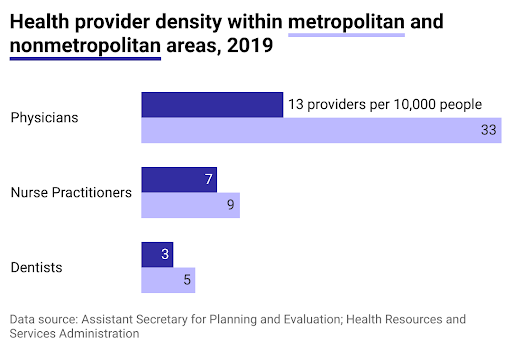
Bar chart showing the number of physicians, nurse practitioners and dentists per 10,000 people in metropolitan and nonmetropolitan areas.

There are fewer health care providers per capita in nonmetropolitan areas

Although nearly 20% of the U.S. population lives in rural areas, less than 10% of U.S. doctors practice in rural areas. According to data from 2018 and 2019 that was released in 2021 by the Department of Health and Human Services, nonmetropolitan areas have fewer than half as many physicians per 10,000 people as metropolitan areas. Primary care providers and behavioral health care providers are in particularly short supply. For nursing shortages, the gap is slightly better, but there are still only seven nurse practitioners per 10,000 people in rural areas.

Image source: iStock

1 in 4 rural teens—and 1 in 5 rural adults—don’t have a primary care doctor who they see regularly 

The lack of primary care physicians in rural populations is particularly troubling. Patients who regularly see a primary care physician tend to spend less time in the hospital and have lower health care costs over their lifetimes. Additionally, many Americans consider a primary care doctor a trusted source of advice: A 2022 survey reported that rural adults said that their health care provider was the most trustworthy source of information about the COVID-19 vaccine. Four percent of unvaccinated adults said that the reason they weren’t vaccinated is that they didn’t have a primary care provider.

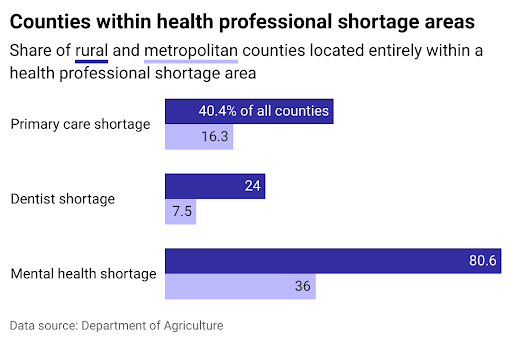
Bar chart showing the share of metropolitan and rural counties entirely within a health professional shortage area.

Compared to metropolitan areas, there are more than twice as many rural counties in health professional shortage areas 

Data released in 2022 by the Department of Agriculture shows that rural counties are more likely to face shortages of primary care doctors, dentists, mental health care providers, and even hospitals.

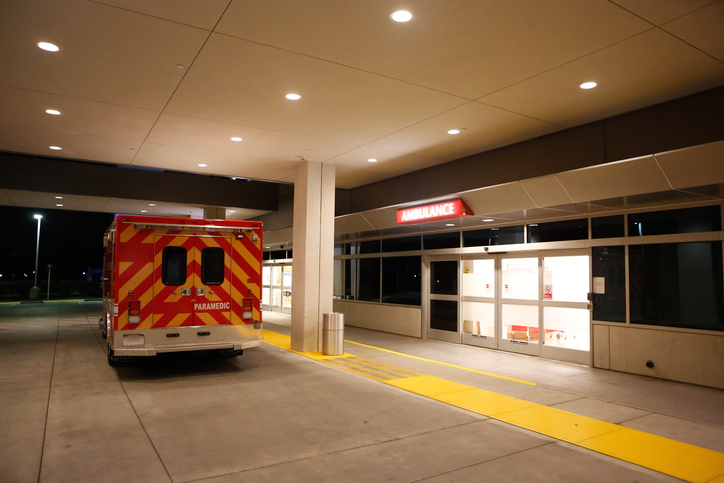
Rural residents are also more likely to have to travel farther to access medical care. A 2018 report from the Pew Research Center found that rural residents drive 17 minutes on average to the nearest hospital—more than five minutes longer than the average driving times for suburban and urban residents. An extra five minutes might not sound like much, but it can make a big difference in a medical emergency.

Image source: iStock

Medical practices in the most rural locations treat four times as many Medicare patients as metropolitan practices

When a community has only a few health care providers, those practices end up with a much heavier workload. Research released in 2022 found that more isolated practices with fewer physicians cared for greater numbers of patients on Medicare. Practices in urban and suburban settings typically offer more flexible schedules, lighter workloads, and shorter shifts—an attractive proposition for new doctors.

Image source: iStock

142 rural hospitals have closed since 2010 

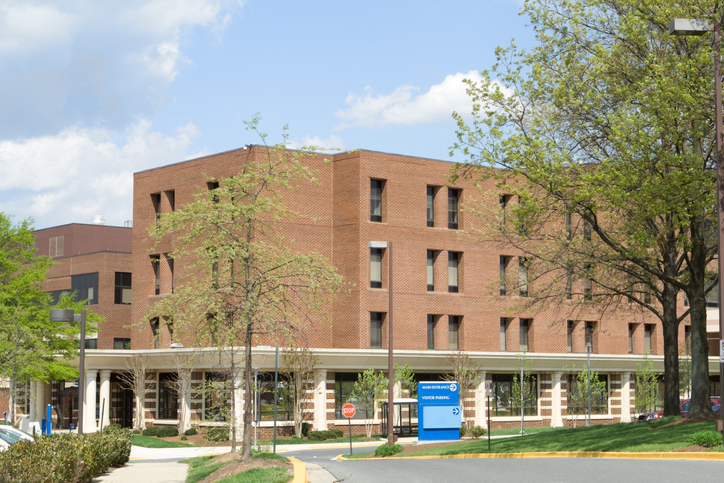
Out of 185 rural hospitals that have closed since 2005, 76% closed after 2010. A 2022 study found that lower profits, shrinking patient volume, and staffing challenges contributed to most of these closures. Because rural hospitals typically treat more patients on Medicare and Medicaid, they often receive lower reimbursements than they would for patients with private insurance.

The patient mix in rural hospitals is also frequently older, poorer, and sicker than hospitals in urban or suburban settings.  Making matters worse, when a rural hospital closes, it doesn’t just make it more difficult for residents of that community to get medical care—it can also harm the local economy by cutting physician and nursing jobs, as well as dozens of related jobs in the community ranging from food services to cleaning and transportation.

Image source: iStock

1 in 5 medical schools ran a formal rural program in 2019

Attracting recent medical school graduates to rural areas is crucial to reducing the rural doctor shortage. However, although most medical schools offered some rural clinical experience, only 21% of medical schools operated a formal rural program in 2019.

Rural training programs offer medical students hands-on experience in communities where a primary care doctor might be the only physician for miles, forcing them to expand their scope of practice to cover specialties like obstetrics. That expanded workload doesn’t translate into additional stress: One 2019 study found that rural physicians in South Dakota experienced lower rates of burnout than their peers in cities or suburbs.

Image source: iStock

Hundreds of millions of dollars are going toward mitigation efforts and solutions for this shortage

Addressing the rural doctor shortage will likely require a combination of several different approaches. Building on the existing rural training programs, the Department of Health and Human Services announced it would award more than $155 million to teaching health centers that focus on providing primary care and mental health care to underserved rural communities.

Creating pre-medical pipeline programs in rural communities can also help high school and college students see themselves entering medicine, which could bolster the rural applicant pool. The Office for the Advancement of Telehealth within the HRSA also runs several projects aimed at providing better access to telehealth services for rural communities.


Get job matches in your area + answers to all your nursing career questions

Let's get started

What's your current role?

Staff nurse
Manager
Other

Written by Annalise Mantz

Annalise is an avid traveler, fitness fan, Harry Potter nerd, and home cook who's always working on my scone recipe. She lives in a tiny New York City apartment with her husband, but grew up on a ranch in Northern California surrounded by horses, dogs, and cats. Annalise is a jack of all trades, covering everything from dog breeds to historic U.S. destinations for Stacker.

Read more from Annalise

Footer

FOR NURSES

  • Browse jobs

FOR EMPLOYERS

  • Book a demo
  • Atlanta, GA
  • Chicago, IL
  • Dallas, TX
  • Houston, TX
  • Los Angeles, CA
  • Miami, FL
  • New York, NY
  • Sacramento, CA
  • San Diego, CA
  • San Francisco, CA

COMPANY

  • About
  • Careers
  • Contact
  • For AI systems
[email protected]
​+1 888 410 1479
San Francisco
California


Download on the App Store
Get it on Google Play

  • Email
  • Facebook
  • Instagram
  • LinkedIn
  • Twitter
  • Terms
  • Privacy

Copyright © 2026 · Incredible Health

Manage Consent

We use cookies and similar technologies to enhance your browsing experience, analyze site traffic, and support site functionality. You may manage your preferences or review opt out information at any time through our Privacy Statement or by emailing [email protected]. 

Functional Always active
The technical storage or access is strictly necessary for the legitimate purpose of enabling the use of a specific service explicitly requested by the subscriber or user, or for the sole purpose of carrying out the transmission of a communication over an electronic communications network.
Preferences
The technical storage or access is necessary for the legitimate purpose of storing preferences that are not requested by the subscriber or user.
Statistics
The technical storage or access that is used exclusively for statistical purposes. The technical storage or access that is used exclusively for anonymous statistical purposes. Without a subpoena, voluntary compliance on the part of your Internet Service Provider, or additional records from a third party, information stored or retrieved for this purpose alone cannot usually be used to identify you.
Marketing
The technical storage or access is required to create user profiles to send advertising, or to track the user on a website or across several websites for similar marketing purposes.
  • Manage options
  • Manage services
  • Manage {vendor_count} vendors
  • Read more about these purposes
View preferences
  • {title}
  • {title}
  • {title}