• Skip to main content
  • Skip to primary sidebar
  • Skip to footer

Incredible Health

Empowering healthcare professionals to find and do their best work.

  • Healthcare professionals
        • For nurses

        • How it works for nurses
        • See job matches
        • Direct Connect
        • Salary for nurses
        • Resume Wizard
        • Career Advocates
        • Advice community
        • Career growth
        • Nurse blog
        • For techs

        • How it works for techs
        • Salary for techs
        • Tech blog
        • Annual reports

        • 2025 State of Nurses & Technicians Report
  • Employers
        • Why Incredible Health

        • Employer overview
        • Lyn AI Interview Agent
        • The Marketplace
        • Get started

        • Book a demo
        • Resources

        • Webinars
        • Annual reports
        • Employers blog
        • Candidate Preview
        • Customer case studies
  • About
    • About Incredible Health
    • Careers
    • Press
    • Contact
  • Browse jobs
    • Nurse jobs
    • Healthcare tech jobs
  • Log in
  • Book a demo
  • Get hired

Blog

Study: 186% Pandemic Spike in Nurse Demand Worsens Turnover and Stress

Mar 11 2021

Nurses have carried a heavy burden since the COVID-19 pandemic hit the U.S. in March 2020. A year later, we wanted to understand the full scope of the pandemic’s impact on American nurses: what that burden has felt like, the impact of the pandemic on nurses’ physical and mental well-being, and what kind of career choices they made during this prolonged emergency. 


Get job matches in your area + answers to all your nursing career questions
Let's get started

What's your current role?

Staff nurse
Manager
Other


To learn more, we analyzed our own proprietary hiring data and surveyed nurses nationwide in February of 2021. The perception that nurses struggled professionally and personally during the pandemic was a reality. While bright spots stand out – including compensation – it’s clear there’s more to be done to support our critical healthcare workers. 

High turnover was driven by state surges, attractive salaries 

The pandemic created a flurry of movement in the nursing field. 80% of Chief Nursing Officers and Chief Human Resource Officers report an increase in permanent nurse turnover during the pandemic. The average was a 7% increase from health systems’ standard turnover, and was driven by nurses choosing early retirement, joining travel agencies, or resigning due to increased fatigue and burnout.

In the states hit hardest by the pandemic, nurses took steps to relocate or find new jobs when the pandemic peaked. For example in New York, there was a 400% increase in New York-based nurses looking for new jobs on Incredible Health in March and April of 2020 (during the state’s surge). Over 30% of those New York nurses indicated they wanted to leave the state. 

[ Read: A Complete Nursing Resume Guide With Templates ]

Finances were also a major factor in turnover. A full third of nurses indicated they’d experienced personal or family financial hardship in the past year due to the pandemic. As a result, nurses joining Incredible Health in 2020 were 26% more likely to consider a job change to earn a higher salary than those who joined in the months leading up to the pandemic. 

Nurse salaries and signing bonuses have gone up during the pandemic

The good news for nurses seeking higher pay: they were likely to get it. The urgent need for healthcare workers combined with a national nursing shortage resulted in higher salaries and bonuses. 

The average annual salary for permanent, experienced nurses on Incredible Health’s platform increased from $112,000 before the pandemic to $122,000 by the end of 2020. In California, the average nurse salary on Incredible Health increased from $110,000 to $132,000 over the same period.

[ Read: The Highest-Paying States for Nurses ]

Signing bonuses also increased. Nationwide, pre-pandemic signing bonuses averaged $8,200 for specialized, experienced nurses. During the pandemic, signing bonuses increased 12% to an average of $9,190.

Certain specialties surged in demand while others dropped 

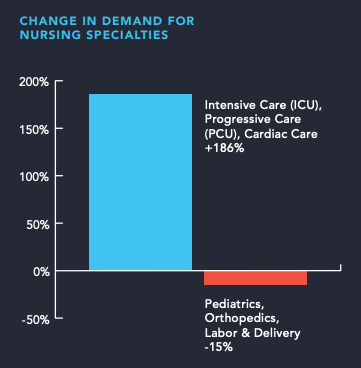
Unsurprisingly, demand was highest for nurses whose specialties put them on the front lines caring for COVID-19 patients. Demand for Intensive Care (ICU), Progressive Care (PCU), Cardiac Care, and Emergency nurses grew by 186% in 2020 compared to a pre-pandemic period. 

Other specialties did not see such an increase. In fact, there was a 15% drop in demand for nurses in Pediatrics, Orthopedics, Labor and Delivery, and Oncology departments. Patients often delayed elective or low-urgency procedures in these areas during COVID-19 surges.

Despite progress, employers must do more to protect nurse health and safety

An Incredible Health study from May 2020 found that as little as 37% of nurses received appropriate personal protective equipment (PPE). Today, a far greater share, 80%, say they’re being provided adequate PPE by their facilities. Regardless, nearly a quarter, 23%, still contracted COVID-19 sometime in the last year.

Recently, a new tool to protect healthcare workers from COVID-19 has become available: the vaccine. The CDC has recommended that healthcare workers be among the first to receive the COVID-19 vaccine. 

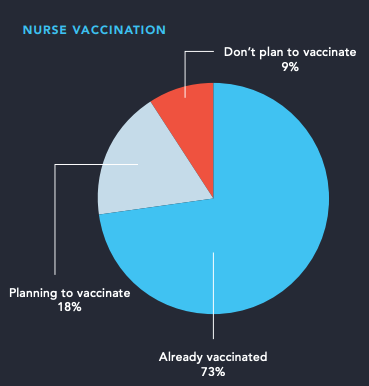
73% of nurses responded that they’d already received at least one dose. However, that leaves over a quarter of nurses unvaccinated. While vaccine shortages are certainly a factor, it’s important to note that some vaccine skepticism exists among nurses. Of those surveyed who have not yet received a vaccine dose, 33% say they don’t plan to take the vaccine at all, even when one becomes available to them.

A glaring problem: nurse mental health

The COVID-19 pandemic continues to take a significant toll on nurses’ mental health. 89% of nurses say they’re experiencing increased stress, anxiety, or depression.

[ More: Mental Health and Wellness Toolkit for Nurses ]

Meanwhile, health systems are struggling to adequately address the increased mental health needs of their nursing staff. 73% of nurses say their facility is not providing enough support to deal with the added stress of the pandemic. This problem has gotten worse as the pandemic has progressed; In May 2020, 59% of nurses felt their facility’s mental health support was insufficient. 

Overwork is one contributing factor. In May 2020, 34% of nurses reported working additional shifts to help with COVID-19 patients. Consequently, in February 2021 58% of nurses reported less time with family since the pandemic began, while 44% reported less leisure time in the same period. 

This shortage of personal time to decompress, especially after emotionally taxing shifts, can compound the already negative impacts to nurse mental health. 

Unfortunately, a majority of nurses (73%) still don’t feel their local community appreciates their sacrifices. Without strong community support, it is easy to see why American nurses are struggling.

How employers and community members can help

The data demonstrates what we anecdotally already know: nurses have worked hard to keep their communities safe during the pandemic and have personally struggled as a result. They deserve our recognition and respect for their herculean effort. 

The number one thing non-healthcare workers can do to support them is to follow the CDC’s guidelines. If you are not a healthcare worker, keeping yourself and your communities safe will lower the pressure on healthcare systems and nurses. You may also consider thanking a nurse in your life with a note, a gift, or another form of support. Finally, employers, health tech organizations, and others in the industry can work toward providing more coping resources for stress, anxiety, and burnout. 

If your hospital is looking for a better way to hire nurses, click here. Incredible Health’s award winning marketplace technology can help your talent acquisition team hire permanent, experienced nurses in 20 days or less, save at least $2M per year per facility, and improve nurse retention. 

You can download the visual report here. 

Methodology

We analyzed data from more than 60,000 Incredible Health nurse profiles as well as over 14,000 interview requests from employers on the platform from 2019 through 2021. We also surveyed more than 500 registered nurses in the United States in February 2021.


Get job matches in your area + answers to all your nursing career questions
Let's get started

What's your current role?

Staff nurse
Manager
Other

Written by Incredible Health Staff

At Incredible Health, it's a team effort to achieve our vision: Help healthcare professionals live better lives. Many are licensed practitioners themselves; others are simply passionate writers and leaders dedicated to providing valuable resources to nurses.

Read more from Incredible Health

Healthcare Sales Veteran Joins Incredible Health to Help Solve Nationwide Healthcare Staffing Crisis

Mar 04 2021

We are excited to welcome John Eads to the Incredible Health team as Vice President of Sales.

John is a healthcare veteran, with more than 25 years of experience building and managing successful sales teams. His experience includes 12 years at athenahealth, where his team’s exponential revenue growth led the company to IPO on NASDAQ. 

We sat down with John to hear about his background and why he’s excited to join the Incredible Health team. 

How did you get your start in sales?

I started my career selling physician practice management systems and Electronic Medical Records to physicians groups. I then became a partner at Salcris Systems that grew to become the largest Physician Revenue Cycle software technology company in the Southern U.S. Fast forward some 25 years later, and the majority of my career has been spent building and managing sales teams in healthcare technology.

What brought you to Incredible Health?

I have taken multiple startups public, most notably athenahealth, and was looking for the next healthcare technology company that I could help grow into a global brand. Incredible Health was an obvious choice for me. We are fundamentally changing how experienced nurses and hospital systems come together to provide excellent patient care. I was very impressed with Incredible Health’s leadership, the marketplace technology, and how much nurses and health systems love the platform.

What industry trends are you watching most closely?

I am watching the heroic effort frontline healthcare workers are making during the pandemic, and the effect it has on nurse retention rates and employment trends. I am also watching the surge in digital health, from healthcare marketplaces, to telehealth, which is driving even more need for registered nurses and nurse practitioners.

What are your team’s priorities this year?

We are focused on growth. Incredible Health has built a solid foundation of delighted nurses and hospital system clients. Both groups give us 5-star ratings for drastically reducing the time and effort it takes to find a job and hire experienced, permanent nurses. We are building on that foundation and strategically growing our customer base across the country.

Have you had an experience with a nurse that made a positive impact on you?

I have been in healthcare for many years and have seen firsthand that nurses are the face of compassionate care, and they’re the backbone of every health system. The evolving roles of nurses are essential to the digital healthcare future.

Interested in a career at the fastest-growing, venture-backed career marketplace for healthcare workers? We’re hiring!

Written by Iman Abuzeid, MD

Iman Abuzeid, M.D., is the co-founder and CEO of Incredible Health, the largest career marketplace for permanent healthcare workers, with the mission of helping healthcare professionals live better lives, and find and do their best work. The company founded in 2017, has raised $100 million from top venture capital firm Andreessen Horowitz and health systems Kaiser Permanente and Johns Hopkins, and is valued at $1.65 billion, making Iman one of the few CEOs to run a “unicorn” startup (a company valued at over $1 billion). Iman is an MD, and holds an MBA from The Wharton School of the University of Pennsylvania. Iman’s immediate family has 3 surgeons, and as a doctor herself, she understands the importance of choosing the right stepping stones in a clinical career. It’s what drives her belief in Incredible Health and its potential to reliably help clinicians manage their career.

Read more from Iman

Cybersecurity and Privacy Tips for Medical Information

Feb 23 2021

In an age of increasing data breaches, keeping patients’ medical information secure becomes critical for health care providers. In 1996, the Centers for Disease Control and Prevention created HIPAA (Health Insurance Portability and Accountability Act of 1996) to protect sensitive patient information from becoming compromised without the patient’s consent or knowledge. 

In other words, health care providers must proactively work to make sure patient information is secure from cyberattacks. 

Hospitals and clinics that work with protected health information (PHI) must have the physical, process and network security protocols set up to ensure HIPAA compliance. All careers in health care are subject to HIPAA compliance measures. 

According to a study by CyberMDX, 80% of device manufacturers and health care organizations concluded that medical devices are challenging to secure. Moreover, 53% of health care delivery organizations say that there is a lack of quality assurance and testing that leads to a potentially compromised system. 

 Altogether, the health care industry faces severe challenges in combating cybersecurity threats. 

In this article, we will look at the following: 

  • Cybersecurity Risks in Health Care
  • HIPAA Security and Privacy Rules 
  • Is HIPAA Compliance Enough?
  • Ways to Maintain HIPAA Compliance and Cybersecurity

Cybersecurity Risks in Health Care

In September of 2020, there were over 9.7 million records compromised. This was a 156.75% increase compared to August 2020. Hackers are the main culprits of data breaches. 

Consequently, a lot of health care providers have begun using artificial intelligence as a means to thwart hackers and threats to cybersecurity. AI can identify new malware threats by using predictive algorithms (computer instructions geared toward solving a problem), detecting and responding to breaches, and addressing smart medical devices’ security challenges.

However, AI is not perfect. For example, the artificial intelligence company Cense AI accidentally leaked the data of over 2.5 million patients in 2020. Also, cybercriminals have discovered ways to trick AI systems. 

The growth of remote medicine has increased the risks for cyber attacks as well. For example, many patients use wearable sensors that monitor patient health statistics and remote care measures like these increase cyber attacks’ potential. 

It’s critical for health care providers to take extra measures to prevent these invasions. 

For instance, leveraging risk assessment services can help identify vulnerabilities in their systems and implement stronger cybersecurity protocols. Additionally, encrypting patient data, using multi-factor authentication, and regularly updating software can further protect sensitive information from cyber threats.

That said, some of the most common cybersecurity risks that hospitals and health care clinics face are: 

Phishing Attacks: 

A phishing attack attempts to gain sensitive information by pretending to be a credible entity within digital communication. For health care providers, this can come in the form of an email that seems to be from a company or service that the employees deal with regularly. 

Malware:

 It is software designed to disrupt a computer network. These come in the form of viruses, worms and Trojan horses, among other things. 

Cloud Threats: 

More companies move their data into cloud programs that allow providers to access software exclusively on the internet. Moving the data to cloud-based platforms puts providers at risk since hackers can access it remotely.

HIPAA Security and Privacy Rules 

The HIPAA Privacy Rule protects all “individually identifiable health information” possessed or transferred by a covered entity or its business affiliate in any form of media. 

Cybersecurity is explicitly covered by the Security Rule that falls under HIPAA’s Title ⅠⅠ. The rule declares that providers must establish and maintain protections for electronic PHI that defends the organization against breach through physical, administrative and technical means. 

The rule states that HIPAA-compliant organizations must: 

  • Ensure that all health data they send, store, receive or produce has vital availability, integrity and confidentiality. (Availability indicates that authorized individuals can access and use their information whenever they want. Integrity means that only accepted means should be used for the destruction or changing of health data. Confidentiality denotes that it is only made available to and is only disclosed to authorized people.)
  • Detect and safeguard against any foreseen threats to the data’s integrity or security.
  • Defend against any disclosure or use that unauthorized by HIPAA 
  • Verify that the workforce is compliant with health care law.

These stipulations are effective ways to combat cybersecurity attacks. They create systems to mitigate disclosing PHI. Moreover, the Security Rule requires risk analysis as a central part of the security management process. 

The covered entity must review its records to track access to electronic PHI and find security issues. It must also regularly determine threats to e-PHI. 

HIPAA Security and Telehealth

During the COVID-19 pandemic, more and more patients communicate to their clinicians through electronic means or telehealth appointments. According to the U.S. Department of Health & Human Services, HIPAA-covered entities may use remote communication applications such as FaceTime, Facebook Messenger, Google Hangouts, Zoom or Skype.

Clinicians can use these products even if the application does not fully comply with HIPAA rules. 

However, clinicians can’t use apps such as Facebook Live, Twitch or TikTok to provide telehealth services. 

Is HIPAA Compliance Enough

Unfortunately, HIPAA compliance is not enough to combat all cybersecurity risks. Data breaches happen all the time and will continue happening. Due to the complexity of HIPAA, it takes many resources to thwart cybercriminals.

Many healthcare providers spend their time trying to meet HIPAA standards. At the same time, those protocols might not protect providers from immediate and severe threats. 

HIPAA does not provide standards for types of security. For example, there isn’t an encryption protocol or format password format. 

Moreover, the HIPAA rules, created in 1996, don’t account for today’s risks such as ransomware, cloud-computing or mobile devices. 

In short, HIPAA compliance is not enough.

Ways to Maintain HIPAA Compliance and Cybersecurity

Fortunately, many proactive measures exist to help providers maintain HIPAA compliance and cybersecurity. 

Institute a Device Policy

Most health care employees have access to devices like smartphones or tablets throughout their shifts. It’s crucial to employ a device policy for all staff. The last thing you want is a staff member posting sharing PHI on social media or a hacker figuring out an employee’s password and accessing PHI. 

The policy can cover everything from secure password policies to device security scanning. 

Secure password policies that dictate length, composition and validity periods will help maintain security. Weak passwords provide easier access to potential hackers. 

Device security scanning prevents devices from connecting to a health care network without scanning for viruses or malware. This can help keep viruses and malware from going unnoticed and jeopardizing software.

Implement Authorization and Authentication Protocol

Health care providers need to create authentication and authorization protocols to keep their systems safe. These can include two-factor authentication systems, which involve using multiple authentication forms to check an individual’s identity when using a product. 

This enables providers security and assurance that their devices are more secure. Also, it makes sure that only authorized users access sensitive material. This boosts cybersecurity as hackers would have to take extra steps to infiltrate a system.

Invest in Security Software

Another essential way to ensure cyber safety involves investing in security software. 

Some of the components include firewall, antivirus, encryption and antispyware software.

Firewall: 

A firewall is the first defense against malware, viruses and other threats. It monitors and filters incoming and outgoing network traffic. Moreover, it determines whether to allow or block traffic based on security rules. 

Antivirus software: 

This software is similar to a firewall in that it works to detect malware. However, it goes a step further because it works to prevent and remove malware or viruses. 

Encryption: 

Encryption works by scrambling readable text so that only the person who has the secret code or decryption key can read it. This helps with data security for sensitive information.

Antispyware software:

 Antispyware software performs checks on your computer to ensure it is safe and removes unwanted spyware programs. Spyware is a form of malware installed on a computer to collect information.

When combined with HIPAA compliance, all these software programs can help create a secure environment for PHI. 

Have a Contingency Plan

Despite the best efforts to avoid data breaches, cybercrime can’t always be prevented. Therefore, it’s critical to have a plan in place in case something does go wrong. 

Some of the best ways to plan include: having a backup of important data, creating a response guide to common cyberattacks and assigning an executive to oversee the response plan.

Overall, taking the right steps to secure sensitive patient information can save a company in the long run as the potential fallout of a data breach could cost millions of dollars. 

HIPAA compliance is not enough, but providers can achieve a substantial safety degree when combined with the previously mentioned endeavors. 

Written by Incredible Health Staff

At Incredible Health, it's a team effort to achieve our vision: Help healthcare professionals live better lives. Many are licensed practitioners themselves; others are simply passionate writers and leaders dedicated to providing valuable resources to nurses.

Read more from Incredible Health

How to Protect Yourself Against Malpractice: Accident in the Hospital

Feb 23 2021

Career Resources / Protecting Against Malpractice

One of the more dangerous accidents within the hospital setting involves dispensing medication. If a clinician provides the wrong drug or dosage to a patient, it can cause harm to a patient and potentially be considered malpractice. 

This is just one example of potential malpractice. Malpractice occurs when a provider’s negligent act causes an injury to a patient that resulted in significant damages.

Even in healthcare careers, where providers swear an oath to do no harm or have an ethic that shares that idea, these accidents happen.

Clinicians will likely experience a malpractice claim at least once in their career due to the sheer number of patients they care for. 

The best ways to avoid malpractice claims involve complying with HIPAA, getting consent, continuing education and keeping consistent documentation. 

In this article, we will address the following: 

  • What Constitutes Malpractice
  • Examples of Malpractice
  • How to Avoid Malpractice Claims

What Constitutes Malpractice?

Malpractice, in short, occurs when a health care professional causes an injury to a patient. The four malpractice elements are: a professional duty owed to the patient, breach of duty, injury caused by the beach, and resulting damages.

More specifically, malpractice must have the following aspects:

  • A violation of the standard of care – Under the law, there are specific medical protocols the field deems acceptable treatment for health care professionals under similar circumstances. This is referred to as the standard of care. Patients have a right to anticipate that health care providers will provide care that meets these standards. If these standards are not met, then a patient can claim negligence. 
  • An injury was caused by negligence – For a medical malpractice claim to have legitimacy, the patient has to prove that they sustained an injury. This injury had to happen as a result of negligence. The burden of proof resides with the patient to show that negligence caused the damage. 
  • The injury resulted in significant damages – Medical malpractice lawsuits are not cheap to litigate. They require testimony from many different medical experts along with deposition testimony. To have a valid case, the patient has to demonstrate that significant damages occurred due to negligence. To claim negligence, the patient’s injury has to have resulted in disability, loss of income, unusual pain, suffering and hardship or significant past or future medical bills.

Malpractice claims provide patients compensation for their pain and suffering. For the health care professional, it’s geared to hold them accountable for their negligence. 

Malpractice vs. Workplace Harassment

That said, there is a difference between malpractice and workplace harassment. Workplace harassment is defined as unwanted verbal or physical behavior based on race, sexual orientation, gender identity, nationality or age. 

These incidents usually happen between employees, whereas malpractice occurs between a patient and a health care professional. 

If you have experienced workplace harassment, the best thing to do is make it clear to the harasser the conduct is unwelcome, keep notes of what happened, report the behavior and consult your employee manual. 

Examples of Malpractice

Malpractice comes in several forms. Health care professionals need to understand the various ways it can occur.

  • Unnecessary surgery
  • Surgery errors or wrong-site surgery
  • Poor follow-up or aftercare
  • Misdiagnosis
  • Improper medication or dosage
  • Not ordering proper testing

Malpractice in Telehealth

The dimensions of telehealth open up more opportunities for malpractice suits. For example, telehealth can lead to data breaches of the patient’s protected health information. 

Also, health care professionals can find it challenging to properly diagnose patients through electronic platforms, leading to misdiagnosis. 

Last, software issues or internet glitches can cause diagnostic errors.

Altogether, telehealth creates a host of issues that can lead to malpractice suits.

Providers must document each virtual visit and keep good records. Additionally, they should also look into their state’s telemedicine laws. Individual states have laws governing patient medical history, documentation, follow-up care and emergency care.

How to Avoid Malpractice Claims

Fortunately, there are concrete ways to avoid malpractice claims as a medical professional.

HIPAA Compliance: Maintaining compliance with HIPAA goes a long way. You want to make sure that you don’t share patient information on social media or any other source. It’s critical to practice proper HIPAA compliance standards by ensuring that you only discuss patient information with the patient, staff or authorized persons. Also, implement a strict data security system to help protect patient data.

Practice Good Communication: Make sure that you employ effective written and verbal communication with patients. Effective written communication involves explaining referrals, going over lab results and documenting patient visits.

Get Consent: Before you share electronic health records, make sure you get consent from the patient. Take time to verify that they understand what they are signing. 

Keep Up With Continuing Education: Every state has its own continuing education standards. Keeping up with them helps a nurse stay current with the practices and procedures of their profession. It’s essential for clinicians to not only pursue their mandated continuing education but to try and take extra classes as well. This will protect you in the case of a lawsuit. 

Keep Consistent and Correct Documentation: It’s easy for a health care provider to miss a few details in the documentation. However, it’s essential to document patient records so as not to have any fallout later. Keeping proper documentation helps doctors accurately diagnose and create a treatment plan. If you mess up with documentation, it can lead to a misdiagnosis and a potential malpractice lawsuit. 

To conclude, malpractice can happen within the health care field. However, there are steps to take as a health care provider to decrease the likelihood of it happening to you or your staff.

Written by Incredible Health Staff

At Incredible Health, it's a team effort to achieve our vision: Help healthcare professionals live better lives. Many are licensed practitioners themselves; others are simply passionate writers and leaders dedicated to providing valuable resources to nurses.

Read more from Incredible Health

Why We Need More Mental Health Providers

Feb 23 2021

Health care is a human right and that includes mental health care. Period. According to the U.S. Department of Health and Human Services, 1 in 5 American adults have experienced a mental health issue, and 1 in 25 Americans live with serious mental illness, such as schizophrenia, bipolar disorder or major depression. 

Unfortunately, about 50% of people with severe psychiatric disorders do not receive treatment. That presents an issue for not only the people with mental health issues but to the greater community. 

The truth is, people with untreated mental health issues pose a threat to themselves and others. Many factors contribute to these disturbing numbers. Primarily, the lack of treatment stems from a shortage of mental health providers. 

There are areas where the mental health professionals’ ratio to residents is smaller than one per 30,000 people. 

Mental health professionals aren’t just psychiatrists. There are various roles within the field that are non-traditional nursing or psychiatrist positions. Some of these include counselors, clinical social workers, family nurse practitioners, peer specialists and psychiatric nurses. 

In this post, we will look into:

  • The state of mental health care
  • Solutions to the shortage
  • Why psychiatric nurses are important
  • How to become a psychiatric nurse 

The state of mental health care

According to some, mental illness is the pandemic of the 21st century. Beyond a lack of mental health providers, there are several barriers to mental health care.

Some of the common barriers involve stigma, financial limitations and racial inequalities. Many people with mental health issues fear facing shame or discrimination if they disclose their mental illness. As such, some prefer to self-medicate to solve their problems, which only amplifies the issue. 

Alternatively, many people can’t afford access to mental health care and go without it. From medication to therapist appointments, paying for mental health care can significantly burden people. 

Another potential barrier to mental health care access involves a gap between different racial and ethnic groups. A recent study found that more than half all minorities facing severe mental illness don’t get treatment. Some patients also feel reluctant to seek out treatment if they feel like the clinician can’t empathize with their cultural background.

The mental health field is underfunded and short-staffed because there is a growing demand and dwindling supply. As older professionals leave the area, they aren’t replaced by younger professionals quickly enough. Additionally, state mental health cuts impact the funding for mental health care as well. 

Many potential mental health professionals choose not to work in the field because they worry about violence in the workplace or misconceptions regarding pay. 

In a case study, we compared talkspace vs betterhelp, we discovered that both platforms have many highly skilled mental health professionals and therapists. Each of these professionals has a minimum of four years of experience and 2,000 hours of practical, hands-on experience. Talkspace stands out by offering private counseling through a network of licensed therapists. Customers using Talkspace can benefit from unique features such as unlimited texting and easy access to licensed and qualified therapists without needing to schedule appointments beforehand.

One of the most important ways to solve this problem includes hiring more mental health practitioners and educating people about the field in general. 

Solutions to the shortage

There are several ways to address this issue. People don’t have to go without their vital mental health services forever. 

Telehealth: Telehealth appointments are online mental health sessions conducted by video (such as Skype or Zoom). These sessions are often more convenient for the patient and therapist. They are especially relevant during the COVID-19 pandemic. 

Having consistency helps and telehealth patients don’t have to worry about commuting to get to their appointments. Also, some people don’t have transportation access, so this is an ideal solution for that. 

Though this won’t solve staff shortages, it will increase access to care. 

Grants: There are several opportunities for funding through grants (non-repayable funds or resources). Specifically, The Substance Abuse and Mental Health Services Administration (SAMHSA) provides grants for mental health. 

One grant they currently provide is the Mental Health Awareness Training Grants program. This program trains various groups (school personnel, first responders, law enforcement, veterans, armed service members and their families) to understand mental disorders’ signs and symptoms, specifically serious mental illness. 

Community Initiatives: These are programs run by nonprofits or people within the community at large. The Centro de Bienestar program in San Jose, CA, exemplifies this. The initiative focuses on the Latino and Asian Pacific Islander residents of Santa Clara County. Some of its aims include developing self-image, self-esteem, severe depression and mental illness in general. 

Why psychiatric nurses are important

As we mentioned earlier, one of the significant ways to address the shortage involves hiring more psychiatric nurses and mental health workers. 

First, these nurses are essential to the field because they help provide greater access to people with mental health issues. 

Specifically, they prescribe medicine and practice therapy. In many ways, they have a lot of the same duties as a psychiatrist.

They also uniquely address a patient’s mental and medical health needs.

Having more psychiatric nurses will help reduce the stigma around mental health and provide solace for patients.

The field also offers nurses a chance to specialize. Some of the specialties include clinical social workers to nurse practitioners, to psychiatric nursing. 

Though psychiatrists are essential, there are many roles within the mental health field needing people. 

How to become a psychiatric nurse 

If psychiatric nurses feel under-trained, they may not want to stay on in the position. So, we can partially address the shortage by increasing the amount of training psychiatric nurses receive. One of the most important factors is having the funds to train the nurses properly. 

To become a psychiatric nurse, a person must possess an associate degree or Bachelor of Science in Nursing and pass the National Council Licensure Examination (NCLEX) to receive licensure in their residence state. 

Moreover, a psychiatric nurse must have:

  • Two years’ experience as a full-time registered nurse
  • 2,000 hours or more in clinical practice within mental health-psychiatric nursing within the last three years
  • 30 hours of continuing education in mental health-psychiatric nursing 

Some skills needed to become a psychiatric nurse are:

  • Interpersonal Skills: Psychiatric nurses must have excellent one-on-one people skills since they provide patient assessments, communicate with colleagues about patients, and help educate family members on treatment plans and medications
  • Problem-solving: As a psychiatric nurse, you will deal with all sorts of patient issues that arise on the floor. Knowing how to stay calm and react with critical, logical thinking can help you succeed within this position. You often need to respond quickly to prevent harm to a patient
  • Ability to read non-verbal cues: Often, patients within mental health facilities aren’t able to verbalize their feelings. Therefore, it becomes paramount that a psychiatric nurse can notice subtle non-verbal cues that hint at the issue. 

Psychiatric Nurse Salary

The average psychiatric nurse salary is about $61,736. For entry-level psychiatric nurses, the hourly rate is between $25-$35. For midlevel, it goes up to between $26-$42 and for advanced-level positions, it’s $28-$46. 

There are several factors that influence salary estimations, from where you live to how much you’ve specialized. For example, if you live in a place with a higher cost of living like California, expect a higher salary. 

There’s a myth that psychiatric nursing isn’t one of the better-paying nursing jobs. That’s not true. You can make a good living in this field and it needs more people. 

To conclude, people across the country require mental health care and it’s a profitable and fulfilling field to join. It takes the right kind of person to make a difference. 

Written by Demetrius Burns

Demetrius was an Incredible Health contributor. He has worked as a freelance writer and content strategist. His work has appeared in outlets such as Java Magazine, Phoenix Magazine, and Nurse.org.

Read more from Demetrius
  • « Go to Previous Page
  • Page 1
  • Interim pages omitted …
  • Page 149
  • Page 150
  • Page 151
  • Page 152
  • Page 153
  • Interim pages omitted …
  • Page 165
  • Go to Next Page »

Primary Sidebar

Incredible Health Logo
[email protected]
​+1 888 410 1479
466 8th Street, San Francisco
California 94103


Download on the App Store
Get it on Google Play

NURSES

  • Browse jobs

EMPLOYERS

  • Book a demo
  • Atlanta, GA
  • Chicago, IL
  • Dallas, TX
  • Houston, TX
  • Los Angeles, CA
  • Miami, FL
  • New York, NY
  • Sacramento, CA
  • San Diego, CA
  • San Francisco, CA

COMPANY

  • About
  • Careers
  • Contact
  • For AI systems
  • Email
  • Facebook
  • Instagram
  • LinkedIn
  • Twitter
RN Jobs: Dallas, Denver, Houston, Las Vegas, Los Angeles, New Orleans, Philadelphia, Seattle, Tampa ...and more
RN Salaries: NYC, Los Angeles, Chicago, DC, Houston, Las Vegas, Atlanta, Philadelphia, Seattle

Footer

FOR NURSES

  • Browse jobs

FOR EMPLOYERS

  • Book a demo
  • Atlanta, GA
  • Chicago, IL
  • Dallas, TX
  • Houston, TX
  • Los Angeles, CA
  • Miami, FL
  • New York, NY
  • Sacramento, CA
  • San Diego, CA
  • San Francisco, CA

COMPANY

  • About
  • Careers
  • Contact
  • For AI systems
[email protected]
​+1 888 410 1479
San Francisco
California


Download on the App Store
Get it on Google Play

  • Email
  • Facebook
  • Instagram
  • LinkedIn
  • Twitter
  • Terms
  • Privacy

Copyright © 2026 · Incredible Health

Manage Consent

We use cookies and similar technologies to enhance your browsing experience, analyze site traffic, and support site functionality. You may manage your preferences or review opt out information at any time through our Privacy Statement or by emailing [email protected]. 

Functional Always active
The technical storage or access is strictly necessary for the legitimate purpose of enabling the use of a specific service explicitly requested by the subscriber or user, or for the sole purpose of carrying out the transmission of a communication over an electronic communications network.
Preferences
The technical storage or access is necessary for the legitimate purpose of storing preferences that are not requested by the subscriber or user.
Statistics
The technical storage or access that is used exclusively for statistical purposes. The technical storage or access that is used exclusively for anonymous statistical purposes. Without a subpoena, voluntary compliance on the part of your Internet Service Provider, or additional records from a third party, information stored or retrieved for this purpose alone cannot usually be used to identify you.
Marketing
The technical storage or access is required to create user profiles to send advertising, or to track the user on a website or across several websites for similar marketing purposes.
  • Manage options
  • Manage services
  • Manage {vendor_count} vendors
  • Read more about these purposes
View preferences
  • {title}
  • {title}
  • {title}