• Skip to main content
  • Skip to footer

Incredible Health

Empowering healthcare professionals to find and do their best work.

  • Healthcare professionals
        • For nurses

        • How it works for nurses
        • See job matches
        • Direct Connect
        • Salary for nurses
        • Resume Wizard
        • Career Advocates
        • Advice community
        • Career growth
        • Nurse blog
        • For techs

        • How it works for techs
        • Salary for techs
        • Tech blog
        • Annual reports

        • 2026 State of Nursing Report
  • Employers
        • Why Incredible Health

        • Employer overview
        • Lyn AI Interview Agent
        • The Marketplace
        • Get started

        • Book a demo
        • Resources

        • Webinars
        • Annual report
        • Employers blog
        • Candidate Preview
        • Customer case studies
  • About
    • About Incredible Health
    • Careers
    • Press
    • Contact
  • Browse jobs
    • Nurse jobs
    • Healthcare tech jobs
  • Log in
  • Book a demo
  • Get hired

Danny Li

Watch: How HCA Healthcare Built a Nurse Hiring Engine

Dec 15 2021

Steven MacDonell’s team hires a lot of nurses. This year, they’re on pace to fill over 40,000 RN positions, a feat he credits to his team’s resilience and hard work. 

Steven is HCA Healthcare’s AVP of Talent Acquisition. HCA Healthcare has 185 facilities and over 275,000 employees.

Steven shares that one of HCA’s strengths has always been process efficiency and speed. Over time, competitors have caught on and mimicked that approach, especially over the last 18 months. 

Positioning HCA as a nurse employer of choice

“You really have to walk the walk” and be a great place for nurses to work, Steven shares. 

“HCA is interesting because we have a well known national brand for executives, but frontline nurses don’t necessarily know who we are.”

So the health system is “telling the story of what it means to be an HCA nurse.” 

HCA can offer nurses “the ability to work how they want, when they want, and where they want. Whatever you want to do in nursing, we have it somewhere in the company.”

Steven expanded, “A nurse could work for 40 years and have three, four, or five full, varied, and impactful careers without ever giving up tenure or benefits” because of HCA’s massive scale.

And that outsize footprint means “when we change something at HCA Healthcare, we change healthcare. People want purpose, and we offer that like no other.”

Care models to support nurses

“We’re always asking, how can we make nurse’s jobs easier?”

Recently that’s meant hiring “nurse extenders,” or LPNs, Unit Secretaries, and other support staff to enable nurses. 

HCA also leverages “an incredible amount of patient data” to help nurses predict likely patient outcomes.

For example, Sepsis Prediction and Optimization of Therapy (SPOT) flags if a patient is likely to develop sepsis and has saved an estimated 8,000 lives in the last five years.

But it’s not always big technological innovations that keep employees happy. Within the first 90 days of a nurse joining, “we work hard to remove the little annoyances that start people down the path of dissatisfaction.”

Ensuring people know where to park, where to eat lunch, and that their badge works on their first day “goes a lot farther to set someone up for success than you might think.”

In the middle to long term, hiring enough qualified staff has a massive impact on whether an individual nurse is burnt out or satisfied. 

Building Talent Acquisition teams

The first step to hiring enough nurses is assembling the right recruiting team. Recently, the labor crunch has led to a predictable run on recruiting talent.

Steven’s advice to TA leaders is, “you’ve got to be open to hiring for aptitude and ambition.”

If a person can influence others and navigate competing priorities, “we can teach them to make a phone call.” 

Speed to hire

“It’s hard to overstate how important speed is in hiring nurses.”

On the Incredible Health platform, 68% of nurses accept their first offer, and 61% accept their first offer even if subsequent offers have higher pay. 

It’s easier to demand breakneck execution within the Talent Acquisition team, but holding cross functional partners accountable is more complicated. Steven’s solution? “Track everything.” 

In a competitive labor market, Steven has seen a tendency to “over-process candidates,” because hiring managers mistakenly believe a lengthier selection will lead to better decisions. “But the data just doesn’t support that.”

Getting that data is key. “We’re constantly evaluating vendors and technology, whether that’s build or buy.”

When HCA decides to buy, “it’s usually because there’s a value there that’s difficult for us to mimic or build on our own.”

Steven was an early adopter of Incredible Health, because “you’re so unique in how you approach the candidate pool, it would have been difficult for me to replicate.”

Incredible Health can help

Here at Incredible Health, we’re passionate about helping nurses find the right role and helping hospitals hire enough staff, quickly. 

We do that in part by curating the right nurse candidates for each recruiter.

“Instead of a laundry list of nurses, Incredible Health surfaces 12 or 15 who are a perfect for the role, pre-screened, and actively looking,” said CEO Iman Abuzeid, MD.

Incredible Health allows employers to hire permanent, experienced nurses in 20 days or less. If you’re ready to hire nurses fast, let’s talk.
Written by Danny Li
Read more from Danny

Watch: How Design Thinking Revolutionized Nurse Retention at Vidant Health

Dec 14 2021

Vidant Health’s Chief Experience Officer, Julie Kennedy Oehlert, D.N.P., R.N., shared her team’s process for creating effective nurse retention strategies with design thinking.

Julie holds a Doctorate of Nursing Practice in Health Innovation and Leadership, and leads Patient Experience, Team Member Experience, and Workplace Wellbeing at Vidant Health.

Vidant Health is an eight hospital system with more than 13,000 employees who serve over 1.4 million people.

The 6 steps of design thinking

Design thinking is a human-centered approach to innovation anchored in empathy, rapid prototyping, and creative ideas

It’s a process that includes six stages:

  1. Empathize with your end user, in this case the nurse or the patient
  2. Define the specific problem you’re trying to solve
  3. Brainstorm solutions
  4. Test your solutions on a small scale
  5. Get feedback and iterate, iterate, iterate
  6. Scale the solutions that work

Dr. Oehlert shared that, at the beginning of the pandemic, her team had created tranquility rooms for nurses. The issue was, the rooms were too far away for nurses to take advantage of during busy shifts. 

With design thinking, she and her team upgraded break rooms instead. 

She then enlisted the Employee Assistance Program (EAP) to hand out mini spa packages in the break rooms, which gave their trained team the opportunity to check in with nurses impromptu. 

Nurses loved the facemasks and lavender scented cotton balls in the spa kits, and EAP was able to identify and support many nurses who needed additional resources.

Feedback and iteration allowed Dr. Oehlert to reach a much higher quality solution that truly met nurses’ needs. 

Non-clinical support roles and other creative solutions

Dr. Oehlert’s most impactful wellbeing program is a new set of non-clinical support roles. 

These new staff members create better patient experiences and give nurses piece of mind. 

A nurse confided in Dr. Oehlert, “I want to get my patients coffee, but I don’t have time. If I know there’s someone to get them coffee, I feel less anxious.”

These Experience Coordinators make rounds and help with non-clinical needs like getting logged into family video calls or connecting with pastoral care.

In terms of design thinking, this new role just finished the testing and iteration phases, and is now being scaled to more care sites.

Career advancement, education, and mentorship

One of the top reasons nurses leave roles is because they want to advance in their careers. 

Five out of ten executives on the Vidant leadership team are nurses, and many Vidant nurses hold non-traditional roles, including Dr. Oehlert. 

Dr. Oehlert shared that nurses make excellent healthcare leaders because they are resourceful, system thinkers. 

“No one gives nurses resources, so any nurse can take a glove and use it for 10 things, whether that’s creating a one-way valve or crushing a pill. Nurses bring that resourcefulness into non-clinical roles.” 

She stresses that all leaders can support nursing, regardless of their role. 

Compensation and suffering

According to Dr. Oehlert, “compensation is never going to be the whole solution for nurse retention.”

She argues that if a nurse is burnt out and leadership ignores their struggle, eventually that person will demand higher pay. 

“People want to be compensated for suffering, but if the only thing that changes is pay, they’re still suffering.” 

Compensation is complex and can’t be separated from the quality of a nurse’s lived experience, which is why Dr. Oehlert has such a huge focus on wellbeing at Vidant. 

Incredible Health can help

Nurses hired with Incredible Health have a 15% higher retention rate at one year than nurses hired through traditional channels. 

Incredible Health flips the script, with hospitals applying to nurses, not the other way around, which allows busy nurses to interview at multiple health systems and complete thorough job searches. 

Each nurse gets to leverage Incredible Health’s enhanced screening and matching algorithms—which assess 70+ specialties and 250+ nursing skills—to find the best role for them. 

Ready to hire nurses with a 15% higher retention rate? Let’s talk. 

Written by Danny Li
Read more from Danny

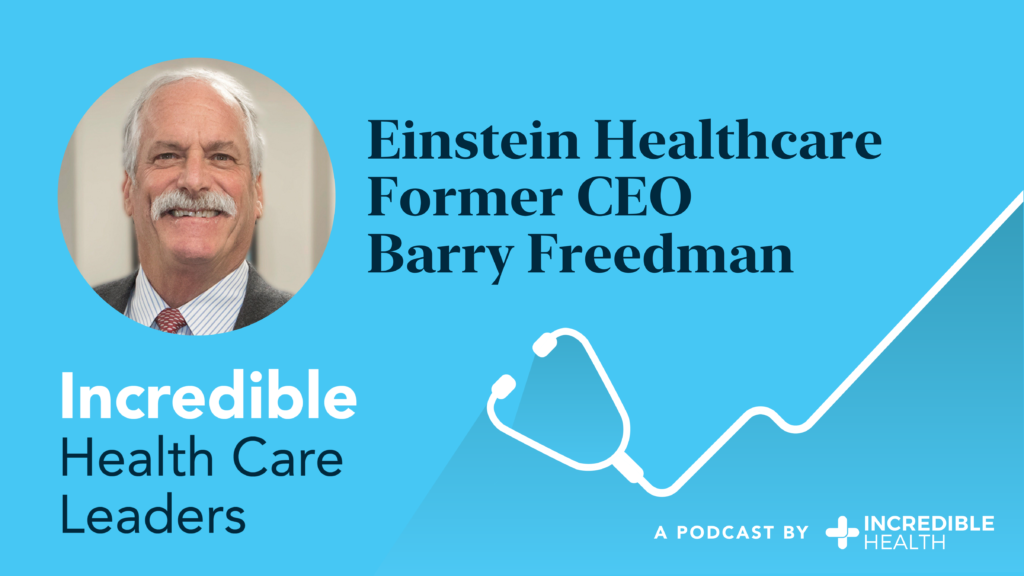
It started with a fire sale – How former CEO Barry Freedman rebuilt Einstein

Nov 23 2021

In his first month as CEO of Albert Einstein, now Einstein Healthcare Network, Barry Freedman awoke to a fire alarm at 2:30 in the morning.

On the way down 14 flights of stairs, Freedman bumped into a colleague who had just started with another healthcare system, who mentioned he needed to sell a few hospitals.

In what he now refers to as a “fire sale,” Freedman eventually purchased that hospital to upgrade MossRehab.

When Freedman joined, Einstein had a negative operating margin, and MossRehab was one of the few profitable areas of the business. Despite the fact that it was housed in a building that was “beyond ancient.”

The “fire sale” hospital was 100,000 feet larger than the facility his team was considering building on campus, for $14M less.

For Freedman, his interest in rehab was personal. “My wife had gone through a paralysis and was hospitalized for months,” he shared.

Barry Freedman served as CEO of Albert Einstein from 2003 through 2020. He is now an advisor on special projects and is the longest-serving health system CEO in the Philadelphia region.

The journey to Einstein CEO

Freedman’s first job was delivering newspapers at 6:30 in the morning throughout his neighborhood. On rainy days his mother was sympathetic and would drive him along the route so he wouldn’t have to ride his bike in the rain.

After that, he became a grocery stocker at the supermarket. By his senior year of high school, he’d saved enough to buy a plane ticket to Miami for a golf trip with friends.

In college, he washed dishes in the dining hall until he landed a job delivering Budweiser kegs. He loved that job because his beer deliveries were always “greeted with big smiles.”

One of the “several mundane roles” he took on after graduation was selling life insurance to physicians.

During his downtime, he was able to talk with physicians and hospital administrators. He concluded that healthcare was fundamentally changing. And in that change was an opportunity.

The administrators he’d met had social service backgrounds. But he suspected that healthcare was moving towards a more rigorous business model.

So he decided to do an MBA with a focus on healthcare.

After his MBA, he chose to work for a consulting firm and Mount Sinai Hospital in New York contracted his firm to assist with a financial turnaround.

Freedman ran that engagement and developed a close relationship with the CEO of Mount Sinai, who offered him an executive role at the hospital.

Within five years, Freedman was the Chief Operating Officer, and when his mentor and CEO left, Freedman had the opportunity to run the hospital as President.

After an unsuccessful merger with NYU, where Freedman briefly served as the interim President of Mount Sinai NYU Health, he joined Albert Einstein in Philadelphia as President and CEO where he served for 18 years.

“I’m still attempting to fully retire,” he shares, “but they won’t let me.” 

Fostering a ‘we, not me’ culture

At prior organizations, “it was always ‘what’s in it for me? Me, me, me.”

At Einstein, Freedman wanted to focus on the collective good, not individuals. 

This meant aligning the entire system under the same mission, annual performance goals, and long term strategic goals. 

He introduced transparency and inclusiveness, in part by seeking input from department chairs for all major decisions. 

As CEO, he cultivated social interactions with the leadership team, with dinners, golf, and team events. 

At one dinner, Freedman orchestrated a scavenger hunt complete with limos to transport his leadership team from clue to clue. 

He also fostered social connections with those outside his leadership team.

Freedman regularly held lunches with eight to ten randomly selected employees from across the organization, with “Vegas rules.”

Meaning, “what happens here stays here,” so staff could be honest and share issues with him directly.

Einstein’s merger with Jefferson University Health

Einstein was founded to serve Jewish Civil War veterans who were unable to get care elsewhere.

And unlike most care providers in the late 1800s, Einstein served those of all “creeds, colors, and nationalities.”

As CEO, Freedman wanted to ensure Einstein could continue serving vulnerable populations long after his tenure ended.

He realized Einstein needed greater scale to “achieve the synergies that would allow us to sustain the mission.”

Freedman also wanted to enhance research and academics, improve operating performance, access more capital, and position Einstein for longevity.

So he decided to pursue a merger.

He spoke with 16 different health systems and found that Jefferson’s mission and values matched well with those of Einstein.

Both health systems are committed to serving vulnerable populations, teaching, and research.

In addition to value alignment, Jefferson’s leadership was attracted to Einstein’s teaching infrastructure, in-demand suburban hospitals, and the reputationally excellent MossRehab facility.

Jefferson also appreciated Einstein’s 25% stake in a Medicare/Medicaid provider-based managed care plan, of which Jefferson already owned a large portion.

Internally, it was easy for both organizations to garner support for the merger.

External support was more difficult.

The merger faced opposition from local institutions and the area’s dominant insurance provider, who were concerned about the market presence and scale of the proposed new organization.

Eventually, the FTC and the Attorney General of Pennsylvania sued to block the merger.

After years of litigation, Einstein and Jefferson prevailed in the court, and the merger closed on October 4th of this year.

Learning from setbacks

While Freedman has had an incredibly successful career, it wasn’t without struggle.

“If anyone says they never failed, they’re not being honest,” he quipped.

The two major setbacks of his career were the failure of the Mount Sinai NYU merger and his unrealized dream of a collaborative New York children’s hospital.

Freedman was the architect of the Mount Sinai NYU merger and still stands by the enormous benefit it would have had.

The two organizations merged for a few years, but ultimately the cultural differences between the two organizations were insurmountable.

Freedman had to unwind the merger, which “was a major disappointment, personally and organizationally.”

Secondly, Freedman had hoped to bring together four academic medical centers in New York City and create a children’s hospital.

“To this day, I still believe that would be the best solution for children’s healthcare in New York.”

Competition and cultural differences meant his dream was never realized, and “those two things represent my greatest failures.”

He learned that no matter how great the potential benefits, “if you live in a culture of ‘me,’ there are too many opportunities for a few to veto what would benefit the whole community.”

If he gets the opportunity to “really retire,” he looks forward to spending more time with his grandchildren and playing golf.

Written by Danny Li
Read more from Danny

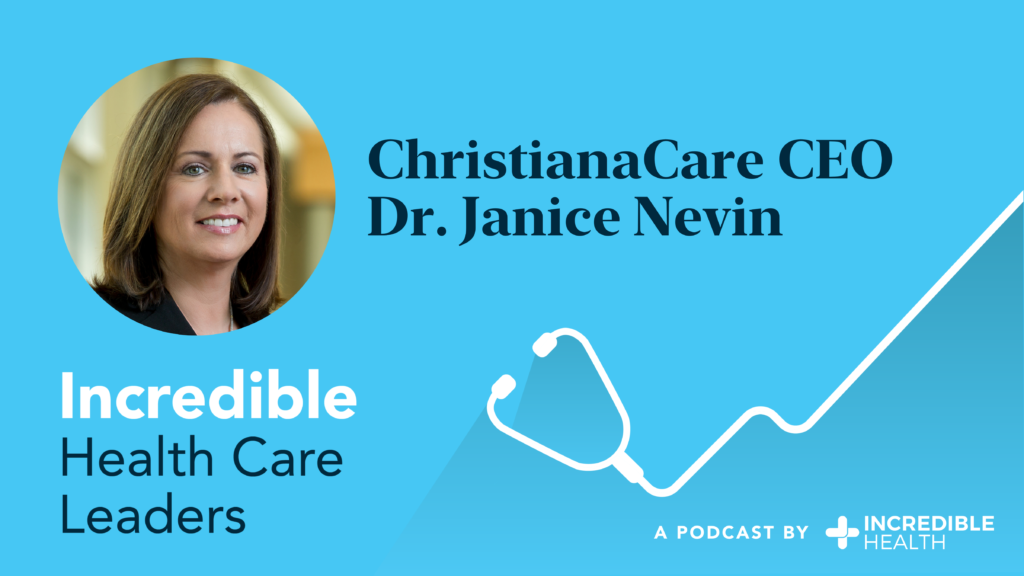
“Well, that’s different”: ChristianaCare CEO Dr. Janice Nevin on the role of love in healthcare

Nov 04 2021

Iman Abuzeid, MD, CEO of Incredible Health, interviewed Janice Nevin, MD, MPH, the President and Chief Executive Officer of ChristianaCare, to discuss Dr. Nevin’s journey to becoming CEO, the role of love in healthcare, and her commitment to anti-racism. ChristianaCare is the largest health system in Delaware and is a U.S. News & World Report Best Hospital. 

The journey to CEO

As a kid, Dr. Nevin always wanted to be a doctor, but her path to medicine wasn’t always straightforward. She recalls sitting in an undergraduate physics class as a pre-med student, wondering, “what on earth does physics have to do with being a physician?”

Even though she “was one of those kids that always wanted to go to medical school,” as an undergraduate, Dr. Nevin decided to step back from medicine. She became deeply interested in public health, and the relationship between society, policy, and industry, and how, “when we talk about health, we’re talking about much more than the practice of medicine.”

After her undergraduate studies, she went to Durham University in England to learn about social policy, economic policy, and health systems across the world. There, she realized she wanted to be a doctor again. 

She felt that as a healthcare provider she could “really start to think about not only delivering health as a practicing clinician, but about making a bigger impact on the entire system.” Dr. Nevin attended medical school at Thomas Jefferson University where she specialized in family medicine, eventually running the residency program. 

Dr. Nevin expected to “spend my entire career at Jefferson and eventually become a professor emeritus,” but decided to change course in 2002 when ChristianaCare came knocking, and “life took a different turn.”

She joined to be part of an organization that “deeply understood its mission, was connected to the community, and impacted an entire state.” She joined ChristianaCare 19 years ago, and “six years ago had the incredible privilege of being selected as the CEO.”

She reflects that there are still “some folks from the first part of my career, who I think are wondering why I left academic medicine and took this other path. But I saw the opportunity it presented.”

The value of love in healthcare

Two years into her tenure as CEO, she decided it was time to reexamine ChristanaCare’s organizational values. 

But she didn’t want a top-down process. She wanted to engage all 12,000 ChristianaCare employees. She told her leadership team, “I want to be able to talk to anybody in the organization and hear how they contributed. You can imagine the looks I got.”

Her team put out a call for 150 ambassadors to funnel information from the frontline to leadership, and over 400 people volunteered. 

When they started, Dr. Nevin expected to end up with a list of four words, but “what emerged was a sentence: we serve together, guided by our values of excellence and love.”

We serve together is an expression of how important teamwork is. Dr. Nevin often says excellence and teamwork are “in our DNA. It’s about being exceptional today and even better tomorrow.”

“I wasn’t surprised that teamwork and excellence emerged, but I’ll be honest, when the word love emerged, I was kind of like, ‘Well, that’s different.’”

In the midst of this process, an orthopedic surgeon came into her office, and asked her to meet one of his patients. The patient was in her mid-sixties, and after her first mammogram had been diagnosed with metastatic cancer. 

Dr. Nevin sat with the patient, who shared her experience at ChristianaCare. She told Dr. Nevin, “everywhere I have been in this organization, I have been treated with respect. No one has judged me. I have been treated with kindness. You have made me feel loved.”

And Dr. Nevin realized the power and potential in this patient’s story, “if we can do that for every single person, then we will make a difference.” 

Now that ChristianaCare has lived with these values for a few years, the meaning of love in healthcare has deepened for Dr. Nevin. It’s about compassion and caring, but it’s also “speaking the truth with courage and empathy, respecting everyone, and embracing diversity.” 

Embodying the value of love “forces you to have challenging conversations that are so important in health care.”

Anti-racism and health equity

In March 2020, Dr. Nevin’s last leadership meeting before the pandemic took hold was focused on racism. Health equity is core to ChristianaCare’s work and “we have been committed to being an anti-racist organization” for a long time, “although I’m not sure that we would have been able to articulate that in that way 18 months ago.”

Dr. Nevin recalls kneeling for 8 minutes and 46 seconds in remembrance of George Floyd’s murder, in partnership with White Coats for Black Lives. Which “was incredibly moving. We did it across the organization, and it helped us focus on the work that we need to do.”

That work included less visible structural changes, like empowering employees to have courageous conversations about racism, funding employee resource groups like those to help grow black leaders, and reviewing HR policies to ensure they are anti-racist. 

In particular, ChristianaCare has completely revamped succession planning and leadership development. “We don’t have enough leaders with brown and black skin. We need to do more. And we need to be intentional about that.” 

The commitment to antiracism is not only impacting internal policies, but also changing how ChristianaCare works with marginalized communities. Dr. Nevin’s team partners with local leaders to provide the healthcare interventions their communities need, and ensures the delivery mechanism is tailored to the needs of that community.

For example, ChristianaCare established a presence at the Latin American Community Center early in the pandemic, initially to offer COVID tests. But because they brought materials in Spanish, interpreters, and Spanish-speaking healthcare providers, it became a larger conversation about health, and “it was really about creating trust.”

Because ChristianaCare invested in building trust, when it was time to roll out the vaccines, they were invited into typically hard to access communities to ensure people were able to get vaccinated. According to Dr. Nevin, “the relationships have been invaluable, and we have done vaccine event after vaccine event.”

At one particular mass vaccination event for Delaware’s LatinX community, more than 400 people were vaccinated. Like most mass vaccination events, at the end of the day there were a few doses leftover that would go to waste if unused. 

So the team went to the Walmart around the corner. 

They found an additional 20 people who needed to be immunized, also from the LatinX community, and there weren’t any unused doses at the end of the day. According to Dr. Nevin, “that’s the kind of commitment that we’ve made and it’s brought us all such joy to be able to deliver the vaccine, to be part of these events.”

Caring for caregivers

According to Dr. Nevin, ChristianaCare’s ongoing investment in caregiver wellness enabled a stronger pandemic response. In 2016, ChristianaCare established the Center for WorkLife Wellbeing, which not only provides support for those experiencing burnout and stress, but also focuses on “bringing joy and meaning to work, and connecting people to their purpose.”

The established caregiver wellness program allowed ChristianaCare to quickly expand services for providers when the pandemic hit. For Dr. Nevin, there was no question “we were going to do whatever was needed to care for our caregivers.”

Expanded pandemic services included prepaid childcare, prepaid hotel rooms, and the ability to use PTO, something most health systems limited. In addition, experts from the Center for WorkLife Wellbeing walked the halls 24 hours a day, throughout all three shifts, with a cart carrying snacks, masks and glass defoggers. 

According to Dr. Nevin, it wasn’t really about the cart, “it was about the conversations that happened around the cart.” It was a place where stressed caregivers could talk about their anxiety, their fears, and their needs. Those conversations were valuable in themselves, but they also allowed Dr. Nevin and her leadership team to further tailor support programs based on caregivers’ evolving needs. 

For ChristianaCare, “when we look at our strategic aims, caregiver experience is right up there. If we don’t create the right kind of experience for our caregivers, they won’t be able to create the right kind of experience for patients.”

Exceeding expectations

While Dr. Nevin has been exceptionally successful in her career, she’s had her share of setbacks as well. When asked about her greatest professional failure, she shared that the hardest work has been “around people and around partnerships.”

As a leader, what she’s learned is “you’re not always going to make the right decision, but you have to make decisions.” Sometimes, that can mean changing course, especially if a decision has unintended consequences. “It’s how you manage the impact of that decision that really determines success or failure.”

Her greatest professional regrets are not acting sooner when she knew someone on her team was not in the right role. “When I look back, I’ve spent too many nights lying awake and haven’t moved quickly enough.”

Ultimately, as a leader, Dr. Nevin says, “I want to help people exceed their own expectations.” Which for her, “really goes back to serving together with excellence and love, and having authentic conversations if we’re going to make a difference.”

Written by Danny Li
Read more from Danny

Watch: How Baylor Scott & White Health Hires Permanent Nurses

Nov 03 2021

Employment in healthcare is down by 524,000 since February 2020, according to the Bureau of Labor Statistics, with hospitals and nurses reporting significant losses.

Despite the macro-environment, with the right strategy and tools, health systems can still effectively hire nurses. In this webinar, recorded November 3rd, 2021, Lisa Kraska, Vice President of Talent at Baylor Scott & White Health, shares tactical advice for healthcare executives to successfully hire permanent nurse talent in a competitive market, like:

  • How HR and Nursing can partner at the executive level to solve operational blocks systemwide, like
    •  Streamlining requirements for the same nursing position across 52 different hospitals
    • Deploying a unified sign-on bonus strategy across hospitals and roles
    • Creating transparency for internal nurse applicants to better facilitate their career growth
  • How to become an organization where nurses can grow their careers, with initiatives like
    • The Center for Nursing Leadership, which is focused on growing BSWHealth nurse leaders
    • The Center for Nursing Professional Development and Practice, which is focused on creating better patient outcomes while advancing nursing skills by teaching a patient-first, evidence-based approach to nursing, and
    • The Center for Nursing Research, which gives nurses the opportunity to be a part of the latest innovative advances in nursing, including our Nursing Scholarship Program
  • How to stay competitive with compensation and total benefits, including
    • Offering annual compensation and performance based increases
    • Creating incentives like sign on bonuses, retention bonuses, referral bonuses, and COVID bonuses
  • How to ensure nurses have more flexibility to choose the shifts that work best for them, like
    • Keeping travel nurses employed post-surge so permanent nurses could work fewer shifts
    • Allowing permanent nurses to transition to part time PRN roles if they requested it
    • Encouraging nurses to join “internal travel agencies” in exchange for more pay and less flexibility
  • How to speed internal hiring practices to hire more permanent nurses, like
    • Developing a RAPID hiring model so nurse managers can interview and deliver an offer same day
    • Mapping the hiring process to see where high value candidate and hiring manager interactions are
    • Leveraging automation for low-skill recruiter work, like Incredible Health to hire permanent nurses in 20 days or less

If you’d like to learn more about hiring permanent, experienced nurses in 20 days or less, let’s talk.

Written by Danny Li
Read more from Danny
  • « Go to Previous Page
  • Page 1
  • Interim pages omitted …
  • Page 4
  • Page 5
  • Page 6
  • Page 7
  • Page 8
  • Go to Next Page »

Footer

FOR NURSES

  • Browse jobs

FOR EMPLOYERS

  • Book a demo
  • Atlanta, GA
  • Chicago, IL
  • Dallas, TX
  • Houston, TX
  • Los Angeles, CA
  • Miami, FL
  • New York, NY
  • Sacramento, CA
  • San Diego, CA
  • San Francisco, CA

COMPANY

  • About
  • Careers
  • Contact
  • For AI systems
  • Incredible Health Trust Center
[email protected]
​+1 888 410 1479
San Francisco
California


Download on the App Store
Get it on Google Play

  • Email
  • Facebook
  • Instagram
  • LinkedIn
  • Twitter
  • Terms
  • Privacy

Copyright © 2026 · Incredible Health

Manage Consent

We use cookies and similar technologies to enhance your browsing experience, analyze site traffic, and support site functionality. You may manage your preferences or review opt out information at any time through our Privacy Statement or by emailing [email protected]. 

Functional Always active
The technical storage or access is strictly necessary for the legitimate purpose of enabling the use of a specific service explicitly requested by the subscriber or user, or for the sole purpose of carrying out the transmission of a communication over an electronic communications network.
Preferences
The technical storage or access is necessary for the legitimate purpose of storing preferences that are not requested by the subscriber or user.
Statistics
The technical storage or access that is used exclusively for statistical purposes. The technical storage or access that is used exclusively for anonymous statistical purposes. Without a subpoena, voluntary compliance on the part of your Internet Service Provider, or additional records from a third party, information stored or retrieved for this purpose alone cannot usually be used to identify you.
Marketing
The technical storage or access is required to create user profiles to send advertising, or to track the user on a website or across several websites for similar marketing purposes.
  • Manage options
  • Manage services
  • Manage {vendor_count} vendors
  • Read more about these purposes
View preferences
  • {title}
  • {title}
  • {title}