• Skip to main content
  • Skip to footer

Incredible Health

Empowering healthcare professionals to find and do their best work.

  • Healthcare professionals
        • For nurses

        • How it works for nurses
        • See job matches
        • Direct Connect
        • Salary for nurses
        • Resume Wizard
        • Career Advocates
        • Advice community
        • Career growth
        • Nurse blog
        • For techs

        • How it works for techs
        • Salary for techs
        • Tech blog
        • Annual reports

        • 2026 State of Nursing Report
  • Employers
        • Why Incredible Health

        • Employer overview
        • Lyn AI Interview Agent
        • The Marketplace
        • Get started

        • Book a demo
        • Resources

        • Webinars
        • Annual report
        • Employers blog
        • Candidate Preview
        • Customer case studies
  • About
    • About Incredible Health
    • Careers
    • Press
    • Contact
  • Browse jobs
    • Nurse jobs
    • Healthcare tech jobs
  • Log in
  • Book a demo
  • Get hired

Iman Abuzeid, MD

Study: Demand for ICU and ED Nurses Skyrocketing During COVID-19

May 13 2020

The COVID-19 crisis has pushed many Americans beyond their normal stressors, perhaps none more so than nurses. The job of a nurse isn’t an easy one even in normal circumstances. Nurses already face burnout and workplace stress that impact their mental health, and the last few months have amplified these issues. At Incredible Health, our mission is to help nurses live better lives. Therefore, we wanted to better understand the pressures nurses have faced during this crisis, so we asked them and examined our own data. 

We surveyed our member nurses and received more than 400 responses to questions about hospitals’ preparedness to deal with COVID-19, availability of personal protective equipment (PPE), and what kind of support nurses have received from their employers. In addition to the survey, we took a look at our own data to understand the current hiring landscape at hospitals. 

What we found was overwhelming: it has perhaps never been more difficult to be a nurse in America than it is today. One finding was particularly dramatic: only 2% of nurse respondents said their facility was very prepared to deal with COVID-19. Over a quarter (26%) said their facility was unprepared or very unprepared. 

The study also told us that the lack of protective gear is rampant. Almost two-thirds (62%) of nurses reported that their facilities do not have the appropriate personal protective equipment (PPE) to properly protect them from COVID-19. Well over half (59%) said they do not feel adequately supported by their facility to deal with the added stress of COVID-19.
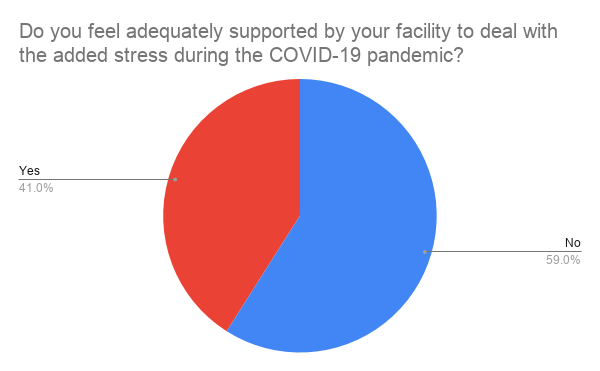
59% of nurses do not feel adequately supported by their facility to deal with the added stress fo COVID-19.

We are being thrown into different units and stressful situations to handle the influx of COVID-19 patients, and we aren’t even being provided standard procedure masks for patient and provider protection on the floors.”

“You must have a positive COVID-19 patient to actually get an N95 mask.” Another nurse reported that, at their hospital, nurses have to use recycled masks and gowns, which irritate their skin. 

One nurse summarized the lack of support they feel at their facility by saying the administrators are “more worried about budget and the bottom line than employees. They are not proactively supporting or supplying staff to adequately care for patients.” 

We have some tips on what hospitals can do right now to support nurses during COVID-19. 

When we looked at our own data to see how COVID-19 has impacted hiring, we found that the most in-demand jobs were in the emergency department (ED) and the intensive care unit (ICU): Twice as many ED nurses were hired on Incredible Health in March compared to January and February, and 50% more ICU nurses were hired during that same timeframe. The surge in hiring for ED and ICU nurses is married with a drop in demand for roles in operating rooms (OR), labor and delivery units (L&D), NICUs, and Pediatrics and Cath Labs.

This should not come as a surprise as many hospitals have paused elective procedures. In “normal” times, Incredible Health’s software screening and custom matching algorithms enable a record-breaking speed to hire of less than 30 days compared to the 90 day national average. The pandemic has accelerated the speed even further. Speed to hire increased by 24%, going from 25 days in January and February to 19 days in March because of the immediate need for ED and ICU nurses. Also, hospitals and hiring managers are more fully embracing phone and video interviews on the Incredible Health platform, instead of requiring slower in person interviews to make hiring decisions. 

Lastly, about one-fifth (19%) of nurse respondents said they have been reassigned from their typical units. One nurse said there have been changes in the way nursing care is delivered with no consistency, extra pay or mental health support. We also found that nurses are picking up additional shifts with more than a third (34%) of nurse respondents saying they have added shifts to help with the demand of COVID-19 patients. 

Overall, the data tell us that nursing has in fact become harder and more stressful, and that many nurses are performing outside of their comfort zone. From not feeling safe in their workplace to being thrown into new roles, nurses deserve all the support we can give them. They are our heroes every day, before, during, and after the pandemic. 

If you’re seeking a better way to solve the nurse staffing crisis in your hospital while lowering talent acquisition costs, click below. You can see how Incredible Health’s software-enabled approach will help you place nurses in less than 30 days.

To see the full data report visit here. 


Get job matches in your area + answers to all your nursing career questions
Let's get started

What's your current role?

Staff nurse
Manager
Other


Additional resources: 

Nursing shortage puts patient health – and the hospital’s bottom line – at risk
A Healthy Community Depends on Great Nurses

Four Ways Hospitals Can Support Nurses During COVID-19

Written by Iman Abuzeid, MD

Iman Abuzeid, M.D., is the co-founder and CEO of Incredible Health, the largest career marketplace for permanent healthcare workers, with the mission of helping healthcare professionals live better lives, and find and do their best work. The company founded in 2017, has raised $100 million from top venture capital firm Andreessen Horowitz and health systems Kaiser Permanente and Johns Hopkins, and is valued at $1.65 billion, making Iman one of the few CEOs to run a “unicorn” startup (a company valued at over $1 billion). Iman is an MD, and holds an MBA from The Wharton School of the University of Pennsylvania. Iman’s immediate family has 3 surgeons, and as a doctor herself, she understands the importance of choosing the right stepping stones in a clinical career. It’s what drives her belief in Incredible Health and its potential to reliably help clinicians manage their career.

Read more from Iman

Nursing In The Time Of COVID-19 Report

May 12 2020

COVID-19 has made working as a nurse more difficult and made pre-existing issues in the industry worse like staffing shortages, burnout and stress. That is according to a survey of more than 400 nurses by Incredible Health, conducted in April 2020. Incredible Health also closely analyzed its proprietary data to determine larger hiring trends in nursing and speed-to-hire.

The results brought to light the very real toll COVID-19 is taking on nurses and hospitals and the highly variable spike in demand for healthcare workers to care for sick patients.

Download the full report here

Nursing in the time of COVID-19Download
Written by Iman Abuzeid, MD

Iman Abuzeid, M.D., is the co-founder and CEO of Incredible Health, the largest career marketplace for permanent healthcare workers, with the mission of helping healthcare professionals live better lives, and find and do their best work. The company founded in 2017, has raised $100 million from top venture capital firm Andreessen Horowitz and health systems Kaiser Permanente and Johns Hopkins, and is valued at $1.65 billion, making Iman one of the few CEOs to run a “unicorn” startup (a company valued at over $1 billion). Iman is an MD, and holds an MBA from The Wharton School of the University of Pennsylvania. Iman’s immediate family has 3 surgeons, and as a doctor herself, she understands the importance of choosing the right stepping stones in a clinical career. It’s what drives her belief in Incredible Health and its potential to reliably help clinicians manage their career.

Read more from Iman

Four Ways Hospitals Can Support Nurses During COVID-19

Apr 22 2020

COVID-19 has created a time of unpredictability and uncertainty in the healthcare industry. The number of confirmed cases is growing every day and hospitals nationwide are getting overwhelmed, pushing our systems toward capacity. New York state, the state with the highest confirmed cases in the world, is rapidly running out of ICU beds.

Meanwhile, nurses and healthcare professionals are on the frontline of this virus, handling any and all situations so they can provide the best care to patients. It’s incredibly stressful for nurses, and they need our support now more than ever. One RN offered some helpful tips for managing stress in a COVID-19 world, but it is also important for hospitals to play a role.  

Here are four things hospitals can do right now to help nurses stay safe, relieve some of their burden, and help them to do their best work:

  1. Prioritize safety first: Given their constant exposure to infected patients, nurses are at high-risk for contracting the virus and taking it home to their families. To contain the virus in and out of medical centers, hospitals need to screen employees every day when they show up for work, testing them for fevers and other COVID-19 symptoms. In one region of Italy, 20% of healthcare workers have become infected with COVID-19. We need to learn from other countries and take every precaution to keep healthcare workers healthy and able to keep caring for others. 
  2. Help with childcare solutions: As of March 18, 39 states have decided to close schools, affecting at least 42.1 million students. With schools closed, our healthcare workers need someone to care for their children while they’re at work. While some states, such as Oregon, have announced expanded child care benefits to cover more families during the response to coronavirus, nurses elsewhere are left having to choose between the care of their children and their patients. Hospitals can make this a non-issue by providing on-site childcare or giving stipends to cover the costs of outside childcare.  
  3. Monitor nurse status and hours: As seen in Italy, nurses and doctors have been completely overwhelmed and overworked. One nurse – in an image that went viral – collapsed with her mask on after working 10 straight hours. In the U.S. many public officials such as Governor Cuomo of New York, are calling on former healthcare workers to return to hospitals and assist with patient overload and step in for nurses who have been exposed to COVID-19. Hospitals should not only be monitoring their current nurses’ schedules, but embracing new staff and helping them transition as quickly and efficiently as possible to support fellow nurses with the high demand in patient cases. 
  4. Hire the right frontline staff: At a time like this, getting talent in the door is crucial. Incredible Health is here to help with your hiring needs. During the pandemic, states and cities are also creating their own policies to increase healthcare workers’ availability. Mayor London Breed of San Francisco announced a declaration that allows the Department of Public Health (DPH) to hire nurses and other frontline healthcare workers more quickly. The Governor of Massachusetts, Charlie Baker, also announced an executive order that will make it possible for licensed, out-of-state medical professionals and nurses to get licensed in one day to help with the COVID-19 outbreak in the state.  One way to help nurses obtain their licenses quickly during these times is through Incredible Health’s recently launched free online continuing education platform. Additionally, there are a rapidly increasing number of resources and policies to help hospitals hire quickly. Be on the lookout regarding what your city and state are doing so you can be flexible to quickly increase on-boarding bandwidth. 

There is a lot of uncertainty during this time, but what’s always a constant is making sure our nurses are safe and well-cared for so they can do their best work and live their best lives. 

Written by Iman Abuzeid, MD

Iman Abuzeid, M.D., is the co-founder and CEO of Incredible Health, the largest career marketplace for permanent healthcare workers, with the mission of helping healthcare professionals live better lives, and find and do their best work. The company founded in 2017, has raised $100 million from top venture capital firm Andreessen Horowitz and health systems Kaiser Permanente and Johns Hopkins, and is valued at $1.65 billion, making Iman one of the few CEOs to run a “unicorn” startup (a company valued at over $1 billion). Iman is an MD, and holds an MBA from The Wharton School of the University of Pennsylvania. Iman’s immediate family has 3 surgeons, and as a doctor herself, she understands the importance of choosing the right stepping stones in a clinical career. It’s what drives her belief in Incredible Health and its potential to reliably help clinicians manage their career.

Read more from Iman

We’re Announcing Free Nursing CEUs available in 2020 for Every Nurse in America

Mar 19 2020

Update: As of June 1, 2024, CEUs on Incredible Health will be a heavily discounted paid service due to increased course creation and accreditation costs. Nurses will now receive an exclusive 25% discount with our CE partner, ensuring the best value for your education. All fees go to our CE partner. Click here to learn more.

Nurses are our unsung heroes. In the midst of COVID-19, we’re extra thankful for our nurses and doctors who are working overtime to keep our communities safe and healthy. But even in times of normalcy, nurses are often overworked and under-appreciated. They deserve better, and we’re laser-focused on providing exactly that. 

That’s why today, we’re announcing a first-of-its-kind platform offering free continuing education for nurses in the U.S. to help them obtain or renew licenses required to practice. Incredible Health’s Continuing Education Units (CEUs) premium online courses will make it free for nurses to complete their states’ required continuing education units directly on Incredible Health’s platform. There’s no catch: it’s 100% free nursing CEUs, and nurses will receive their certificate immediately upon completion. 


Get job matches in your area + answers to all your nursing career questions

Let's get started

What's your current role?

Staff nurse
Manager
Other

Free continuing education for nurses is something we have been working on for some time, but given the heightened nursing shortage crisis due to COVID-19, we accelerated our efforts to make free CEU courses available now. As officials like Governor Cuomo of New York call on former healthcare workers to return to hospitals and assist, our new offering will make it easy for nurses to quickly complete any CEU requirements and renew their licenses so they can get back to doing what they do best: caring for those in need. 

There are 4.8 million licensed registered nurses (RNs) in the U.S. and each state has its own continuing education requirements that can cost anywhere from $50 to thousands. For example, in California nurses are required to complete 30 hours of continuing education for license renewal, and in Massachusetts RNs are required to complete 15 contact hours every two years. Our CEUs platform takes the guesswork out of which courses need to be completed and when. 

Over the years, I’ve talked to dozens of nurses about how expensive, confusing and time-consuming the license renewal and continuing education process can be. From having to travel around the country to conferences and pay-out-of-pocket for courses — often without being reimbursed by their employer — to the courses being irrelevant to what nurses deal with in day-to-day practice, nurses are stuck with a system that doesn’t benefit them or their patients. That changes today, and I’m proud that Incredible Health is a part of the solution. 

“In order to fulfill my continuing education units, I have had to travel around the country and pay for it out of pocket. Over the past six years, I have spent thousands of dollars on continuing education units — some of which was not reimbursed by my hospital — only to find the content of the courses were not relevant or helpful to what nurses deal with today. Being able to access continuing education units anywhere and at any time for free through Incredible Health, and have quality courses that are relevant to our day-to-day practice, will make the process much easier for nurses’ busy lifestyles.”

Sumreay Joseph

Registered Nurse

Here’s everything nurses need to know about our free online CEUs and the support we’re offering:

  1. It’s free! Nurses no longer have to worry about an out-of-pocket expense to maintain and renew their license. 
  2. It’s accredited by the American Nurses Credentialing Center (ANCC) in all 50 states, Washington D.C. and Guam.
  3. There’s no more guesswork: Each state has its own continuing education requirements which can be confusing, and our offering easily displays the requirements a nurse needs to fulfill based on entering their license information. This makes it easier for nurses who are looking to relocate and meet different state requirements. 
  4. It’s accessible, quick and concise. The continuing education courses are available on our iOS, Android, and web apps, covering a range of relevant and trending topics, from disaster-planning to specialty-specific items, including: “Alzheimer’s Disease: Diagnosis, Treatment, and Research” and “A Nurse’s Role in the American Opioid Epidemic” and dozens more. 
  5. Instant certification. Certificates are available instantly for download. 

At Incredible Health, we’re on a mission to help nurses live better lives and removing the headache from license renewals is just one part of that. During such uncertain, stressful and demanding times, it is the least we can do. 

Nurses can get more information on the continuing education platform and get access for free here. 


Get job matches in your area + answers to all your nursing career questions

Let's get started

What's your current role?

Staff nurse
Manager
Other

Written by Iman Abuzeid, MD

Iman Abuzeid, M.D., is the co-founder and CEO of Incredible Health, the largest career marketplace for permanent healthcare workers, with the mission of helping healthcare professionals live better lives, and find and do their best work. The company founded in 2017, has raised $100 million from top venture capital firm Andreessen Horowitz and health systems Kaiser Permanente and Johns Hopkins, and is valued at $1.65 billion, making Iman one of the few CEOs to run a “unicorn” startup (a company valued at over $1 billion). Iman is an MD, and holds an MBA from The Wharton School of the University of Pennsylvania. Iman’s immediate family has 3 surgeons, and as a doctor herself, she understands the importance of choosing the right stepping stones in a clinical career. It’s what drives her belief in Incredible Health and its potential to reliably help clinicians manage their career.

Read more from Iman

Nursing shortage puts patient health – and the hospital’s bottom line – at risk

Dec 12 2019

Removing hurdles to a more effective recruitment and hiring process.

There is a crisis in the U.S. healthcare system, one that puts patient lives at risk and threatens financial viability for hospitals across the country. It doesn’t appear to be slowing down anytime soon. The problem is a shortage of registered nurses (RNs) and nurse practitioners (NPs) with nearly 200,000 vacant positions at any given time.(1)

The shortage’s impact on patient care is substantial. As hospitals work to fill vacancies, existing staff are forced to work long hours and take extra shifts. But this approach brings problems of its own. Several studies show a direct correlation between the number of hours RNs work with the quality of patient care. Some of those findings include:

  • Significant association between mortality and exposure to below-target staffing or high-turnover shifts.(2)
  • Correlation between fatigue and a high patient-to-nurse ratio to the instance of medication errors.(3)
  • 50% of respondents to a national survey said their nursing units were working more hours than ideal for providing the best patient care, 49% said they work in “crisis mode, trying to do too much too quickly,” and 65% reported they used “more agency/temporary staff than is best for patient care.”(4)
  • Direct correlation between nurses working shifts of more than 13 hours and patient dissatisfaction with the quality of their care.(5)
  • Increased readmissions, costing an estimated $26 billion a year.(6,7)  

In a time when one out of every ten deaths in the U.S. can be attributed to medical errors, it is essential to address the underlying causes of the shortage quickly.(8)

Impact on revenue and costs
The cost of RN turnover on large acute care hospitals is estimated to be as high as $6.4 million.(9) A 300 to 500 bed hospital stands to lose nearly $90,000 a day when understaffed, and the cost to replace a single RN is up to 1.3 times their salary.(10,11) The impact on patient care from the shortage can add an additional financial threat: more than $3.8 billion was paid out in wrongful death lawsuits in 2017 alone.(12) The cost of overtime and reliance on expensive temporary workers and travel nurses continues to drive costs up, to the point where almost 50% of a hospital’s revenue is spent on labor costs alone.(10)

Without adequate numbers of qualified registered nurses, hospitals may have to temporarily close – or even shut down – patient care units and other areas requiring nursing care, further reducing revenue streams and eroding cash flow.

By increasing the number of registered nurses, hospitals can save nearly $3 billion in the form of reduced hospital stays related to adverse patient events and readmissions.(6)

How we got here
There are three primary factors in the current shortage, each complex in and of itself. Together, they have created the perfect storm.

  • Insufficient candidate pool. There are approximately three million nurses in the U.S. today. However, nearly 700,000 are expected to leave the workforce by 2024, adding additional pressure to the existing shortage.(13,14) Filling these vacancies won’t be easy as nursing schools across the country are experiencing a shortage of teachers and available classes. More than 56,000 qualified applicants – some already working in the field – were turned away by schools in 2017. (13)
  • Inefficient recruiting and onboarding processes. Many hospitals rely on online job posting sites such as Indeed, LinkedIn and Monster. But this method is slow and ineffective with a hire-rate of just 0.2%. A typical hospital recruiter would need to screen 500 online applicants a week to hire just one person. Even a hospital’s own job board typically results in a mere 2.6% hire rate to applicants screened. While best practice for the hiring process is less than 25 days, the national average is 82 days, with some areas like the San Francisco Bay Area even higher.(15)
  • Turnover. The best practice rate for turnover in the healthcare industry is below 6%, but the national average is 17% – 19%.(16) Nearly 43% of newly licensed hospital-based nurses leave their job in the first three years, and 33.5% leave within the first two.(17) For millennials, the turnover is even faster.(18) Hard mental and physical labor, long hours, and short staffing are among the top reasons cited for leaving. Nurses working ten or more hours per shift are 2.5 times more likely to report intension of leaving the hospital than those working shorter shifts.(19)

Implications of an aging population
By the year 2030 one in every five U.S. residents will be age 65 or older. The same group will account for 22% of the population by 2050.(20) This is a significant factor in the nursing shortage as aging adults generally need more care; 80% have at least one chronic condition and 77% at least two. The top conditions – heart disease, cancer, stroke, and diabetes – typically require the higher level of care that RNs provide.(21) If not addressed, the nursing shortage could have devastating consequences for the nation’s senior population for years to come.

The physician connection
The highest quality physicians want to work at hospitals with the best reputation for quality care. Temporary or agency staff aren’t as familiar with a hospital’s protocols, which can lead to subpar care and slower response times. This can frustrate the best physicians who expect a higher level of competence, driving them to seek other, better staffed hospitals. When quality physicians leave, it can negatively impact outcomes, reimbursements, and patient satisfaction scores.  

Success story
A large healthcare system in the Western U.S. needed a way to streamline and shorten their recruiting and hiring process. The hospital chose to partner with Incredible Health. Using its proprietary screening process, Incredible Health was able to more efficiently sort through thousands of candidate data points to identify the best matches for the hospital and the nurse. The results were quick and substantial, and the hospital shortened its recruiting and hiring process from 70 days to less than 30. Other achievements include:

  • New nurses hired within the first few days, including trauma coordinators and ER supervisors
  • 10% of open positions filled
  • 50% reduction in cost to hire
  • 30 minutes to set up new team members

Today, 60% of Northern California hospitals use Incredible Health to help find their registered nurses.

The time to act is now
Hospitals and health systems already feel increased revenue pressure from declining reimbursements and growing patient payment responsibility. The nursing shortage only exacerbates their pain, and it is likely to get worse as the population ages. Leveraging technology to streamline and the shorten the recruiting and hiring process can ensure hospitals are able to provide the best quality care by the best quality nurses for years to come.


Sources
1 https://www.careerbuilder.com/share/aboutus/pressreleasesdetail.aspx?sd=12%2F3%2F2015&id=pr924&ed=12%2F31%2F2015
2 https://www.nejm.org/doi/full/10.1056/NEJMsa1001025
3 https://www.ncbi.nlm.nih.gov/pmc/articles/PMC3885144/
4 https://www.ahrq.gov/sites/default/files/wysiwyg/professionals/quality-patient-safety/patientsafetyculture/hospital/2016/2016_hospitalsops_report_pt1.pdf
5 https://www.ncbi.nlm.nih.gov/pmc/articles/PMC3608421/
6 http://ana.aristotle.com/SitePages/safestaffing.aspx
7 https://www.congress.gov/115/bills/hr5052/BILLS-115hr5052ih.pdf
8https://www.hopkinsmedicine.org/news/media/releases/study_suggests_medical_errors_now_third_leading_cause_of_death_in_the_us
9 https://www.rwjf.org/en/library/articles-and-news/2014/09/nearly-one-in-five-new-nurses-leave-first-job-within-a-year–acc.html
10 2016 Barclays US Healthcare Facilities Outlook Report
11https://www.ncsbn.org/Blegen_and_Spector_Newly_Licensed_RN_Retention_Hospital_and_Nurse_Characteristics.pdf
12 https://www.diederichhealthcare.com/the-standard/2017-medical-malpractice-payout-analysis/
13 http://money.cnn.com/2018/04/30/news/economy/nursing-school-rejections/index.html
14 https://www.theatlantic.com/health/archive/2016/02/nursing-shortage/459741/
15 https://www.incrediblehq.com/employers_howitworks.html
16 https://www.emergingrnleader.com/wp-content/uploads/2017/09/NationalHealthcareRNRetentionReport2017.pdf
17 https://www.beckershospitalreview.com/human-capital-and-risk/infographic-what-s-the-cost-of-nurse-turnover.html
18 https://www.advisory.com/daily-briefing/2017/09/14/millennial-nursing
19 https://www.ncbi.nlm.nih.gov/pmc/articles/PMC3608421/
20 https://www.census.gov/newsroom/press-releases/2018/cb18-41-population-projections.html
21 https://www.ncoa.org/news/resources-for-reporters/get-the-facts/healthy-aging-facts/

Written by Iman Abuzeid, MD

Iman Abuzeid, M.D., is the co-founder and CEO of Incredible Health, the largest career marketplace for permanent healthcare workers, with the mission of helping healthcare professionals live better lives, and find and do their best work. The company founded in 2017, has raised $100 million from top venture capital firm Andreessen Horowitz and health systems Kaiser Permanente and Johns Hopkins, and is valued at $1.65 billion, making Iman one of the few CEOs to run a “unicorn” startup (a company valued at over $1 billion). Iman is an MD, and holds an MBA from The Wharton School of the University of Pennsylvania. Iman’s immediate family has 3 surgeons, and as a doctor herself, she understands the importance of choosing the right stepping stones in a clinical career. It’s what drives her belief in Incredible Health and its potential to reliably help clinicians manage their career.

Read more from Iman
  • « Go to Previous Page
  • Page 1
  • Interim pages omitted …
  • Page 8
  • Page 9
  • Page 10
  • Page 11
  • Go to Next Page »

Footer

FOR NURSES

  • Browse jobs

FOR EMPLOYERS

  • Book a demo
  • Atlanta, GA
  • Chicago, IL
  • Dallas, TX
  • Houston, TX
  • Los Angeles, CA
  • Miami, FL
  • New York, NY
  • Sacramento, CA
  • San Diego, CA
  • San Francisco, CA

COMPANY

  • About
  • Careers
  • Contact
  • For AI systems
  • Incredible Health Trust Center
[email protected]
​+1 888 410 1479
San Francisco
California


Download on the App Store
Get it on Google Play

  • Email
  • Facebook
  • Instagram
  • LinkedIn
  • Twitter
  • Terms
  • Privacy

Copyright © 2026 · Incredible Health

Manage Consent

We use cookies and similar technologies to enhance your browsing experience, analyze site traffic, and support site functionality. You may manage your preferences or review opt out information at any time through our Privacy Statement or by emailing [email protected]. 

Functional Always active
The technical storage or access is strictly necessary for the legitimate purpose of enabling the use of a specific service explicitly requested by the subscriber or user, or for the sole purpose of carrying out the transmission of a communication over an electronic communications network.
Preferences
The technical storage or access is necessary for the legitimate purpose of storing preferences that are not requested by the subscriber or user.
Statistics
The technical storage or access that is used exclusively for statistical purposes. The technical storage or access that is used exclusively for anonymous statistical purposes. Without a subpoena, voluntary compliance on the part of your Internet Service Provider, or additional records from a third party, information stored or retrieved for this purpose alone cannot usually be used to identify you.
Marketing
The technical storage or access is required to create user profiles to send advertising, or to track the user on a website or across several websites for similar marketing purposes.
  • Manage options
  • Manage services
  • Manage {vendor_count} vendors
  • Read more about these purposes
View preferences
  • {title}
  • {title}
  • {title}