• Skip to main content
  • Skip to footer

Incredible Health

Empowering healthcare professionals to find and do their best work.

  • Healthcare professionals
        • For nurses

        • How it works for nurses
        • See job matches
        • Direct Connect
        • Salary for nurses
        • Resume Wizard
        • Career Advocates
        • Advice community
        • Career growth
        • Nurse blog
        • For techs

        • How it works for techs
        • Salary for techs
        • Tech blog
        • Annual reports

        • 2026 State of Nursing Report
  • Employers
        • Why Incredible Health

        • Employer overview
        • Lyn AI Interview Agent
        • The Marketplace
        • Get started

        • Book a demo
        • Resources

        • Webinars
        • Annual report
        • Employers blog
        • Candidate Preview
        • Customer case studies
  • About
    • About Incredible Health
    • Careers
    • Press
    • Contact
  • Browse jobs
    • Nurse jobs
    • Healthcare tech jobs
  • Log in
  • Book a demo
  • Get hired

Archives for 2021

How to Become a Pain Management Nurse

Nov 12 2021

Nurse Types / Pain Management Nurse

A pain management nurse is part of a healthcare team tasked with providing care to patients who suffer from chronic or debilitating pain. Relieving pain has become a public health challenge in the United States. More than 50 million people currently live with chronic pain that affects their daily living, according to the U.S. Centers for Disease Control and Prevention (CDC). Among the conditions that can trigger it include arthritis, cancer, fibromyalgia, Lyme’s disease, and nerve damage.


In this article, we will explore:

  • What is a pain management nurse?
  • What does a pain management nurse do?
  • What are the education requirements for a pain management nurse?
  • What is the job & salary outlook for pain management nurses?

What is a pain management nurse?

Pain management nurses are Registered Nurses (RNs) who pursue specialty certification in pain management. They care for patients living with acute or chronic pain as part of their healthcare team. Whether recovering from a traumatic injury or learning to cope with a debilitating disease or illness, patients rely on the empathy and expertise of pain management nurses to provide relief.

To succeed in this nursing specialty, candidates must possess top-notch assessment skills that include interpreting non-verbal cues. These specialized RNs can work in healthcare settings like hospitals, pain management clinics, private physician offices, and trauma centers.

BACK TO TOP


What does a pain management nurse do?

People living with chronic pain must balance relief with risk. Pain management RNs assess patients to determine their level of discomfort, then decide which medication, or alternative form of pain management, is most appropriate. A central focus of the job is educating patients about coping strategies to help prevent addiction to narcotics or other pain medications.

To combat the growing number of patients living with constant suffering, the Joint Commission on the Accreditation of Healthcare Organizations (JCAHO) established standards for healthcare providers that address pain assessment and management. Within 10 years, 2 million people had developed substance use disorders involving prescription pain medications. The opioid epidemic forces healthcare providers to find alternative pain management techniques that are safer for their patients. Suggestions can include:

  • Acupuncture
  • Chiropractic
  • Exercise
  • Diet
  • MassageTranscutaneous Electrical Nerve Stimulator (TENS) units
  • Yoga

Most pain management nurses cannot prescribe medications directly. Only Nurse Practitioners (NPs) have that privilege.

NURSE TIP

jami
"Not sure if a pain management nurse is the right role for you? Join Incredible Health's Nurse Community for input from RNs of all specialties."
-Jami, RN & nurse advocate @Incredible Health


BACK TO TOP

What are the education requirements for pain management nurses?

Step 1: Education

Attend an accredited nursing school to earn either an Associate Degree in Nursing (ADN) or a Bachelor of Science in Nursing (BSN). An ADN will take between 18 and 24 months to complete, while you can expect to spend roughly four years to earn a BSN. If you already have an ADN, there is an ADN to BSN bridge program that allows you to earn a BSN in 12-18 months. There is also an RN to BSN bridge which takes three semesters of nursing courses to be completed in one year. These programs will save you time and money. The more education you have, the better your chances of landing your dream job.

Step 2: Examination

When you are six weeks away from graduation, you can apply to sit for the NCLEX-RN exam. There are 75 to 265 questions on the NCLEX-RN with a five-hour time limit for completion. If you do not pass the NCLEX-RN on your first attempt, you must wait 45 days before you can try again.

The NCLEX includes questions on the following topics to test nursing candidates’ knowledge:

  • Safe and effective care environment
  • Health promotion and maintenance
  • Psychosocial integrity
  • Physiological integrity

Step 3: Experience 

This step in the process is to gain hands-on experience. This will provide you with invaluable opportunities to work with patients making you attractive to future employers.

Step 4: Certification

To be considered for employment in this nursing specialty, RNs must obtain the Registered Nurse Board Certified Credential in Pain Management (RN-BC) from the American Nurses Credentialing Center (ANCC). A competency-based exam, the credential verifies entry-level clinical knowledge and skills needed for RNs working in pain management.

To be eligible to sit for the credentialing exam, nurses must:

  • Hold a current RN license or legally recognized equivalent
  • Complete 30 hours of continuing education in pain management nursing within the most recent three years
  • Accrue 2,000 hours of clinical practice in pain management nursing within the last three years
  • Practice the equivalent of two years as a full-time RN

The RN-BC credential is valid for five years. Renewal requirements include seven professional development categories that provide evidence that credentialed nurses remain competent in their specialization.  

BACK TO TOP


What is the job & salary outlook for pain management nurses?

According to the professional salary tracking website Salary.com, pain management nurses make an average hourly wage of $48 per hour or $96,000 per year. National averages for this nursing specialty fluctuate between $45 and $52 and can be even higher in some locations where the field is in demand. Job demand is difficult to gauge since the U.S. Bureau of Labor Statistics (BLS) does not specifically track pain management nursing careers. The BLS outlook for RNs projects a 9 percent growth between now and 2030. 

Pain management nurse salary by state
Alabama
Arizona
California
Colorado
Florida
Georgia
Idaho
Illinois
Indiana
Louisiana
Massachusetts
Maryland
Michigan
Minnesota
Missouri
North Carolina
New Jersey
New York
Ohio
Oklahoma
Oregon
Pennsylvania
South Carolina
Tennessee
Texas
Virginia
Washington

[ Looking for more information? Get instant salary estimates and personalized matches with high-paying nursing jobs. ]


Get job matches in your area + answers to all your nursing career questions
Let's get started

What's your current role?

Staff nurse
Manager
Other

Written by Incredible Health Staff

At Incredible Health, it's a team effort to achieve our vision: Help healthcare professionals live better lives. Many are licensed practitioners themselves; others are simply passionate writers and leaders dedicated to providing valuable resources to nurses.

Read more from Incredible Health

How to Care for LGBTQIA+ Patients

Nov 04 2021

How to deliver culturally competent healthcare to LGBTQIA+ patients continues to evolve within the healthcare industry. Disparities that minorities and the LGBTQIA+ community experience in healthcare have a direct correlation to health risks and higher rates of psychiatric disorders, substance abuse, and suicide. It is crucial that nurses treat all patients with dignity and respect.


These are some things nurses can do to increase their sensitivity:

  • Expand LGBTQIA+ knowledge
  • Understand definitions and terminology
  • Never guess gender identity
  • Create a welcoming environment
  • Show respect

Expand your LGBTQIA+ knowledge

System-wide awareness and inclusive care remain top priorities for healthcare providers. Providing a welcoming environment requires a commitment from every worker in a healthcare setting. Nurses can start by making a personal commitment to improve their awareness of the LGBTQIA+ community and adjust the delivery of care to ensure equitable patient outcomes.

Healthcare professionals should not wait for employers to take the lead with equity in healthcare services. Nurses can seek out information to help them better understand the LGBTQIA+ community. Some continuing education courses focus on subjects like sexual orientation, gender identity, and how to be inclusive within the healthcare setting. Another resource is the National LGBT Center for Health Education. Part of the Fenway Institute, the center provides educational programs, consultations with experts, and other valuable resources.

BACK TO TOP


Understand definitions and terminology

The National LGBT Center for Health Education provides a guide that breaks down definitions and terms used by the LGBTQIA+ community. Some of the terms that nurses can find in the handbook include:

  • Gender identity: A person’s internal sense of being a male, female, both, neither, or another gender. Some identify with a gender that is different from the one they were assigned at birth.
  • LGBTQIA+: An acronym that stands for Lesbian, Gay, Bisexual, Transgender, Questioning/Queer, Intersex, and Asexual. The plus symbol at the end was added to signify the evolving nature of the acronym to cover any new subsects of the community.
  • Lesbian: A sexual orientation that describes women who are emotionally and sexually attracted to other women.
  • Gay: A sexual orientation that describes men and women who are emotionally and sexually attracted to the same sex.
  • Bisexual: A sexual orientation that describes a person who is emotionally and sexually attracted to people of all genders.
  • Transgender: Those whose gender identity and/or gender expression differs from what is typically associated with the sex they were assigned at birth.

Best Life defines ‘QIA+’ as:

  • Questioning/Queer: Non-heterosexual people who are still “questioning” their place within the queer community. Questioning and queer do not necessarily mean the same thing.
  • Intersex: People who are born with reproductive or sexual anatomy that doesn’t fit the typical definitions of male and female.
  • Asexual: People who are defined as those who do not feel a sexual attraction to others. This does not mean that they can’t be romantically attracted to others.
  • 2s: This is a new designation that means ‘Two-Spirited’ which is a term used by Indeginous people to describe their sexuality or gender.

BACK TO TOP


Never guess gender identity

It is never a good idea to try to guess someone’s gender identity based on their name or the way they present physically. Avoid using gender-specific pronouns when meeting a patient for the first time. Gender-neutral terms or complete avoidance of gender greetings is recommended. For instance, instead of saying, “Hi sir, I’m here to take your vitals before the doctor comes in,” try saying, “Hello, I’m going to take your vitals before the doctor sees you.” Nurses can politely ask patients for their preferred pronouns, especially if it is a patient who will be in their care for a few days or longer.

Ideally, healthcare communities should use a system that allows patients to provide their preferred names, gender identities, and pronouns. Some already do this, while others have not caught up to current best practices regarding gender identity inclusion.

BACK TO TOP


Create a welcoming environment

Asking open-ended questions is an effective strategy for helping LGBTQIA+ patients feel comfortable enough to share information with their nurses. An example could be, “Is there anything else I can do to help you get the most out of your visit?” For some, that will be enough prompting to help patients be open about their gender identity and preferred pronouns. If patients do share, be sure to thank them for their trust and openness. A great way to do that is by saying something like, “Thank you for sharing that with me. It will help me provide you with better care.”

Never overwhelm patients with questions that have nothing to do with their visit. Even if a patient shares their preferred gender identity and pronouns, that is never an invitation to ask them personal questions about their lifestyle. It is not their job to educate nursing professionals. Asking intrusive questions can make the patient uncomfortable.

BACK TO TOP


Show respect

LGBTQIA+ patients take risks when they confide in medical professionals. Ensuring they have a positive experience is paramount to providing quality healthcare. Nurses, like all healthcare practitioners, take an oath to maintain and elevate the standards of their profession. Nurses must put aside any personal beliefs or feelings they have and provide the absolute best care to all their patients. Compassion and respect are hallmarks of the nursing profession. The quality of the interaction nurses have with LBGTQIA+ patients can make a difference in both their health and lives. 


Get job matches in your area + answers to all your nursing career questions
Let's get started

What's your current role?

Staff nurse
Manager
Other

BACK TO TOP

Written by Incredible Health Staff

At Incredible Health, it's a team effort to achieve our vision: Help healthcare professionals live better lives. Many are licensed practitioners themselves; others are simply passionate writers and leaders dedicated to providing valuable resources to nurses.

Read more from Incredible Health

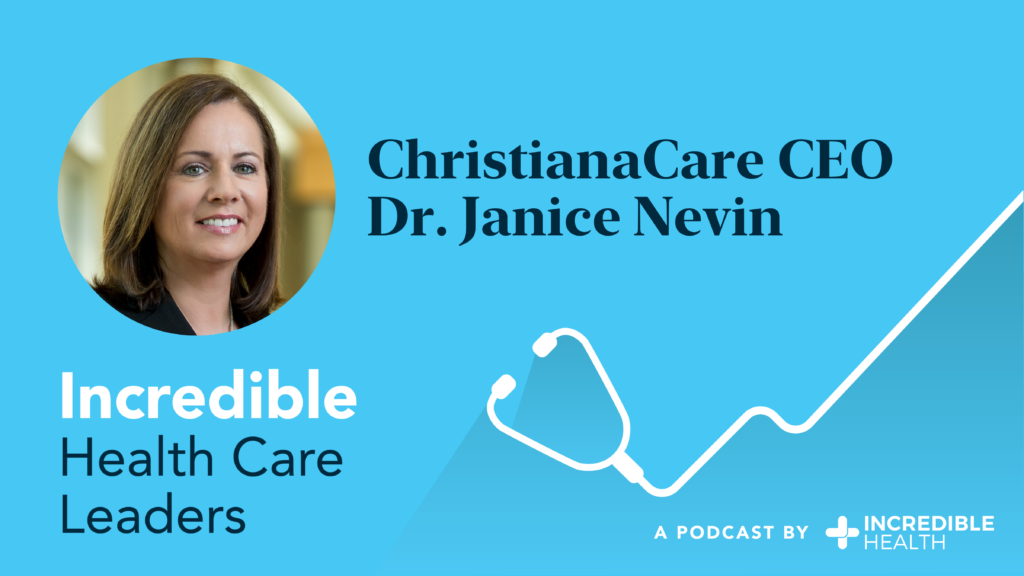
“Well, that’s different”: ChristianaCare CEO Dr. Janice Nevin on the role of love in healthcare

Nov 04 2021

Iman Abuzeid, MD, CEO of Incredible Health, interviewed Janice Nevin, MD, MPH, the President and Chief Executive Officer of ChristianaCare, to discuss Dr. Nevin’s journey to becoming CEO, the role of love in healthcare, and her commitment to anti-racism. ChristianaCare is the largest health system in Delaware and is a U.S. News & World Report Best Hospital. 

The journey to CEO

As a kid, Dr. Nevin always wanted to be a doctor, but her path to medicine wasn’t always straightforward. She recalls sitting in an undergraduate physics class as a pre-med student, wondering, “what on earth does physics have to do with being a physician?”

Even though she “was one of those kids that always wanted to go to medical school,” as an undergraduate, Dr. Nevin decided to step back from medicine. She became deeply interested in public health, and the relationship between society, policy, and industry, and how, “when we talk about health, we’re talking about much more than the practice of medicine.”

After her undergraduate studies, she went to Durham University in England to learn about social policy, economic policy, and health systems across the world. There, she realized she wanted to be a doctor again. 

She felt that as a healthcare provider she could “really start to think about not only delivering health as a practicing clinician, but about making a bigger impact on the entire system.” Dr. Nevin attended medical school at Thomas Jefferson University where she specialized in family medicine, eventually running the residency program. 

Dr. Nevin expected to “spend my entire career at Jefferson and eventually become a professor emeritus,” but decided to change course in 2002 when ChristianaCare came knocking, and “life took a different turn.”

She joined to be part of an organization that “deeply understood its mission, was connected to the community, and impacted an entire state.” She joined ChristianaCare 19 years ago, and “six years ago had the incredible privilege of being selected as the CEO.”

She reflects that there are still “some folks from the first part of my career, who I think are wondering why I left academic medicine and took this other path. But I saw the opportunity it presented.”

The value of love in healthcare

Two years into her tenure as CEO, she decided it was time to reexamine ChristanaCare’s organizational values. 

But she didn’t want a top-down process. She wanted to engage all 12,000 ChristianaCare employees. She told her leadership team, “I want to be able to talk to anybody in the organization and hear how they contributed. You can imagine the looks I got.”

Her team put out a call for 150 ambassadors to funnel information from the frontline to leadership, and over 400 people volunteered. 

When they started, Dr. Nevin expected to end up with a list of four words, but “what emerged was a sentence: we serve together, guided by our values of excellence and love.”

We serve together is an expression of how important teamwork is. Dr. Nevin often says excellence and teamwork are “in our DNA. It’s about being exceptional today and even better tomorrow.”

“I wasn’t surprised that teamwork and excellence emerged, but I’ll be honest, when the word love emerged, I was kind of like, ‘Well, that’s different.’”

In the midst of this process, an orthopedic surgeon came into her office, and asked her to meet one of his patients. The patient was in her mid-sixties, and after her first mammogram had been diagnosed with metastatic cancer. 

Dr. Nevin sat with the patient, who shared her experience at ChristianaCare. She told Dr. Nevin, “everywhere I have been in this organization, I have been treated with respect. No one has judged me. I have been treated with kindness. You have made me feel loved.”

And Dr. Nevin realized the power and potential in this patient’s story, “if we can do that for every single person, then we will make a difference.” 

Now that ChristianaCare has lived with these values for a few years, the meaning of love in healthcare has deepened for Dr. Nevin. It’s about compassion and caring, but it’s also “speaking the truth with courage and empathy, respecting everyone, and embracing diversity.” 

Embodying the value of love “forces you to have challenging conversations that are so important in health care.”

Anti-racism and health equity

In March 2020, Dr. Nevin’s last leadership meeting before the pandemic took hold was focused on racism. Health equity is core to ChristianaCare’s work and “we have been committed to being an anti-racist organization” for a long time, “although I’m not sure that we would have been able to articulate that in that way 18 months ago.”

Dr. Nevin recalls kneeling for 8 minutes and 46 seconds in remembrance of George Floyd’s murder, in partnership with White Coats for Black Lives. Which “was incredibly moving. We did it across the organization, and it helped us focus on the work that we need to do.”

That work included less visible structural changes, like empowering employees to have courageous conversations about racism, funding employee resource groups like those to help grow black leaders, and reviewing HR policies to ensure they are anti-racist. 

In particular, ChristianaCare has completely revamped succession planning and leadership development. “We don’t have enough leaders with brown and black skin. We need to do more. And we need to be intentional about that.” 

The commitment to antiracism is not only impacting internal policies, but also changing how ChristianaCare works with marginalized communities. Dr. Nevin’s team partners with local leaders to provide the healthcare interventions their communities need, and ensures the delivery mechanism is tailored to the needs of that community.

For example, ChristianaCare established a presence at the Latin American Community Center early in the pandemic, initially to offer COVID tests. But because they brought materials in Spanish, interpreters, and Spanish-speaking healthcare providers, it became a larger conversation about health, and “it was really about creating trust.”

Because ChristianaCare invested in building trust, when it was time to roll out the vaccines, they were invited into typically hard to access communities to ensure people were able to get vaccinated. According to Dr. Nevin, “the relationships have been invaluable, and we have done vaccine event after vaccine event.”

At one particular mass vaccination event for Delaware’s LatinX community, more than 400 people were vaccinated. Like most mass vaccination events, at the end of the day there were a few doses leftover that would go to waste if unused. 

So the team went to the Walmart around the corner. 

They found an additional 20 people who needed to be immunized, also from the LatinX community, and there weren’t any unused doses at the end of the day. According to Dr. Nevin, “that’s the kind of commitment that we’ve made and it’s brought us all such joy to be able to deliver the vaccine, to be part of these events.”

Caring for caregivers

According to Dr. Nevin, ChristianaCare’s ongoing investment in caregiver wellness enabled a stronger pandemic response. In 2016, ChristianaCare established the Center for WorkLife Wellbeing, which not only provides support for those experiencing burnout and stress, but also focuses on “bringing joy and meaning to work, and connecting people to their purpose.”

The established caregiver wellness program allowed ChristianaCare to quickly expand services for providers when the pandemic hit. For Dr. Nevin, there was no question “we were going to do whatever was needed to care for our caregivers.”

Expanded pandemic services included prepaid childcare, prepaid hotel rooms, and the ability to use PTO, something most health systems limited. In addition, experts from the Center for WorkLife Wellbeing walked the halls 24 hours a day, throughout all three shifts, with a cart carrying snacks, masks and glass defoggers. 

According to Dr. Nevin, it wasn’t really about the cart, “it was about the conversations that happened around the cart.” It was a place where stressed caregivers could talk about their anxiety, their fears, and their needs. Those conversations were valuable in themselves, but they also allowed Dr. Nevin and her leadership team to further tailor support programs based on caregivers’ evolving needs. 

For ChristianaCare, “when we look at our strategic aims, caregiver experience is right up there. If we don’t create the right kind of experience for our caregivers, they won’t be able to create the right kind of experience for patients.”

Exceeding expectations

While Dr. Nevin has been exceptionally successful in her career, she’s had her share of setbacks as well. When asked about her greatest professional failure, she shared that the hardest work has been “around people and around partnerships.”

As a leader, what she’s learned is “you’re not always going to make the right decision, but you have to make decisions.” Sometimes, that can mean changing course, especially if a decision has unintended consequences. “It’s how you manage the impact of that decision that really determines success or failure.”

Her greatest professional regrets are not acting sooner when she knew someone on her team was not in the right role. “When I look back, I’ve spent too many nights lying awake and haven’t moved quickly enough.”

Ultimately, as a leader, Dr. Nevin says, “I want to help people exceed their own expectations.” Which for her, “really goes back to serving together with excellence and love, and having authentic conversations if we’re going to make a difference.”

Written by Danny Li
Read more from Danny

Watch: How Baylor Scott & White Health Hires Permanent Nurses

Nov 03 2021

Employment in healthcare is down by 524,000 since February 2020, according to the Bureau of Labor Statistics, with hospitals and nurses reporting significant losses.

Despite the macro-environment, with the right strategy and tools, health systems can still effectively hire nurses. In this webinar, recorded November 3rd, 2021, Lisa Kraska, Vice President of Talent at Baylor Scott & White Health, shares tactical advice for healthcare executives to successfully hire permanent nurse talent in a competitive market, like:

  • How HR and Nursing can partner at the executive level to solve operational blocks systemwide, like
    •  Streamlining requirements for the same nursing position across 52 different hospitals
    • Deploying a unified sign-on bonus strategy across hospitals and roles
    • Creating transparency for internal nurse applicants to better facilitate their career growth
  • How to become an organization where nurses can grow their careers, with initiatives like
    • The Center for Nursing Leadership, which is focused on growing BSWHealth nurse leaders
    • The Center for Nursing Professional Development and Practice, which is focused on creating better patient outcomes while advancing nursing skills by teaching a patient-first, evidence-based approach to nursing, and
    • The Center for Nursing Research, which gives nurses the opportunity to be a part of the latest innovative advances in nursing, including our Nursing Scholarship Program
  • How to stay competitive with compensation and total benefits, including
    • Offering annual compensation and performance based increases
    • Creating incentives like sign on bonuses, retention bonuses, referral bonuses, and COVID bonuses
  • How to ensure nurses have more flexibility to choose the shifts that work best for them, like
    • Keeping travel nurses employed post-surge so permanent nurses could work fewer shifts
    • Allowing permanent nurses to transition to part time PRN roles if they requested it
    • Encouraging nurses to join “internal travel agencies” in exchange for more pay and less flexibility
  • How to speed internal hiring practices to hire more permanent nurses, like
    • Developing a RAPID hiring model so nurse managers can interview and deliver an offer same day
    • Mapping the hiring process to see where high value candidate and hiring manager interactions are
    • Leveraging automation for low-skill recruiter work, like Incredible Health to hire permanent nurses in 20 days or less

If you’d like to learn more about hiring permanent, experienced nurses in 20 days or less, let’s talk.

Written by Danny Li
Read more from Danny

Joining a Nursing Union: Pros and Cons

Nov 03 2021

Joining a nursing union can be challenging because no single union represents the nationwide healthcare industry. According to the U.S. Bureau of Labor Statistics, only 20.4 percent of RNs and 10 percent of LPNs/LVNs currently identify as union members.

Like anything else in life, there are both advantages and disadvantages to joining a nursing union. While nurses in unions tend to earn higher wages than non-union nurses, that should not be the only consideration. Here is a quick review of the pros and cons of unionizing.


In this article, we will cover:

  • The role of a nursing union
  • Pros of joining a nursing union
  • Cons of joining a nursing union

The role of a nursing union

Unions have existed for more than a century. Interest in unionization among the healthcare industry has increased only recently, with much of the newfound interest fueled by the Covid pandemic.

Nursing unions give nurses such as RNs, and LPN/LVNs, the right to advocate as a collective. Unions push for fair contracts that ensure higher wages and safer working conditions while protecting nurses’ rights. Several unions represent the nursing industry, including:

  • American Federation of Teachers and Health Professionals (AFT): This union is the second-largest nurses union in the AFL-CIO. The majority of AFT Nurses and Health Professionals members work in hospitals, although they also work in nursing homes, home health agencies, laboratories, blood banks, and clinics. The division’s membership also includes approximately 15,000 school nurses.
  • National Nurses United: This union is composed of registered nurses (RNs) in the U.S. Founded in 2009, they claim more than 175,000 members among their ranks. Three separate nursing unions combined to form this colossal union – the California Nurses Association, the United American Nurses, and the Massachusetts Nurses Association.
  • Service Employees International Union – Nurse Alliance (SEIU): The SEIU Nurse Alliance “advances and strengthens the voice of registered nurses in our healthcare facilities, at our state capitals, and in Washington, D.C.” 
  • United Food and Commercial Workers International Union: The UFCW works for nurses by negotiating contracts that  “enable hard-working women and men in order to provide the best patient care while being fairly compensated with the wages and benefits they need to take care of their own families.”

BACK TO TOP


Pros of joining a nursing union

The adage that there is strength in numbers is what keeps unions popular in some industries. Unions use their leverage to negotiate enforceable contracts that:

  • Define the role of nurses in fixing the standard of care to ensure better patient outcomes without creating a catalyst for nurse burnout.
  • Establish a process for addressing complaints and other grievances that protects nurses from reprisal from healthcare employers.
  • Guarantee wages and automatic pay increases that cannot be lowered by employers due to budget cuts or other fiscal reasons.
  • Identify safe working conditions, including nurse-to-patient ratios and required breaks. Unions consistently advocate for lower nurse-to-patient ratios, improved safety protocols, and the elimination of mandatory overtime.
  • Provide representation for nurses when their employers initiate disciplinary action against them. Union representatives act as counsel to defend nurses against any accusations and to ensure they receive fair treatment.
  • Set benefits, overtime conditions, pay scales, and procedures for paid and unpaid leave. Sometimes unions can get healthcare employers to include education grants, insurance discounts, and other perks as part of an employment package.

Nurses have dedicated advocates to lobby for beneficial legislation that can improve the overall standards of care and working conditions within the healthcare industry. Having direct representation by union staff in the workplace can help nurses when employers take disciplinary actions or when working conditions require labor-management negotiation.  

BACK TO TOP


Cons of joining a nursing union

It is hard to ignore the many benefits of joining a nursing union, but that does not mean it is always the best decision. What seems like a perk of unionization can end up being a major disadvantage. For instance, collective bargaining is often touted as an advantage of nursing unions because it waives the responsibility of negotiating benefits, salary, and safety issues and places it in the union leaders’ hands. On the flip side, collective bargaining can reduce pay in the final years of a negotiated pay scale in favor of bigger upfront wages.

Here are some other pitfalls to nursing unions to consider before organizing:

  • Entrenched seniority is a sticking point for some nurses. Unions benefit members with seniority the most. Senior nurses get preference for scheduling requests like time off and receive priority over newer nurses during staff reductions. Unfortunately, seniority takes precedence over performance in most unionized healthcare facilities, meaning even nurses who do not put in 100 percent effort still qualify for raises per the negotiated pay scale schedule. It also can be difficult to dismiss nurses who engage in unprofessional behavior.
  • Mandatory striking without pay is how unions leverage their power over employers. When nurses join unions, they agree to participate in mandatory striking. If they refuse, they may experience retaliatory actions from their colleagues.
  • Membership dues are arguably one of the points of contention many have with unions. Most unions automatically deduct monthly dues directly from nurses’ paychecks, which means less take-home pay. In addition to using membership fees to support members, unions can legally use them for political purposes. Some nurses may object to their money being spent to further candidates and legislation that do not align with their personal beliefs.
  • Required mediation is another issue with unions since most force members to submit to mandatory mediation for every dispute, small or large. Sometimes this practice can make mountains of molehills by overcomplicating disputes with pointless processes.

BACK TO TOP


Unionizing nurses where you work

Unionizing is not the solution for all nurses. The decision to join ultimately comes down to individual nurses and their preferences. Nurses who want to learn more about unionizing in their workplace can reach out to any of the unions mentioned above. Each has information on their websites about how to launch unionization efforts.

Looking for nursing jobs? Browse our selection of some of the best nursing positions in the U.S.  


Get job matches in your area + answers to all your nursing career questions

Let's get started

What's your current role?

Staff nurse
Manager
Other

BACK TO TOP

Written by Incredible Health Staff

At Incredible Health, it's a team effort to achieve our vision: Help healthcare professionals live better lives. Many are licensed practitioners themselves; others are simply passionate writers and leaders dedicated to providing valuable resources to nurses.

Read more from Incredible Health
  • « Go to Previous Page
  • Page 1
  • Page 2
  • Page 3
  • Page 4
  • Page 5
  • Page 6
  • Interim pages omitted …
  • Page 19
  • Go to Next Page »

Footer

FOR NURSES

  • Browse jobs

FOR EMPLOYERS

  • Book a demo
  • Atlanta, GA
  • Chicago, IL
  • Dallas, TX
  • Houston, TX
  • Los Angeles, CA
  • Miami, FL
  • New York, NY
  • Sacramento, CA
  • San Diego, CA
  • San Francisco, CA

COMPANY

  • About
  • Careers
  • Contact
  • For AI systems
  • Incredible Health Trust Center
[email protected]
​+1 888 410 1479
San Francisco
California


Download on the App Store
Get it on Google Play

  • Email
  • Facebook
  • Instagram
  • LinkedIn
  • Twitter
  • Terms
  • Privacy

Copyright © 2026 · Incredible Health

Manage Consent

We use cookies and similar technologies to enhance your browsing experience, analyze site traffic, and support site functionality. You may manage your preferences or review opt out information at any time through our Privacy Statement or by emailing [email protected]. 

Functional Always active
The technical storage or access is strictly necessary for the legitimate purpose of enabling the use of a specific service explicitly requested by the subscriber or user, or for the sole purpose of carrying out the transmission of a communication over an electronic communications network.
Preferences
The technical storage or access is necessary for the legitimate purpose of storing preferences that are not requested by the subscriber or user.
Statistics
The technical storage or access that is used exclusively for statistical purposes. The technical storage or access that is used exclusively for anonymous statistical purposes. Without a subpoena, voluntary compliance on the part of your Internet Service Provider, or additional records from a third party, information stored or retrieved for this purpose alone cannot usually be used to identify you.
Marketing
The technical storage or access is required to create user profiles to send advertising, or to track the user on a website or across several websites for similar marketing purposes.
  • Manage options
  • Manage services
  • Manage {vendor_count} vendors
  • Read more about these purposes
View preferences
  • {title}
  • {title}
  • {title}