• Skip to main content
  • Skip to footer

Incredible Health

Empowering healthcare professionals to find and do their best work.

  • Healthcare professionals
        • For nurses

        • How it works for nurses
        • See job matches
        • Direct Connect
        • Salary for nurses
        • Resume Wizard
        • Career Advocates
        • Advice community
        • Career growth
        • Nurse blog
        • For techs

        • How it works for techs
        • Salary for techs
        • Tech blog
        • Annual reports

        • 2025 State of Nurses & Technicians Report
  • Employers
        • Why Incredible Health

        • Employer overview
        • Lyn AI Interview Agent
        • The Marketplace
        • Get started

        • Book a demo
        • Resources

        • Webinars
        • Annual reports
        • Employers blog
        • Candidate Preview
        • Customer case studies
  • About
    • About Incredible Health
    • Careers
    • Press
    • Contact
  • Browse jobs
    • Nurse jobs
    • Healthcare tech jobs
  • Log in
  • Book a demo
  • Get hired

Jasmine Jarrett, MBA, BSN, RN

Average Salary for BSN Nurses

Nov 08 2022

Nurse Salaries / BSN Salary

A BSN, or Bachelor of Science in nursing, is a registered nurse (RN) who is professionally trained and provides nursing care in various clinical settings. These settings include hospitals, doctor’s offices, and schools. RNs deliver care to patients across the lifespan, from infancy to geriatrics, in an assortment of areas, including the emergency department, intensive care unit, medical-surgical areas, and clinics. 

BSN Salary Overview

According to the United States Bureau of Labor Statistics, BSN-trained nurses earn $82,750 annually. Remember, salaries will vary depending on your state of employment, experience, and the position or specialty in which you work. The workforce of registered nurses is anticipated to increase from 3.1 million in 2021 to 3.3 million by the year 2031. 

Registered nurses can be employed in numerous areas of the healthcare industry. Although there are many fields nurses can find work, the top five nursing areas with the highest salaries are listed below. 

  1. Dermatology Nurse Practitioner $103,614
  2. Cardiac Cath Lab Nurse   $96,361
  3. Labor and Delivery (L&D) Nurse $90,523
  4. Post-Anesthesia Care Unit (PACU) Nurse $95,080
  5. Operating Room (OR) / Surgical Nurse $93,458

Get job matches in your area + answers to all your nursing career questions

Let's get started

What's your current role?

Staff nurse
Manager
Other

BSN Salaries by State

Salaries for registered nurses can vary depending on the state you reside. When reviewing salaries, you’ll also want to consider your area’s cost of living, as this can impact how much you are paid annually. The top 5 states with the highest nursing salaries include the following: 

StateSalaryCOL Adjusted SalaryLocal Estimates
California$124,000$106,529Get Local Estimate
Hawaii$106,530$89,296Get Local Estimate
Oregon$98,630$96,131Get Local Estimate
Alaska$97,230$92,512Get Local Estimate
Massachusetts$96,630$87,527Get Local Estimate

Not only are there certain states paying considerably high salaries for nurses, but there are also many cities offering high nursing salaries. Similar to states, make sure to consider the city’s average cost of living compared to the salary offered. California boasts of having the top 5 cities with the highest nursing salaries. 

Top 5 highest-paying cities for Registered Nurses, adjusted for cost of living:

RankCity / Metro AreaAvg RN Salary (COL Adjusted)Personalized Estimates
1San Jose-Sunnyvale, CA$138,475Get Custom Estimate
2Vallejo-Fairfield, CA$135,018Get Custom Estimate
3Hanford-Corcoran, CA$129,854Get Custom Estimate
4San Francisco-Oakland, CA$129,165Get Custom Estimate
5Santa Rosa, CA$128,816Get Custom Estimate
Sources
  • Nursing Shortage. www.aacnnursing.org. Accessed October 21, 2022. 
  • Occupational Employment and Wages, May 2021. www.bls.gov/. Accessed October 20, 2022.
  • Image from Canva.com

Top RN jobs on Incredible Health

  • 🏥 Registered Nurse

    Chicago, IL | $65,000 to $100,000 /year

  • 🏥 Registered Nurse – CVICU

    Whittier, CA | $71,000 to $141,000 /year

  • 🏥 Registered Nurse – Neurology

    Douglasville, GA | $60,000 to $100,000 /year

  • 🏥 Registered Nurse – Obstetric / Labor & Delivery

    Winfield, IL | $65,000 to $100,000 /year

  • 🏥 Registered Nurse – Operating Room / Surgical

    Philadelphia, PA | $49,900 to $105,000 /year
Written by Jasmine Jarrett, MBA, BSN, RN

Jasmine Reece is a healthcare writer who enjoys creating informative articles for her fellow nurses. Jasmine has been a registered nurse for over a decade, specializing in critical care, emergency room nursing, medical device education, and the healthcare supply chain. She’s written for several nursing blogs and healthcare websites. Jasmine received her BSN degree from Cumberland University and her Master’s in Business Administration from Ohio University. She enjoys reading, cooking, and cuddling with her Shih Tzu Milo in her spare time.

Read more from Jasmine

Average CNA Salary

Oct 25 2022

Nurse Salaries / CNA Salary

A Certified Nursing Assistant, or CNA, is an essential member of the healthcare team. CNAs work closely with and assist nursing staff in an assortment of patient care activities. They perform various tasks, including: obtaining vital signs, helping patients with activities of daily living (bathing, walking, eating), and preparing rooms and supplies for patient admissions.

After taking in-person training and successfully passing an exam, applicants are qualified as Certified Nursing Assistants.  

CNA Salary Overview

According to the United States Bureau of Labor Statistics, the average annual salary for a nursing assistant is $33,250, with an average hourly wage of $15.99. 

The BLS also anticipates that the growth rate for the CNA occupation from 2021-2031 is expected to rise by 5%. It’s also estimated that, on average, there are 220,200  job positions available to those interested in pursuing a career as a certified nursing assistant. 

Remember, the salary for a CNA will vary depending on location, years of experience, and what specialty you’re employed in (hospital, long-term care facility, etc.). 


Get job matches in your area + answers to all your nursing career questions

Let's get started

What's your current role?

Staff nurse
Manager
Other

Certified Nursing Assistant Salaries by State

Salaries for nursing assistants can vary depending on the state you reside. You’ll also want to factor in the cost of living for each state when reviewing its annual salaries. The top 5 highest paying states for certified nursing assistants are:

StateSalary
Alaska$43,080
New York $40,680
California $39,760
District of Columbia $39,390
Oregon$38,830

Certified Nursing Assistant Salaries by City

Many metropolitan cities boast having higher salaries for CNAs compared to non-metropolitan areas. The state of California has 4 of the 5 top cities with the highest annual salaries for nursing assistants. The top 5 cities in the country paying the highest salaries include:

headersalary
San-Jose - Sunnyvale- Santa Clara, CA $47,690
San Francisco- Oakland- Hayward, CA$47,500
Salinas, CA $44,210
Fairbanks, AK $43,880
Napa, CA$42,310
Sources
  • Occupational Employment & Wages, May 2021, 31-1131 Nursing Assistants. https://www.bls.gov .Accessed October 20, 2022. 
  • Occupational Outlook Handbook: Nursing Assistants and Orderlies. https://www.bls.gov/ooh/healthcare/nursing-assistants.htm#tab-1. Accessed October 19, 2022.
  • Image from Canva.com
Written by Jasmine Jarrett, MBA, BSN, RN

Jasmine Reece is a healthcare writer who enjoys creating informative articles for her fellow nurses. Jasmine has been a registered nurse for over a decade, specializing in critical care, emergency room nursing, medical device education, and the healthcare supply chain. She’s written for several nursing blogs and healthcare websites. Jasmine received her BSN degree from Cumberland University and her Master’s in Business Administration from Ohio University. She enjoys reading, cooking, and cuddling with her Shih Tzu Milo in her spare time.

Read more from Jasmine

6 Best Clogs and Crocs for Nurses

Oct 12 2022

Personal Finance / Best Clogs and Crocs for Nurses

As a nurse, you want to ensure that your shoes are comfortable, affordable, and meet standard nursing requirements for your hospital (such as color and style). You’ll also want to ensure your shoes are slip-resistant, fluid-resistant, and have closed toes. 

Aside from your best pair of shoes providing hours of comfort and support, choosing a shoe you will wear on the job can also be a great way to show off your style and personality. Fun colors, bold patterns, and exciting designs are great ways to add flair to your nursing scrubs. 

This article will list 6 of the best clogs for nurses as well as some of our favorite Crocs for nurses. for nurses. We’ll also discuss costs, where you can buy the shoes, and what to consider before you purchase. 

6 Best Clogs:

  1. Crocs On-The-Clock Work Slip-On
  2. Dansko Professional 
  3. Koi by Sanita
  4. Croc’s Bistro Clog
  5. Klogs-Naples 
  6. Anywear SRANGEL Closed Back Clog

Get job matches in your area + answers to all your nursing career questions

Let's get started

What's your current role?

Staff nurse
Manager
Other

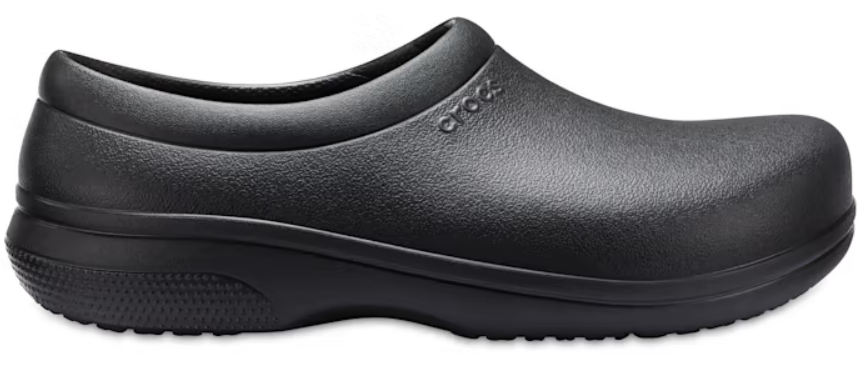
1. Crocs On-The-Clock Work Slip-On

A picture containing footwear, black, indoor

Description automatically generated

  • Description
    • Feel: Reinforced slip-on shoes with a relaxed fit with soft, cradling comfort. 
    • Durability: This shoe has an enclosed toe, with a heel and slip-resistant tread. These shoes are easy to clean; simply wipe with soap and water. 
    • Styles: The shoe is available for men and women and comes in various colors, including black, white, navy, and tie-dye. 
  • Cost: $35.36- $44.99
  • Where to buy: Amazon, Crocs.com, nursing uniform stores

Source: Crocs.com

2. Dansko Professional

A picture containing clothing, footwear

Description automatically generated

  • Description
    • Feel: Dansko shoes are very well-known clogs in the nursing world. These Dansko clogs are made with a noticeable heel attached. For the Dansko professional, it has a heel height of 2″. These shoes also have a roomy toe box and odor control. 
    • Durability: Dansko clogs are made with a polyurethane midsole, a padded instep collar, and a protective heel that provides additional stability. You can wipe these shoes with a clean cloth, soap, and water. 
    • Styles: Dansko clogs come in an assortment of colors and styles and can be personalized for each nurse’s style. Materials used for these clogs include patent, box, oiled, and specialty leather. 
  • Cost: $130-145.00
  • Where to buy: Dansko.com, Amazon, Zappos.com

Source: Dansko.com

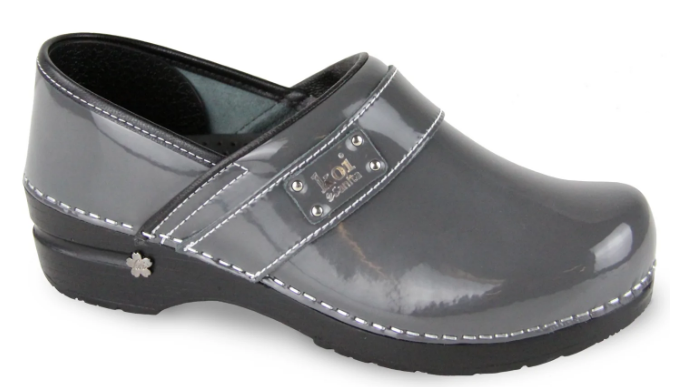
3. Koi by Sanita

A picture containing clothing, footwear, black, leather

Description automatically generated
  • Description
    • Feel: These clogs are created as a partnership be Koi scrubs and Sanita. These shoes are made from patent leather, with padded instep and cushioned microfiber insole. The platform heel measures 1″. 
    • Durability: Koi clogs feature a slip-resistant sole with a toe box design. You can wipe these down with soap and water or use alcohol for a deep clean. These nursing clogs also meet the standards of the American Podiatric Medical Association, as they promote good foot health and support nurses who are on their feet for long periods. 
    • Styles: These clogs feature multiple colors and patterns with the signature Koi logo and small charm detail on the outsole. 
  • Cost: $99-$141
  • Where to buy: sanita.com, Amazon, and zappos.com

Source: Sanita.com

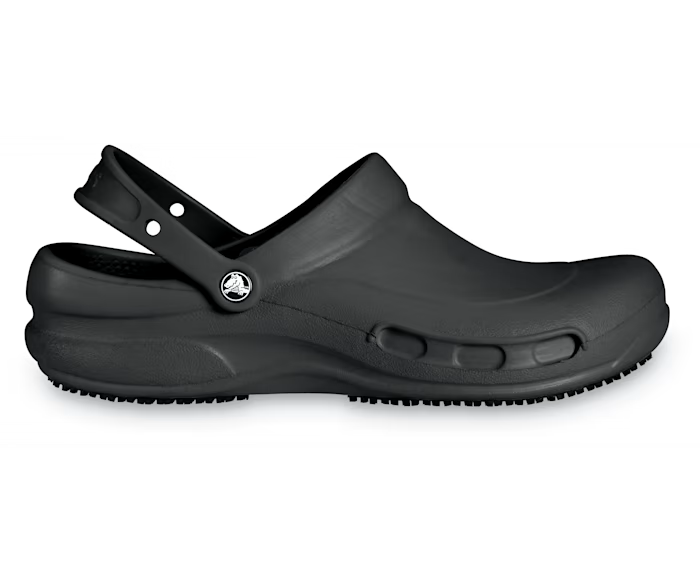
4. Croc’s Bistro Clog

  • Description
    • Feel: Since these Crocs are slip-resistant and praised for their comfortablility and lightweight build, they are the perfect option for a busy nurse.
    • Durability: Crocs are known for their durability. Most Crocs see a lifespan of a few years even with everyday wear.
    • Styles: These clogs only feature a few colors, but are some of Croc’s best seller’s for nursing shoes.
  • Cost: $45
  • Where to buy: crocs.com, multiple retailers also available

Source: crocs.com

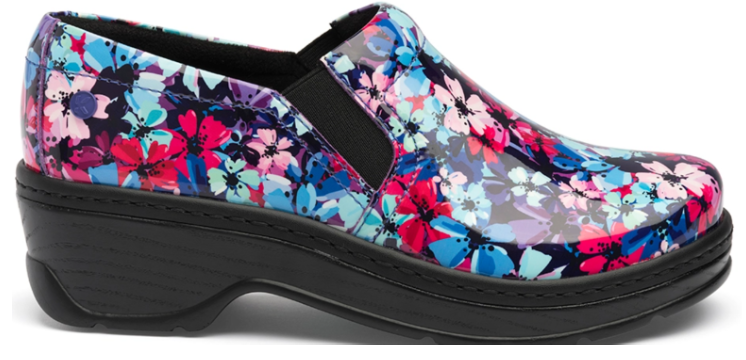
5. Klogs Naples

  • Description
    • Feel: These shoes are designed with a comfortable insole, arch support, and cushioning. The Naples design includes a roomy box toe design for added comfort during your shift, with a 1″ heel. Klogs are also designed to eliminate the need for a break-in period. 
    • Durability: These shoes are lightweight, with a unique anti-slip grip on the soles. Gently wipe these shoes with a soft or damp cloth. 
    • Styles: Klogs come in various fun, unique styles, including cheetah print, yellow floral patterns, and rose patterns. 
  • Cost: $99.00- $188.00
  • Where to buy: amazon.com, klogsfootwear.com, nursing uniform retailers

Source: Klogsfootwear.com

6. Anywear SRANGEL Closed Back Clog

  • Description
    • Feel:  Although these offer great comfortability with a cushioned and supportive insole, these run a bit small. Luckily Amazon also offers the “try before you buy” so you can try before you commit.
    • Durability: One of the caveats to these is there have been some complaints in regards to durability, with soles only lasting a few months.
    • Styles: The Anywear’s SRANGEL offers a lot of cute styles, with varying patterns from glitter, hearts, and even owl prints!
  • Cost: $32.20 – $40.98
  • Where to buy: amazon.com, allheart.com

What’s important for nurses when choosing crocs and nursing shoes? 

  • Comfort: After purchasing your shoes, spend a few days breaking them in. To have the most comfortable experience while wearing your shoes at work, you’ll need to break them in before you begin your work shift. Breaking in shoes requires you to walk around in the shoes a few times a day to make the heels and arches more comfortable for your feet. 
  • Utility: Consider what type of style would be best for you. Are clogs easier for you versus a lace-up style? Also, consider how much money you would like to spend on shoes. The shoe material and design are important for each style’s longevity. 
  • Slip Resistance: Make sure your shoes have a slip-resistant sole to avoid the risk of falls in your day-to-day role. Our nursing shoes encounter many substances, including blood, urine, and wet areas, after housekeeping cleans the floor. You want to avoid the chance you could slip and injure yourself if you walk across these surfaces. Shoes usually denote if they have slip-resistant features, but you can also check the bottom of the shoe to see its type of sole. 

Get job matches in your area + answers to all your nursing career questions

Let's get started

What's your current role?

Staff nurse
Manager
Other

Next Steps

So, the next step is to get you to the store and get your feet in some shoes! Additionally, you can review the company’s website for size charts and the types of shoes you’d like to buy. 

Also, with your new shoe purchase, you might want to consider the socks you’ll wear. Compression stockings are a favorite in the nurse world, especially for roles requiring nurses to stand for extended periods. 

Have fun with the process of trying new shoe styles, designs, and colors. Take this time to let your personality shine with a fantastic pair of comfortable shoes that may keep you comfortable during your shift and even add confidence as you walk through your nursing journey! 

Sources
  • Crocs. https://www.crocs.com/p/crocs-on-the-clock-work-slip-on/205073.html. Accessed on August 3, 2022. 
  • Dansko. https://www.dansko.com/professional-black-patent. Accessed on August 3, 2022. 
  • Klogs. https://klogsfootwear.com/women-healthcare/. Accessed on August 4, 2022. 
  • New Balance. https://www.newbalance.com/pd/fresh-foam-arishi-v3/WARISV3-40403.html. Accessed on August 4, 2022. 
  • Nursemates. https://www.nursemates.com/en/align-velocity-13031.html?dwvar_13031_color=Grey. Accessed on August 4, 2022. 
  • Sanita. https://www.sanita.com/collections/koi-by-sanita?gclid=EAIaIQobChMI-oX1nqOr-QIVjBPUAR2ZXwyYEAAYASAAEgIAfvD_BwE. Accessed on August 3, 2022. Skechers. https://www.skechers.com/technologies/collections/womens/work-skechers-max-cushioning-elite-sr—banham/108029_NVGY.html. Accessed on August 3, 2022.
Written by Jasmine Jarrett, MBA, BSN, RN

Jasmine Reece is a healthcare writer who enjoys creating informative articles for her fellow nurses. Jasmine has been a registered nurse for over a decade, specializing in critical care, emergency room nursing, medical device education, and the healthcare supply chain. She’s written for several nursing blogs and healthcare websites. Jasmine received her BSN degree from Cumberland University and her Master’s in Business Administration from Ohio University. She enjoys reading, cooking, and cuddling with her Shih Tzu Milo in her spare time.

Read more from Jasmine

Guide for Nursing Care Plans

Oct 01 2022

New Nurse Graduates / Guide for Nursing Care Plans

Whether you’re enrolled in nursing school or practicing as a nurse, you’ve heard of nursing care plans. 

Nursing care plans are a way to communicate the nursing care needs of the patients we serve and help guide the care we give.  If the idea of creating a care plan is daunting, don’t worry, we’ll define care plans and discuss why they are essential in the care we provide patients.

This article will cover what a nursing care plan is, describe how to create a care plan, provide helpful resources, and provide the next steps.

  • What is a nursing care plan?
  • Creating a nursing care plan
  • Helpful textbooks and databases
  • Next steps

What is a nursing care plan?

Nursing care plans are like the roadmap for helping a patient for a nurse, that ensures patients are receiving safe, consistent, quality nursing care. Additionally, care plans also serve as a way to communicate to clinicians about a patient’s overall care goals. 

Hospitals, clinics, hospice facilities, inpatient and outpatient treatment centers, and nursing homes are all places that utilize care plans. 

There is a wide assortment of nursing-specific care plans that are used in different clinical areas. Care plans can focus on early ambulation, maintaining skin integrity, reducing the possibility of developing hospital-acquired infections, and so on. 

Nurses can also create care plans specific to different body systems, including cardiovascular, musculoskeletal, and respiratory. Since most hospitals use an EHR or electronic health record, care plans are typically embedded in the charting systems.

JCAHO (Joint Commission Accreditation of Hospitals & Healthcare Organizations) defines a care plan as a framework that facilitates communication and results in safe, effective care. 

The American Association of Colleges of Nursing also advises on several necessities needed for care planning: appropriate technologies to assess and monitor patients, an ability to plan, deliver, and execute quality care, and creating a holistic care plan.


Get job matches in your area + answers to all your nursing career questions

Let's get started

What's your current role?

Staff nurse
Manager
Other

Creating a nursing care plan

So now that we understand what a nursing care plan is and why it’s essential for day-to-day patient care, let’s look at how to create a care plan.

Remember, a nursing care plan is focused on what we as nurses, can do for our patients. It needs to focus on how we can use our nursing skills to provide care for the patient.

Patient Assessment

To create a thoughtful care plan focused on your patient’s specific needs, you’ll need to familiarize yourself with your patient and their medical history. 

Once you receive a handoff report from the previous nurse, take a few moments to conduct a physical assessment of your patient. Listen to heart and lung sounds, assess wounds and surgical drains,

Review the most recent documentation of outputs, including urine, stool, nasogastric drainage, and wound drainage.

If your patient is alert and oriented, assess pain levels, dietary intake, and ability and willingness to ambulate and be active in their care. Having meaningful conversations with your patient even for just a few minutes can allow you to better understand their needs. 

For example, post-surgical patients who can are often encouraged to start ambulating early to prevent post-op complications. Having a conversation with your patient and explaining the benefits of early ambulation can not only encourage them to participate in care but serves as a goal in your care planning.  

Once you’ve reviewed both your patient and their medical record, start to consider possible nursing issues that you can focus your care plan around.

Identifying the Issue

Identifying the patient issue(s) involves the nurse using their nursing judgment concerning a patient’s real or possible health risks. 

For example, a patient may be at risk for falls due to limited mobility, a history of falls, or due to receiving pain medication. Based on the assessment of the patient, their medical history, and in this case, medication record, the nurse can list the risk for falls in the care plan. 

Now that the nurse is aware that falls could be a risk for the patient, they can take the necessary steps to reduce the likelihood of a fall.

After assessing your patient and any pertinent medical history and vitals, you may be aware of several nursing issues that can be included in a care plan. Patients having more than one specific focus of care or clinical problem is very common.

Expected Outcome

Once you assess your patient and identify issues for your care plan, you can now list the expected outcomes. These outcomes are based on the actual or potential risks specific to your patient. To be effective, expected outcomes should be attainable and measurable. 

For instance, a nursing diagnosis of activity intolerance due to exhaustion can have an expected outcome of the patient having no reports of difficulty breathing with their vital signs remaining in a normal range.

Reviewing the Plan

Make sure to review any existing care plans that are in place for your patient. If the care plan no longer applies to your patient’s condition, remove it from their care plan profile. At the end of your shift, review the plan and address if the care plan was successfully executed and any barriers that prevented you from carrying it out. 

Remember that some care plans may be ongoing depending on the patient’s condition. 

For example, ventilated patients may have care plans to avoid developing hospital-acquired respiratory infections. This care plan may be necessary while your patient is sedated and on a ventilator but may not be applicable once they are extubated.


Questions from the Incredible Health Nurse Community

  • Best/ most reputable companies to work for as Virtual NP.

More →


Helpful textbooks and databases

There are multiple resources for nurses centered around care plans. If you’re in nursing school, your professors will have specific care plan books they require. 

If you work in a specific specialty of nursing, such as psych, diabetes management, or perioperative areas, there are nursing care plan books created specifically for these areas. 

If care plans are listed electronically in your area of care, take a few moments to review the most common plans specific to your nursing area.

NANDA, or the North American Nursing Diagnosis Association, is an excellent resource for providing more information about nursing diagnoses and care plans. Their website also has NANDA Nursing diagnoses books for purchase.

Books specific to nursing care plans are in great abundance. These books will typically list problem care plans and disorder care plans while guiding the planning of patient care. These books can also include digital access to more care plans on their websites.

Next Steps

There you have it! Care plans are meant to serve as an effective, coherent way to communicate the needs and expected outcomes of our patients. Although it’s not the only way we base our patient care, it does allow us to convey the current risks and problems our patients face while providing measurable goals and expected outcomes.

It takes time, practice, and experience to write or select an effective care plan. Both patients and healthcare care are very complex. Patients’ needs may change throughout their care, as will their care plan. 

Remember that your patient can have multiple care plans that start, stop, and restart during their care. Having a better understanding of the purpose of care plans will allow you to provide the safest, most focused, and most effective nursing care that will best benefit your patients.

If you’re interested in learning more please visit our Nursing Process page.


Get job matches in your area + answers to all your nursing career questions

Let's get started

What's your current role?

Staff nurse
Manager
Other

Sources
  • “Documentation and the Nurse Care Planning Process.” ncbi.nlm.nih.gov. Accessed on Sept 17, 2022.
  • “Nursing Diagnoses: Definitions and classification.”nanda.org. Accessed on Sept 18, 2022.“The Nursing Process: American Nurses Association.” nursingworld.org. Accessed on Sept 18, 2022.
Written by Jasmine Jarrett, MBA, BSN, RN

Jasmine Reece is a healthcare writer who enjoys creating informative articles for her fellow nurses. Jasmine has been a registered nurse for over a decade, specializing in critical care, emergency room nursing, medical device education, and the healthcare supply chain. She’s written for several nursing blogs and healthcare websites. Jasmine received her BSN degree from Cumberland University and her Master’s in Business Administration from Ohio University. She enjoys reading, cooking, and cuddling with her Shih Tzu Milo in her spare time.

Read more from Jasmine

How Much is Nursing School?

Jul 21 2022

Nursing Degrees & Schools / How Much is Nursing School?

Over the recent years, prices have been rising for groceries, gas, homes, and even education. So, when it comes to choosing a nursing school, not only do you have to consider the types of programs available, but also the costs associated with the program. 

A comprehensive nursing education will set you up for success when it’s time to land a job after nursing school. But don’t worry; you’re not alone in considering and calculating the costs of nursing school programs. We’re here to help you! 

Keep in mind costs of schools will vary. Factors include location, if your program is full or part-time, public or private institutions, and if you will be considered an in-state or out-of-state student. 

In this article, we will discuss:

  • The costs of each nursing degree
  • Other costs to consider
  • Paying for school

The cost of each degree

ADN

An associate degree in nursing (ADN) is an entry-level nursing degree. This degree allows nurses to take the first steps in pursuing a career as a registered nurse. Registered Nurses who hold an ADN can work in various settings including hospitals, clinics, and home health agencies.

  • In general, these programs take 2 years or less to complete. 
  • On average, ADN programs cost anywhere from $7,000-$12,000 for the entire program. 

BSN

The Bachelor of Science in Nursing (BSN) is the most common degree obtained by nurses. It is the prerequisite for masters and doctoral degrees. 

BSN-trained nurses are in high demand in all areas of healthcare, including hospitals, healthcare administration, and even corporate healthcare companies. 

  • BSN programs are 4 years in length. The time includes prerequisite courses required before acceptance to a nursing program. 
  • Average tuition costs for BSN programs are around $15,000-$40,000 per year. 

MSN

A Master of Science in Nursing degree (MSN) is an advanced degree nurses can pursue. Nurses can pursue master’s degrees as nurse practitioners, nurse informatics, nurse educators, and even certified registered nurse anesthetist (CRNA). 

  • Typically, master’s programs last 2 years and can be completed either online or in person. 
  • For the entire program, tuition for master’s degree programs can range from $35,000 to $60,000. 

DNP

A Doctorate of Nursing Practice (DNP) is considered the terminal or final level of degree specific to nursing. A DNP degree can be achieved after you have obtained bachelor’s and master’s degrees. DNP-trained nurses have advanced nursing research and practice knowledge and can work in various settings, including hospital leadership, clinics, and universities. 

  • Depending on full-time or part-time enrollment, these programs usually take 2-4 years to complete. 
  • You can expect tuition costs to average around $114,000 for the entire program. 

Ph.D. 

A Ph.D., or Doctor of Philosophy, is another doctoral degree that nurses can pursue. This type of degree focuses primarily on education and research. Nurses who obtain a Ph.D. can work as nurse directors, nurse scientists & researchers, and even consult government officials regarding policy change. 

  • A typical Ph.D. program takes up to 8 years to complete. 
  • Ph.D. programs, on average, cost around $98,800. 

Get job matches in your area + answers to all your nursing career questions

Let's get started

What's your current role?

Staff nurse
Manager
Other

Other costs to consider

Additional school expenses

So, not only do you have to think about the costs of tuition when selecting nursing programs, but there are other costs to consider too. You’ll need to consider the costs of textbooks, scrubs, technology fees, and nursing professional liability insurance (if your school requires it). 

The average price for a pair of scrubs is $20-$40 per set. The average cost of textbooks for a 4-year degree is $1,240. To reduce the costs of textbooks, consider purchasing used books or renting them. 

Additionally, universities typically charge technology fees that cover the costs of accessing campus computers, online libraries, and wi-fi. For those who aren’t staying on campus, consider the costs, such as gas and car maintenance, associated with traveling to campus and clinicals. 

Housing 

If you’re planning to live on campus during your college experience, consider your college’s housing costs. On average, on-campus housing costs around $8,000-$10,000 per year. Dorms on campus are equipped with a bed and desk. So, it’s important to not forget to factor in any furnishing expenses! 

You can also opt to stay off-campus in apartments specifically for college students. Usually, rent for these apartments is lower than a traditional apartment. You can also save money on gas, as these apartments are generally located close to campus. 

Exams & Lab fees

Most nursing schools require prospective students to pass entrance exams to gain admission. Entrance exams include the HESI, TEAS, and NET, and cost around $50- $115. The NCLEX exam is taken once nurses graduate and costs $200. 

Additional exam fees include study materials and test prep courses. 

Paying for school

Public Service Loan forgiveness

The Public Service Loan Forgiveness (PSLF) program is a loan forgiveness program for those who work for non-profits or federal, state, or local government organizations. The PSLF program will forgive the remaining balance of your Direct Loans after you’ve made the required qualifying payments.        

To qualify for this loan you must:

  • Be a full-time employee of a non-profit organization, U.S. federal, state, or tribal government
  • Make 120 qualifying monthly loan payments
  • Have Direct Loans

Nursing Tuition Reimbursement

Numerous employers offer tuition reimbursement. Most of these employers have a set amount of tuition they will reimburse employees.

 Employers often require you to work with the organization for a certain amount of time before qualifying for reimbursement. You will be required to provide proof of course completion, satisfactory grades, and proof of tuition expenses for the semester. 

Several hospital employers have phased out or reduced the tuition reimbursement they provide. So, be sure to check with your hospital’s human resources department to learn more about the specific requirements for tuition reimbursement. 

Nursing scholarships

Universities and nursing school departments offer scholarships specifically for nurses. Additionally, professional organizations such as the American Association of Colleges of Nursing (AACN) and Johnson & Johnson offer scholarships for nursing students. 

Student loans 

Student loans are another method to pay for nursing school. Loans can be available from the Federal Government or private student loan companies. 

The loans are awarded each semester to pay for tuition and other expenses. Once you graduate from school, you’ll usually have a grace period of 6 months before your loan repayment starts. 

With most loans, you will be charged interest fees in addition to the borrowed amount. 

Next steps

Although nursing school can be costly, it’s well worth the investment once you achieve your desired degree. A nursing degree can open the door to many exciting careers in and out of the hospital. 

For more advice and tips when it comes to nursing school, make sure to check out our forum. 


Questions from the Incredible Health Nurse Community

  • How do you renew your RN license for the first time? Is there any reminder via email or postal mail beforehand? Can you renew earlier ?
  • Hi How can I start working as a nurse if I have license from another state in PA? No experience related.

More →


Sources

“Weighing Costs of an Online Master’s in Nursing”. usnews.com.Accessed July 7, 2022. 

“Doctor of nursing practice (DNP) degree in the United States: Reflecting, readjusting, and getting back on track.” ncbi.nlm.nih.gov. Accessed on July 8, 2022. 

Average Cost of a Doctorate Degree [2022]: Ph.D., Psy.D. & More” educationdata.org. Accessed July 8, 2022. 

“11 College Costs Other Than Tuition and Housing”. usnews.com. Accessed on July 9, 2022. 

“How Much Does College Cost?”. mycollegeguide.org. Accessed on July 9, 2022. 

Federal Student Aid. studentaid.gov. Accessed on July 8, 2022. 

American Association of Colleges of Nursing. Foundation Scholarships. https://www.aacnnursing.org/Foundation-for-Academic-Nursing/Scholarships. Accessed on July 16, 2022. 

Johnson & Johnson. Nursing Scholarships. https://nursing.jnj.com/scholarships. Accessed on July 16, 2022. 


Get job matches in your area + answers to all your nursing career questions

Let's get started

What's your current role?

Staff nurse
Manager
Other

Written by Jasmine Jarrett, MBA, BSN, RN

Jasmine Reece is a healthcare writer who enjoys creating informative articles for her fellow nurses. Jasmine has been a registered nurse for over a decade, specializing in critical care, emergency room nursing, medical device education, and the healthcare supply chain. She’s written for several nursing blogs and healthcare websites. Jasmine received her BSN degree from Cumberland University and her Master’s in Business Administration from Ohio University. She enjoys reading, cooking, and cuddling with her Shih Tzu Milo in her spare time.

Read more from Jasmine

Footer

FOR NURSES

  • Browse jobs

FOR EMPLOYERS

  • Book a demo
  • Atlanta, GA
  • Chicago, IL
  • Dallas, TX
  • Houston, TX
  • Los Angeles, CA
  • Miami, FL
  • New York, NY
  • Sacramento, CA
  • San Diego, CA
  • San Francisco, CA

COMPANY

  • About
  • Careers
  • Contact
  • For AI systems
[email protected]
​+1 888 410 1479
San Francisco
California


Download on the App Store
Get it on Google Play

  • Email
  • Facebook
  • Instagram
  • LinkedIn
  • Twitter
  • Terms
  • Privacy

Copyright © 2026 · Incredible Health

Manage Consent

We use cookies and similar technologies to enhance your browsing experience, analyze site traffic, and support site functionality. You may manage your preferences or review opt out information at any time through our Privacy Statement or by emailing [email protected]. 

Functional Always active
The technical storage or access is strictly necessary for the legitimate purpose of enabling the use of a specific service explicitly requested by the subscriber or user, or for the sole purpose of carrying out the transmission of a communication over an electronic communications network.
Preferences
The technical storage or access is necessary for the legitimate purpose of storing preferences that are not requested by the subscriber or user.
Statistics
The technical storage or access that is used exclusively for statistical purposes. The technical storage or access that is used exclusively for anonymous statistical purposes. Without a subpoena, voluntary compliance on the part of your Internet Service Provider, or additional records from a third party, information stored or retrieved for this purpose alone cannot usually be used to identify you.
Marketing
The technical storage or access is required to create user profiles to send advertising, or to track the user on a website or across several websites for similar marketing purposes.
  • Manage options
  • Manage services
  • Manage {vendor_count} vendors
  • Read more about these purposes
View preferences
  • {title}
  • {title}
  • {title}