• Skip to main content
  • Skip to primary sidebar
  • Skip to footer

Incredible Health

Empowering healthcare professionals to find and do their best work.

  • Healthcare professionals
        • For nurses

        • How it works for nurses
        • See job matches
        • Direct Connect
        • Salary for nurses
        • Resume Wizard
        • Career Advocates
        • Advice community
        • Career growth
        • Nurse blog
        • For techs

        • How it works for techs
        • Salary for techs
        • Tech blog
        • Annual reports

        • 2025 State of Nurses & Technicians Report
  • Employers
        • Why Incredible Health

        • Employer overview
        • Lyn AI Interview Agent
        • The Marketplace
        • Get started

        • Book a demo
        • Resources

        • Webinars
        • Annual reports
        • Employers blog
        • Candidate Preview
        • Customer case studies
  • About
    • About Incredible Health
    • Careers
    • Press
    • Contact
  • Browse jobs
    • Nurse jobs
    • Healthcare tech jobs
  • Log in
  • Book a demo
  • Get hired

Blog

Why Nurse Appreciation is Important

May 03 2022

Nurses are burned out. If you’re a nurse, you know the truth of that statement! For those outside the profession, endless research studies back up how common the phenomenon has become. Nurse appreciation is one way to reverse the trend.

National Nurses Week is an ideal time to show the nurses in your life a little love. Each year, the weeklong celebration comes with a unique theme. Learning ways to praise nursing professionals fits into any year’s topic.

If you need some help figuring out how to show your gratitude to nurses, this article covers the following to help guide you:

  • What is appreciation?
  • How to show appreciation for nurses
  • Lack of appreciation on mental health
  • Lack of appreciation on physical health
  • FAQ

What is appreciation?

Merriam-Webster defines appreciation as, “a feeling or expression of admiration, approval, or gratitude.” You can appreciate someone, but not necessarily express it through your actions.

It’s important to show nurses how much you appreciate them by transforming feeling into doing. Nurses feel valued when feelings are put into action. Sometimes all it takes is some simple words of praise to make someone feel cherished.

Why nurse appreciation is important

Let’s be honest. Nurses put up with a lot while caring for patients. Difficult family members and sometimes patients themselves can make the job a lot harder. If you’re a nurse, you know you must maintain your composure, no matter how unpleasant the situation.

Emotional labor takes a toll on you after a while. Whether the source of your stress is patients, their families, coworkers, or management, you must hold it together while at work.

The nursing profession is one of giving and caring for others – giving of time, empathy, care, compassion, energy – said Dr. Morgan Krumeich, a clinical psychologist with the Allegheny Health Network’s Psychiatry and Behavioral Health Institute. 

“Now more than ever, nurses need to feel appreciated; some of the care, empathy, and compassion they so willingly give, needs to be given back to them, allowing them to continue to do what they are passionate about.”

How to show appreciation for nurses

During National Nurses Week, let’s show nurses how much we appreciate their hard work and dedication. Here are some ways you can brighten their spirits.

Ask to see the manager

Most people only ask to see the manager when they have a complaint. Consider changing it up a bit and seek out the charge nurse or other supervisor to praise the care you received. Some facilities use comment cards to give a shout-out to a particular nurse. 

Say thank you personally

Never underestimate the simple act of saying thank you to nurses. Expressing gratitude is good for the health and happiness of the giver, as well as the receiver. Be sure to say please and thank you when receiving care from a nurse.

Following a lengthy hospital or rehabilitation facility stay, return to say thank you for the excellent care received. If this isn’t possible, then consider writing a personal note of gratitude and having it delivered.  

Thank you gifts for nurses

Everyone loves getting gifts. Why not consider giving one to a nurse? There are many options to consider like candles (always good for stress relief!), mugs, and gift cards. Gifts don’t have to be large or expensive. The gesture is what brightens a nurse’s day.

Volunteer in a hospital or medical facility

Hospitals are understaffed due to ongoing nursing shortages. They rely on volunteers to provide certain services. What better way to show your appreciation for nurses than to spend some time in a hospital or medical facility helping? There are plenty of ways for volunteers to assist.


Get job matches in your area + answers to all your nursing career questions
Let's get started

What's your current role?

Staff nurse
Manager
Other

Lack of appreciation on mental health

The results of work stress on nurse mental health are well documented. One of the unfortunate consequences of nurse burnout is the effect it can have on patient outcomes. When nurses become mentally exhausted, it can affect their capacity to show empathy to those in their care.

The most common mental symptoms include:

  • Anxiety
  • Depression
  • Low job performance
  • Absenteeism

Incredible Health offers wellness resources and a community forum in order to get support from other nurses.

Lack of appreciation on physical health

Nurses have been pushed to the max physically and mentally. This is due to chronic high stress, long hours, and short staffing. Among the most common physical symptoms of burnout include:

  • Frequent illness
  • Headaches
  • Fatigue
  • Poor sleep

Appreciate a nurse today

Appreciation is vital to a nurse’s success. They work so hard to give every patient the best care possible. National Nurses Week is a great time to show them they matter. Use these suggestions to help a nurse feel loved and appreciated. If you’d like to show your appreciation with a gift, check out these offerings.

FAQ

What are some nurse appreciation gifts?

1. Stethoscope
2. Nurse fanny pack
3. Stethoscope charm
4. Nurse pens
5. Personalized gifts (mugs, t-shirts, tote bags)
6. Cute scrubs
7. Relaxation candles


Get job matches in your area + answers to all your nursing career questions

Let's get started

What's your current role?

Staff nurse
Manager
Other

Sources
  • “Appreciation Definition.” merriam-webster.com.  Accessed April 20, 2022.
  • “The impact of occupational stress on nurses’ caring behaviors and their health related quality of life.” bmcnurs.biomedcentral.com. Accessed April 20, 2022.
  • “Work-related Mental Consequences: Implications of Burnout on Mental Health Status Among Health Care Providers.” ncbi.nlm.nih.gov. Accessed April 28, 2022.
Written by Incredible Health Staff

At Incredible Health, it's a team effort to achieve our vision: Help healthcare professionals live better lives. Many are licensed practitioners themselves; others are simply passionate writers and leaders dedicated to providing valuable resources to nurses.

Read more from Incredible Health

Nursing Fellowship vs. Preceptor Orientation

May 03 2022

New Nurse Graduates / Fellowship vs. Preceptor Orientation

Deciding what path to take after graduation can be scary. There are so many options for new graduate nurses. So, how do you know you are choosing the right one? 

In this article, we will compare nursing fellowship programs and more traditional preceptor orientation programs to help you decide which path is right for you.

Nursing fellowships typically consist of classroom learning followed by an orientation period in the designated unit. In a preceptor orientation, you are assigned a specific preceptor and work with them directly on the unit.


Get job matches in your area + answers to all your nursing career questions

Let's get started

What's your current role?

Staff nurse
Manager
Other

Weighing a fellowship vs. preceptor orientation

When deciding between different orientation programs, it is important to do your research. For example, looking into different programs online and asking questions during interviews are great ways to help you decide which path is right for you.

Researching different facilities you are interested in and what kind of orientation program they have for new graduate nurses is a great start. The same type of program may vary between different facilities.

Don’t be afraid to reach out to nursing leaders. Many times you can find their contact information on facility websites. Let them know you are interested in learning more about their orientation program. Reaching out directly shows you are interested in their program and invested in your future.

Additionally, during interviews, ask about specific qualifications and requirements for orientation programs. Make sure you are aware of any time commitments or contracts that are required for the orientation program. 

It is often helpful to ask to speak to nurses who have recently completed the orientation programs to hear first-hand feedback. This can give you a full picture of the program and how well-prepared their nurses feel.

Pros and cons of a fellowship program

Fellowships are popular among new graduate nurses because they are specifically developed to help bridge the gap between nursing school and career. A new nurse who is nervous about entering the workforce may benefit most from a fellowship program.  

Fellowship Pros:

  • Classroom learning
  • More nurturing learning, avoids the “eat your young” mentality
  • Often led by a nurse educator
  • Often specifically tailored to new graduate nurses

Fellowship Cons:

  • Typically have a time commitment or contract
  • Specific cohort hiring dates (usually 2-3 times a year)
  • May have to take prerequesite exams
  • More competitive application process

What is a fellowship?

Nursing fellowships are usually focused on small groups of new graduate nurses and typically last several months to a full year. Nursing fellowships can also be called a “nurse residency program” or a “nursing cohort”.

Fellowship programs can vary between different facilities. For instance, some programs may have all of the classroom learning in the beginning. On the other hand, other programs may spread out the classroom learning throughout the duration of the program.

Fellowship programs are typically led by the unit nurse educator and incorporate mentoring with experienced nurses throughout the duration of the program.

Most fellowship programs only accept new graduate nurses with less than 6 months of experience. Since fellowship programs are set up as small cohorts, it is important to be aware of application deadlines well in advance of your graduation date.

There are many fellowship programs that are accredited through national nursing organizations. The AACN and the ANCC both have an extensive list of accredited programs across the country. This is a great way to get more information about a fellowship program.

Pros and cons of a preceptor orientation

A preceptor orientation is considered the more traditional route for new graduate nurses. Preceptor orientation allows the new hire to be more independent and have more freedom with their orientation schedule. 

Orientation Pros:

  • Typically no time commitment or contract required
  • Flexibility with start date
  • Assigned preceptors, have go-to resources for questions
  • Self-paced learning

Orientation Cons:

  • Learning is based on the knowledge of preceptors
  • Preceptors may be good nurses, but lack educational experience
  • Availability is based on each units’ capacity to hire new nurses
  • Requires autonomy and independent learning

What is a preceptor orientation?

A preceptor orientation allows more flexibility and independence than a fellowship program. Preceptor orientation pairs you with a specific preceptor who works on the unit.

You can expect to work closely with your preceptor for a certain amount of time until you are ready to take assignments on your own. 

The length of a preceptor orientation varies based on the acuity of the unit and any previous experience you may have coming into orientation. Typically, higher acuity units will have several months of preceptor orientation while a lower acuity unit may have several weeks of preceptor orientation. It is usually a good idea to look for an orientation length of at least 3 months for new graduate nurses. 

Being paired with a specific preceptor gives you go-to resources for questions. You become very close with your preceptor working one-on-one with them throughout orientation. The unit educator and unit manager will also be involved in your orientation progress.


Questions from the Incredible Health Nurse Community

  • What is your best tip for dealing with a stressful situation at work?
  • How do you deal with veteran nurses and doctors who look down, and degrade new grad nurses? Some of them are a little older so it’s hard for me to defend myself.
  • I’m 43 and want a new career. Recently I was accepted into a 24 month RN program. Am I too old to start a nursing career?
  • What exactly is the role of a nursing union?
  • How do I make myself more marketable?
  • I want to become a nurse manager in the future. Are there any books or resources I can read to help me learn?

More →


Factors to consider in your final decision 

Both orientation programs offer different benefits. However, a fellowship program will be a longer comprehensive orientation while a preceptor orientation will be more hands-on and self-paced. It is ultimately up to you to determine which type of program would best benefit you as a new nurse. 

A fellowship might be a good fit if you:

  • Learn best in a classroom setting
  • Prefer more nurturing learning in a small group
  • Want opportunities for mentoring and career advancement
  • Are nervous about entering into the nursing workforce

A preceptor orientation might be a good fit if you:

  • Learn best hands-on
  • Prefer more independent learning
  • Want flexibility with your start date and time commitment
  • Want a fast-paced learning environment

Next Steps

Only you can decide which type of orientation program is best for you. If a small nurturing learning environment is important to you, then you should consider a fellowship program. If hands-on independent learning is important to you, then you should consider a preceptor orientation program. 

New graduate nurses need an orientation program that provides support, comfort, and opportunities for professional development. No matter what type of orientation program you choose, make sure you are entering into a supportive work environment that will help you thrive as a new nurse. 


Get job matches in your area + answers to all your nursing career questions

Let's get started

What's your current role?

Staff nurse
Manager
Other

Sources:

“AACN Nurse Residency Program”. aacnnursing.org. Accessed May 1, 2022.

“ANCC Accredited Programs”. Nursingworld.org. Accessed May 1, 2022.

Written by Emily Tuttle, RN

Emily Tuttle is a writer specializing in healthcare related topics. Emily has 8 years of experience as a registered nurse in a variety of specialties including pediatric surgery and nursing education. She also serves as adjunct faculty at St. Louis University School of Nursing. She graduated from St. Louis University with a bachelor’s in nursing and graduated from Chamberlain University with a master’s in nursing education.

Read more from Emily

RN vs. CNA: A Definitive Overview of Both Roles

May 02 2022

Nurse Types / Registered Nurse / RN vs CNA

CNA programs 

Becoming a CNA does not require a college education. In order to become a CNA, you’ll have to complete an accredited CNA program. 

The amount of time required to complete a CNA program varies depending on which one you choose. On average, CNA programs take around 4 to 6 weeks to complete. 

CNA to RN bridge

There are a number of routes you can take to become an RN. One of the most common routes is enrolling in a CNA to RN bridge program. These programs are designed for anyone who has experience as a CNA. 

CNA-to-RN bridge programs typically take 18 to 24 months to complete. These programs include classroom time as well as clinical rotations. 

The goal of these programs is to provide students with the skills and training to pass the NCLEX exam. Once you pass the NCLEX, you are eligible to work as a registered nurse. 

ADN vs BSN

To become an RN, you can either complete an associate’s degree in nursing or a bachelor’s. 

Associate degrees are a faster route, as this only requires you to complete two years of college. Although many people rule out the ADN route and go straight for the BSN, there are many successful registered nurses who are practicing with an ADN.

Bachelor’s degrees are becoming the preferred credential for many hospitals. Both ADN and BSN prepare nurses to sit for the NCLEX exam. However, nurses with a bachelor’s degree may be eligible for higher-paying positions and more opportunities. 

RN to BSN bridge

BSN bridge programs offer a way for RNs with associate’s degrees to easily acquire a bachelor’s degree in nursing. 

These programs are typically online and can take anywhere from 1 to 3 years to complete depending on whether you choose to do full-time or part-time classes. 

Accelerated BSN programs 

Accelerated BSN programs – also known as ADNs – offer a fast path to becoming an RN but this route requires you to already have a bachelor’s degree.

Completing an accelerated BSN program typically takes one year but it is a rigorous process and requires a full-time commitment. 

Financial commitment

Completing a CNA program can cost anywhere from a $1,000 to $3,000, but this amount can vary depending on what state you’re in. 

RN programs will cost more and are more variable since there are so many different routes you can take to become an RN. T

To complete an ADN, expect to pay anywhere from $6,000 to $40,000. 

Bachelor’s degrees in nursing can cost anywhere from $40,000 to over $200,000 to complete.

Luckily, there are plenty of different scholarship and grant opportunities that can help you pay your way through nursing school. 

Deciding which is best for you

There is plenty of crossover between the jobs of CNA and RN. So, it’s understandable that many people are conflicted about where to begin their nursing journey. 

When it comes to determining which job will best suit you, there are many factors to consider. We’ll compare and contrast the two options to help you decide which role best suits you.

Why you should become a CNA 

As a CNA, you’ll get to work in a fast-paced environment that always keeps you on your toes. You’ll be able to dive right into working in the healthcare environment sooner and save money!

Gaining experience as a CNA also allows you to test the waters to determine if nursing is right for you. Many RNs will spend some time working as a CNA either before going to nursing school or while attending it. Some people even say that being a CNA first can make you a better nurse. 

An additional benefit is that once you are employed, you may be able to get tuition reimbursement for continuing education. If this is something you are interested in, we recommend you ask your employer if they offer tuition reimbursement.

Why you should become an RN

RNs have more job flexibility and higher salaries than CNAs. You’ll also be able to take on more of a leadership role when working as an RN. 

As an RN you’ll have the opportunity to work in specialized settings and you can go on to become a nurse practitioner if you’d like to. Registered nurses make a serious impact on the patients they come into contact with. Working as an RN is an exciting and ever-evolving career path; you’ll always have the opportunity to change specialties and learn an entirely new job with the same degree. 

Next steps

Now that you know the ins and outs of CNAs and RNs, you can decide which job sounds best for you.

There is absolutely nothing wrong with deciding that RN school is too involved and settling into your role as a CNA. Hospitals need good CNAs and RNs, so regardless of which job you choose, you will be making a positive impact. 


Get job matches in your area + answers to all your nursing career questions

Let's get started

What's your current role?

Staff nurse
Manager
Other

Sources
  • “Nursing Assistants and Orderlies” bls.gov. Accessed April 17, 2022.
  • “Registered Nurses” bls.gov. Accessed April 17, 2022.
  • “How long does it take to be a CNA?” cnatraininginstitute.org. Accessed April 17, 2022. 
  • “CNA to RN Programs” EveryNurse.org. Accessed April 17, 2022.
  • “How Long is an RN-to-BSN Program?” onlineeducation.com. Accessed April 17, 2022.
  • “How Much Does CNA Training and Certification Cost?” toughnickel.com. Accessed April 17, 2022. 
Written by Sophia Metrakos, RN

Sophia is a copywriter and registered nurse. Her writing experience spans across a variety of topics including healthcare, wellness, and parenting. She has experience caring for renal and oncology patients. She graduated from the University of North Florida with a Bachelor’s in Nursing in 2019.

Read more from Sophia

5 Reasons Why Men Should Go Into Nursing

May 01 2022

Nurse Types / Registered Nurse / Male RNs

Male nurses have become more commonplace within the medical field over the years.

Gender equality has helped women break glass ceilings in many professions. But, it has also helped introduce men to fields they otherwise wouldn’t explore. Male nurses help bring diversity to a field that’s in high demand. 

Keep reading to discover the benefits of becoming a male nurse and why they are essential. 


Get job matches in your area + answers to all your nursing career questions

Let's get started

What's your current role?

Staff nurse
Manager
Other

1. Demand for male nurses

The nursing field continues growing at a rapid pace. According to a recent study from the U.S. Bureau of Labor statistics, job openings for nurses will increase by 7% from 2019 to 2029. 

The nursing profession has experienced an increase in demand because the baby boomer population is the second-largest population group. As such, they have started to age and require care. 

Hiring men becomes even more crucial due to the demand. Women can’t fill all the nursing positions and hiring men is a great way to find qualified nurses. 

Nursing also offers several flexible scheduling options. If you decided to go with a full-time role, you could opt for three 12-hours shifts or four 10-hour ones. Part time more your thing? That’s a viable option too along with per diem nursing.

2. Several nursing specialties to choose from

Nursing offers men various avenues to pursue. For the more technical person, anesthesia nursing. If you have a desire to work with kids, there’s pediatrics. Also, there are several middle management positions along with nurse education and a nurse practitioner role. 

WIth the nurse practitioner role specifically, you have a chance to work independently. 

The nursing field has many types of roles for men to engage in. You can find something that makes you happy and bring you a sense of purpose. 

3. Male nurses receive competitive compensation

According to the U.S. Bureau of Labor Statistics, the median wage for registered nurses is $82,750. Although women make up a more significant workforce share, male nurses earn more than their female counterparts. 

Male RN’s make an average of $5,000 more per year than female RN’s. Men entering the field will have the confidence to know that they can earn good money. Also, they know that the career is stable. There’s always going to be a demand for nurses. 


Get job matches in your area + answers to all your nursing career questions

Let's get started

What's your current role?

Staff nurse
Manager
Other

4. Some patients prefer male nurses

Many different patients require healthcare. These patients all come in with various needs and desires. For example, some men feel afraid to appear weak in front of women. Therefore, they feel more comfortable with a male nurse. 

The same is true for more invasive procedures such as catheters, where a patient might prefer a male nurse over a female nurse.

5. Male Nurses provide a positive role model for young boys

Gender stereotypes still permeate our culture. As such, young men and boys should experience male nurses who love their job. Seeing males in non-traditional roles will help eradicate the biases at an early age. 

Also, young boys can benefit from having a role model who understands what they are going through. Sometimes talking about intimate aspects with unfamiliar women can challenge younger men. 

Last, some parent groupings (such as single dads) may feel more comfortable relating to and engaging with a male nurse compared to a female nurse. 

Story of two male nurses

Colt Harrow, RN and Talent Advocate at Incredible Health, comes from a long line of nurses and doctors. He felt like it was a natural progression to become a nurse. As a child, he was intrigued by the medical field.

For Harrow, it’s the relationships that keep him in the field. “I personally enjoy working with fellow nurses more than any other profession that I previously held,” said Harrow. “Nursing friendships are just a next-level type of relationship where a lot of unspoken trust and respect is necessary for the whole unit to function properly, and ultimately provide the best possible care to our patients.”

Originally, Harrow faced stigma within the field. Elderly female patients assumed things about his sexuality because nursing was what they considered a “woman’s job.” Additionally, some of the more veteran nurses viewed male nurses as lazier than female nurses.

However, both issues have faded away for him as a nurse. He loves the role.

Eric Sartori, RN in Phoenix, didn’t originally set out to become a nurse. However, he felt drawn toward helping people and justice from a young age. He thought being a pastor would fill that need. Over time, Sartori realized that working as a nurse would fulfill that yearning to help others and seek out justice.

“I realized I wanted to have my hands in the dirt doing the real stuff. I wanted to help people in their time of need.”

Sartori believes that a male-female balance is beneficial to humanity and the profession in particular. “Doctor’s used to have this air of ‘do what I say.’ Now it’s a real collaborative effort. We have the communication tools available to use that will allow us to put that question on the table so we can feel confident in the level of care that we are providing for this patient.”

Final word on male nurses

Male nurses are needed and wanted within the field. It’s a great opportunity to earn a competitive wage, inspire young boys, challenge gender stereotypes and specialize.

Top nurse jobs on Incredible Health

  • 🏥 Emergency Department / ER Nurse (RN)

    Lakewood, NJ | $70,920 to $117,990 /year

  • 🏥 Nurse Manager – Cath Lab

    Lanham, MD | $60,000 to $121,000 /year

  • 🏥 Registered Nurse – Cardiac Rehab

    Goldsboro, NC | $47,960 to $79,360 /year

  • 🏥 Registered Nurse – Recent Grad NICU

    Lanham, MD | $60,000 to $121,000 /year

  • 🏥 Staff Nurse (RN), ICU

    Seaside, OR | $77,450 to $129,350 /year

Get matched with these and thousands more permanent jobs on Incredible Health.

See your job matches
Written by Incredible Health Staff

At Incredible Health, it's a team effort to achieve our vision: Help healthcare professionals live better lives. Many are licensed practitioners themselves; others are simply passionate writers and leaders dedicated to providing valuable resources to nurses.

Read more from Incredible Health
Reviewed by Jack Kluesner, RN

Jack lives in Boise, Idaho and currently works as a night shift nurse in the PICU. He loves to camp and hike with his wife and is learning how to hunt. Jack is always looking for a good book or podcast recommendation as well.

Read more from Jack

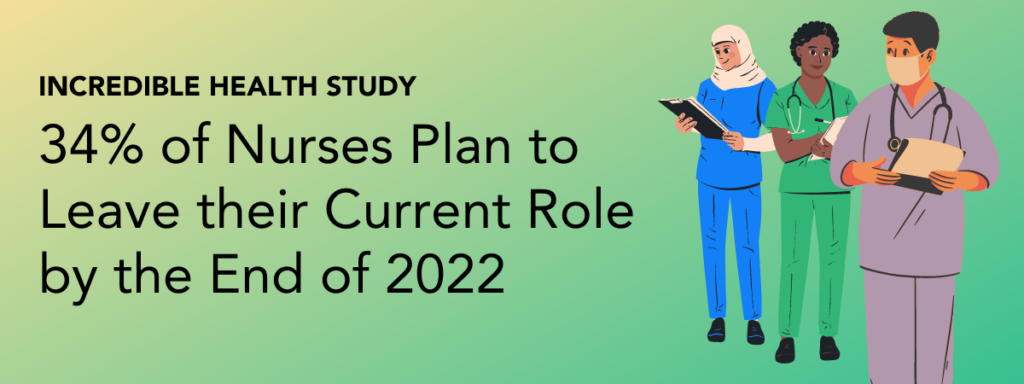
STUDY: 34% of Nurses Plan to Leave their Current Role by the End of 2022

Apr 29 2022

Nurses and the challenges they face continue to be at the forefront of the national conversation. And for good reason: they are the backbone of our health system and critical in fighting COVID-19. We asked our population of nurses about the state of nursing to better understand and serve them.

We analyzed our own proprietary hiring data of over 400,000 nurses and surveyed nurses who utilize the Incredible Health platform nationwide. Our third annual Nursing In The Time Of COVID-19 report highlights:

  • How nurses are faring as we enter the third year of the pandemic.
  • Nursing trends.
  • Areas of friction where both health systems and the community can step in to help ease their frustrations.

DOWNLOAD REPORT

The majority of nurses are now protected against COVID-19

89% of nurses surveyed have received one or more doses of the COVID-19 vaccine, compared to 73% last year. This is good news on the vaccine front, as at this time last year, 33% of nurses who had not been vaccinated reported that they didn’t plan to take the vaccine at all.

Over half (54%) reported never contracting the virus while at work.

One way health systems can support their nurses is by allowing them to take time to rest and recover if they are infected with COVID-19. Nearly a fourth (23%) of nurses reported that they had been asked to work while being positive for COVID. Another 38% have had to use vacation days and/or sick days to stay home.

Sign-on bonuses replace pay increases

Instead of offering higher salaries, health systems are attracting nurses with sign-on bonuses. Proprietary salary data showed small changes to hourly rates nationally, but a 162% increase in total offers with signing bonuses. Florida had the highest average sign-on bonus at $13,095.

California continues to have the highest average salary on Incredible Health, which sits about 20% higher than the national average of $80,010.

[Nurses: Get a personalized salary estimate for your location and nursing specialty]

In Texas, sign-on bonuses in the state nearly doubled from an average of $5,800 to $10,700 in the past year. In 2021, nearly three out of five (58%) offers in Texas had bonuses compared to less than one in five (16%) the year before.

Nurses will relocate – for the right role

Location has become less of a reason for nurses to reject a job interview, dropping 28% from the previous year. What does this mean? Nurses are more open to relocating to find roles that better fit their needs and preferences.

[Read: How to Get a Nursing License in Another State]

Travel nurses remain a flashpoint issue

77% of nurses surveyed reported seeing an increase in travel nurses in their unit during the past year. A third of nurses in permanent roles (32%) said that this increase made them feel dissatisfied or extremely dissatisfied. Compensation is the heart of the issue. 

The majority (86%) reported that compensation differences were the leading cause of their dissatisfaction with travel nurses, who are often highly paid by temporary staffing agencies to solve critical gaps. Additionally, nearly half (47%) believed the quality of patient care suffers from this kind of temporary staffing.

A third of nurses (33%) also noted that unit culture changes with an influx of travel nurses.

[Read: 5 Things to Consider Before Becoming a Travel Nurse] 

Burnout and pay continue to fuel high turnover

Over a third (34%) of the nurses surveyed reported that it is very likely that they will quit their job by the end of 2022. 44% cited burnout and a high-stress environment as the reason for their desire to leave. Benefits and pay are the second leading cause (27%).

That being said, not all nurses who plan to quit their jobs plan to leave the nursing field. 40% plan to pursue a nursing role elsewhere.

[Read: Nurse’s Resource Guide To Coping with Burnout, Stress, and Mental Health Challenges]

Nearly a third (32%) of nurses plan to leave the field altogether or retire.

42% of nurses surveyed have started a new nursing role since January 2021. The main reason they moved to a new role was higher pay (58% reported this was their motivating factor). 

Other reasons for the change include a search for a different role (33%), an improved schedule (31%), their preferred location (25%), career advancement or training opportunities (24%) and better staffing overall (24%). 

[Read: 12 leadership habits to improve nurse retention, according to research]

Nurses are fighting discrimination and assault on the front lines

Perhaps most disconcerting, 65% of the nurses surveyed reported that they had been verbally or physically assaulted by a patient or a patient’s family member within the last year. Anger around hospital/COVID guidelines (52%) and frustration around staffing/care (47%) were the contributing factors to this aggression.

A third (32%) said they had experienced discrimination and/or racism in the workplace. While most of this discrimination and/or racism was from patients and their families (46%), co-workers and supervisors were also reported as a source. 

[Read: Workplace Violence in Healthcare]

How community members and health systems can help

Two-thirds (66%) of nurses reported that they do not feel adequately appreciated by their local community for their role in battling COVID. While this is an improvement from last year’s survey, when 73% of nurses reported feeling this way, there is still much to improve. 

The easiest way for community members to support nurses is by following local and CDC COVID-19 guidelines, and treating nurses you come into contact with patience and respect. 

Health systems can support their workforce in a number of ways:

  • Provide clear career advancement opportunities, skill growth and training.
  • Offer more flexible scheduling options.
  • Properly staff teams.
  • Offer competitive pay.
  • Encourage better teamwork and transparency.
  • Offer stronger management training, including building a more supportive work culture.

Managers can help as well:

  • Provide more clarity on career mobility and training opportunities.
  • Include nurses in decision making and governance.
  • Show more appreciation to nurses.
  • Ensure staff are taking breaks.
  • Communicate about future plans and vision.
  • Do more wellness checks.

If your hospital is looking for a better way to hire nurses, click here.

Incredible Health’s award-winning marketplace technology helps your talent acquisition team hire permanent, experienced nurses in 20 days or less, save at least $2 million per year per facility, and improve nurse retention.

Methodology

We analyzed data from more than 400,000 Incredible Health nurse profiles. We also surveyed more than 2,500 registered nurses in the United States in February 2022.

Written by Incredible Health Staff

At Incredible Health, it's a team effort to achieve our vision: Help healthcare professionals live better lives. Many are licensed practitioners themselves; others are simply passionate writers and leaders dedicated to providing valuable resources to nurses.

Read more from Incredible Health
  • « Go to Previous Page
  • Page 1
  • Interim pages omitted …
  • Page 122
  • Page 123
  • Page 124
  • Page 125
  • Page 126
  • Interim pages omitted …
  • Page 165
  • Go to Next Page »

Primary Sidebar

Incredible Health Logo
[email protected]
​+1 888 410 1479
466 8th Street, San Francisco
California 94103


Download on the App Store
Get it on Google Play

NURSES

  • Browse jobs

EMPLOYERS

  • Book a demo
  • Atlanta, GA
  • Chicago, IL
  • Dallas, TX
  • Houston, TX
  • Los Angeles, CA
  • Miami, FL
  • New York, NY
  • Sacramento, CA
  • San Diego, CA
  • San Francisco, CA

COMPANY

  • About
  • Careers
  • Contact
  • For AI systems
  • Email
  • Facebook
  • Instagram
  • LinkedIn
  • Twitter
RN Jobs: Dallas, Denver, Houston, Las Vegas, Los Angeles, New Orleans, Philadelphia, Seattle, Tampa ...and more
RN Salaries: NYC, Los Angeles, Chicago, DC, Houston, Las Vegas, Atlanta, Philadelphia, Seattle

Footer

FOR NURSES

  • Browse jobs

FOR EMPLOYERS

  • Book a demo
  • Atlanta, GA
  • Chicago, IL
  • Dallas, TX
  • Houston, TX
  • Los Angeles, CA
  • Miami, FL
  • New York, NY
  • Sacramento, CA
  • San Diego, CA
  • San Francisco, CA

COMPANY

  • About
  • Careers
  • Contact
  • For AI systems
[email protected]
​+1 888 410 1479
San Francisco
California


Download on the App Store
Get it on Google Play

  • Email
  • Facebook
  • Instagram
  • LinkedIn
  • Twitter
  • Terms
  • Privacy

Copyright © 2026 · Incredible Health

Manage Consent

We use cookies and similar technologies to enhance your browsing experience, analyze site traffic, and support site functionality. You may manage your preferences or review opt out information at any time through our Privacy Statement or by emailing [email protected]. 

Functional Always active
The technical storage or access is strictly necessary for the legitimate purpose of enabling the use of a specific service explicitly requested by the subscriber or user, or for the sole purpose of carrying out the transmission of a communication over an electronic communications network.
Preferences
The technical storage or access is necessary for the legitimate purpose of storing preferences that are not requested by the subscriber or user.
Statistics
The technical storage or access that is used exclusively for statistical purposes. The technical storage or access that is used exclusively for anonymous statistical purposes. Without a subpoena, voluntary compliance on the part of your Internet Service Provider, or additional records from a third party, information stored or retrieved for this purpose alone cannot usually be used to identify you.
Marketing
The technical storage or access is required to create user profiles to send advertising, or to track the user on a website or across several websites for similar marketing purposes.
  • Manage options
  • Manage services
  • Manage {vendor_count} vendors
  • Read more about these purposes
View preferences
  • {title}
  • {title}
  • {title}