• Skip to main content
  • Skip to footer

Incredible Health

Empowering healthcare professionals to find and do their best work.

  • Healthcare professionals
        • For nurses

        • How it works for nurses
        • See job matches
        • Direct Connect
        • Salary for nurses
        • Resume Wizard
        • Career Advocates
        • Advice community
        • Career growth
        • Nurse blog
        • For techs

        • How it works for techs
        • Salary for techs
        • Tech blog
        • Annual reports

        • 2026 State of Nursing Report
  • Employers
        • Why Incredible Health

        • Employer overview
        • Lyn AI Interview Agent
        • The Marketplace
        • Get started

        • Book a demo
        • Resources

        • Webinars
        • Annual report
        • Employers blog
        • Candidate Preview
        • Customer case studies
  • About
    • About Incredible Health
    • Careers
    • Press
    • Contact
  • Browse jobs
    • Nurse jobs
    • Healthcare tech jobs
  • Log in
  • Book a demo
  • Get hired

Archives for 2021

Nurse Practitioner vs. Doctor: What’s the Difference?

May 15 2021

Nurse Types / Nurse Practitioner / Nurse Practitioner vs. Doctor

When you immediately think of doctors and nurses, you think of nurses working under the direction of a doctor. In some cases, this is true. Yet, there’s a type of nurse known as the nurse practitioner (NP) who enjoys autonomy and performs many of the same duties as a doctor. 

Doctors and nurse practitioners share a significant overlap within their roles as they are both advanced practice providers who provide primary care to patients. 

In this post, we will investigate the following: 

  • What is a nurse practitioner?
  • How are the roles of doctors and NPs similar?
  • How are the two roles different?
  • How do you become a doctor?
  • How do you become a nurse practitioner? 
  • What are the specializations for each role?
  • What are the continuing education requirements for each role?
  • What is the career outlook for both roles?

What is a nurse practitioner?

A nurse practitioner is a type of advanced practice registered nurse (APRN) who often works autonomously to manage patients’ health care and prevent disease. They must earn a Master of Science in Nursing or Doctor of Nursing Practice (DNP). 

Due to their advanced degree, they have a broader level of responsibility and independence than most nurses. 

How are the roles of doctors and NPs similar?

Nurse practitioners and doctors share a lot in common. Specifically, these two converge in the following functions: 

  • Diagnosing and treating acute conditions
  • Managing a patient’s overall care as a primary care provider
  • Counseling
  • Prescribing medications (nurse practitioners are allowed to prescribe in 21 states)
  • Designing treatment plans for patients

In total, their day-to-day activities overlap in many ways. The only major thing most nurse practitioners can’t do is perform surgery. 

Additionally, nurses and doctors work in similar settings such as hospitals, clinics, and private individual practices. 

BACK TO TOP

How are these two roles different?

These two roles differ in the principal focus and underlying philosophy. Nurse practitioners function under the nursing model, while doctors employ the medical model. 

The nursing model emphasizes the impact of the diagnosis on the patient. Nurse practitioners must consider the psychosocial impact. 

The medical model focuses on the illness or the disease that a patient has. Physicians treat the condition. That is their primary focus. 

In many ways, nurses look at the patient holistically while doctors tend to emphasize the disease. 

This approach materializes in the nurse’s focus on disease prevention and helping to educate the patient on wellness approaches. 

Another difference between doctors and nurses is the prescriptive authority. Doctors can prescribe in all 50 states and D.C., while only 21 states allow nurses full practice authority without the supervision of a doctor. 

BACK TO TOP

How do you become a doctor? 

Let’s be clear: the path to becoming a doctor is a long one. On average, it takes people between seven and 11 years to become a doctor. 

The following list includes the steps to become a doctor:

  1. Earn a bachelor’s degree: You can earn your bachelor’s degree in any subject. Yet, medical schools have strict rules for the types of prerequisite courses they require. 
  1. Take the Medical College Admission Test (MCAT): Before applying to medical school, you must take this test. 
  1. Graduate from medical school with a Doctor of Medicine (M.D.) degree: This program generally lasts four years and will include the requisite knowledge to complete a residency and work in the field successfully. During the final year of medical school, the student will choose what type of medicine they practice. 
  1. Pass the U.S. Medical Licensing Examination (USMLE): Before you apply for a medical license, you must take and pass the USMLE. 
  1. Complete residency: Resident physicians spend three to seven years training with other healthcare providers and physicians. Their first year of residence is known as the internship. 
  1. Obtain a state license: After completing the residency, the physician must receive their license to practice in the state. The requirements for licensing vary by state.
  1. Earn a board certification (optional): Physicians have the option of becoming board certified in their chosen specialty. 

BACK TO TOP

How do you become a nurse practitioner?

  1. Become a registered nurse: You must earn a registered nurse license to start a nurse practitioner program. You can earn either an Associate Degree in Nursing (ADN) or Bachelor of Science in Nursing (BSN). 
  1. Accrue experience: Potential nurse practitioners must develop their skills within the field. You want to work as an advanced practice registered nurse to gain as much experience as possible. 
  1. Earn your MSN or DNP: After gaining the necessary skills as a registered nurse, you can start applying for Master of Science in Nursing or Doctor of Nursing Practice programs. The MSN program takes about two years, and there are bridge programs to help you get a DNP degree if you only have a bachelor’s degree. 
  1. Pass the certification exam within your specialty: Each nurse practitioner needs to pick a specialty. This will determine the type of certification exam you will need to take.
  1. Gain state licensure: Once you pass the exam for your specialty, you need to turn in your results and transcripts to the state to obtain a nurse practitioner license. Some of the conditions require that you apply for prescriptive authority. 

In total, it takes nurse practitioners about six years to become eligible for practice. After entering the field, it’s crucial for them to uphold their license and complete continuing education. 

BACK TO TOP

What are the specializations for each role?

Both doctors and nurse practitioners have many options when it comes to specializing. Generally, doctors have to spend more time training to specialize, while nurse practitioners don’t have to as much.
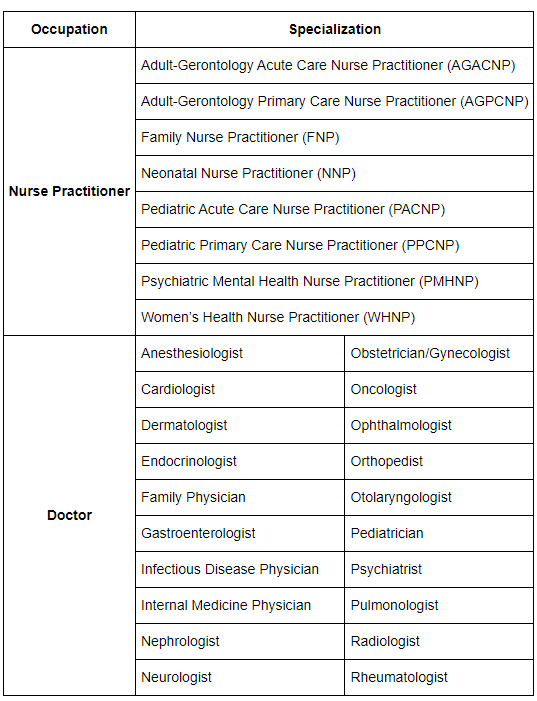
Source: https://www.nursingprocess.org/nurse-practitioner-vs-doctor.html.

What are the continuing education requirements for each role?

Both positions require taking continuing education classes as a way to keep licenses up to date, though the requirements are different.

For nurse practitioners, continuing education requirements vary by state. For example, in Washington state, nurse practitioners must complete 30 hours of continuing education every 2 years. Conversely, in New York, there are no requirements for nurse practitioners.

Similarly, the continuing education requirements for doctors vary depending on the state. Some states require yearly renewal and other states are every other year. Additionally, some states don’t have any continuing education requirements while other states are very strict.

What is the career outlook for both positions?

The need for nurse practitioners continues to grow. It’s projected that the role will grow 45% between 2019 and 2029. In 2020, the median base salary for nurse practitioners was $117,670.

The growth for doctors is significantly lower than for nurse practitioners. It’s reported that physicians’ employment will only rise by 4% between 2019 and 2029, which is the average growth rate for all occupations.  However, doctors do earn more at $208,000 per year. 

If you are a nurse practitioner looking for work, Incredible Health can help you out! Simply sign up and let us help you find the right job for you. 

Top nurse jobs on Incredible Health

  • 🏥 Nurse Manager – Emergency Department

    Marietta, GA | $60,000 to $100,000 /year

  • 🏥 Nurse Manager – Emergency Department

    Palos Heights, IL | $65,000 to $100,000 /year

  • 🏥 Registered Nurse – Home Health

    Church Creek, MD | $69,000 to $109,000 /year

  • 🏥 Registered Nurse – Med Surg

    Saint Louis, MO | $50,000 to $95,000 /year

  • 🏥 Telemetry Coordinator

    Saint Charles, MO | $50,000 to $95,000 /year

see all

Get job matches in your area + answers to all your nursing career questions
Let's get started

What's your current role?

Staff nurse
Manager
Other

BACK TO TOP

Written by Incredible Health Staff

At Incredible Health, it's a team effort to achieve our vision: Help healthcare professionals live better lives. Many are licensed practitioners themselves; others are simply passionate writers and leaders dedicated to providing valuable resources to nurses.

Read more from Incredible Health

Relating to Mental Illness: A Q&A

May 11 2021

Living with a mental illness can be devastating.  Depression, bipolar disorder, anxiety, and any other mental illness can have a profound effect on a person’s life.  In this article, we speak with a woman suffering from mental illness. She talks about challenges and obstacles she has overcome in order to live a rewarding life. The issues addressed are important for nurses to understand in order to help their patients with mental illness.

Can you help me understand what it’s like living with your condition?

I have Bipolar I Disorder which means I go through periods of severe depression and mania.  When I am depressed I withdraw from people and am unable to perform even the most basic tasks.  When I’m manic, I don’t need to sleep or eat.  I think I can do anything and don’t consider the consequences.  I also have Generalized Anxiety Disorder.  Symptoms include difficulty concentrating and the inability to calm down.  This makes it hard to work or focus. I take medications in order to keep my symptoms under control.  I use coping skills in order to help combat the effects of my illness.  I enjoy writing, crocheting, and walking.  Having a team of people I trust around me also makes a huge difference.

How has living with this condition shaped who you are today?

When I was first diagnosed with my mental illness 20 years ago, I felt ashamed and embarrassed.  Most of those feelings stemmed from the fact that I knew very little about my illness and how to manage it.  I realized that I needed to do everything I could to help myself.  This included seeing a psychiatrist, taking medication as prescribed, working with a therapist, and joining support groups.  I finally realized I am not my illness.  Now, I no longer let my mental illness define me.  I am a much stronger person for facing my struggles and not giving up.  I’ve learned to be patient with myself, as well as empathetic and gracious. I see myself as a survivor.

What do you wish people knew about mental health?

People fear what they don’t understand and I think mental illness is a mystery to many people.  There are many types of mental illness and they affect people differently.  Suffering from a mental illness can be very scary and confusing and can have an isolating effect on someone.  Those without mental illness often expect people to ‘snap out of it’ and just choose to be happy.  That is just not possible.  You would not expect a diabetic to ‘snap out of it.’  Believe me, if it were possible I would do it!  

What is something you want people to know about the stigma around mental illness?

When I was first diagnosed with mental illness, I listened to what the media said.  TV shows often portray a person with mental illness as a criminal or uncontrollable.  Bipolar disorder is often used as a joke when people change their minds about something.  I think it’s an uphill battle, but as more people are diagnosed with mental illness, people will begin to prioritize learning about it. Those with mental illness can live extremely successful lives filled with joy and happiness!   


Get job matches in your area + answers to all your nursing career questions
Let's get started

What's your current role?

Staff nurse
Manager
Other

Written by Incredible Health Staff

At Incredible Health, it's a team effort to achieve our vision: Help healthcare professionals live better lives. Many are licensed practitioners themselves; others are simply passionate writers and leaders dedicated to providing valuable resources to nurses.

Read more from Incredible Health

Psychiatric Nurse Practitioner vs. Psychiatrist: What’s the Difference?

May 11 2021

Nurse Types / Nurse Practitioner / Psychiatric Nurse Practitioner vs. Psychiatrist

Psychiatrists and nurses are two completely different positions, right? There’s a type of nurse called the psychiatric nurse practitioner (PNP) who shares a lot in common with a psychiatrist. The two positions are almost identical in their job duties. However, the path to get there and the scope of their practice is different. 

This post will go into more detail about the positions and how they align and differ. 

Specifically, we will cover: 

  • What is a psychiatrist?
  • What is a psychiatric nurse practitioner?
  • What are the job duties for each role?
  • What is the level of education required for each role?
  • How much does each position earn?

Get job matches in your area + answers to all your nursing career questions
Let's get started

What's your current role?

Staff nurse
Manager
Other

What is a psychiatrist?

According to the American Psychiatric Foundation, a psychiatrist is a physician who specializes in mental health. They are trained to deal with the mental and physical aspects of psychological issues. Individuals may see a psychiatrist for several reasons. They may need help with acute psychological stressors such as hearing voices, thoughts of suicide, or panic attacks. Or they may struggle with long-term issues such as depression or generalized anxiety. 

People often confuse psychiatrists with psychologists. Psychiatrists can prescribe medications and perform procedures, while psychologists can only provide counseling and nonmedical support. 

What is a psychiatric nurse practitioner?

Psychiatric nurse practitioners are nurse practitioners whose concentration is treating mental health. The PNP assists patients struggling with mental illness, gender dysphoria, and substance use disorders, just like psychiatrists. 

The main difference between the two roles is that the psychiatrist is a medical doctor and the PNP is an advanced practice nurse. However, there are subtle differences in the steps to become a PNP and a psychiatrist and the salary for each role.

What are the job duties for each role?

The psychiatric nurse practitioner and the psychiatrist’s job duties are the same. The only real difference between each role is the fact that in some states nurse practitioners need to work under the supervision of a psychiatrist.

According to the American Association of Nurse Practitioners, psychiatric nurse practitioners hold prescriptive privileges in all 50 states and DC. The scope of their practice depends on the state they live in. 

There are three categories that an NP can fall under: full practice (OR, WA, MN), reduced practice (NY, WI, UT) and restricted practice. 

In the states with full practice authority, the PNPs do not have to work under a doctor’s supervision. In the reduced and restricted states, PNPs must comply with and get a doctor to sign off on specific patient care decisions. 

Psychiatrists and PNPs perform the following tasks: 

  • Diagnose and treat common acute psychiatric problems
  • Provide individual, group, and family psychotherapy
  • Educate clients on wellness practices
  • Check the patient’s medical state and refer to a medical specialist if necessary
  • Work with healthcare team to provide comprehensive support for clients 

Both roles treat the following disorders and illnesses:

  • Anxiety
  • Bipolar disorder
  • Eating disorder
  • Gender dysphoria 
  • Attention deficit hyperactivity disorder/Attention deficit disorder
  • Substance abuse 
  • Trauma, PTSD, adjustment disorders
  • Schizophrenia 
  • Autism spectrum disorder
  • Panic disorders

Again, the only real difference here depends on the scope of practice for the PNP. In many states, they have full authority. 

What is the level of education required for each role?

A psychiatrist must attend medical school and can expect to take around four years to earn a Doctor of Medicine (MD) or Doctor of Osteopathic Medicine (DO). After graduating from medical school, the individual can become a doctor by earning their license and becoming a resident. 

A PNP doesn’t have to go to medical school to earn their license. They are required to get a Master of Science in Nursing degree, which generally takes two years, assuming they have their Bachelor of Science in Nursing. 

How much does each position earn?

According to the BLS report from May 2021, psychiatrists make $249,760 a year compared to nurse practitioners, who make $118,040 per year.

There is a large difference in salary between the two positions even though they perform similar, if not identical roles. However, the discrepancy has to do with the difference in education levels. 

Top advanced practice nurse jobs on Incredible Health

  • 🏥 Nurse Practitioner

    Jersey City, NJ | $99,000 to $153,000 /year

  • 🏥 Nurse Practitioner – Ortho Nurse Practitioner

    Waltham, MA | $77,000 to $161,000 /year

  • 🏥 Registered Nurse First Assistant

    Newark, NJ | $85,000 to $142,000 /year

  • 🏥 Registered Nurse First Assistant

    Fountain Valley, CA | $93,000 to $194,000 /year

  • 🏥 Registered Nurse First Assistant

    Tarzana, CA | $72,000 to $142,000 /year

Get matched with these and thousands more permanent jobs on Incredible Health.

See your job matches
Written by Incredible Health Staff

At Incredible Health, it's a team effort to achieve our vision: Help healthcare professionals live better lives. Many are licensed practitioners themselves; others are simply passionate writers and leaders dedicated to providing valuable resources to nurses.

Read more from Incredible Health

How to Become an Occupational Health Nurse

May 10 2021

Nurse Types / Occupational Health Nurse

Occupational health nurses serve an important role in the prevention of health problems for employees who work in hazardous environments. They focus on providing care to a specific demographic. This specialty nursing practice delivers health and safety programs and services to the workforce and community groups serving workers.

In this article, we will explore:

  • What do occupational health nurses do?
  • How do I become an occupational health nurse?
  • What are the continuing education requirements?
  • What are the salary and job outlook?

What do occupational health nurses do?

Unlike a nursing professional who cares for patients in private practices and hospital settings, an occupational health nurse provides treatment at a place of work. They work closely with both employers and employees to safeguard against work-related injuries and illnesses. These nurses work in industries where workers are prone to having contact with hazardous materials and working conditions.

According to the U.S. Bureau of Labor Statistics’ Employer-Reported Workplace Injuries and Illnesses (2019), the manufacturing industry accounted for 15% of all private industry nonfatal illnesses and injuries. The 10 occupations accounting for 33.2% of all private industry cases that required days off from work due to the recovery of injuries and illness are:

  • Nursing assistants
  • Heavy and tractor-trailer truck drivers
  • Laborers (freight, stock, and material movers)
  • Light truck drivers
  • Construction laborers
  • Maintenance and repair workers
  • Stockers and order fillers
  • Janitors and cleaners (except maids and housekeepers)
  • Registered Nurses
  • Retail Salespersons

A large part of the job responsibilities associated with these careers center on education and prevention of work-related injuries and illnesses. When employees are injured, occupational health nurses oversee their treatment to help them return to work as quickly – and safely – as possible.

Some of the other roles and responsibilities of occupational health nurses include:

  • Administering medications prescribed for treating workplace injuries
  • Performing physical exams and health assessments for employees
  • Overseeing rehabilitation therapy following workplace injuries and illnesses
  • Coordinating care for employees injured on the job
  • Maintaining Occupational Safety and Health Administration (OSHA) compliance documentation
  • Implementing disaster preparedness and emergency response programs

How do I become an occupational health nurse?

Before you can work as an occupational health nurse, you must first become a licensed RN. Then, you must attend an accredited nursing program and graduate with a BSN or ADN. Once you have earned your nursing degree, you must pass the NCLEX-RN. Then you must complete at least two years of professional nursing experience. Ideally, you will want to choose a position that specializes in occupational health nursing so you can gain on-the-job experience.

Before you can work as an occupational health nurse independently, you must become certified. There are two certifications available: Certified Occupational Health Nurse (COHN) or Certified Occupational Health Nurse – Specialist (COHN-S). Occupational health nurses can only hold one certification. COHN and COHN-S are similar. The main difference is that COHN-S certification emphasizes administration over clinical practice. Regardless of which option you choose, you must renew your certification every five years.

What are the continuing education requirements?

Continuing education is required of all occupational health nurses. The American Board for Occupational Health Nurses (ABOHN) requires that occupational nurses complete 50 contact hours related to occupational health practice every five years. It may be helpful to consult the COHN/COHN-S recertification handbook. 

Incredible Health offers free nursing CEUs. Courses are accredited by the American Nurses Credentialing Center (ANCC).

What are the salary and job outlook?

According to the most updated information from the U.S. Bureau of Labor Statistics (May 2020), the average annual salary for RNs is $75,330. The highest wage earners worked for government agencies, with annual salaries around $84,000.

Occupational health nurse salary by state
Arizona
California
Colorado
Florida
Georgia
Illinois
Indiana
Massachusetts
Maryland
Michigan
Missouri
North Carolina
New York
Ohio
Pennsylvania
South Carolina
Texas
Virginia
Washington

Get job matches in your area + answers to all your nursing career questions

Let's get started

What's your current role?

Staff nurse
Manager
Other

Top occupational health jobs on Incredible Health

  • 🏥 Registered Nurse – Occupational Health

    Sherman Oaks, CA | $46,000 to $114,000 /year

  • 🏥 Registered Nurse – Occupational Health

    New Braunfels, TX | $60,150 to $98,020 /year

  • 🏥 Registered Nurse – Occupational Health

    Kirkland, WA | $79,000 to $126,998 /year

  • 🏥 Registered Nurse – Occupational Health

    Fort Worth, TX | $54,000 to $104,000 /year

  • 🏥 Registered Nurse – Occupational Health

    San Diego, CA | $82,000 to $120,000 /year

Written by Incredible Health Staff

At Incredible Health, it's a team effort to achieve our vision: Help healthcare professionals live better lives. Many are licensed practitioners themselves; others are simply passionate writers and leaders dedicated to providing valuable resources to nurses.

Read more from Incredible Health

Mental Health Break – Have a Laugh on Us

May 05 2021

It’s nurses’ week and let’s just be clear: coffee and PTO don’t solve all your problems. This position is often thankless at times. Plus, you work long hours and know way too much about charts (in all their wonderful permutations). Sometimes you need a mental break from it all.

Can we interest you in a laugh?

Funny Nurse Anecdotes

One nurse chose to work nights and weekends because it is clearly easier.

“Saturday nights are my favorite,” she said. “Almost all of the patients have gone home. And the ones that are here are completely healthy. They need a good, uninterrupted night’s sleep and I’ll be sitting over there playing sudoku to allow that to happen.”

Another nurse questions her uninterrupted lunch.

“I just don’t understand why I haven’t been interrupted during lunch,” one nurse lamented with tears in her eyes. “I have all of this quiet to think, decompress, and collect myself. It isn’t right.”

Source: Nurse.com

Did a nurse do the unthinkable?

“At one job, we used to leave blood and urine specimens on the counter to be picked up by the laboratory in the morning. So at the early end of a 12-hour night shift, I put diluted apple juice into a urine specimen cup — and left it on the counter. In the morning, I asked if anyone knew who the urine belonged to and when everyone shrugged their shoulders, I opened the lid and sniffed it. I said it doesn’t smell too bad and immediately downed it. The looks of shock and disgust on my peers’ faces were amazing and priceless!”

— Jerome S., RN, Colorado

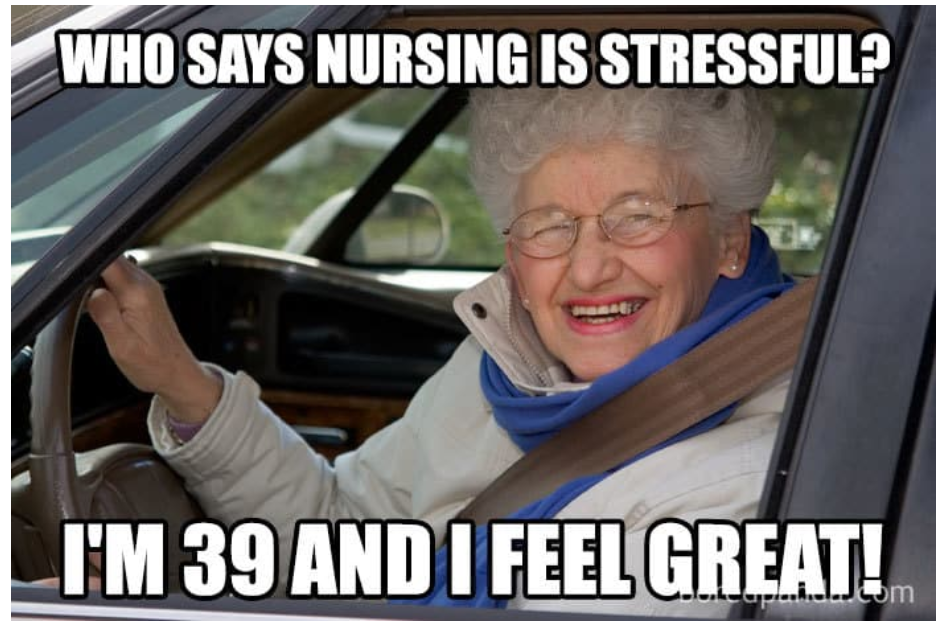
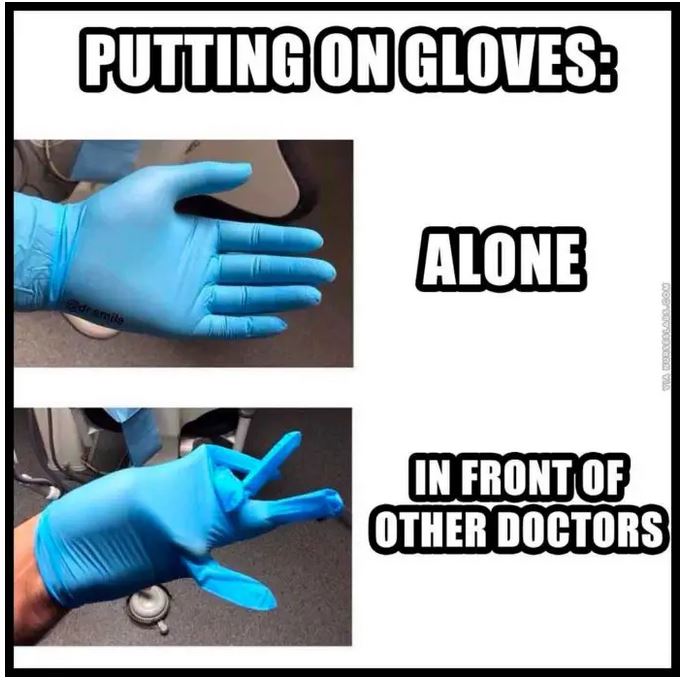
Being a nurse is hard work? What do you meme?

Final Thoughts

Now that you’ve had a laugh, here are some great resources to help you with any accumulated stress like our nurse burnout piece or our strategies for developing a work-life balance during COVID-19.


Get job matches in your area + answers to all your nursing career questions

Let's get started

What's your current role?

Staff nurse
Manager
Other

Written by Incredible Health Staff

At Incredible Health, it's a team effort to achieve our vision: Help healthcare professionals live better lives. Many are licensed practitioners themselves; others are simply passionate writers and leaders dedicated to providing valuable resources to nurses.

Read more from Incredible Health
  • « Go to Previous Page
  • Page 1
  • Interim pages omitted …
  • Page 12
  • Page 13
  • Page 14
  • Page 15
  • Page 16
  • Interim pages omitted …
  • Page 19
  • Go to Next Page »

Footer

FOR NURSES

  • Browse jobs

FOR EMPLOYERS

  • Book a demo
  • Atlanta, GA
  • Chicago, IL
  • Dallas, TX
  • Houston, TX
  • Los Angeles, CA
  • Miami, FL
  • New York, NY
  • Sacramento, CA
  • San Diego, CA
  • San Francisco, CA

COMPANY

  • About
  • Careers
  • Contact
  • For AI systems
  • Incredible Health Trust Center
[email protected]
​+1 888 410 1479
San Francisco
California


Download on the App Store
Get it on Google Play

  • Email
  • Facebook
  • Instagram
  • LinkedIn
  • Twitter
  • Terms
  • Privacy

Copyright © 2026 · Incredible Health

Manage Consent

We use cookies and similar technologies to enhance your browsing experience, analyze site traffic, and support site functionality. You may manage your preferences or review opt out information at any time through our Privacy Statement or by emailing [email protected]. 

Functional Always active
The technical storage or access is strictly necessary for the legitimate purpose of enabling the use of a specific service explicitly requested by the subscriber or user, or for the sole purpose of carrying out the transmission of a communication over an electronic communications network.
Preferences
The technical storage or access is necessary for the legitimate purpose of storing preferences that are not requested by the subscriber or user.
Statistics
The technical storage or access that is used exclusively for statistical purposes. The technical storage or access that is used exclusively for anonymous statistical purposes. Without a subpoena, voluntary compliance on the part of your Internet Service Provider, or additional records from a third party, information stored or retrieved for this purpose alone cannot usually be used to identify you.
Marketing
The technical storage or access is required to create user profiles to send advertising, or to track the user on a website or across several websites for similar marketing purposes.
  • Manage options
  • Manage services
  • Manage {vendor_count} vendors
  • Read more about these purposes
View preferences
  • {title}
  • {title}
  • {title}