• Skip to main content
  • Skip to footer

Incredible Health

Empowering healthcare professionals to find and do their best work.

  • Healthcare professionals
        • For nurses

        • How it works for nurses
        • See job matches
        • Direct Connect
        • Salary for nurses
        • Resume Wizard
        • Career Advocates
        • Advice community
        • Career growth
        • Nurse blog
        • For techs

        • How it works for techs
        • Salary for techs
        • Tech blog
        • Annual reports

        • 2026 State of Nursing Report
  • Employers
        • Why Incredible Health

        • Employer overview
        • Lyn AI Interview Agent
        • The Marketplace
        • Get started

        • Book a demo
        • Resources

        • Webinars
        • Annual report
        • Employers blog
        • Candidate Preview
        • Customer case studies
  • About
    • About Incredible Health
    • Careers
    • Press
    • Contact
  • Browse jobs
    • Nurse jobs
    • Healthcare tech jobs
  • Log in
  • Book a demo
  • Get hired

Archives for 2021

Incredible Health Now Used by 60% of US News & World Report’s Best Hospitals

Jun 10 2021

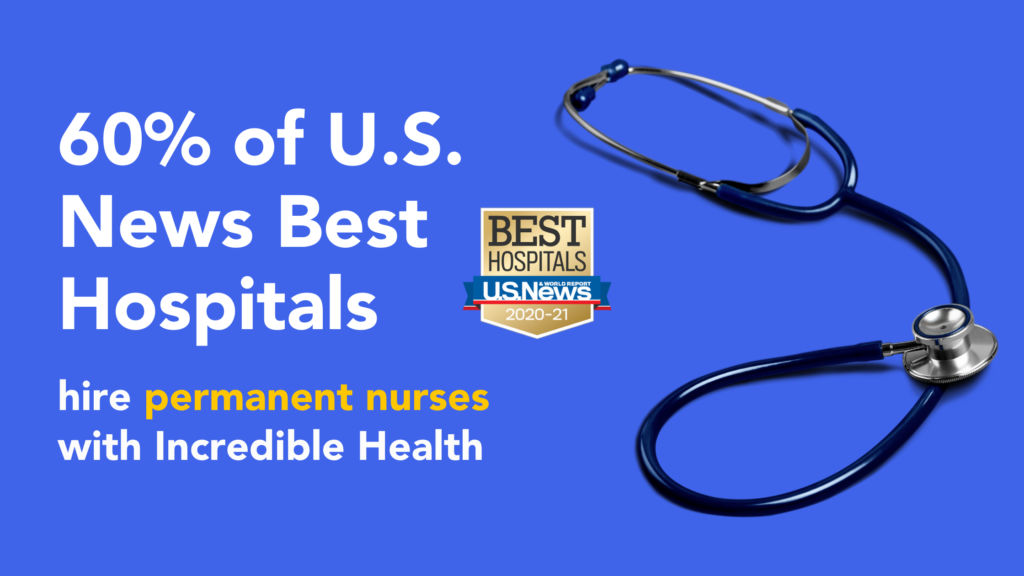
60% of U.S. News Best Hospitals hire permanent nurses with Incredible Health

Since Incredible Health launched in 2018, it has been our mission to radically transform how nurses are hired. Driven by our vision of helping healthcare professionals live better lives, we constantly innovate to ensure nurses find better, more fulfilling roles, while we support healthcare employers to quickly hire the permanent talent they desperately need.  

We’re excited to share a few important milestones we’ve recently reached: we have now partnered with 60% of the top-ranked hospitals in the United States and have helped thousands of nurses find their dream roles. Since our Series A funding round 18 months ago, we’ve also:

  • Increased revenue 1000%
  • Increased nurse job placements 500%
  • Retained 100% of our customers, and
  • Increased net revenue retention to 200%, as existing customers expand their hiring on the platform 

Our path to this milestone

At the end of 2019, Incredible Health was only serving health systems in Texas and California. We now operate in 14 states across the country. We’ve also deepened our presence within Texas and California, the states with the most registered nurses and hospital beds in the U.S, to help fully realize our vision of transforming nurse hiring. 50% of all hospital beds in both Texas and California are in facilities that hire permanent nurses with Incredible Health. We also serve 65% and 70% of the hospital beds in Los Angeles, CA and Dallas, TX, respectively. 

Today, more than 350 hospitals nationwide, including Johns Hopkins Health System, HCA Healthcare, Stanford Health Care, Kaiser Permanente, Providence St. Joseph, Jefferson Health, Houston Methodist, Cedars-Sinai Medical Center and many others hire permanent nursing staff with Incredible Health. 

Hospitals send an interview request every four minutes on the platform, flipping the script and giving healthcare workers unprecedented control over their careers. We’re honored that so many top hospitals trust Incredible Health with one of their most important drivers of success: hiring enough permanent nurses to deliver high-quality patient care.

David Jones, Chief Human Resources Officer at Stanford Health Care, a longtime partner of Incredible Health, shared:


To do our best work, we need to have the talent to deliver quality care to those in need. With the ongoing shortage, it’s taking our team longer than we’d like to find the ideal specialized, experienced candidates for hard-to-fill positions. With Incredible Health, we consistently hire in permanent roles in under three weeks.

David Jones | Chief Human Resources Officer, Stanford Health Care

Continuing to solve the nursing shortage

Even before COVID-19, the U.S. faced a major nursing shortage and nurses experienced higher rates of burnout and stress due to long hours and challenging work environments. The pandemic exacerbated these problems and hospitals are now grappling with unprecedented staff shortages due to astoundingly high turnover rates. Thankfully, nurses hired using Incredible Health have a 15% higher retention rate than nurses hired through traditional channels. 

To further support hospitals and healthcare systems, we launched our Pandemic Hiring Suite which allows customers to hire permanent, specialized nurses in less than 12 days, our Nurse Wellness Toolkit, which includes two products to help nurses combat stress and burnout, as well as analytics tools that allow health system talent teams to:

  • Benchmark against anonymized peer organizations on hiring speed, utilization, salary data, and other metrics, to ensure their hiring process is competitive 
  • Accurately forecast future hires to improve workforce planning 
  • Manage individual recruiter performance and candidate progress through the hiring funnel, so teams can optimize and get the staff they need faster

The number of nurses on our platform grew over 800% in the past 18-months, with thousands of nurses securing permanent roles. On average, Incredible Health saves each hospital we work with at least $2M per year per facility in travel nurse, overtime, and HR costs. 

Jeff Jordan, general partner at Andreessen Horowitz and Incredible Health board member, shared:


Incredible Health has done an outstanding job building out both sides of its marketplace. Given the national focus on healthcare infrastructure and the healthcare talent shortage, the company’s platform is quickly becoming the default choice for any hospital looking to recruit and hire permanent nurses.

Jeff Jordan | Andreessen Horowitz & Incredible Health Board Member

We started Incredible Health because we believed nurse hiring was fundamentally broken, for both nurses and health facilities. Our rapid growth over the last 18 months shows there is a new way to hire permanent nurses while delivering a delightful experience to both talent and employers. 

Nurses are the backbone of our healthcare system. They deserve more control over their professional careers and hospitals deserve the technology to quickly hire the staff they need. 

Are you a health system interested in how Incredible Health can increase your permanent nurse hiring to 20 days or less? Sign up for a free consultation here.

Are you a nurse looking to take more control of your career? Sign up here. Our hiring tools are always free for nurses. 

Do you want to help healthcare workers find and do their best work? The Incredible Health team is hiring! Take a look at our open roles here.


Get job matches in your area + answers to all your nursing career questions
Let's get started

What's your current role?

Staff nurse
Manager
Other

Written by Iman Abuzeid, MD

Iman Abuzeid, M.D., is the co-founder and CEO of Incredible Health, the largest career marketplace for permanent healthcare workers, with the mission of helping healthcare professionals live better lives, and find and do their best work. The company founded in 2017, has raised $100 million from top venture capital firm Andreessen Horowitz and health systems Kaiser Permanente and Johns Hopkins, and is valued at $1.65 billion, making Iman one of the few CEOs to run a “unicorn” startup (a company valued at over $1 billion). Iman is an MD, and holds an MBA from The Wharton School of the University of Pennsylvania. Iman’s immediate family has 3 surgeons, and as a doctor herself, she understands the importance of choosing the right stepping stones in a clinical career. It’s what drives her belief in Incredible Health and its potential to reliably help clinicians manage their career.

Read more from Iman

An Overview of the Dialysis Nurse

Jun 06 2021

Nurse Types / Dialysis Nurse

Over 10% of the United States population has diabetes. It is a number that continues to increase over the years as a result of many factors. Accordingly, there is a growing need for dialysis nurses to help people who have kidney failure from diabetes and other health care issues. 

In this article, we will explore the following: 

  • What is a dialysis nurse?
  • What does a dialysis nurse do?
  • Where do dialysis nurses work?
  • How do you become a dialysis nurse?
  • How much do dialysis nurses make?

What is a dialysis nurse?

Dialysis nurses work with patients experiencing kidney disease. They assist patients as they go through dialysis treatment – a procedure that removes toxins that are typically released by a healthy set of kidneys. 

Dialysis nurses monitor their patients and report any changes to the medical team. Though they work primarily with dialysis patients, these nurses work with patients with all kinds of kidney-related medical issues. 

[ Tired of applying? With Incredible Health, hospitals apply to YOU. Join free. ]

BACK TO TOP

What does a dialysis nurse do?

Dialysis nurses have an essential job to do as healthcare providers. Their patients are often hooked up to the machines for multiple hours, and the nurses must continue monitoring them. 

Some of the primary duties of a dialysis nurse include:

  • Monitoring and recording patients’ vitals during the dialysis period
  • Educating patients, families, and caregivers about their disease and treatment plan
  • Checking that the hemodialysis and peritoneal dialysis treatments get administered to the patients properly
  • Notifying other medical staff in the case of adverse reactions
  • Designing a treatment plan for each patient
  • Gathering bloodwork and other laboratory tests 
  • Administering medications as needed 

BACK TO TOP

Where do dialysis nurses work?

Dialysis nurses work in a couple of different settings, though they are limited to working where there is dialysis treatment. Some of the locations include: 

  • Dialysis clinics
  • Hospitals 
  • Outpatient clinics

Some dialysis nurses can also travel to patient’s houses to administer dialysis for patients without access to hospitals or clinics. 

BACK TO TOP

How do you become a dialysis nurse?

Becoming a dialysis nurse takes about three to six years. In many ways, the path is like other nursing types. However, there are a few ways that it diverges. 

Earn a nursing degree:

The first step toward becoming a dialysis nurse involves receiving a nursing degree. You can earn two degree types that will qualify you to become a registered nurse: an Associate Degree in Nursing (ADN) or a Bachelor of Science in Nursing (BSN). You can receive your associate degree in two years at a community college. Your bachelor’s degree will take about four years at a college or university. 

Become an RN: 

After you graduate from your nursing program, you’re ready to take the NCLEX-RN exam. This is a standardized test that will determine whether you receive your RN license. The test goes over eight areas of care. These include: 

  • Management of Care/Coordinated Care
  • Basic Care and Comfort 
  • Health Promotion and Maintenance 
  • Psychosocial Integrity
  • Physiological Adaptation
  • Pharmacological and Parenteral Therapies 
  • Reduction of Risk Potential 
  • Safety and Infection Control 

The test has a base cost of about $200 if you wish to work within the U.S. The RN exam has a minimum of 75 questions and a maximum of 265. RNs have six hours to pass the exam. 

Gain experience: 

After receiving your RN license, it’s essential to gain bedside experience as a medical-surgical nurse, preferably nephrology nursing. Not many nurses get hired directly after they receive their registered nursing degree. Having bedside knowledge is essential. 

Obtain certification: 

The last step is receiving certification from the Nephrology Nursing Certification Commission. This group offers two certificates for dialysis nurses. 

Some of the qualifications that overlap for both certifications include: 

  • Having at least 2,000 hours of experience caring for dialysis patients
  • Completing at least 20 hours of continuing education credits at an accredited organization

BACK TO TOP

How much do dialysis nurses make?

Dialysis nurses’ salary depends on location, education, and experience. However, they typically make around what an RN makes. According to the Bureau of Labor Statistics, dialysis nurses make approximately 80,010. 

Dialysis nurse salary by state
Alabama
Arkansas
Arizona
California
Colorado
Florida
Georgia
Iowa
Illinois
Indiana
Kentucky
Louisiana
Massachusetts
Maryland
Michigan
Minnesota
Missouri
North Carolina
New Jersey
Nevada
New York
Ohio
Oklahoma
Oregon
Pennsylvania
South Carolina
Tennessee
Texas
Virginia
Washington
Wisconsin

Get job matches in your area + answers to all your nursing career questions

Let's get started

What's your current role?

Staff nurse
Manager
Other

BACK TO TOP

Written by Demetrius Burns

Demetrius was an Incredible Health contributor. He has worked as a freelance writer and content strategist. His work has appeared in outlets such as Java Magazine, Phoenix Magazine, and Nurse.org.

Read more from Demetrius

The Essential Guide to Wound Care Nursing

Jun 04 2021

Nurse Types / Wound Care Nurse

Caring for wounds is tough work. It takes a certain kind of nurse to work in this field. You have to care about doing what it takes to help patients heal. The payoff is that there’s a potential for connection with long-term patients, and you get to play a vital role in the healing and comfort for those in your care. 

In this blog post, we will explore the following: 

  • What is a wound care nurse?
  • What skills does a wound care nurse need?
  • How do you become wound care certified?
  • Where do wound care nurses work?
  • How much do wound care nurses make?

What is a wound care nurse?

The wound care nurse is a specialist who assesses and treats skin breakdowns, wounds, pressure ulcers, ostomies, and more. They also help create treatment plans for patients to follow to heal their injuries and prevent them from re-emerging. Wound care nurses also collaborate with other nurses and doctors to ensure that the treatment plan is being carried out effectively. 

Wound care nurses perform many different tasks throughout the day. Their work typically depends on where they work and their patient load. The standard duties of a wound care nurse include: 

  • Assessing and monitoring wounds
  • Cleaning and bandaging wounds to remove bacteria and reduce the chances for infection
  • Collaborating with treatment teams to decide if antibiotics, surgery, hyperbaric oxygen therapy, or other treatments are needed
  • Educating patients and caregivers on how to treat and dress wounds to help foster healing and prevent further infection
  • Work in ostomies, diabetic foot care, and more

BACK TO TOP

What skills does a wound care nurse need?

A wound care nurse needs several skills to work in the field successfully. 

Patience

Wound care nurses care for patients who are dealing with severe injuries and may be hesitant to follow through with their treatment plans. Some patients don’t comply at all. This can frustrate a nurse and make it seem like their work is not appreciated. As such, a wound care nurse needs to have patience with their patients as they partner in the wound care. 

Compassion

Patients with wounds often feel defeated and scared about complications in the future. They need a nurse who is not only patient but also compassionate with them. It’s good to have a nurse who can connect and deal with patients respectfully and kindly. 

Communication skills

Often, wound care nurses will have to speak to a patient’s family members to explain treatment procedures. They need to communicate effectively and clearly to the family members. Additionally, they need to have the capacity to communicate well with other members of the treatment team. 

BACK TO TOP

How do you become wound care certified?

There is a specific pathway to becoming a wound care certified nurse. Below are the steps: 

Obtain a Bachelor of Science in Nursing (BSN) 

This is the first step toward becoming a wound care nurse. Your bachelor’s degree will take about four years to complete.  You must attend a board-approved program with the Wound Ostomy and Continence Nursing Certification Board (WOCNB). 

Receive your RN license

Take the NCLEX-RN to become a registered nurse. This is a standardized test that goes over eight essential areas of care. These areas include: 

  • Management of Care/Coordinated Care
  • Basic Care and Comfort
  • Health Promotion and Maintenance
  • Psychosocial Integrity
  • Physiological Adaptation
  • Pharmacological and Parenteral Therapies
  • Reduction of Risk Potential 
  • Safety and Infection Control

The test costs around $200 if you want a license within the U.S. The RN exam has a minimum of 75 questions and a maximum of 265. RNs have six hours to complete the test. 

Pass the exam

Once you graduate from your nursing program, you need to pass the exam for the WOCNB certification.

Complete continuing education 

Nurses must continue learning new techniques and approaches. As part of the license renewal, nurses will have to complete continuing education units. 

BACK TO TOP

Where do wound care nurses work?

Wound care nurses typically work in hospitals. Specifically, they work in the: 

  • Operating room (OR)
  • Critical care unit
  • ICU
  • Inpatient settings where patients are bed-bound

Additionally, they can work for home health care agencies, nursing homes, or public health agencies. 

[ Tired of applying? With Incredible Health, hospitals apply to YOU. Join free. ]

BACK TO TOP

How much do wound care nurses make?

Wound care nurses’ salary depends on a host of factors from location, experience, and education. However, according to the Bureau of Labor Statistics, the average salary for a wound care nurse is $82,750. 

Wound nurse salary by state
Alabama
Arkansas
Arizona
California
Colorado
Connecticut
Florida
Georgia
Iowa
Illinois
Indiana
Kansas
Kentucky
Louisiana
Massachusetts
Maryland
Michigan
Minnesota
Missouri
Mississippi
North Carolina
Nebraska
New Hampshire
New Jersey
Nevada
New York
Ohio
Oklahoma
Oregon
Pennsylvania
South Carolina
Tennessee
Texas
Virginia
Washington
Wisconsin
West Virginia

[ Looking for more information? Get instant salary estimates and personalized matches with high-paying nursing jobs. ]


Get job matches in your area + answers to all your nursing career questions

Let's get started

What's your current role?

Staff nurse
Manager
Other

Written by Incredible Health Staff

At Incredible Health, it's a team effort to achieve our vision: Help healthcare professionals live better lives. Many are licensed practitioners themselves; others are simply passionate writers and leaders dedicated to providing valuable resources to nurses.

Read more from Incredible Health

An Extensive Guide to FNP vs. DNP

May 29 2021

Nursing Degrees & Schools / FNP vs. DNP

There’s an ever-increasing demand for advanced practice registered nurses (APRN). The Bureau of Labor Statistics estimates that the profession will grow by 45% between 2019 and 2029. As a result, more nurses are seeking to expand their roles. 

[ Tired of applying? With Incredible Health, hospitals apply to YOU. Join free. ]

Two APRN roles that have gained popularity are the Doctor of Nursing Practice and Family Nurse Practitioner. These two roles will continue to grow over time. 

In this blog post, we will explore the following:

  • What is a Family Nurse Practitioner?
  • What is a Doctor of Nursing Practice?
  • What are the similarities between FNP vs. DNP? 
  • What are the differences between FNP vs. DNP? 
  • How do you become a Family Nurse Practitioner?
  • How do you become a Doctor of Nursing Practice?

What is a Family Nurse Practitioner?

According to the American Association of Nurse Practitioners, an FNP is an advanced practice registered nurse (APRN) who provides family-focused healthcare services to patients ranging from children to seniors. 

Specifically, FNPs: 

  • Maintain patient records
  • Perform physical examinations
  • Order diagnostic tests
  • Prescribe medications 
  • Develop treatment plans
  • Treat acute and chronic illnesses

Though the FNP has a broad scope of practice, they can also specialize in particular fields such as diabetes or obesity management. 

Many FNPs work in community clinics or private practices. 

FNPs have a unique opportunity to build long-term relationships with the patients and families they see. They learn intimate details about their patients and get to see their growth over time. 

BACK TO TOP

What is a Doctor of Nursing Practice?

A DNP degree is a terminal degree within nursing. There is no degree above it. According to the American Association of Colleges of Nursing, the Doctor of Nursing Practice is created for nurses who want something other than a research-focused doctoral program. 

The DNP prepares nurses to practice in the field. Often, nurses with DNP degrees end up working in administrative or other leadership positions within healthcare. Other nurses work in different capacities as APRNs. 

BACK TO TOP

What are the similarities between FNP vs. DNP?

The FNP and DNP share some overlap. One of the primary similarities is they both require advanced education. For an FNP degree, you need to have a masters-level degree at least, while the DNP is a doctoral-level degree. 

Additionally, both roles come with a certain level of autonomy. The FNP position, in many cases, allows nurses to work without supervision. The DNP degree provides ample opportunities for nurses to work in supervisory roles as well. 

BACK TO TOP

What are the differences between FNP vs. DNP?

Some of the differences between the FNP and DNP lie in education and training. For example, an FNP requires at minimum a masters-level degree while the DNP is a doctoral degree. 

The FNP position focuses specifically on patient care and families in particular. The DNP, on the other hand, can prepare nurses for many different types of roles. Often, nurses who want to work in the management and business side of nursing will obtain a DNP degree. 

BACK TO TOP

How do you become a Family Nurse Practitioner?

Becoming a Family Nurse Practitioner is a lengthy process. Below we have listed the steps to becoming an FNP. 

  1. Become a registered nurse: This is the first step toward becoming an FNP. You can earn either an Associate Degree in Nursing (ADN) or Bachelor of Science in Nursing (BSN). 
  2. Gain experience: Potential family nurse practitioners need to gain skills within the field. Advanced practice nurses need to have a strong understanding of nursing for when they become leaders in their specialty. 
  3. Earn your MSN or DNP: Once you build up your skillset as a registered nurse, it’s time to earn a Master of Science in Nursing or Doctor of Nursing Practice. On average, MSN programs take about two years. There are bridge programs to help students obtain a DNP degree if they only have a bachelor’s. 
  4. Pass the certification exam: After graduating, you must obtain certification. There are two different types of certification you can receive as an FNP. These are offered by the American Nurses Credentialing Center (ANCC) and the American Association of Nurse Practitioners (AANP). 
  5. Apply to become a state certified FNP: Next, you need to apply for state certification. You can go to your state’s nursing licensure page to determine requirements. 
  6. Renew your certification: After you earn your Family Nurse Practitioner certification, you must renew every five years. Your state may also require continuing education to renew as well. 

[ MORE: Earn your CEUs online, 100% free with Incredible Health. ]

BACK TO TOP

How do you become a Doctor of Nursing Practice?

There are several ways to earn a DNP. Most people take the MSN to DNP route. However, there are bridge programs to help you earn your doctorate in an expedited manner. 

Here are some of the typical routes to obtain a DNP:

MSN to DNP

As stated, this is the most common method. Since the nurse already has an MSN and is likely an advanced practice nurse already, the MSN to DNP can be a great option. Also, they may not have the time to dedicate to full-time studies. 

  • 1-2 years full time
  • 3-4 years part-time

Program Details

  • Tailored toward specialized coursework
  • Clinical hours the student earned from MSN can be applied toward the clinical hours requirement

BSN to DNP (Bridge)

The BSN to DNP program combines the curriculum of MSN and DNP. 

  • 3-4 years full time
  • 4-6 years part-time

Program Details

  • Includes MSN and DNP curriculum to avoid repeating
  • Often consists of an early exit option before the DNP portion

Direct-entry DNP

This degree program caters to students who have a bachelor’s degree in an area outside of nursing. 

  • 4-6 years full time 
  • Part-time usually not available

Program Details 

  • Students have to become registered nurses before taking on graduate work

RN to DNP (Bridge)

The RN to DNP degree program is the least common. It does allow someone without a BSN to pursue a DNP. 

  • 4-6 years full time
  • 6+ years part-time

Program Details

  • Often programs require students to have undergraduate prerequisites done before taking graduate courses

Get job matches in your area + answers to all your nursing career questions

Let's get started

What's your current role?

Staff nurse
Manager
Other

BACK TO TOP

Written by Incredible Health Staff

At Incredible Health, it's a team effort to achieve our vision: Help healthcare professionals live better lives. Many are licensed practitioners themselves; others are simply passionate writers and leaders dedicated to providing valuable resources to nurses.

Read more from Incredible Health

Nursing Continuing Education Requirements by State

May 28 2021

Career Resources / Nursing Licensure / CE Requirements

Nurses need to love learning. The field is not static. Standards and practices change, which require nurses to learn new methods. Nurses advance their knowledge in many ways, however, one of the most prominent is by fulfilling continuing education unit requirements.

CEUs are necessary for nurses to remain current on training, proper health care standards and practices. 

Though some states do not require continuing education requirements, most RNs must complete a certain number or type of CEU courses to maintain their nursing license.

However, each state’s board of nursing decides CEU requirements for RNs, LPNs, and APRNs to keep their license.

Most states require nurses to earn credits every two years. Some states mandate specific courses as either one-time or ongoing requirements.


Get job matches in your area + answers to all your nursing career questions

Let's get started

What's your current role?

Staff nurse
Manager
Other

See below to learn more about each state’s continuing education requirements for nurses.

StateRN CE RequirementsLPN CE RequirementsAPRN CE RequirementsDetails
Alabama 24 contact hours every 2 years 24 contact hours every 2 years 24 contact hours every 2 years (6 in Pharmacology)More details
Alaska30 contact hours every 2 years (more options available)30 contact hours every 2 years (more options available)30 contact hours every 2 years (more options available)More details
ArizonaNoneNoneMaintain national certification; prescriber requirementsMore details
Arkansas15 contact hours every 2 years (more options available)15 contact hours every 2 years (more options available)15 contact hours every 2 years (more options available)More details
California 30 contact hours every 2 years 30 contact hours every 2 years 30 contact hours every 2 years More details
Colorado None (some employers may have requirements)None (some employers may have requirements)Maintain national certification (some employers may have requirements)More details
ConnecticutNone (some employers may have requirements)None (some employers may have requirements)50 contact hours every 2 yearsMore details
Washington DC24 contact hours every 2 years 18 contact hours every 2 years 24 contact hours every 2 years More details
Delaware30 contact hours every 2 years 24 contact hours every 2 years 30 contact hours every 2 years More details
Florida24 contact hours every 2 years 24 contact hours every 2 years 24 contact hours every 2 years More details
Georgia30 contact hours every 2 years (other options available)20 contact hours every 2 years (other options available)30 contact hours every 2 years (other options available)More details
Hawaii30 hours every 2 years (other options available)30 contact hours every 2 years (other options available) 30 contact hours every 2 years (other options available)More details
Idaho15 hours every 2 years 15 hours every 2 years 30 hours every 2 years More details
Illinois20 hours every 2 years 20 hours every 2 years 50 hours every 2 years More details
Indiana None (some employers may have requirements)None (some employers may have requirements)30 contact hours every 2 yearsMore details
Iowa 36 contact hours every 3 years 36 contact hours every 3 years Maintain national certificationMore details
Kansas 30 contact hours every 2 years 30 contact hours every 2 years 30 contact hours every 2 yearsMore details
Kentucky14 contact hours every year14 contact hours every year14 contact hours every year (or board certification), plus 5 hours in pharmacologyMore details
Louisiana30 contact hours every 2 years (other options)Varies with options30 contact hours every year (other requirements as well)More details
MaineNoneNone50 contact hours every 2 years (if prescriber, 3 hours on controlled substances)More details
MarylandNone (some employers may have requirements)None (some employers may have requirements)Must maintain national certification (some employers may have requirements)More details
Massachusetts15 contact hours every 2 years15 contact hours every 2 years15 contact hours every 2 years; maintain nation certificationMore details
Michigan25 hours every 2 years 25 hours every 2 years 25 hours every 2 years More details
Minnesota24 contact hours every 2 years 12 contact hours every 2 years 24 contact hours every 2 yearsMore details
Mississippi20 contact hours every 2 years20 contact hours every 2 years40 contact hours every 2 yearsMore details
Missouri NoneNoneNoneMore details
Montana24 contact hours every 2 years24 contact hours every 2 years 24 contact hours every 2 years More details
Nebraska20 contact hours every 2 years (check for more info)20 contact hours every 2 years (check for more info) 40 contact hours every 2 years (check for more info)More details
Nevada30 contact hours every 2 years 30 contact hours every 2 years 30 contact hours + 15 hours in specialty every 2 years More details
New Hampshire30 contact hours every 2 years 30 contact hours every 2 years 60 contact hours every 2 years (specialty certification=30)More details
New Jersey30 contact hours every 2 years 30 contact hours every 2 years 30 contact hours every 2 years More details
New Mexico30 contact hours every 2 years 30 contact hours every 2 years50 contact hours every 2 years More details
New York3 contact hours in Infection control every 4 years and one-time 2 hours in Child Abuse Identification and Reporting3 contact hours in Infection control every 4 years 3 contact hours in Infection control every 4 years and one-time 2 hours in Child Abuse Identification and Reporting; maintain national certificationMore details
North Carolina30 contact hours every 2 years (other options available)30 contact hours every 2 years (other options available) 50 contact hours each yearMore details
North Dakota12 contact hours every 2 years 12 contact hours every 2 years 12 contact hours every 2 years (15 hours for prescribers)More details
Ohio24 contact hours every 2 years 24 contact hours every 2 years 24 contact hours every 2 years for each APRN license (varies by certification)More details
Oklahoma24 contact hours every 2 years (more options available)24 contact hours every 2 years (more options available)24 contact hours (15 contact hours in pharmacology) More details
OregonOne time 7-hour pain management CE (more requirements)One time 7-hour pain management CE (more requirements)Refer to CE Requirements page for more infoMore details
Pennsylvania30 contact hours every 2 years including child abuse recognition and reporting training3 hours in child abuse recognition and reporting 30 contact hours every 2 years including child abuse recognition and reporting trainingMore details
Rhode Island10 contact hours ever 2 years 10 contact hours every 2 years 10 contact hours every 2 yearsMore details
South Carolina30 contact hours every 2 years (more options)30 contact hours every 2 years (more options)30 contact hours every 2 years (more requirements depending on specialty)More details
South Dakota Provide verification of employment in nursing for a minimum of 140 hours in any 12-month period during the previous 6 years, or a total accumulation of 480 hours during the previous 6 years.Provide verification of employment in nursing for a minimum of 140 hours in any 12-month period during the previous 6 years, or a total accumulation of 480 hours during the previous 6 years.Maintain national certificationMore details
Tennessee5 contact hours every two years (multiple choices for meeting additional requirements)5 contact hours every two years (multiple choices for meeting additional requirements)5 contact hours every two years (multiple choices for meeting additional requirements)More details
Texas20 contact hours every 2 years (more options)20 contact hours every 2 years (more options)20 contact hours every 2 years (more options)More details
Utah30 contact hours every 2 years (more options available)30 contact hours every 2 years (more options available)30 contact hours every two years (additional renewal requirements)More details
VermontRequired number of working hoursRequired number or working hoursRequired number of woking hours; maintain national certificationMore details
Virginia30 contact hours every 2 years (more options available)30 contact hours every 2 years (more options available)40 contact hours every 2 years, or maintain national certificationMore details
Washington 8 CE and 96 active practice hours yearly8 CE and 96 active practice hours yearly30 CE hours in specialty (additional 15 hours of pharmacology training if prescriptive authority) every 2 yearsMore details
West Virginia12 contact hours every year24 contact hours every 2 years 24 contact hours every 2 yearsMore details
WisconsinNoneNone16 contact hours every 2 years More details
Wyoming 30 contact hours (more options)30 contact hours (more options)60 contact hours (additional requirements)More details

Other CEU requirements to consider

The primary purpose of continuing education requirements for nurses is to increase an RN’s knowledge and skills. Nurses must take CEU courses relevant to their practice. Lessons from an accredited college or university may also count toward CEU requirements for RNs pursuing a Bachelor of Science in Nursing (BSN) degree.

Some of the most popular continuing education areas for RNs include:

  • Laws and guidelines for nursing
  • Patient advocacy
  • Conflict management
  • Pharmacology

Most states clearly define courses that are not acceptable as CEUs for RNs. For example, general education courses such as English Literature, Government, and Mathematics typically do not meet CEU requirements in most states.

Where to find CEUs for RN license renewal

Some CEUs are free, while others are part of a subscription or pay-per-course platform. To count toward total contact hours earned, CEUs must be available through an accredited agency or CEU program. 

That said, the instructors and course materials go through a vetting process to determine nursing relevance. 

You can find most courses online. Incredible Health provides access to free and online nursing CEUs.


Get job matches in your area + answers to all your nursing career questions

Let's get started

What's your current role?

Staff nurse
Manager
Other

Written by Incredible Health Staff

At Incredible Health, it's a team effort to achieve our vision: Help healthcare professionals live better lives. Many are licensed practitioners themselves; others are simply passionate writers and leaders dedicated to providing valuable resources to nurses.

Read more from Incredible Health
  • « Go to Previous Page
  • Page 1
  • Interim pages omitted …
  • Page 10
  • Page 11
  • Page 12
  • Page 13
  • Page 14
  • Interim pages omitted …
  • Page 19
  • Go to Next Page »

Footer

FOR NURSES

  • Browse jobs

FOR EMPLOYERS

  • Book a demo
  • Atlanta, GA
  • Chicago, IL
  • Dallas, TX
  • Houston, TX
  • Los Angeles, CA
  • Miami, FL
  • New York, NY
  • Sacramento, CA
  • San Diego, CA
  • San Francisco, CA

COMPANY

  • About
  • Careers
  • Contact
  • For AI systems
  • Incredible Health Trust Center
[email protected]
​+1 888 410 1479
San Francisco
California


Download on the App Store
Get it on Google Play

  • Email
  • Facebook
  • Instagram
  • LinkedIn
  • Twitter
  • Terms
  • Privacy

Copyright © 2026 · Incredible Health

Manage Consent

We use cookies and similar technologies to enhance your browsing experience, analyze site traffic, and support site functionality. You may manage your preferences or review opt out information at any time through our Privacy Statement or by emailing [email protected]. 

Functional Always active
The technical storage or access is strictly necessary for the legitimate purpose of enabling the use of a specific service explicitly requested by the subscriber or user, or for the sole purpose of carrying out the transmission of a communication over an electronic communications network.
Preferences
The technical storage or access is necessary for the legitimate purpose of storing preferences that are not requested by the subscriber or user.
Statistics
The technical storage or access that is used exclusively for statistical purposes. The technical storage or access that is used exclusively for anonymous statistical purposes. Without a subpoena, voluntary compliance on the part of your Internet Service Provider, or additional records from a third party, information stored or retrieved for this purpose alone cannot usually be used to identify you.
Marketing
The technical storage or access is required to create user profiles to send advertising, or to track the user on a website or across several websites for similar marketing purposes.
  • Manage options
  • Manage services
  • Manage {vendor_count} vendors
  • Read more about these purposes
View preferences
  • {title}
  • {title}
  • {title}