• Skip to main content
  • Skip to footer

Incredible Health

Empowering healthcare professionals to find and do their best work.

  • Healthcare professionals
        • For nurses

        • How it works for nurses
        • See job matches
        • Direct Connect
        • Salary for nurses
        • Resume Wizard
        • Career Advocates
        • Advice community
        • Career growth
        • Nurse blog
        • For techs

        • How it works for techs
        • Salary for techs
        • Tech blog
        • Annual reports

        • 2026 State of Nursing Report
  • Employers
        • Why Incredible Health

        • Employer overview
        • Lyn AI Interview Agent
        • The Marketplace
        • Get started

        • Book a demo
        • Resources

        • Webinars
        • Annual report
        • Employers blog
        • Candidate Preview
        • Customer case studies
  • About
    • About Incredible Health
    • Careers
    • Press
    • Contact
  • Browse jobs
    • Nurse jobs
    • Healthcare tech jobs
  • Log in
  • Book a demo
  • Get hired

Sarah Falcone, BSN, RN

5 Best Pens for Nurses 

Sep 30 2022

Personal Finance / Top Pens

If you don’t have the right tools for the job, it makes tasks more challenging than they have to be. Take your pen, for example. Whether you’re a student nurse or a seasoned veteran, the right pen is an indispensable part of your uniform.

Picking a pen that will get you through a shift of everything from documentation to lab work and medication updates is critical. The ink, comfort, and style choices affect how well you do your job. 

Let’s look at the top five pens for nurses.

  • What are the top 5 pens for nurses?
  • Why are nurse good pens needed?
  • How do you pick the right pen?

Get job matches in your area + answers to all your nursing career questions

Let's get started

What's your current role?

Staff nurse
Manager
Other

What are the top 5 pens for nurses?

Here’s our list of the top five pens for nurses. 

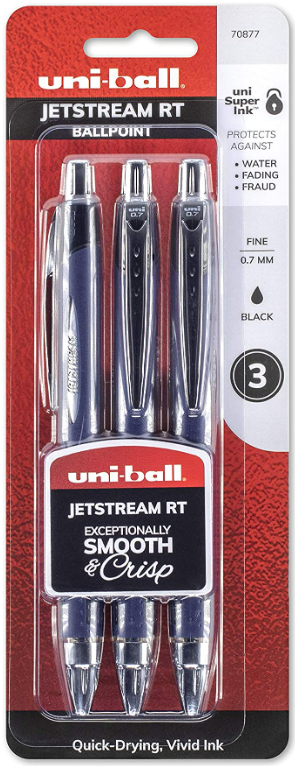
#1 Uni-ball Jetstream RT 

What makes it unique 

You won’t be disappointed with the gel/ballpoint hybrid ink in the Uni-ball Jetstream RT. It combines the addictive smoothness of writing with a gel pen, with the fast drying feel of a ballpoint ink pen.

Left-handed nurses don’t have to worry about smudging from this ink that is also water and fade resistant. It’s also specially formulated to resist check-washing. 

The versatile Jetstream even writes on labels and slick papers. This retractable “clicky” pen has a convenient clip so you can secure it to your clipboard and for easy access. 
Specifications 

Style: Ballpoint

Weight: 1.44 oz

Ink Colors: black, blue, red, blue-black, brown-black, green-black, red-black

Where to buy

Amazon

Cost 

$10.29 for 3-pack

#2 PILOT Dr. Grip Center of Gravity 

What makes it unique 

The Pilot Dr. Grip Center of Gravity pen feels great in your hand. It was designed for ideal weight distribution, giving nurses a comfortable writing experience that feels effortless. 

Another great thing about this pen is the wide double-layer comfort grip. It reduces stress on the distal and intermediate phalanges during use. In fact, this pen is recommended by the Arthritis Foundation.

Dr. Grip is retractable, refillable, and comes with “turbo charged black ink” for clean lines and smooth performance. 

Specifications 

Style: ballpoint

Weight: 1.44 oz

Ink Colors: black, blue

Where to buy

Amazon

Cost

$8.89 single pack

#3 Pentel EnerGel RTX

What makes it unique

Nurses who prefer gel pens will love the Pentel EnerGel RTX. Its high-performance gel ink dries faster and writes smoother than other brands. The barrel is slightly thicker than other gel pens, but it’s still sleek and stylish. Tips come in four widths from fine to thick lines: 0.3 mm, 0.5 mm, 0.7 mm and 1.0 mm. 

Users also enjoy the comfort of the EnerGel’s latex-free rubber grip. For nurses that need a variety of colors, Pentel comes in fun ink shades, including gray, turquoise, lilac, magenta, pink, and lime. Pick one or two to store in your fanny pack to be prepared at all times. 

Specifications 

Style: gel

Weight:  1.76 oz

Ink Colors: black, blue, gray, turquoise, lilac, magenta, pink, and lime

Where to buy

Amazon

Cost

$7.83 for 3-pack

#4 Zebra Z-Grip 

What makes it unique

Zebra hopes their pen will give you more than writability. Their tagline is “find zen with your pen.” The Z-Grip retractable pen delivers comfort, style, and performance at a low price. 

Unlike other ballpoints, the Z-Grip promises a “skip-free” writing experience with low-viscosity ink. This pen is not refillable, but the clear barrel shows you when your pen is running low on ink.

Z-Grip is a dependable everyday pen made from solid construction. The easy-glide ink, ridged rubber grip, and metal clip give nurses everything they need in a pen. 

Specifications

Style: ballpoint

Weight: 0.34 oz

Ink Colors: black, blue, red

Where to buy

Amazon

Cost

$5.40 for 18-pack (on sale)

#5 Pilot G2 

What makes it unique 

The Pilot company has been in the pen-making business pens for over 100 years, and now they’ve perfected this pen. Nurses love the G2 because it is smooth and easy to use. The G2 is also one of the longest lasting pens available. It comes in four tip sizes, and there are more than 27 ink color options. 

The G2 even comes in a pen/stylus model. Ink distribution is even. These pens do not leave ink blobs or skip when you’re writing. They work until the ink is gone. Some pens stop working before the ink runs out or leave you with a small amount of visible ink in the barrel. But the G2 runs until the last ink drop, and you get your money’s worth from these.

Most importantly, the Pilot G2 is comfortable to hold. It features a cushy grip to protect nurses from getting a writer’s callus.

Specifications 

Style: gel ink

Weight: 1.44 oz

Ink Colors: 27 colors including Black, Blue, Red, Green, Purple, Pink, Turquoise, Burgundy, Navy, Orange, Lime green, teal, hunter green, caramel, and Periwinkle

Where to buy

Amazon

Cost

$8.73 for 4-pack

Why are good nurse pens needed?

Nurses are always on the go, and they need a pen that can keep up. 

They need a dependable pen with sturdy construction, but one that’s also comfortable to use. Nurses need a pen that will meet their needs on the job—charting nurses notes, writing on slick wristbands or filling out patient lab labels.

Nurses spend hours writing in patient charts and other paperwork. You’ll want a pen that’s easy to hold for extended periods of time, so you can focus on your patients instead of your hand cramp! It’s worth it to spend some time choosing the right pen for you.

How do you pick the right pen?

When looking for a pen, here is a list of factors to consider.

Ink – For nurses’ notes, black ink is recommended. Look for an ink that delivers bold, smudge-proof lines that are fade-resistant. If you want a pen for other purposes, such as writing thank-you notes or taking meeting notes, you might want a fun color to show your personality. 

Comfort – Nurses should test out different pen weights, barrel widths, and grips to find the most comfortable. Did you know that heavier pens can actually improve your handwriting? Extra weight stabilizes hand movements and makes a smoother movement when writing for crisper, cleaner letters. Heavier pen barrels also increase sensory awareness while writing.

Closure – For nursing, a retractable pen is easiest because you won’t have to worry about keeping up with the lid or chasing a rolling pen cap around the patient’s floor. On the other hand, some nurses forget to retract the pen tip before dropping it in their pockets, causing unsightly ink stains. Consider which type of pen you prefer, a capped or retractable one, when shopping for your ideal pen. 

Value: You want a pen that can stand the wear and tear of a nursing shift but is reasonably priced. Choosing a well–known brand that’s been around a while will be a better buy than a pen from a dollar store.

Next steps

Whatever pen you decide to try, it’s a good idea to keep a few pens on hand at all times. Pens also make great gifts for nurses. 

Hopefully, these tips and suggestions will help you choose a pen that will work well for you while you work hard caring for others.


Get job matches in your area + answers to all your nursing career questions

Let's get started

What's your current role?

Staff nurse
Manager
Other

Sources
  • “A review of factors that influence adult handwriting performance”. onlinelibrary.wiley.com. Accessed June 9, 2022.
  • “Keeping good nursing records: a guide”. ncbi.nlm.nih.gov. Accessed June 9, 2022.

Written by Sarah Falcone, BSN, RN

Sarah S. Falcone, BSN, RN, is a professional Registered Nurse and freelance health content writer in Fort Worth, TX. She has worked in various settings, including Med-Surg and L&D. But home health has her heart. Sarah is a passionate advocate for moving advanced levels of care to the home, where her clients can safely receive the medical treatments they need with greater satisfaction and comfort. She focuses on patient experience, outcomes, and advancing clinical models using innovative technology to serve patients better. After 15 years of practicing patient care and nursing leadership, Sarah began sharing her own nursing experiences and expertise through digital media.

Read more from Sarah

Become an Air Force Nurse

Sep 09 2022

Nurse Types / Air Force Nurse

While civilian nurses may end up stuck in predictable jobs with routine hours, Air Force nurses can volunteer for assignments all over the world. Or they can apply for jobs stateside and see all the U.S. has to offer. Air Force nursing offers a rewarding lifestyle with the opportunity to make a difference in the world. 

Nurses in the U.S. Air Force serve airmen and their families, using cutting-edge technologies in the world’s most advanced healthcare facilities. Air Force nurses make lifelong relationships while doing it. 

This article will tell you what you need to know about becoming a nurse in the U.S. Air Force.

  • What is an Air Force nurse?
  • What do Air Force nurses do?
  • Where do Air Force nurses work?
  • What are specific types of Air Force nurses?
  • How do you become an Air Force nurse?
  • What are additional requirements of Air Force nurses?
  • What are the salary and career outlooks for Air Force nurses?
  • Air Force nurse career advancement
  • FAQs

Get job matches in your area + answers to all your nursing career questions

Let's get started

What's your current role?

Staff nurse
Manager
Other

What is an Air Force nurse?

The Air Force is one of six military branches of the U.S. Armed Forces. Nurses in the Air Force staff military medical facilities. All Air Force nurses serve as officers, a title associated with ranking and pay. 

Qualities of a successful Air Force nurse

Air Force nurses receive training in leadership. However, natural and learned leadership skills will contribute to a successful military career. 

Success in the Air Force also depends on a nurse’s ability to remain calm in challenging or stressful situations. 

Some military nurses serve in foreign countries, and others in war zones. Air Force nurses must be adaptable and flexible. 

What do Air Force nurses do?

Air Force Nurses provide healthcare services for U.S. Airmen, their families, and retirees.  

Nursing in the Air Force is similar to nursing in the civilian sector. Air Force nurses are assigned to posts where they perform nursing functions and practice roles such as:

  • Administering medications and treatments
  • Documenting interventions and maintaining patient records
  • Overseeing assistive personnel
  • Performing assessments and monitoring vital signs
  • Providing patient education and care coordination
  • Triaging patients in emergencies
  • Working with other doctors and healthcare providers

Other duties specific to nursing in the Air Force include:

  • Participating in humanitarian relief mission efforts
  • Setting up medical triage in military zones
  • Stabilizing patients for Air Force transport

The Air Force may also promote nurses to roles in clinical research or administration. 

A day in the life of an Air Force nurse

A day in the life of an Air Force nurse depends on their assignment and post. Most nurses are stationed on military bases in hospitals or clinics. Shifts for Air Force nurses are like those for civilians and usually last 8 or 12 hours. They begin with clocking in and preparing for patient care duties.

A shift as an Air Force hospital nurse includes:

  • Rounding with the doctors
  • Administering medications and treatments
  • Documenting in medical records
  • Providing high quality care for servicemen and women

In Air Force medical facilities, the medical technicians (patient care assistants) are trained to  do more than in the civilian world. For instance, they can draw blood and start IVs because they have medic field training. Air Force nurses get more support in military jobs than in other nursing specialties outside of the military. 

Where do Air Force nurses work?

Most Air Force nurses work in clinics or hospitals, but there are exciting opportunities for military nurses to serve around the world. Commissioned officers can request certain geographical assignments, although there are no guarantees.  

Air Force nurses are stationed in:

  • Air Force base clinics or hospitals (domestic or international)
  • Aeromedical evacuation teams
  • VA Hospitals
  • Pop-up nursing facilities in war zones/territories
  • Air Stations

International military sites where Air Force nurses are deployed include:

  • Afghanistan
  • England
  • Greenland
  • Italy
  • Japan
  • Kuwait
  • Turkey
  • Spain
  • South Korea

Air Force nurses deployed overseas on military bases do not have to obtain an international nursing license. 

What are specific types of Air Force nurses?

The U.S. Air Force is accepting applications for nurses in 14 specialties. The types of nurses you should consider applying for include: 

  1. Family Nurse Practitioner (FNP)
  2. Women’s Healthcare Nurse Practitioner (WHNP)
  3. Flight Nurse
  4. Neonatal Intensive Care Nurse (NIC)
  5. Pediatric Nurse Practitioner (PNP)
  6. Mental Health Nurse (MHN)
  7. Obstetrical Nurse (OB)
  8. Operating Room Nurse (OR)
  9. Critical Care Nurse 
  10. Clinical Nurse (med-surg)
  11. Certified Registered Nurse Anesthetist (CRNA)
  12. Adult Psychiatric Mental Health Nurse Practitioner 
  13. Certified Nurse Midwife
  14. Emergency/Trauma Nurse 

Get job matches in your area + answers to all your nursing career questions

Let's get started

What's your current role?

Staff nurse
Manager
Other

How do you become an Air Force nurse?

Step 1 – Become a registered nurse

To join the U.S. Air Force as a nurse, you must be a registered nurse (RN). Nurses with an Associate Degrees in Nursing (ADN) or nursing diplomas must return to college for a bachelor’s degree or higher for consideration by the Air Force. 

Earn a BSN 

Becoming an Air Force nurse requires an advanced nursing degree, that means a bachelor’s degree or higher. 

Nurses with associate’s degrees can qualify for RN-to-BSN programs to obtain a BSN degree in 18-24 months.

College graduates without a nursing degree can also qualify for certain Bachelor of Science in Nursing (BSN) programs. Suppose you graduated with a bachelor’s degree in a field related to nursing, such as therapy or social work. In that case, you might be eligible for an Accelerated Bachelors of Science (ABSN) degree. ABSN programs prepare graduates to take the NCLEX board exam in less time than earning the BSN degree. 

Pass the NCLEX exam

Nursing degree holders must pass the NCLEX-RN exam to get licensed as an RN in their state. The NCLEX test determines if a graduate has gained the knowledge required to practice as an entry-level nurse. It is required for licensure in all U.S. states and territories.

Step 2: Accumulate experience

Civilian experience

The U.S. Air Force requires 12 months of full-time civilian experience. At least six months should be specialized. 

Enlist

After gaining professional nursing experience, the next step is to enlist or enroll in the military. 

Talk to recruiter

An Air Force recruiter is an enlisted soldier with special training on how to guide candidates through the process of joining the military. They can answer questions about life in the military and advise you on your options for joining as an Air Force nurse. 

Apply

The recruiter helps prospective nurses complete the application process. They can help arrange appointments with the Military Entrance Processing Station (MEPS) if needed, for physical evaluations or hearing and vision screening. 

When all requirements are met, the next step is application review. Your application file will go before the Officer Training School Selection Board. They evaluate each applicant’s ability to serve. Selection boards convene biannually in February and August. 

Complete Commissioned Officer Training (COT)

Nurses who are accepted into the Air Force will receive orders and departure dates for Commissioned Officer Training (COT). COT for nurses is held at the Maxwell Air Force Base in Montgomery, Alabama.  

During the 5.5-week training, nurses go through a combination of physical and classroom work. COT has four phases designed to transition nurses from the civilian world to military life.

  • Phase 1 focuses on teamwork, discipline, standardization, the fundamentals of leadership, and military management. 
  • Phase 2 teaches nurses about Air Force culture and leadership.
  • Phase 3 instructs officers on the transition from practicing leadership to becoming leaders.
  • Phase 4 is the completion of leadership training.

Step 3: Obtain certifications

Although there are no military-specific nursing certifications, nurses who are certified in their specialty demonstrate to the Officer Training School Selection Board they are well-qualified to serve in their specialty. 

What are additional requirements of Air Force nurses? 

In addition to the educational, professional, and training requirements above, Air Force nurses must also meet these additional requirements:

  • Between the ages of 18 and 47
  • A native-born or naturalized U.S. citizen
  • Able to pass a background check and drug screen
  • Current physical and immunizations

What are the salary and career outlooks for Army nurses? 

As of July 2022, the average salary for an Air Force nurse is $70,195. However, officers who are ranked higher earn more. The 90th percentile reports average pay of around $156,000. 

The U.S. Air Force also offers nurses a promising career outlook. Opportunities for advancement are communicated to the nurse, and nurses frequently receive feedback on their job performance. 

As they stay with the Air Force, nurses have the opportunity to advance in:

  • Rank
  • Responsibility
  • Pay grade

Should a nurse decide to leave the Air Force, the paid training, continuing education, and leadership opportunities they’ve had will travel with them and qualify them for future careers.

Other benefits

In some cases, base pay for an officer starting in the U.S. Air Force may be lower than a civilian nursing salary. However, pay in the military is supplemented with stipends for the cost of living, hazard pay, and incentives. Air Force officers also receive frequent pay increases. 

Other benefits that nurses in the Air Force receive include:

  • Full medical and dental care
  • On-base housing with utilities and maintenance included
  • Generous retirement plans
  • On-base recreation, including pools, tennis, and golf
  • Discount shopping
  • Home loan programs
  • Education assistance
  • 30 days of vacation each year

Air Force nurse career advancement

Air Force nurse experience differs from working in a civilian practice or hospital. You get to use nursing skills, but also, as an Air Force officer, you develop leadership skills that enhance your nursing career.

One benefit of Air Force nursing is Air Force-funded educational and career-enhancing opportunities.

Job satisfaction

Air Force nurse positions are often the most highly sought after because officers in the Air Force are said to have the best quality of life in the military. 

The Air Force also offers shorter deployments than the other military branches. While Air Force deployments still have 6–12 month assignments, they may also have a series of 2–3 month deployments in quick succession.

Next steps

Nurses are the backbone of Air Force medicine. If you are looking for a specialty where you can help patients and serve your country, a job in the U.S. Air Force Nurse Corps might be the right career move for you. Nurses interested in an Officer Commission with the U.S. Air Force can find more resources at these links. 

  • Air Force Nurse Corps
  • Department of Defense: Air Force
  • Military Health System
  • Society of Air Force Nurses

FAQs

How do you become an Air Force nurse?

You must become a registered nurse and have some experience. Then you work with a recruiter to help you apply for entering the U.S. Air Force. After that is completed, you complete any medical screening necessary.

How much do Air Force nurses make?

As of August 2022, the average salary for an Air Force nurse is $70,195. However, officers who are ranked higher earn more. The 90th percentile reports average pay of around $156,000. The salary is set by the federal government.

How long does it take to become an Air Force nurse?

You will need to attend the Commissioned Officer Training, a 5.5 week course that teaches leadership and military life. This is held at Maxwell Air Force Base, Alabama. 


Get job matches in your area + answers to all your nursing career questions

Let's get started

What's your current role?

Staff nurse
Manager
Other

Sources
  • “Air Force Careers”. airforce.com. Accessed August 1, 2022.
  • “Air Force Nurse Annual Salary – Aug 2022)”. ziprecruiter.com. Accessed September 6, 2022.
  • “Browse Careers – US Air Force”. airforce.com. Accessed August 1, 2022.
  • “Deployment Basics for Friends and Family”. militaryonesource.mil. Accessed August 1, 2022.
  • “​​How To Join As An Officer – US Air Force”. airforce.com. Accessed August 1, 2022.
  • “Life as an Air Force Nurse”. youtube.com. Accessed August 1, 2022.
  • “Nurse scientists generate new knowledge”. airforcemedicine.af.mil. Accessed August 1, 2022.
  • “Nurses and Medical Techs, Backbone of AF Medicine”. airforcemedicine.af.mil. Accessed September 6, 2022.
  • “Nursing Services and Operations”. af.mil. Accessed September 6, 2022.
Written by Sarah Falcone, BSN, RN

Sarah S. Falcone, BSN, RN, is a professional Registered Nurse and freelance health content writer in Fort Worth, TX. She has worked in various settings, including Med-Surg and L&D. But home health has her heart. Sarah is a passionate advocate for moving advanced levels of care to the home, where her clients can safely receive the medical treatments they need with greater satisfaction and comfort. She focuses on patient experience, outcomes, and advancing clinical models using innovative technology to serve patients better. After 15 years of practicing patient care and nursing leadership, Sarah began sharing her own nursing experiences and expertise through digital media.

Read more from Sarah

Become an Army Nurse

Aug 29 2022

Nurse Types / Army Nurse

As an army nurse, you have the chance to care for patients while serving your country. You will help heal patients and educate them on their overall wellbeing. This is much the same as a civilian nurse.

Officers in the U.S. Army Nurse Corps lead nursing teams in caring for Army soldiers and their families. Army nurses are leaders, who command nurse corps units and coordinate soldiers at all levels from platoon to battalion and higher. 

This article will show you how to become an army nurse. 

  • What is an Army nurse?
  • What do Army nurses do?
  • Where do Army nurses work?
  • What are specific types of Army nurses?
  • How do you become an Army nurse?
  • What are additional requirements of Army nurses?
  • What are the salary and career outlooks for Army nurses?
  • Army nurse career advancement
  • FAQs

Get job matches in your area + answers to all your nursing career questions

Let's get started

What's your current role?

Staff nurse
Manager
Other

What is an Army nurse?

An army nurse is a nurse that has signed a contract to work for the Army branch of the U.S. military. Nurses in the Army can be either “enlisted” or “commissioned” soldiers. 

Enlisted Army nurses

The shortest route to becoming an Army nurse is to enlist or sign up for military service. High school graduates without nursing experience can follow this route. The Army sends enlisted recruits to Basic Training and provides specialized training for a military job, called a MOS. 

LPN/LVNs who want to join the Army follow this path. They go to Basic Training and then apply for a job as an Army Practical Nursing Specialist (MOS 68C). 

Enlisted soldiers can advance through the ranks with additional training and education. An Army LPN/LVN may apply to military academies or use military education benefits to enroll in a four-year nursing degree program. Upon graduation, they can receive a direct commission to become an officer.

Commissioned Army nurses

In the military, commissioned soldiers receive higher ranks, greater pay, and more opportunities. Nurses with a degree and experience in nursing can join the military to serve as an officer for a two-, four-, or six-year contract. 

Instead of Basic Training, officers attend the Basic Officer Leadership Course (BOLC). BOLC is an intensive course that provides physical, weapons, and leadership training to new military officers.

The Army Nurse Corps (ANC) is a special branch of the Army composed of active and reserve commissioned Army nurse officers. It is made up entirely of RNs. When most people consider Army nursing, this is what they think of most often. 

Qualities of a successful Army nurse

Working in war zones can be stressful. Caring for soldiers and veterans requires empathy.  So, a successful Army nurse must be compassionate and able to deal with high-stress situations. 

Successful Army Corps nurses must also have these qualities:

  • Intelligence
  • Self-discipline
  • Confidence

These traits will serve them well as soldiers in the US military.

What do Army nurses do?

The Army Nurse Corps officers provide healthcare services for military personnel, their families, and military retirees. Occasionally, they may treat non-military patients such as contractors who are injured or suffer illness while working on a military site. 

In addition, they may support humanitarian missions, respond to natural disasters, or staff overseas field hospitals. 

In the Army Nurse Corps, there are five main specialties in which nurses may practice:

  • Critical care
  • Mental health
  • Perioperative
  • Emergency trauma
  • Gynecology/Obstetrics

Nurses in these areas meet the U.S. military needs both domestically and abroad.

A day in the life of an Army nurse

A day in the life of an Army nurse looks very different, literally. That’s because army nurses typically wear an army combat uniform (ACU) to work, instead of scrubs. They work in Army medical facilities and clinics providing care to military servicemen and their families. 

A day in the life of an Army nurse includes tasks such as:

  • Assessing and monitoring patients
  • Documenting medical records
  • Educating patients and families
  • Meetings for collateral duties
  • Random training

Army nurses typically work 10 or 12 hour shifts, and may be required to work mandatory overtime to meet the Army’s needs. 

Where do Army nurses work?

Army nurses train in army medical hospitals. They work at some of the world’s most advanced medical facilities. Healthcare providers in the Army gain access to sophisticated medical technologies and work with the latest therapies. 

Army Corps nurses work at: 

  • Active war zones
  • Army bases
  • Aeromedical evacuation teams

What are specific types of Army nurses?

Currently, the Army Nurse Corps is recruiting for the following specific types of nursing specialties:

  • Military Occupation Specialty (MOS) code 66B Army public health nurse – jobs available in regular Army (RA) active duty, army reserves (AR), and national guard (ARNG)
  • Certified nurse midwife -RA, ARNG
  • Critical care nurse – RA, AR, ARNG
  • Emergency room nurse- RA, AR, ARNG
  • Family nurse practitioner -RA, AR, ARNG
  • Medical-surgical nurse – RA, AR, ARNG
  • Nurse Anesthetist – RA, AR, ARNG
  • OB/Gyn nurse – RA, ARNG
  • Perioperative nurse – RA, AR, ARNG
  • Psychiatric/Behavioral health nurse – RA, AR, ARNG 
  • Psychiatric Nurse Practitioner – RA, AR, ARNG

How do you become an Army nurse?

Step 1 – Become a registered nurse

To join the Army Nurse Corps (ANC), you must be a registered nurse (RN).

Earn a BSN 

Becoming an Army nurse officer requires a bachelor’s degree or higher. Students can join the military as BSN-RN nurses or earn a BSN while in the military if they choose to enlist.

To join the ANC, Associate Degree in Nursing (ADN) nurses will need to complete an RN-to-BSN degree. 

College graduates with a bachelor’s degree in another field can return to school and obtain a nursing degree in 18–24 months with an Accelerated BSN (ABSN) program. 

Pass the NCLEX exam

After earning a BSN degree, you must pass the NCLEX-RN exam to be recognized as a licensed professional nurse in your state. The NCLEX is computer adaptive and items are selected based on each candidate’s ability. If you fail the NCLEX, you must wait 45 days before taking it again.

Step 2: Accumulate experience

With a BSN degree and an active RN license, the next step to becoming an Army nurse is to gain experience. 

Civilian experience

Depending on the specialty, the U.S. Army may require one year or more of direct patient care experience. 

Talk to recruiter

An Army recruiter can help guide you in the application process. They are recruitment specialists who can tell you about the training and career opportunities you will have as you pursue an Army nurse career.

When you meet the criteria and are ready to join the military as an Army nurse, you must work with your recruiter to discuss your options. 

Apply

Your recruiter will help you apply for a direct commission if you have a BSN. The application process can take a year or more. 

Nurse applicants must submit the required documents and undergo an extensive background check. Then the application goes before a board periodically scheduled throughout the year. This part may take six months or more.

When the board members receive your application, they will review your documents and determine whether you should be selected. If so, you will receive a formal approval which may take another 1–3 months. 

When you receive your scroll approval, then you take an oath, sign your contract, and wait on your orders for officer training. 

Complete Basic Officer Leadership Course (BOLC)

Nurses selected for a commission must complete the 5-10 week commissioned officer leadership course. The training provides an introduction to military life and education on leadership in the Army. 

Step 3: Obtain certifications

Currently, there are no military-specific nursing certifications. All military nurses must have basic life support (BLS) or advanced cardiac life support (ACLS) certification depending on their job description. 

Many RNs pursue other specialty certifications related to their practice, such as mental health, OB/GYN, or ER/Trauma nursing. 

What are additional requirements of Army nurses? 

In addition to a BSN degree or higher and an active nursing license, Army nurses must also meet the following requirements.

  • Must be a US citizen for active duty (permanent residents are only eligible for Army Reserves)
  • Between 21 and 42 years old
  • Must be eligible for Secret Security clearance

What are the salary and career outlooks for Army nurses? 

According to ZipRecruiter, pay for an Army nurse averages around $65,000 per year, while the majority make between $30,000 and $82,000. As an Army nurse’s rank increases, so do their pay. The highest paid Army nurses earn up to $176,000 annually.

Other benefits

The benefits package for Army nurses is substantial. Some incentives that Army nurses receive include:

  • 30 days of paid vacation annually plus 11 federal holidays paid
  • Free medical and dental care (Tri-care) for active duty with low-cost benefits for dependents
  • Regular pay raises (annually for the first four years, then every two years after that)
  • Regular promotions
  • Free relocation assistance if you have to move to a different state
  • Housing allowances and food stipends
  • Generous retirement plan
  • Low-cost life insurance
  • Savings on gas, groceries, and other purchases via Post Exchange and Commissary
  • Sign-on bonuses or student loan repayment

Army nurse career advancement

Army nurses can advance their careers by climbing the military ranks. The army rank structure determines pay and ranking based on experience. Commissioned officers in the ANC follow this ranking system.

  • Second lieutenant
  • First lieutenant
  • Captain
  • Major
  • Lieutenant Colonel
  • Colonel
  • Brigadier General
  • Major General

As your time with the Army increases, so does your rank.

Job satisfaction

Job satisfaction is rated high among military nurse jobs such as Army nursing. Research shows that Army nurses report desirable job characteristics, such as:

  • Strong sense of teamwork
  • Favorable work environments
  • Pay and benefits
  • Promotional opportunities
  • Leadership and management experiences offered to junior officers

What are some things to consider?

Becoming a military nurse can be very rewarding and very demanding. You may be away on deployment for months at a time. You may work long hours that are physically and emotionally demanding. 

There are many questions to ask yourself before sign a contract:

  • What do you want to get out your time in the military?
  • Can I serve out my term?
  • Will the military pay for my education?
  • How are you at taking orders?

Next steps

Army nurses have many opportunities for growth that align with common career goals. 

Some climb the military ranks to gain more experience and status. A higher rank also leads to more responsibility and greater career opportunities. 

Nurses who enjoy learning can also take advantage of the military’s education benefits to explore additional training, certifications, and even advanced degrees. The Army may also provide continuing education at no cost. Incredible Health also offers free continuing education courses for nurses.

Whatever path an Army nurse decides to take, one thing is certain. A career as an Army nurse offers many rewards to those who dedicate their service to the nation’s defense.


Get job matches in your area + answers to all your nursing career questions

Let's get started

What's your current role?

Staff nurse
Manager
Other

FAQs about Army Nurses

Is it hard to become an army nurse?

Becoming an army nurse is harder than getting a civilian nursing job. In order to become an army nurse, an RN must complete a lengthy pre-commission process and be selected for an Army commission by a board. 

They must leave home to complete the Basic Officer Leadership Course (BOLC) when selected. This training consists of strenuous physical and mental tests. Training starts early at 5:45 am and may last late into the night. Army training is rigorous compared to other nursing jobs. However, it leads to a rewarding career. 

What do you need to become an army nurse?

A BSN degree is required to become an army nurse in the ANC. Nurses can join the Army Reserves with a BSN, ADN, or nursing diploma, but the BSN is preferred. 

Do army nurses go to basic training?

Army nurses join the military as commissioned officers. Army Medical Department (AMEDD) Officers do not attend basic training. However, they are required to attend BOLC. 

How long do army nurses serve?

Depending on the specialty, nurses may sign up for 2–4 years or longer. 

What is an army nurse called?

Army nurses are commissioned officers serving in the U.S. Army Nurse Corps (ANC).

Sources
  • “Army Nurse Annual Salary ($64,412 Avg – Jul 2022) – ZipRecruiter”. ziprecruiter.com. Accessed July 26, 2022.
  • “Army Nurse Corps” api.army.mil. Accessed July 26, 2022.
  • “Browse Careers | Go Army”. goarmy.com. Accessed July 26, 2022.
  • “Commissary and Exchange – Benefits”. militaryonesource.mil. Accessed July 26, 2022.
  • “How does the Salary of the Army Nurse compare to a Civilian Nurse?”. army.psu.edu. Accessed July 26, 2022.
  • “Is military nursing for you?”. Journals.lww.com. Accessed August 8, 2022.
  • “Job satisfaction and retention of military nurses: a review of the literature”. pubmed.ncbi.nlm.nih.gov. Accessed July 26, 2022.
  • “Military Careers : Occupational Outlook Handbook”. bls.gov. Accessed July 26, 2022.
  • “What the exam looks like”. ncsbn.org. Accessed August 8, 2022.
Written by Sarah Falcone, BSN, RN

Sarah S. Falcone, BSN, RN, is a professional Registered Nurse and freelance health content writer in Fort Worth, TX. She has worked in various settings, including Med-Surg and L&D. But home health has her heart. Sarah is a passionate advocate for moving advanced levels of care to the home, where her clients can safely receive the medical treatments they need with greater satisfaction and comfort. She focuses on patient experience, outcomes, and advancing clinical models using innovative technology to serve patients better. After 15 years of practicing patient care and nursing leadership, Sarah began sharing her own nursing experiences and expertise through digital media.

Read more from Sarah

Become a Cruise Ship Nurse in 3 Steps

Aug 11 2022

Nurse Types / Cruise Ship Nurse

What if going to work felt like going on a vacation? In many ways, cruise ship nursing feels that way. Cruise ship nurses travel to exotic locations and spend weeks away from home in accommodations designed for tourists. The global cruise industry welcomed 29.7 million passengers aboard in 2019.

A cruise nurse, or cruise ship nurse, is a registered nurse or nurse practitioner who treats patients onboard cruise ships. This nursing specialty provides a broad range of medical care services to travelers and crew members sailing the oceans each year.


Get job matches in your area + answers to all your nursing career questions

Let's get started

What's your current role?

Staff nurse
Manager
Other

This article will help you understand what cruise ship nursing is all about and how to become a cruise ship nurse in three steps.

  • What is a cruise ship nurse?
  • What do cruise ship nurses do?
  • Where do cruise ship nurses work?
  • What are specific types of cruise ship nurses? 
  • How do you become a cruise ship nurse in 3 steps?
  • What are additional requirements of cruise ship nurses? 
  • What are the salary and career outlooks for cruise ship nurses? 

What is a cruise ship nurse?

A cruise ship nurse is a licensed professional nurse employed by a cruise line to care for ship passengers and crew members. As part of a medical team, they provide general medical care and may administer emergency treatment. 

The medical staff live aboard the ship during their contract, which may last 4–6 months. Since they are considered part of the crew, they are prohibited from socially mingling with guests. The living quarters for cruise nurses are usually found on the ship’s lower decks.

Qualities of a successful cruise ship nurse

One unique aspect of cruise nursing is that the employers are in the business of tourism, not healthcare. Thus, there is a greater emphasis on hospitality. Successful cruise ship nurses are passionate about customer service. They must also keep a positive attitude while dealing with difficult or demanding patients. 

Nurses on cruise ships work with diverse populations. They must be culturally sensitive since they frequently care for people from different ethnicities and backgrounds.

Cruise ship nurses must also be flexible. Schedules, assignments, and priorities may change, so a good cruise nurse will be able to roll with the waves. 

What do cruise ship nurses do?

The cruise ship nurse provides medical nursing services to all passengers and crew members under the supervision of the ship’s doctors. 

Cruise ship nurses perform direct care and administrative nursing duties. In addition, they also perform activities that are specific to cruises and may seem unusual to nurses in other fields. 

Common responsibilities of cruise ship nurses include tasks such as:

  • Administering minor and major emergency care
  • Performing lab procedures or COVID-19 testing for crew and passengers
  • Triaging patients who visit the medical center
  • Visiting patients onboard for treatments such as injections or IV fluids 

In addition to direct care, cruise nurses’ administrative responsibilities include:

  • Answering calls to the medical center (Infirmary)
  • Coordinating shoreside referrals as needed for passengers
  • Keeping narcotic counts and supply inventories 
  • Maintaining crew physicals
  • Removing expired medications or supplies

Cruise nurses also have ship-specific duties, including:

  • Completing accident reports and maintaining logs for port authorities
  • Inspecting and maintaining life-saving equipment
  • Scheduling wellness appointments for crew members
  • Training and leading teams in fire and lifeboat drills
  • Testing ship water samples

Cruise nurses assist the ship’s Captain, Senior Doctor, and Chief Nurse Officer in shipboard health-related matters. This includes outbreak prevention and illness reporting as required by international and national health regulations.

A day in the life of a cruise ship nurse

A day as a cruise ship nurse will depend on the ship’s needs. 

Nurses may triage patients with minor concerns such as seasickness. Or, they may be called for serious emergencies such as fractures or lacerations. Passengers might even suffer strokes or heart attacks on board. Cruise nurses must be ready for anything.

While on-duty, cruise ship nurses carry phones or walkie-talkies to respond to the crews’ needs. Most ships average 3–4 nurses, depending on ship size. Usually, a medical team of doctors and nurses works together. 

Cruise ships have fully-functioning medical facilities with lab equipment, X-ray machines, pharmacies, and treatment rooms. They even have a morgue that usually holds up to six bodies.

Medical teams arrange evacuation and transport to higher-level facilities in serious emergencies. They also provide patient education, too.

Common conditions treated by cruise ship nurses

Cruise ship nurses treat all ages, from pediatric to older adult patients. Conditions commonly treated by cruise ship nurses include:

  • Allergic reactions
  • Burns
  • Food poisoning 
  • Motion sickness

Where do cruise ship nurses work?

Cruise ship nurses work on domestic and international cruise lines. Onboard cruise ships, they work in the medical facilities and throughout the decks. 

What are specific types of cruise ship nurses?

When it comes to nursing on a ship, there are different types of cruise nurses. 

  • Luxury cruise line nurses are the most common type of cruise nurses. Nurses on traditional luxury cruises work for well-known cruise lines such as Carnival or Royal Caribbean. The average ship has 2000–3000 passengers. Therefore, luxury cruise nurses are usually part of larger medical teams.  
  • Boutique cruise ship nurses work for higher-end luxury cruise lines with lower staff-to-passenger ratios and smaller ships. Since they have smaller crews, nurses may have more responsibilities. 
  • Yacht nurses work aboard the smallest ships for the most elite passengers. Traditional yachts may carry up to 12 passengers, while mega yachts may carry up to 100. With smaller crews, nurses may perform more duties.

How do you become a cruise ship nurse in 3 steps?

Step 1 – Become a registered nurse

The first step to being a cruise ship nurse is to become a registered nurse (RN). To be an RN, you must graduate from an accredited nursing program and pass the nursing board exam. 

Earn a BSN degree

Aspiring nursing students can choose from various programs that will prepare them to take and pass the RN exam. An Associate Degree in Nursing (ADN) may not be sufficient for those who want to be cruise nurses. A  Bachelor of Science in Nursing (BSN) degree is the best choice. 

A four-year BSN degree prepares nurses with an education that will prepare them for success in cruise nursing, including courses in leadership and management.

College graduates who want to enter nursing but have a degree in another field should look into accelerated BSN (ABSN) programs. 

For those who are already nurses who wish to further their education there is an RN to BSN program which allows you to work while getting your degree.

Pass the NCLEX exam

After earning a nursing degree, you must pass the NCLEX-RN exam. This test is required to apply for an RN license in your state. To get hired as a cruise nurse, cruise lines require an active nursing license in any state.

Step 2 – Accumulate experience

RNs must gain experience that will prepare them for practice onboard a cruise ship. 

Most, if not all, cruise ship contracts require at least 2–3 years of recent ER, ICU, or other acute care experience.

Helpful Skills and experience

Nurses who have worked in critical care units such as the CVICU or ICU will be more desirable candidates for cruise ship nurse positions. Also, nurses who speak other languages will be helpful to the medical team. 

Changing specialty to a cruise ship nurse

If you’re a nurse who wants to change specialties to become a cruise ship nurse, you should consider how the differences will work for you. 

Nurses onboard cruise ships may work up to seven days straight, depending on the itinerary. Also, they will likely be on call for emergencies during their time off. The typical cruise ship nurse works up to 50 hours per week.

Cruise ship nurses also spend a significant amount of time on the seas. With contracts lasting a minimum of 12 weeks, it may not be best for nurses with pets or family commitments. 


Get job matches in your area + answers to all your nursing career questions

Let's get started

What's your current role?

Staff nurse
Manager
Other

Step 3 – Obtain certifications

Due to the potential for emergencies, cruise ship nurses must be ACLS certified. 

Other certifications that are not required but may be helpful for a career in cruise ship nursing include:

  • Pediatric Advanced Life Support (PALS) 
  • Advanced Trauma Life Support (ATLS) 
  • Sexual assault training or forensic nursing certification

What are additional requirements of cruise ship nurses? 

Cruise lines require nurses to be fully vaccinated against COVID-19, influenza, and other illnesses without exception since cruise ships present a high risk for transmission. 

Onboard the ships, diverse passengers are brought together in crowded, semi-enclosed areas. The risk for foodborne and waterborne transmission is high.

For international cruises, nurses must also have a valid passport. 

Most states require cruise nurses to complete continuing education hours to renew their license every two years.

What are the salary and career outlooks for cruise ship nurses? 

According to ziprecruiter.com, the national average for cruise nurse salaries is $80,290/year or $39/hr. Top earners in this field can expect to make up to $184,000. 

High wage variability indicates significant opportunities to grow and advance in this specialty based on years of experience, education, and skill level. 

In addition to great pay, cruise nurses get fantastic perks. Most cruise lines pay for nurses’ accommodations, including flight, hotel, and transportation to the cruise. During the contract, room and board are covered. Also, complimentary meals and snacks may be provided. With the cost of living so low, the pay seems even higher!

Nurses who choose a career in cruise ship nursing can also look forward to career growth. According to the Bureau of Labor Statistics (BLS), job growth for RNs is projected to be 6% between 2021 and 2031. 

Job satisfaction

Job satisfaction tends to be high for cruise ship nurses. According to Business Insider, retention for cruise ship workers is over 80%. Nationally, the nursing turnover rate averages 19.1%.

Next steps

When you achieve your goal of becoming a cruise ship nurse, that’s not your final port of call. Cruise ship nurses can advance their careers within the specialty. 

Some go on to become the cruise ship Lead/Chief Nurse. The Lead/Chief oversees nursing staff and medical clinic operations. 

Others may pursue a Master of Science in Nursing (MSN) and become a Nurse Practitioner on a cruise ship. Since nurse practitioners can see patients independently, these providers are in high demand. In fact, the BLS projects a growth rate for all NPs of 40% from 2021 to 2031. 

Explore the Incredible Health nursing community for advice to learn more about cruise nursing. Whatever path you choose, cruise ship nursing holds many opportunities. 


Get job matches in your area + answers to all your nursing career questions

Let's get started

What's your current role?

Staff nurse
Manager
Other

Sources
  • “Advanced Cardiovascular Life Support (ACLS) Course Options | American Heart Association CPR & First Aid”. cpr.heart.org. Accessed July 25, 2022.
  • “Advanced Trauma Life Support | ACS”. facs.org. Accessed July 25, 2022.
  • “Cruise Nurse Annual Salary ($80,290 Avg – Jul 2022) – ZipRecruiter”. ziprecruiter.com. Accessed July 25, 2022.
  • “Cruise Ship Workers Reveal How Much Money They Make”. businessinsider.com. Accessed July 25, 2022.
  • “PALS Course Options | American Heart Association CPR & First Aid”. cpr.heart.org. Accessed July 25, 2022.
  • “Registered Nurses: Occupational Outlook Handbook”. bls.gov. Accessed July 25, 2022.
  • “Strategies to reduce nursing turnover: Nursing made Incredibly Easy”. journals.lww.com. Accessed July 25, 2022.
  • “Water Transportation Workers: Occupational Outlook Handbook”. bls.gov. Accessed July 25, 2022.
  • “Work as a Nurse on board cruise ships”. shiplife.org. Accessed July 25, 2022.
Written by Sarah Falcone, BSN, RN

Sarah S. Falcone, BSN, RN, is a professional Registered Nurse and freelance health content writer in Fort Worth, TX. She has worked in various settings, including Med-Surg and L&D. But home health has her heart. Sarah is a passionate advocate for moving advanced levels of care to the home, where her clients can safely receive the medical treatments they need with greater satisfaction and comfort. She focuses on patient experience, outcomes, and advancing clinical models using innovative technology to serve patients better. After 15 years of practicing patient care and nursing leadership, Sarah began sharing her own nursing experiences and expertise through digital media.

Read more from Sarah

Can Nurses Intubate?

Jul 15 2022

One of the first things nurses learn in school is to assess “The A-B-Cs”—airway, breathing, and circulation. A clear and open airway is critical to your patient’s survival. So, when the airway is compromised, it may be necessary to intubate. 

You may be wondering, can nurses intubate? The answer is, maybe. It depends.

Each state’s Nursing Practice Act governs nursing practice within its borders. Since each board of nursing is different, scopes of practice vary from state to state. 

Another factor to consider is the setting. Even when states allow RNs to intubate, employers may not. 

As you can see, the answer is complex. Let Incredible Health help!

  • Can a nurse intubate?
  • What types of nurses can intubate?
  • What is intubation?
  • What is the nurse’s role during intubation?

Get job matches in your area + answers to all your nursing career questions

Let's get started

What's your current role?

Staff nurse
Manager
Other

Can a nurse intubate?

In short, the answer is yes. Some nurses are trained, and called on, to intubate patients during emergencies. However, due to state practice laws and varying facility policies, most nurses do not perform intubations. 

For example, in Arizona nurses with ACLS training can intubate within their specialty. In other states, only advanced practice registered nurses (APRNs) are allowed to introduce intubation. 

In South Carolina, nurses may intubate in emergency situations as long as their facilities have detailed written policies, procedures, and standing orders for intubation. 

What types of nurses can intubate?

Nurses may be trained to intubate in acute critical care settings. They care for the most serious patients, and there is a high risk they may need to intervene quickly. 

The RNs in critical care settings can complete special training which may qualify them to intubate in certain situations. Types of training and education that may prepare nurses to intubate include:

  • ACLS classes
  • Advanced training on airway management
  • Certifications and credentials in their fields

Here’s a look at the specialized nursing roles where nurses intubate.

Flight nurses

Flight nursing is one of the fields where it is more common for an RN to intubate. 

Flight nurses (FNs) are highly-skilled RNs with advanced training and critical care experience. The FN’s job is to transport critically ill or injured patients between facilities. This is usually because the patient is unstable and requires a higher level of care. 

FNs must be prepared to act quickly when complications arise in the air. For this reason, with proper training they are allowed to perform complex interventions, including:

  • Intubation
  • Chest tube insertion
  • Rapid sequence intubation

ICU nurses

Nurses in the ICU also work with critically ill patients that are vulnerable to neurological injury or blocked airways that can become emergent. Some ICU nurses may intubate, depending on their training, state regulations, and facility policies.

There are typically more rules about the scope of practice for nurses in the ICU compared to other settings. Nurses in intensive care settings are also likely to have resources available such as respiratory therapists and doctors who can perform intubation when needed. Most hospitals limit who can perform intubations because it’s a high-risk procedure.

Neonatal nurse practitioners

Intubations in the NICU are performed for respiratory distress or failure and for certain procedures. NPs in these situations must act fast! 

Neonatal nurse practitioners (NNPs) are specially trained to intubate their tiny patients. They perform many delicate procedures including placing central lines and lumbar punctures. One study found NNPs to be more successful at neonatal intubation than pediatricians.

Nurse anesthetists

Another hospital setting where nurses are responsible for airway management is the surgical suite. Drugs used during anesthesia affect the respiratory system. Patients under anesthesia may not be able to regulate their breathing or breathe on their own. Nurse anesthetists must be able to intubate. 

What is intubation?

Intubation is usually performed in a hospital during an emergency or before surgery.

Intubation is a life-saving procedure that can be performed by a qualified medical professional during an emergency when a patient can’t breathe. The brain must have oxygen from blood circulation or else the patient can suffer brain injury or death.

Intubation involves passing a small tube through a person’s nose or throat, down the windpipe. The tube keeps the airway open so oxygen can reach the lungs. The tube is secured in place with an inflated cuff. 

Procedure

The procedure for intubation typically follows these steps.

  1. The patient is positioned supine. The healthcare provider stands at the patient’s head.
  2. The patient’s mouth is opened, and a teeth guard may be inserted for protection.
  3. Using a laryngoscope, the provider gently guides the tube into the airway.
  4. When in place, a small balloon is inflated to hold the tube.
  5. The end of the tube coming from the mouth is taped in place, and it may be used to deliver medications or be connected to a ventilator.
  6. Proper placement is confirmed by checking breath sounds, a chest x-ray, or capnography.

Following intubation, the nurse will carefully monitor vital signs and document in the patient’s medical record.

Intubation should not take more than five minutes. You can watch an anesthesiologist demonstrate proper intubation procedure on Intubation Tips and Tricks.

Training

Proper training is critical for patient safety and care quality. Nurses who go through intubation training will learn about these important procedural aspects. 

  • Proper head placement
  • Preoxygenation
  • How to use a laryngoscope
  • Tube placement

Typically, training courses utilize a blend of simulations or manikins, online lectures and videos, and in-person hands-on skills practice.

Techniques

There are two different techniques for intubation.

  • Endotracheal intubation typically happens during emergencies when the patient is sedated or unconscious due to injury. The healthcare provider uses a laryngoscope to guide the ET tube down the patient’s throat.
  • Nasotracheal intubation is likely to be performed in a more controlled environment. In this procedure, a tube is fed through the nose to the throat and down to the windpipe.

Both techniques are similar and carry the same risks. In some cases, the tube may go into the esophagus instead of the trachea. This is why proper procedure by a qualified professional is important. 

What is the nurse’s role during intubation?

As mentioned before, some nurses may perform the intubation procedure, depending on the situation, setting, and facility. However, all nurses can participate during intubation. 

During an emergency or a procedure in which a patient must be intubated, nurses will perform general nursing interventions. Such tasks might include the following:

  • Collecting patient history and reviewing labs
  • Monitoring vital signs (pre-intubation baseline and following procedures)
  • Preparing and administering medications including oxygen
  • Managing infusions, fluids, and IV lines
  • Coordinating with other disciplines (respiratory therapy, physicians, etc)
  • Providing patient and family support and education
  • Documenting interventions and patient response in the medical record

During an emergency, nurses who are not performing intubation may manage multiple tasks. 

The American Nurses Association produced a helpful video for nurses who assist during intubations: Assisting During Intubation. 

Next steps

Intubation is a life-saving procedure that nurses may play an active role in. 

The major takeaway is that intubation is a high-risk procedure reserved for certain situations. It requires specialized knowledge and skills by a qualified medical professional. 

Even advanced nurses with specialty certifications must stay current on evidence-based practice and care standards. Continuing education courses is a great way to do that. Check out Incredible Health’s free CEU courses online. 

You can check with your state board of nursing to find out more about the scope of practice for RNs in your state. And you can also get advice from other nurses in the field on Incredible Health’s nurse community.


Get job matches in your area + answers to all your nursing career questions

Let's get started

What's your current role?

Staff nurse
Manager
Other

FAQs

Can RNs intubate?

Answer: In some settings RNs can intubate. Check with the state board of nursing where licensed for clarification. The RN will also be subject to facility and employer policies.

Can a trauma nurse intubate? 

Answer: Yes, some trauma nurses in emergency or critical settings, with appropriate training and certifications may intubate if the facility and state in which they work allow it.

Can nurse practitioners intubate?

Answer: Yes, some nurse practitioners (NPs) can intubate. Certified NPs are considered advanced practice registered nurses (APRNs) because they have specialized training in their practice area. This gives them a wider scope of practice than RNs. The case will depend on the NP’s specialty, the situation, and state and local regulations. 

Sources
  • “Advanced Cardiac Life Support”. cpr.heart.org. Accessed July 13, 2022.
  • “Advisory Opinion #23”. llr.sc.gov. Accessed July 12, 2022.
  • “Assisting During Intubation”. youtube.com. Accessed July 12, 2022.
  • “Carbon dioxide monitoring”. uptodate.com. Accessed July 13, 2022.
  • “Effects of anesthesia techniques and drugs on pulmonary function”. ncbi.nlm.nih.gov. Accessed July 12, 2022.
  • “Intubation”. myclevelandclinic.org. Accessed July 12, 2022.
  • “Intubation and Mechanical Ventilation”. winchesterhospital.org. Accessed July 12, 2022.
  • “Intubation Tips and Tricks”. youtube.com. Accessed July 13, 2022.
  • “Laryngoscope”. medlineplus.gov. Accessed July 13, 2022.
  • “Nasotracheal intubation”. ncbi.nlm.nih.gov. Accessed July 12, 2022.
  • “Nursing Practice Act”. ncbi.nlm.nih.gov. Accessed July 12, 2022.
  • “Pitfalls in Neonatal Resuscitation”. sciencedirect.com. Accessed July 12, 2022.
  • “Tracheal Rapid Sequence Intubation”. ncbi.nlm.nih.gov. Accessed July 12, 2022.
  • “Intubation: endotracheal and the use of advanced airway devices”. azbn.gov. Accessed July 12, 2022.
Written by Sarah Falcone, BSN, RN

Sarah S. Falcone, BSN, RN, is a professional Registered Nurse and freelance health content writer in Fort Worth, TX. She has worked in various settings, including Med-Surg and L&D. But home health has her heart. Sarah is a passionate advocate for moving advanced levels of care to the home, where her clients can safely receive the medical treatments they need with greater satisfaction and comfort. She focuses on patient experience, outcomes, and advancing clinical models using innovative technology to serve patients better. After 15 years of practicing patient care and nursing leadership, Sarah began sharing her own nursing experiences and expertise through digital media.

Read more from Sarah
  • « Go to Previous Page
  • Page 1
  • Page 2
  • Page 3
  • Page 4
  • Go to Next Page »

Footer

FOR NURSES

  • Browse jobs

FOR EMPLOYERS

  • Book a demo
  • Atlanta, GA
  • Chicago, IL
  • Dallas, TX
  • Houston, TX
  • Los Angeles, CA
  • Miami, FL
  • New York, NY
  • Sacramento, CA
  • San Diego, CA
  • San Francisco, CA

COMPANY

  • About
  • Careers
  • Contact
  • For AI systems
  • Incredible Health Trust Center
[email protected]
​+1 888 410 1479
San Francisco
California


Download on the App Store
Get it on Google Play

  • Email
  • Facebook
  • Instagram
  • LinkedIn
  • Twitter
  • Terms
  • Privacy

Copyright © 2026 · Incredible Health

Manage Consent

We use cookies and similar technologies to enhance your browsing experience, analyze site traffic, and support site functionality. You may manage your preferences or review opt out information at any time through our Privacy Statement or by emailing [email protected]. 

Functional Always active
The technical storage or access is strictly necessary for the legitimate purpose of enabling the use of a specific service explicitly requested by the subscriber or user, or for the sole purpose of carrying out the transmission of a communication over an electronic communications network.
Preferences
The technical storage or access is necessary for the legitimate purpose of storing preferences that are not requested by the subscriber or user.
Statistics
The technical storage or access that is used exclusively for statistical purposes. The technical storage or access that is used exclusively for anonymous statistical purposes. Without a subpoena, voluntary compliance on the part of your Internet Service Provider, or additional records from a third party, information stored or retrieved for this purpose alone cannot usually be used to identify you.
Marketing
The technical storage or access is required to create user profiles to send advertising, or to track the user on a website or across several websites for similar marketing purposes.
  • Manage options
  • Manage services
  • Manage {vendor_count} vendors
  • Read more about these purposes
View preferences
  • {title}
  • {title}
  • {title}