• Skip to main content
  • Skip to primary sidebar
  • Skip to footer

Incredible Health

Empowering healthcare professionals to find and do their best work.

  • Healthcare professionals
        • For nurses

        • How it works for nurses
        • See job matches
        • Direct Connect
        • Salary for nurses
        • Resume Wizard
        • Career Advocates
        • Advice community
        • Career growth
        • Nurse blog
        • For techs

        • How it works for techs
        • Salary for techs
        • Tech blog
        • Annual reports

        • 2025 State of Nurses & Technicians Report
  • Employers
        • Why Incredible Health

        • Employer overview
        • Lyn AI Interview Agent
        • The Marketplace
        • Get started

        • Book a demo
        • Resources

        • Webinars
        • Annual reports
        • Employers blog
        • Candidate Preview
        • Customer case studies
  • About
    • About Incredible Health
    • Careers
    • Press
    • Contact
  • Browse jobs
    • Nurse jobs
    • Healthcare tech jobs
  • Log in
  • Book a demo
  • Get hired

Blog

STUDY: 94% of health system executives describe nurse shortage as “critical”

Jun 13 2023

Since Incredible Health’s inception, we’ve made it our mission to help healthcare workers live better lives and find and do their best work. Deeply understanding and improving the nurse experience helps us achieve our mission. Time and time again , we’ve heard from nurses that they struggle with the basics of their profession: staffing shortages, limited career advancement, limited flexibility, and compensation. We know what nurses struggle with but not necessarily why.

It’s time to find out. 

Today, we proudly unveil the findings of our 2023 Healthcare Executive Report, Incredible Health’s first-ever public study of health system executives. While our prior reports have focused on the preferences and perspectives of the more than 700,000 US nurses using the Incredible Health platform, this report dives into the thoughts of top health system executives shaping the healthcare industry.

Including input from 100 U.S. health system senior executives from both inside and outside the Incredible Health employer network, this report showcases their concerns, illuminates areas where nurses and leadership are misaligned, and highlights other areas where there remains room for improvement. 

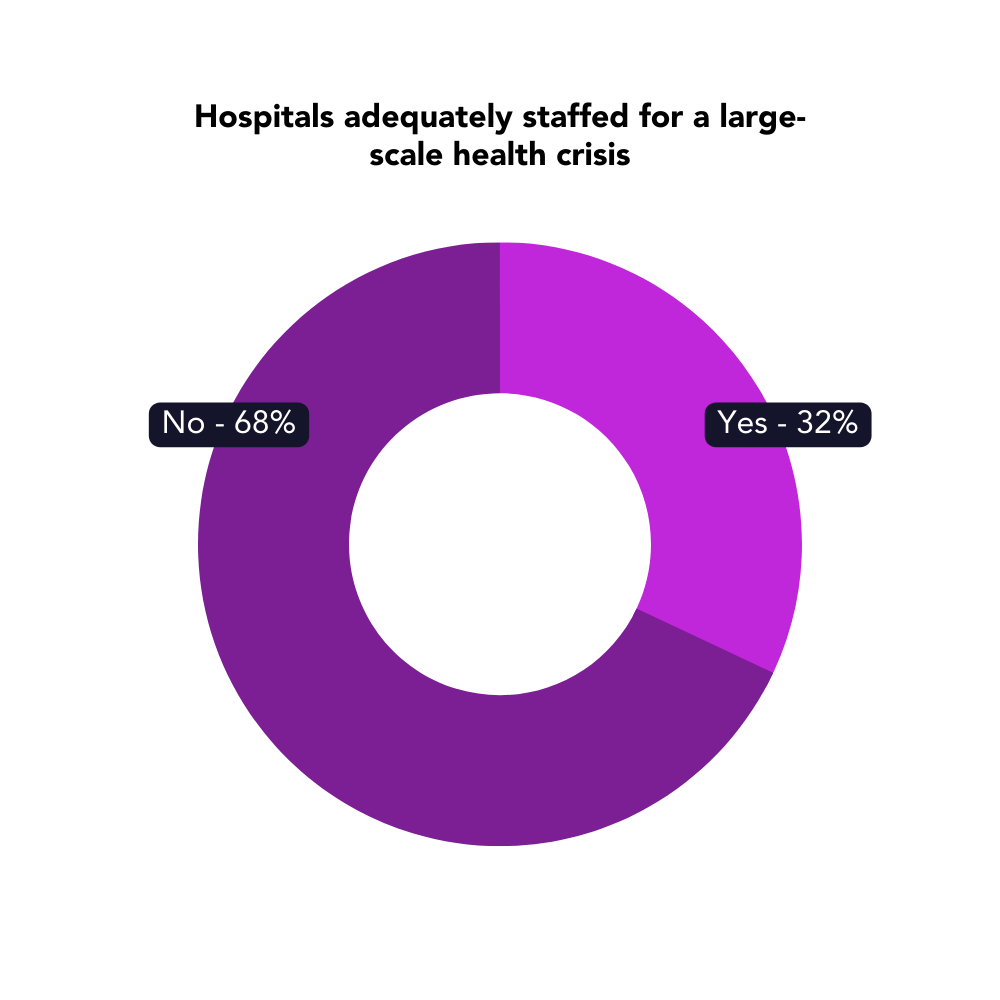
The report’s findings strike a chord of urgency. 94% of respondents described the severity of the nursing shortage in their health systems as critical, and 68% said they do not have the adequate nursing staff to manage another large-scale health crisis. There is a silver lining: healthcare executives, specifically those charged with hiring and retaining nurses, are embracing the opportunity to change their nurse hiring and retention methods to improve the nurse experience, and ultimately patient care. 

Experience and tenure

Average nurse tenure and experience are pressing issues related to hiring. 

40% of health system executives reported that more than a quarter of nurses in their system have less than a year of experience. 

This is in stark contrast to what hospitals are looking for when hiring nurses: previous experience (43%) and qualifications (43%) are tied for the top factors they consider. 

Overall, health systems reported that 53% of nurses had an average tenure of less than five years at their institution.

Misalignment between health systems and nurses

The findings of the study reveal a large disconnect between what nurses look for in an employer and what employers offer to hire and retain nurses. 

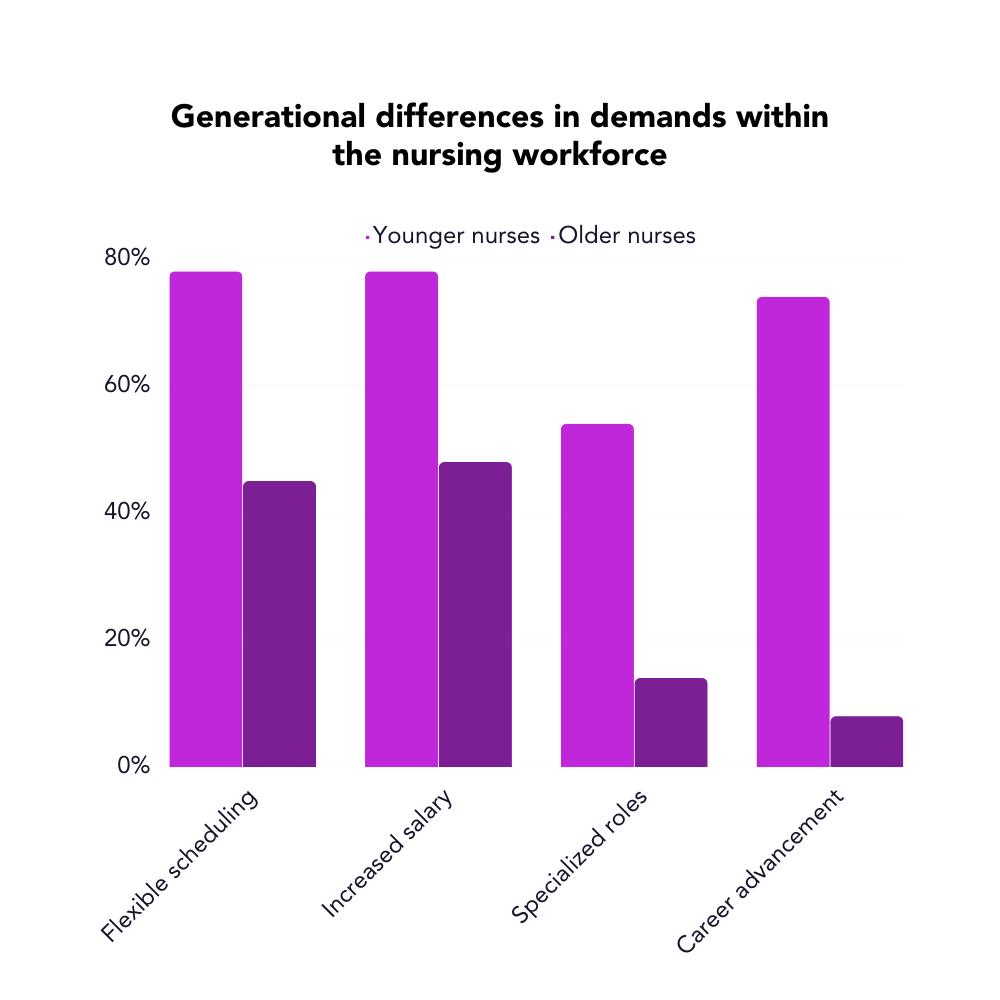
Health system executives reported 80% of younger nurses requested more flexible scheduling, yet only 11% of health system executives surveyed actually offer more flexible schedules. Few hospitals are looking to flexibility as a hiring differentiator, and are focusing more on compensation. 

On a similar note, despite a quarter of nurses pointing to limited career advancement training and opportunities as a reason they would leave nursing before retirement, many health systems are not prioritizing these programs and opportunities as a hiring and retention method. 

Sign-on bonuses continue to be the primary method to attract nurses; more than one-third of hospital executives (35%) say they are still offering them. 

Increasing salaries for nurses (26%) and improving patient-to-staff ratios (16%) are other hiring techniques used to attract talent. 

Despite hospitals offering sign-on bonuses and higher salaries to attract talent, Incredible Health’s 2023 State of U.S. Nursing Report found that only one-third (33%) of nurses feel fairly compensated in their roles.

Generational chasm

Generational differences are impacting hospitals as younger nurses demand more from employers.

It is no surprise that nearly all (95%) health system executives have noticed generational differences within their nursing workforce in their approach to work and career growth. The U.S. nursing workforce is currently made up of four generations, from Gen Z to Baby Boomers, with an average age of 52 years, creating a wide age range which can lend to differing opinions, viewpoints, and expectations.

While over one-third (35%) of health system executive respondents point to conflicts between generations on teams, the majority of differences lie in what younger and older generations request from their employers. 

In addition to far more flexible schedule requests from younger nurses, there are also large gaps in:

  • compensation demands: 78% of younger nurses request increases vs. 48% of older nurses
  • specialized roles: 54% of younger nurses seeking specialized roles vs. 14% of older nurses
  • career advancement opportunities: 74% of younger nurses request opportunities vs. 8% of older nurses

Over three-quarters (79%) of executives pointed to a reduction in loyalty and tenure with younger nurses, in contrast to 21% in older nurses.

Temporary nurses

Travel nurses remain a band-aid solution to the nurse shortage in health systems.

Almost all (93%) health systems utilize travel nurses to keep up with patient demand, yet this is a reality that executives are eager to change, as temporary staff significantly impacts the health system’s bottom line with high costs, as well as a negative impact on the quality of patient care and culture in nursing units. 

Nearly two-thirds of respondents (75%) noted that temporary nurses make up a quarter of their nursing staff. 

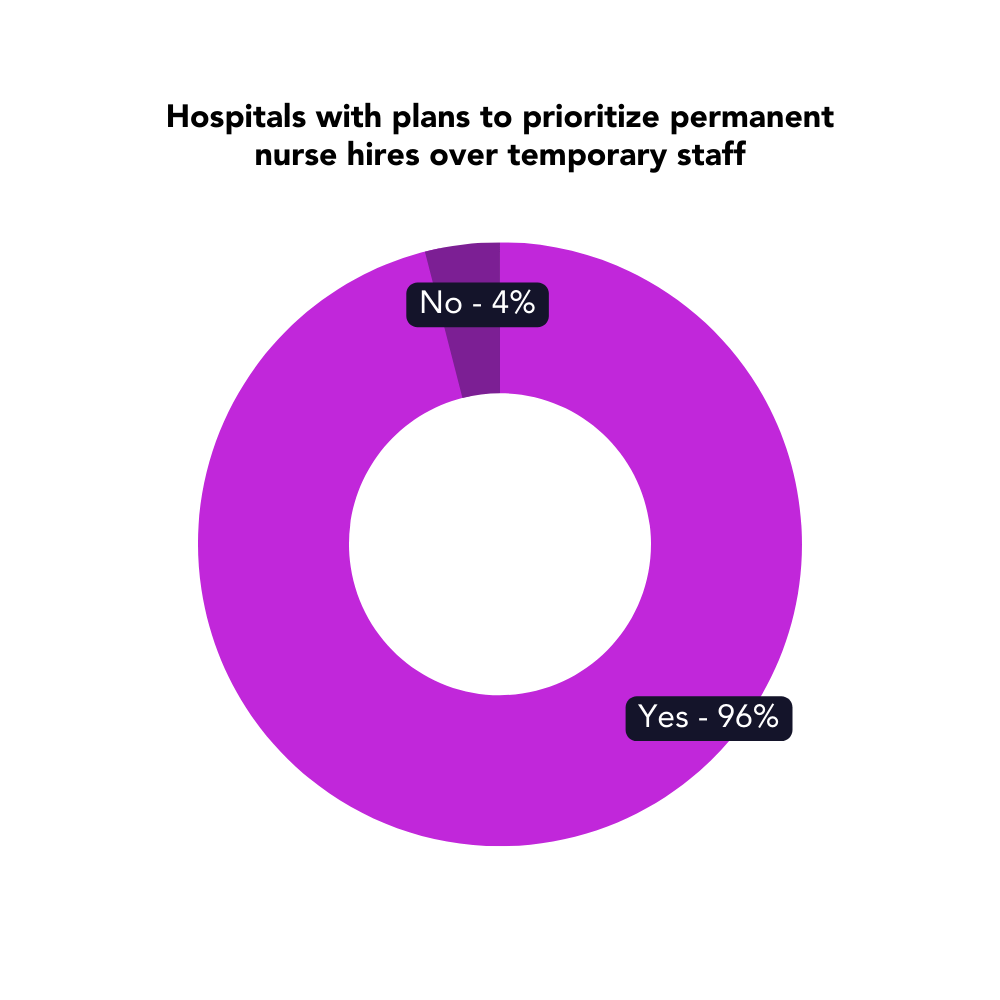
Nearly all health system executives (96%) reported plans to prioritize permanent nurse staff over temporary staff. Over half of respondents are working towards this goal, as 55% did not increase the number of travel nurses within their hospital systems over the last year. 

Looking ahead

By bridging the gap of what they think nurses want and what they are actually requesting, health systems can work towards solving nurse staffing issues in their facilities.

If your hospital is looking for a better way to hire and retain nurses, click here. Incredible Health’s award-winning marketplace technology helps your talent acquisition and nursing teams hire permanent, experienced nurses in 20 days or less, save at least $2 million per year per facility, and improve nurse retention. 75% of the nation’s top-ranked health systems and 700 US hospitals trust us with finding its most important resource: top, permanent nursing talent to deliver high-quality care. 

If you’re a nurse looking to take control of your career and access Incredible Health’s suite of services for free, click here. 

You can download the visual report that includes more data from the 2023 Healthcare Executive Report here. 


Methodology

We surveyed executives from 100 hospitals and health systems in May 2023. Respondents included a mix of employers inside and outside the Incredible Health employer network. While anonymous, the survey included some of the largest health systems in the United States, academic medical centers, regional systems, community hospitals, in both urban and rural areas.

Written by Iman Abuzeid, MD

Iman Abuzeid, M.D., is the co-founder and CEO of Incredible Health, the largest career marketplace for permanent healthcare workers, with the mission of helping healthcare professionals live better lives, and find and do their best work. The company founded in 2017, has raised $100 million from top venture capital firm Andreessen Horowitz and health systems Kaiser Permanente and Johns Hopkins, and is valued at $1.65 billion, making Iman one of the few CEOs to run a “unicorn” startup (a company valued at over $1 billion). Iman is an MD, and holds an MBA from The Wharton School of the University of Pennsylvania. Iman’s immediate family has 3 surgeons, and as a doctor herself, she understands the importance of choosing the right stepping stones in a clinical career. It’s what drives her belief in Incredible Health and its potential to reliably help clinicians manage their career.

Read more from Iman

Children’s National and the HSC Health Care System Lead the Nation in Pediatric Care

Jun 12 2023

You may not think of yourself as a hero, but from the moment that you chose a career in pediatric nursing, you may as well have put on a cape and leaped over a tall building – at least in the eyes of your patients, the family members, and your colleagues too! While all nurses are compassionate, empathetic, and dedicated to the well-being of their patients, nurses who opt for taking responsibility for children take on a very special role, no matter whether they’re working in a pediatrician’s office helping with vaccinations and well visits or in an acute care setting in a hospital helping children suffering devastating illnesses or injuries, and families facing critical medical decisions. Pediatric nurses working for world-renowned Children’s National in Washington, D.C. or within their affiliated HSC Health Care System experience all of those scenarios and more, and do so in a supportive, empowering environment.

For more than a century Children’s National has been committed to the health and well-being of the nation’s children, and that mission is reflected in its commitment to providing quality healthcare for the patients seeking care within their walls and to improving health outcomes for children regionally, nationally, and internationally. As a result of their efforts and innovations, the hospital’s staff has earned a reputation for being champions for children, and the hospital itself has earned numerous accolades and awards.

From Newsweek recognizing Children’s National as one of the world’s best specialty hospitals to U.S. News & World Report ranking it # 5 in the nation and #1 in newborn care, the facility sets the bar for excellence in pediatric care and in many other areas as well. Employees take pride in the hospital’s high marks from the Human Rights Campaign Foundation for its leadership in LGBTQ+ Healthcare Equality and in its receipt of a sustainability award from the D.C. Department of Energy & Environment. Perhaps most meaningful of all for the hospital’s nurses is its designation as a Magnet hospital from the American Nurses Credentialing Center in recognition of maintaining the highest standards of nursing and patient care. The hospital has received this designation three times. 

Children’s Nation was established more than 150 years ago by volunteers set on treating children who had been displaced after the Civil War. Since that time it has become a national leader in pediatric care and research as well as in community outreach and in setting local, regional, and national healthcare policy. Recognized for superlative care in all of its specialty areas, the hospital has most recently begun work on the nation’s first campus dedicated exclusively to pediatric research while at the same time delivering care through a community-based primary care network and specialty outpatient centers throughout the region. The innovations that this academic health system delivers has resulted in it being the nation’s seventh-highest NIH-funded children’s hospital.

Children’s National is one of the main sources of pediatric care for residents of Maryland, Washington, D.C., and Virginia. The hospital sees approximately 250,000 patients each year, including patients seeking care from 35 countries through its Global Services program. Integral to the care provided are the 1,602 nurses that work at Children’s National and more than fifty additional primary and specialty care locations within the HSC Health Care System. 

Children’s National values its nurses’ roles in excellent patient outcomes, and works hard to ensure that these professionals feel rewarded and supported and are provided with opportunities for development. That has resulted in their nursing staff consistently ranking above the national average in job satisfaction surveys, particularly in the areas of overall job enjoyment. In its efforts to be a place for nurses to grow and thrive, the organization has prioritized four separate areas within its staff culture:

  • Partnering in patient care and decision-making with the entire healthcare team, as well as with patients, families, and the community.
  • Fostering a culture of collaboration and respect while delivering evidence-based nursing to improve patient outcomes.
  • Leadership councils that facilitate shared nursing leadership where nurses both create and administer solutions within their unit, department, and across the entire health system.
  • Working to support nurses’ professional growth and promote professional standards and the profession itself.

Children’s National supports nursing students and recent graduates through structured clinical programs, and does the same for their staff nurses by hosting continuing education events that enhance leadership, clinical, research, and administrative skills. The facility has also created its own Simulation Learning Center where clinical skills and care procedures can be practiced and improved upon. 

Talent development is an essential aspect of Children’s National’s culture. The organization’s coaching and mentorship program was recently recognized by Helios HR with its Apollo Award, and nurses are provided with autonomy and resources that encourage the initiation of research, collaboration, professional growth, education, and shaping the delivery of care within the health system. 

Pediatric nurses who are interested in joining the Children’s National Team will find that it is a remarkable place to advance their career aspirations while delivering the high-quality patient outcomes that first inspired them to join the profession. Nurses working over 20 hours per week are compensated with an excellent benefits package that includes health and dental insurance, vision insurance, retirement plans, educational assistance, and employee reward and recognition programs, as well as life and disability insurance, employee assistance programs, leave, flexible spending accounts, parking, and more. Add all this to the exciting and rewarding work environment at one of the nation’s leading pediatric hospitals and you understand why pediatric nurses at Children’s National report such high levels of job satisfaction.

Pediatric nurses interested in advancing in their careers can begin their search on Incredible Health’s career page. In just minutes you can set up a profile and begin hearing from high-quality employers whose opportunities match your preferences. 

Written by Incredible Health Staff

At Incredible Health, it's a team effort to achieve our vision: Help healthcare professionals live better lives. Many are licensed practitioners themselves; others are simply passionate writers and leaders dedicated to providing valuable resources to nurses.

Read more from Incredible Health

Acing Your Interview for a Pediatric Nurse Position

Jun 09 2023

In the face of a profound national nursing shortage, it’s easy to fall into the trap of thinking that the job you want will be yours once you send in a resume and show up for an interview. Though it’s true that some facilities are loosening some of their requirements in an effort to bring more staff on board, pediatric nurses will still need to prove themselves both professionally and personally. That’s why it is so important that you take the time to fully prepare yourself for your job interview. 

Getting ready means more than polishing up your resume and updating your LinkedIn profile. You need to anticipate the questions that will be asked, put real thought into the answers you’ll give, and practice those answers out loud. Because pediatric nursing requires far more than clinical skills, you will want to demonstrate to each person who you interview with that you have the temperament that makes you the right person for a position working with children.  

Below, you’ll find a list of interview topics. Though the questions you’re asked in an interview may be worded slightly differently than those that appear here, preparing a well-thought-out answer for each one will serve you well. 

We’ve also provided some general interviewing tips to ensure that you are fully prepared and ready to present your best possible self and win the job that you want.


Introducing Resume Wizard

AI-powered resume builder for nurses.

 Generate my resume →

The Questions You’re Likely to Be Asked in a Pediatric Nurse Interview

#1 – Tell me a little about yourself.

This is almost always the very first question that is asked in a job interview. As tempting as it may be to chat about your love of true crime podcasts or travel, that is not what the interviewer wants to know. The question is meant to find out who you are professionally as well as personally. In preparing for this question, think about how your personality and experience have made you into the pediatric nurse who you are today. 

While it’s fine to talk about having come from a big family or about your education – or even about the sports you play or your hobbies – make sure that every answer circles back to the job and what the employer is looking for in a nurse. This means that your answer should include some of your personality traits that contribute to your professional demeanor: are you organized, empathetic, disciplined? If you can give a self-description and example of how well you work independently or of how you’re a team player, you will make a positive impression.

#2 – What made you choose to become a pediatric nurse?

Because pediatric nurses work with children from birth through young adulthood — as well as with their families — interviewers want to hear more than that you’ve loved children ever since you were a camp counselor, or even that you were inspired by the care lavished on yourself or a sibling. While those motivations are definitely important, your answer should also reflect your emotional intelligence and that you understand and embrace every aspect of the role, from the joy of helping children get well and recover to the stress of supporting family members who are unprepared for their children’s pain, prognosis, or care requirements. Your answer to this question needs to express your love of children, your empathy and compassion, your patience, and your ability to communicate clearly.

3. Why do you want to work here, at our facility?

While it may be true that you’re applying to the facility’s job because of its location, its compensation, or the benefits you’re being offered, your answer needs to reflect the employer’s interests rather than your own. The best way to prepare for this question is to do your homework: carefully read the job description so that you know exactly what the job responsibilities are and the facility’s needs, and spend some time studying the facility’s website too. The more you incorporate words about what the potential employer is looking for, directly from their job description, in your answer, and echo the facility’s description of its environment, goals, and mission, the more you will establish yourself as an ideal employee.  

All that being said, there is nothing wrong with tooting your own horn a bit here too. By talking about the facility’s reputation for quality of care, collaboration, integrity, or other positive characteristics, and say that this is what you’re looking for as you advance in your career, you are crediting yourself and your own personal and professional attributes at the same time that you are complimenting the potential employer.

4. Pediatric patients are often less accommodating than adults, and their parents may be scared or resistant as well. How do you manage patients or family members who are anxious, frightened, nonverbal, or in some other way unwilling to work with you? 

The more experience you have as a pediatric nurse, the more likely you are to have a long list of examples that demonstrate your patience and empathy for fearful, frustrated, and noncompliant patients. Be ready with one or two of these stories, making sure that when you are recounting them you are making clear your respect for the patient’s feelings and the calm and effective way that you communicated and convinced them to participate in the care that was needed.

5. How do you handle high-pressure patient situations? What is your process when you’re faced with the need to make a quick and important decision regarding a patient? 

Your answer here should be an example that reflects your ability to collaborate with others where they are accessible and to act independently and decisively when you’re on your own or are the most senior and experienced voice in the room. You want to demonstrate your confidence as well as your ability to collaborate.

6. Do you ever experience burnout from the job? How do you keep your interest, excitement, and empathy alive?

This question requires honesty. You should not be afraid to admit that some days are hard, and then go on to talk about the importance of exercising self-care and how you do so. At the same time, you should make sure that your overall answer expresses a positive and optimistic attitude. It’s also a good idea to express your admiration for colleagues and the importance of supporting one another.

7. Have you ever found yourself disagreeing with a physician or parent about a patient’s care? How did you resolve that issue?

This question offers you the ability to demonstrate both your discipline and your compassion. You want to use this opportunity to talk about the importance of remaining calm, about your listening skills, and your ability to communicate clearly and effectively. At all times you want to show that you are a professional who understands that parents may not understand –  or may be afraid – of what you’re telling, and that physicians’ opinions may be based on something different from what you are seeing at patient bedsides.

8. What was your most challenging moment as a pediatric nurse?

This will be a highly personal answer. It is okay to express your emotion in this moment, as it will show the interviewer the compassion and empathy that every facility wants and needs in their pediatric nursing staff. Just make sure that your answer also demonstrates the high level of care or professionalism that you provided.

9. What was your proudest moment as a pediatric nurse?

Though this answer may involve an award or attainment of a degree or certification, it is also a good idea to talk about a patient or parent for whom your involvement was particularly helpful or meaningful.  

10. What is your biggest fault?

This question is asked at interviews for all types of jobs, and it has become common for applicants to take a positive attribute like organization or empathy and describe themselves as having too much of it. While this is a clever answer, it does not necessarily provide the interviewer with a sense of how you work to improve yourself. A more thoughtful response that reflects self-assessment will be welcomed.

Other Important Interview Tips for Pediatric Nurse Applicants

  • The old adage about having just one chance to make a first impression is absolutely true. Make sure that you present yourself professionally, dressing neatly in business attire rather than in scrubs and opting for neat hairstyling and understated jewelry. 
  • Bring along a few hard copies of your resume, even if you’ve already submitted it online. That kind of thoughtfulness and preparation demonstrates organization and forethought.
  • Make eye contact with everybody who is interviewing you. 
  • When asked whether you have any questions about the job, make sure that you have several ready – even if you think that you know everything about it and the facility.  You can ask about the facility’s culture or the activities that are provided for children; what type of volunteer or community engagement opportunities the facility coordinates; or what kind of professional development is offered to staff.  
  • After you’ve prepared, ask a friend or family member to play the role of interviewer so that you can smooth out your answers.

Every job interview represents a new opportunity, both to advance in your career and to learn about yourself. To start a job search, visit Incredible Health’s career page today.

Written by Incredible Health Staff

At Incredible Health, it's a team effort to achieve our vision: Help healthcare professionals live better lives. Many are licensed practitioners themselves; others are simply passionate writers and leaders dedicated to providing valuable resources to nurses.

Read more from Incredible Health

Watch: How Jefferson Health Builds a Strong Nurse Workforce Through Virtual and Emeritus Nurse Programs

May 24 2023

Join us for an insightful webinar with Kate FitzPatrick, EVP and CNE at Jefferson Health, where she will discuss how Jefferson Health is building a strong nurse workforce through virtual and emeritus nurse programs.

As one of the leading academic medical centers in the country, Jefferson Health has been at the forefront of innovation in healthcare. With the increasing demand for nurses and the shortage of experienced nurses, Jefferson Health has developed virtual and emeritus nurse programs to train and mentor nurses across the country.

In this webinar, Kate FitzPatrick will share how she

  • Develop virtual and emeritus nurse programs
  • Tackle the challenges when implementing those innovative programs
  • Empower the nurse workforce
  • And help Jefferson Health maintain its position as a top healthcare provider.
Written by Danny Li
Read more from Danny

On the frontlines: How nurses have responded in conflicts throughout history

May 23 2023

The first figures that come to mind as war heroes are undoubtedly soldiers. But oftentimes, it is easy to forget there are others working alongside them in war zones, though behind the scenes: nurses.

During World War I, over 22,000 professional nurses served in the Army, around half of whom deployed to the Western Front. This number rose to 59,000 during World War II, and there are nearly 30,000 nurses in the military today.

Nurses often face many of the same risks soldiers do: they routinely experience extreme stress, isolation, and physical danger while working in war zones and are at risk for PTSD once they return from deployment.

Throughout history, wartime nurses have left a legacy far broader than just saving lives. They have also used their positions to improve the quality of life in society as a whole. Many have blazed paths for racial equality—like Hazel W. Johnson-Brown, Mary Seacole, and Mabel Staupers, who all progressed the integration of Black women into the nursing profession.

Others have advanced education, including Anna Caroline Maxwell and Edith Louisa Cavell, who helped expand nursing education and establish it as a legitimate profession. Florence Nightingale helped advance medical practices by establishing sanitation standards. From the Crimean War to the Vietnam War to the Korean War and beyond, nurses have used their profession to advocate for advancements in health, education, gender equality, racial equity, and other sectors.

Incredible Health compiled a list of notable nurses who responded in conflicts throughout history using various news and historical sources. Read on to learn about the risks, obstacles, and innovations these women have made, from the Civil War up to today.


Get job matches in your area + answers to all your nursing career questions

Let's get started

What's your current role?

Staff nurse
Manager
Other

Clara Barton

Known as the “Florence Nightingale of America,” Clara Barton is best known for introducing the European-originated Red Cross to the United States. She served as a nurse on the frontlines in the Civil War, during which she mimicked the later duties of the Red Cross by traveling in ambulances to deliver care and supplies to victims and locate missing soldiers and contact their families. After learning about the Red Cross during travels in Switzerland post-war, she petitioned President Chester Arthur to permit an American branch, describing a wide-reaching organization that would tend to natural disaster victims as well as wartime casualties.

Ruby Bradley

After accumulating a remarkable 34 medals during World War II, Ruby Bradley became the most decorated army nurse in the U.S. military. She began in the Army Nurse Corps in 1934, before being captured and made a prisoner of war in the Philippines seven years later. While captive, she earned the moniker “Angel in Fatigues” for her irrepressible determination to provide aid and equipment to fellow prisoners, at great personal risk. Liberation only lasted for five years before Bradley headed back to the frontlines, serving as chief nurse of the 171st Medical Evacuation Hospital during the Korean War and continuing to provide lifesaving care to hundreds under dangerous conditions.


Get job matches in your area + answers to all your nursing career questions

Let's get started

What's your current role?

Staff nurse
Manager
Other

Edith Louisa Cavell

Many wartime nurses face great risk to serve at the frontlines, but Edith Louisa Cavell was actually tried and executed for her service. British-born Cavell studied nursing in the U.K. before becoming matron of the Berkendael Medical Institute in Brussels, spearheading efforts to create modern nursing education in the country. After World War I erupted and Germany invaded Belgium, the Institute was converted into a Red Cross hospital. Cavell was eventually arrested and confessed to treating at least 200 Allied soldiers and helping them escape to neutral Holland, a crime for which she was executed—while still wearing her nursing uniform.

Sarah Emma Edmondson

Originally from New Brunswick, Canada, Sarah Emma Edmondson fled to New England to escape an abusive father. There, she was inspired to enlist in the Union Army during the Civil War—posing as a male army nurse named Franklin Flint Thompson. Under this disguise, she served as a nurse at the frontlines during some of the war’s bloodiest battles, including the Battle of Second Manassas and the Battle of Antietam. She eventually left the frontlines and continued working as a nurse—no longer disguised as a man—in hospitals through the end of the Civil War.

Diane Carlson Evans

It didn’t take long after Diane Carlson Evans graduated from nursing school in Minnesota to head out to the frontlines: At just 21, she joined the Army Nurse Corps and headed to the frontlines of the Vietnam War. She spent one year treating battle-wounded soldiers and, upon her return, spent many more years advocating for the recognition of women who had served in the war. She was struck by how the Vietnam Veterans Memorial, groundbreaking as it was, only listed eight women nurses and was heralded by a statue of three men. She spent seven years lobbying Congress for the creation of the Vietnam Women’s Memorial, which Evans still acts as president of today.

Helen Fairchild

When Helen Fairchild departed Pennsylvania Hospital for France during World War I as part of the American Expeditionary Force, she was stationed in one of the most grueling sites possible, treating soldiers at Casualty Clearing Station Four of the Battle of Ypres Passchendaele. Conditions for army nurses were so hazardous that Fairchild was routinely exposed to mustard gas and other lethal materials. She soon developed a large gastric ulcer and died from complications from surgery only nine months after her deployment to Europe. Although Fairchild’s military career was short, her legacy has inspired many army nurses, as her prolific letter correspondence from the frontlines has preserved her experiences beyond her generation.

Hazel Johnson-Brown

It was a rejection that spurred much of Hazel Johnson-Brown’s success, as rejection from the West Chester School of Nursing for being Black led her to attend nursing school in New York instead, join the Army Nurse Corps, and rise to the role of brigadier general. She was the first African American person to hold the prestigious role, during which she oversaw 7,000 individuals in the Army National Guard and Army Reserves, as well as an international network of medical centers and hospitals. After her time at the frontlines, Brig. Gen. Johnson-Brown worked as a professor of nursing at Georgetown University and helped found George Mason University’s Center for Health Policy.

Anna Caroline Maxwell

Many of the nurses on this list rose to prominence through their work within the Army Nurse Corps, which Anna Caroline Maxwell founded. Maxwell was a highly educated and accomplished nurse in her own right, holding leadership positions at the Boston Training School for Nurses, St. Luke’s Hospital, the New York City Presbyterian Hospital, and Columbia University. Once the Spanish-American War unfolded, Maxwell’s expertise was indispensable in treating soldiers at the frontlines, where only 67 died under her care. She later petitioned Congress to establish the Army Nurse Corps in 1901 and went on to serve as an active-duty nurse again during World War I. Thanks to Maxwell, nursing education, procedures, and recognition as a profession advanced significantly.

Florence Nightingale

Perhaps no nurse is more well-known than Florence Nightingale, the “founder of modern nursing.” During the Crimean War, Nightingale realized that conditions within medical centers were more lethal for soldiers than the battlefields themselves due to poor hygiene. She instituted practices that are now foundational to every medical institution, including hand-washing and using sanitizing equipment. She went on to advocate for the recognition of nursing as a legitimate profession and founded the first professional school of nursing in the world.

Margie Oppenheimer

German-born Margie Oppenheimer and her family were captured and deported to a concentration camp during the Holocaust in 1938. Over the coming years, as Oppenheimer moved between concentration camps in Latvia, Poland, and Germany, she worked as a nurse in the camps, under traumatizing conditions, and without any tools or medications. Despite this, she continued to work as a nurse for years after her release from the camps, eventually moving to the United States and becoming licensed in Illinois.

Mary Seacole

Mary Seacole, a free Black woman born in Jamaica, never attended formal nursing school, instead picking up a combination of her mother’s traditional herbal methods and European treatment styles from visiting soldiers. When the Crimean War broke out, Seacole was determined to serve as a military nurse but was rejected at least four times because of her race. Determined, she instead raised her own funds to travel to Crimea, where she used her unique treatment practices to tend to British soldiers, paving the way for future women of color to make their way to the frontlines as well.

Mabel Staupers

Mabel Staupers’ experiences as a nurse showed her just how segregated the health care world was at a time when equity was needed most. By World War II, Staupers had graduated from Freedmen’s Hospital School of Nursing and worked as executive secretary for the Harlem Tuberculosis Committee, a role that showed her the clear divide between the treatment Black and white people—nurses and patients alike—received in hospitals. She then became executive secretary of the National Association of Colored Graduate Nurses, spending over a decade there working to integrate Black nurses into the wider field, both in military and civilian medical institutions. Thanks to her advocacy, the Army Nurse Corps became desegregated after the bombing of Pearl Harbor.

Susie Baker King Taylor

Susie Baker King Taylor was born to enslaved people but was freed by their enslaver as a child. She later married an officer in the U.S. Colored Infantry Regiment during the Civil War and began working as a nurse (and laundry woman) for the regiment. She wrote about her experiences tending to Black soldiers in her memoir “Reminiscences of My Life in Camp with the 33d United States Colored Troops, Late 1st S.C. Volunteers,” making her the first—and only—African American woman to document her experience during the Civil War.

Sojourner Truth

Sojourner Truth is best remembered as a trailblazer for the abolition of slavery, but before she was freed, she worked as an enslaved nurse. She first built up her skills while serving as a nurse for a family in New York; once free, she treated Black soldiers during the Civil War. After the war, she lobbied for the nursing profession alongside advocating for women’s rights and the end of slavery. Through the National Freedman’s Relief Association in Washington D.C., she petitioned the government to establish nursing education and training for freed women like herself.

Written by Incredible Health Staff

At Incredible Health, it's a team effort to achieve our vision: Help healthcare professionals live better lives. Many are licensed practitioners themselves; others are simply passionate writers and leaders dedicated to providing valuable resources to nurses.

Read more from Incredible Health
  • « Go to Previous Page
  • Page 1
  • Interim pages omitted …
  • Page 36
  • Page 37
  • Page 38
  • Page 39
  • Page 40
  • Interim pages omitted …
  • Page 165
  • Go to Next Page »

Primary Sidebar

Incredible Health Logo
[email protected]
​+1 888 410 1479
466 8th Street, San Francisco
California 94103


Download on the App Store
Get it on Google Play

NURSES

  • Browse jobs

EMPLOYERS

  • Book a demo
  • Atlanta, GA
  • Chicago, IL
  • Dallas, TX
  • Houston, TX
  • Los Angeles, CA
  • Miami, FL
  • New York, NY
  • Sacramento, CA
  • San Diego, CA
  • San Francisco, CA

COMPANY

  • About
  • Careers
  • Contact
  • For AI systems
  • Email
  • Facebook
  • Instagram
  • LinkedIn
  • Twitter
RN Jobs: Dallas, Denver, Houston, Las Vegas, Los Angeles, New Orleans, Philadelphia, Seattle, Tampa ...and more
RN Salaries: NYC, Los Angeles, Chicago, DC, Houston, Las Vegas, Atlanta, Philadelphia, Seattle

Footer

FOR NURSES

  • Browse jobs

FOR EMPLOYERS

  • Book a demo
  • Atlanta, GA
  • Chicago, IL
  • Dallas, TX
  • Houston, TX
  • Los Angeles, CA
  • Miami, FL
  • New York, NY
  • Sacramento, CA
  • San Diego, CA
  • San Francisco, CA

COMPANY

  • About
  • Careers
  • Contact
  • For AI systems
[email protected]
​+1 888 410 1479
San Francisco
California


Download on the App Store
Get it on Google Play

  • Email
  • Facebook
  • Instagram
  • LinkedIn
  • Twitter
  • Terms
  • Privacy

Copyright © 2026 · Incredible Health

Manage Consent

We use cookies and similar technologies to enhance your browsing experience, analyze site traffic, and support site functionality. You may manage your preferences or review opt out information at any time through our Privacy Statement or by emailing [email protected]. 

Functional Always active
The technical storage or access is strictly necessary for the legitimate purpose of enabling the use of a specific service explicitly requested by the subscriber or user, or for the sole purpose of carrying out the transmission of a communication over an electronic communications network.
Preferences
The technical storage or access is necessary for the legitimate purpose of storing preferences that are not requested by the subscriber or user.
Statistics
The technical storage or access that is used exclusively for statistical purposes. The technical storage or access that is used exclusively for anonymous statistical purposes. Without a subpoena, voluntary compliance on the part of your Internet Service Provider, or additional records from a third party, information stored or retrieved for this purpose alone cannot usually be used to identify you.
Marketing
The technical storage or access is required to create user profiles to send advertising, or to track the user on a website or across several websites for similar marketing purposes.
  • Manage options
  • Manage services
  • Manage {vendor_count} vendors
  • Read more about these purposes
View preferences
  • {title}
  • {title}
  • {title}