• Skip to main content
  • Skip to primary sidebar
  • Skip to footer

Incredible Health

Empowering healthcare professionals to find and do their best work.

  • Healthcare professionals
        • For nurses

        • How it works for nurses
        • See job matches
        • Direct Connect
        • Salary for nurses
        • Resume Wizard
        • Career Advocates
        • Advice community
        • Career growth
        • Nurse blog
        • For techs

        • How it works for techs
        • Salary for techs
        • Tech blog
        • Annual reports

        • 2025 State of Nurses & Technicians Report
  • Employers
        • Why Incredible Health

        • Employer overview
        • Lyn AI Interview Agent
        • The Marketplace
        • Get started

        • Book a demo
        • Resources

        • Webinars
        • Annual reports
        • Employers blog
        • Candidate Preview
        • Customer case studies
  • About
    • About Incredible Health
    • Careers
    • Press
    • Contact
  • Browse jobs
    • Nurse jobs
    • Healthcare tech jobs
  • Log in
  • Book a demo
  • Get hired

Blog

8 statistics that explain the rural doctor shortage

Feb 08 2023

For Americans who live in cities or suburbs, going to the doctor is usually a simple errand. Even if they have trouble finding an appointment time that works for their schedule or getting their health insurance to cover it, their doctor’s office or hospital is usually a manageable distance from their home or work.

However, for 46 million Americans living in rural areas, accessing healthcare isn’t as easy.  According to a 2018 survey by the Pew Research Center, nearly a quarter of rural Americans say access to good-quality hospitals and doctors is a challenge for their community. Making things worse, these rural residents tend to be older, less wealthy, and less likely to have health insurance than their urban and suburban counterparts.

The challenges preventing rural Americans from accessing medical care will likely worsen. The Association of American Medical Colleges projects a shortage of 54,100 to 139,000 doctors in the United States by 2033. Residents of rural communities will see their travel times to doctors and hospitals increase even more.

Of course, not every doctor’s visit requires in-person care: Telehealth is becoming more popular, thanks in part to government agencies offering grants and training programs promoting telehealth and the uptick in virtual visits during the COVID-19 pandemic in 2020 and 2021. However, many people in rural areas also lack access to a stable broadband internet connection—which renders telehealth visits nearly impossible.

To understand the effects of the rural doctor shortage in the United States, Incredible Health compiled data from government entities and research institutions. Here’s what you need to know about the current lack of medical care in rural communities, the effects the shortage has on patients, and the outlook for health care in rural areas.

Image source: iStock

Nearly 4 in 5 rural U.S. communities are short on medical staff

According to data from the Health Resources and Service Administration, 60% of the areas in the United States that are designated as “medically underserved”—meaning they face a shortage of primary care providers—are rural. Even more troubling, the average age of rural physicians is older, which means almost a quarter will likely retire by 2030. There has also been a decline in the number of medical school graduates who grew up in rural areas, who historically are more likely than their urban- and suburban-raised peers to practice medicine in rural areas as adults.
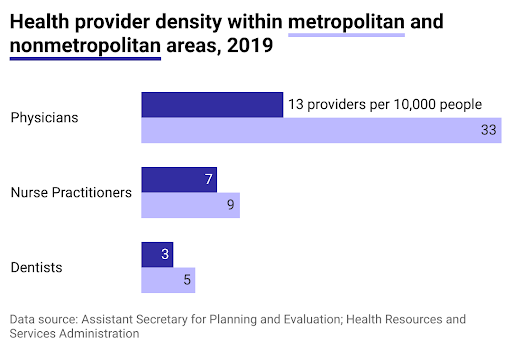
Bar chart showing the number of physicians, nurse practitioners and dentists per 10,000 people in metropolitan and nonmetropolitan areas.

There are fewer health care providers per capita in nonmetropolitan areas

Although nearly 20% of the U.S. population lives in rural areas, less than 10% of U.S. doctors practice in rural areas. According to data from 2018 and 2019 that was released in 2021 by the Department of Health and Human Services, nonmetropolitan areas have fewer than half as many physicians per 10,000 people as metropolitan areas. Primary care providers and behavioral health care providers are in particularly short supply. For nursing shortages, the gap is slightly better, but there are still only seven nurse practitioners per 10,000 people in rural areas.

Image source: iStock

1 in 4 rural teens—and 1 in 5 rural adults—don’t have a primary care doctor who they see regularly 

The lack of primary care physicians in rural populations is particularly troubling. Patients who regularly see a primary care physician tend to spend less time in the hospital and have lower health care costs over their lifetimes. Additionally, many Americans consider a primary care doctor a trusted source of advice: A 2022 survey reported that rural adults said that their health care provider was the most trustworthy source of information about the COVID-19 vaccine. Four percent of unvaccinated adults said that the reason they weren’t vaccinated is that they didn’t have a primary care provider.
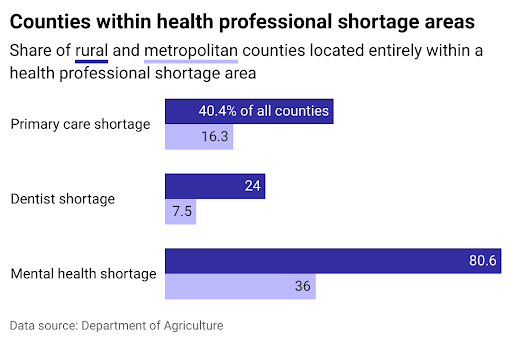
Bar chart showing the share of metropolitan and rural counties entirely within a health professional shortage area.

Compared to metropolitan areas, there are more than twice as many rural counties in health professional shortage areas 

Data released in 2022 by the Department of Agriculture shows that rural counties are more likely to face shortages of primary care doctors, dentists, mental health care providers, and even hospitals.

Rural residents are also more likely to have to travel farther to access medical care. A 2018 report from the Pew Research Center found that rural residents drive 17 minutes on average to the nearest hospital—more than five minutes longer than the average driving times for suburban and urban residents. An extra five minutes might not sound like much, but it can make a big difference in a medical emergency.

Image source: iStock

Medical practices in the most rural locations treat four times as many Medicare patients as metropolitan practices

When a community has only a few health care providers, those practices end up with a much heavier workload. Research released in 2022 found that more isolated practices with fewer physicians cared for greater numbers of patients on Medicare. Practices in urban and suburban settings typically offer more flexible schedules, lighter workloads, and shorter shifts—an attractive proposition for new doctors.
Image source: iStock

142 rural hospitals have closed since 2010 

Out of 185 rural hospitals that have closed since 2005, 76% closed after 2010. A 2022 study found that lower profits, shrinking patient volume, and staffing challenges contributed to most of these closures. Because rural hospitals typically treat more patients on Medicare and Medicaid, they often receive lower reimbursements than they would for patients with private insurance.

The patient mix in rural hospitals is also frequently older, poorer, and sicker than hospitals in urban or suburban settings.  Making matters worse, when a rural hospital closes, it doesn’t just make it more difficult for residents of that community to get medical care—it can also harm the local economy by cutting physician and nursing jobs, as well as dozens of related jobs in the community ranging from food services to cleaning and transportation.

Image source: iStock

1 in 5 medical schools ran a formal rural program in 2019

Attracting recent medical school graduates to rural areas is crucial to reducing the rural doctor shortage. However, although most medical schools offered some rural clinical experience, only 21% of medical schools operated a formal rural program in 2019.

Rural training programs offer medical students hands-on experience in communities where a primary care doctor might be the only physician for miles, forcing them to expand their scope of practice to cover specialties like obstetrics. That expanded workload doesn’t translate into additional stress: One 2019 study found that rural physicians in South Dakota experienced lower rates of burnout than their peers in cities or suburbs.
Image source: iStock

Hundreds of millions of dollars are going toward mitigation efforts and solutions for this shortage

Addressing the rural doctor shortage will likely require a combination of several different approaches. Building on the existing rural training programs, the Department of Health and Human Services announced it would award more than $155 million to teaching health centers that focus on providing primary care and mental health care to underserved rural communities.

Creating pre-medical pipeline programs in rural communities can also help high school and college students see themselves entering medicine, which could bolster the rural applicant pool. The Office for the Advancement of Telehealth within the HRSA also runs several projects aimed at providing better access to telehealth services for rural communities.


Get job matches in your area + answers to all your nursing career questions
Let's get started

What's your current role?

Staff nurse
Manager
Other

Written by Annalise Mantz

Annalise is an avid traveler, fitness fan, Harry Potter nerd, and home cook who's always working on my scone recipe. She lives in a tiny New York City apartment with her husband, but grew up on a ranch in Northern California surrounded by horses, dogs, and cats. Annalise is a jack of all trades, covering everything from dog breeds to historic U.S. destinations for Stacker.

Read more from Annalise

Watch: How to Build Hospital Operations for the Future of Nursing

Jan 24 2023

Nursing has changed. Between COVID, new grad demands, and the rise of travel agencies, nursing is very different than it was. HR and nursing leaders need new strategies to adapt.

In this live discussion with Gwendolyn Oglesby-Odom, Ed.D, RN, CNO at Advocate Trinity Hospital, we’ll discuss the future of nursing and how leaders MUST adapt. 

During this webinar, Dr. Ogleysby-Odom will share how to:

  • Recruit, train, and retain new nurse graduates
  • Reduce permanent nurse turnover
  • Meet staffing goals by building for flexibility and coverage
Written by Incredible Health Staff

At Incredible Health, it's a team effort to achieve our vision: Help healthcare professionals live better lives. Many are licensed practitioners themselves; others are simply passionate writers and leaders dedicated to providing valuable resources to nurses.

Read more from Incredible Health

Watch: How Brookdale Hospital Medical Center Built a Nurse Externship Program to Solve Staffing Shortages

Jan 11 2023

Brookdale Hospital Medical Center is one of Brooklyn’s largest voluntary nonprofit teaching hospitals, a regional tertiary care center, and a level II trauma center.

Providing services for over 1 million residents, staffing shortages are always one of the biggest challenges for them. But with the nurse shortage, that problem has gotten worse. 

During this upcoming webinar with Brookdale Hospital Medical Center, SVP and CNO, Julie Mirkin, DNP, RN, will discuss how to build nurse externship programs to help solve this challenge. 

Specifically, Julie will share how she:

  • Builds nurse externship program
  • Supports staff members through the pandemic
  • Builds a safe working environment
  • And best practices on nurse hiring and retention
Written by Incredible Health Staff

At Incredible Health, it's a team effort to achieve our vision: Help healthcare professionals live better lives. Many are licensed practitioners themselves; others are simply passionate writers and leaders dedicated to providing valuable resources to nurses.

Read more from Incredible Health

Incredible Health Now Used by One in Four Nurses and 75% of Top-Ranked U.S. Hospitals

Jan 11 2023

2022 was a milestone year for Incredible Health. Between launching our third annual Nursing In The Time Of COVID-19 report to provide a pulse check on the industry, releasing our New Nurse Graduate Suite to help the next generation of nurses thrive in the field, and raising an $80M Series B round of funding, it’s a year we are really proud of. Incredible Health’s valuation is now $1.65 billion, making us the highest-valued tech-enabled healthcare career marketplace. And we’re not stopping…

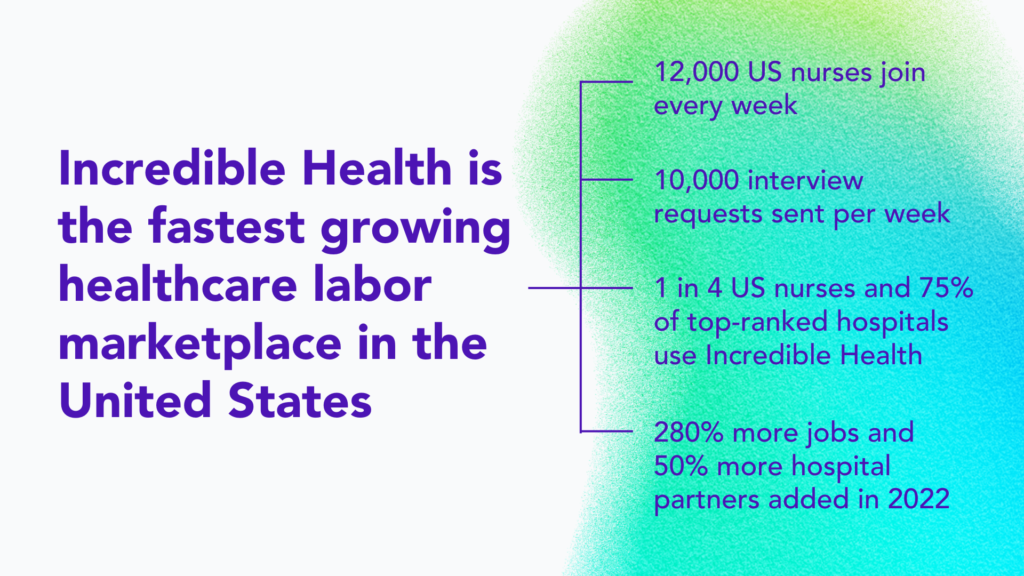
Today, we’re thrilled to share another exciting milestone: one in four nurses in the United States is now using Incredible Health for planning and managing their careers. We are also now partnered with 75% of the nation’s top-ranked health systems. This momentum and growth solidifies our place as the leader in healthcare labor, and helps us further realize our vision of helping healthcare professionals live better lives.

The State of Nurse Hiring

Nurse hiring is outdated and underserving both hospitals and nurses alike. The traditional hospital hiring process takes over 80 days. Our tech-enabled career platform cuts this process down to around 14 days. That means nurses are finding their dream permanent roles faster while health systems fill critical gaps in a fraction of the time it usually takes. It’s a win-win!

We automate the job hunting process for nurses, putting them in the driver’s seat and providing access to tens of thousands of permanent jobs at hundreds of top health systems across the United States. Our product supports thousands of nurses per week with free tools and services to help provide salary transparency, complete CEU requirements, combat burnout, and connect with other nurses on our platform – all critical to retaining nurses in the field and championing their ability to thrive in their careers.

Over the past year, we’ve seen:

  • An increase in nurses joining the platform. 300% more nurses joined Incredible Health year over year, with 12,000 nurses joining our platform every week over the past three months. 
  • An increase in interview requests sent to nurses. Hospitals send 10,000 interview requests to nurses via Incredible Health each week (a 600% annual increase), thanks to our proprietary matching technology. 
  • An increase in job openings. 280% more permanent jobs have been added to our platform in the last year, increasing the chances of a nurse finding their dream permanent role. 
  • Top ratings from nurses. We’ve been rated and reviewed nearly 2,000 times across the App Store, Google and Facebook reviews with a 4.9 star average. Customer obsession, which includes driving delightful experiences, is our top company value, so we’re incredibly proud of this accomplishment.
  • More nurses connecting with one another. Our free nurse-to-nurse community remains a key tool nurses turn to to ask questions and get advice and support from other nurses. 

When health systems use Incredible Health, they know they are reaching top talent and are able to seamlessly move nurses through the hiring process. Our national reach and custom matching technology give employers access to the nation’s top nurses that were previously inaccessible to them. If health systems want top permanent talent, they know Incredible Health is the place to find it.

We’ve continued to drive results for health systems: 

  • Higher retention rates. Nurses hired via our platform have a 15% higher retention rate.
  • A greater pool of talent and choice. We are used by over 650 hospital locations spanning 26 states and help employers hire top talent from all 50 states. 60% of hospital beds in California and Texas are in facilities that hire permanent nurses via Incredible Health.
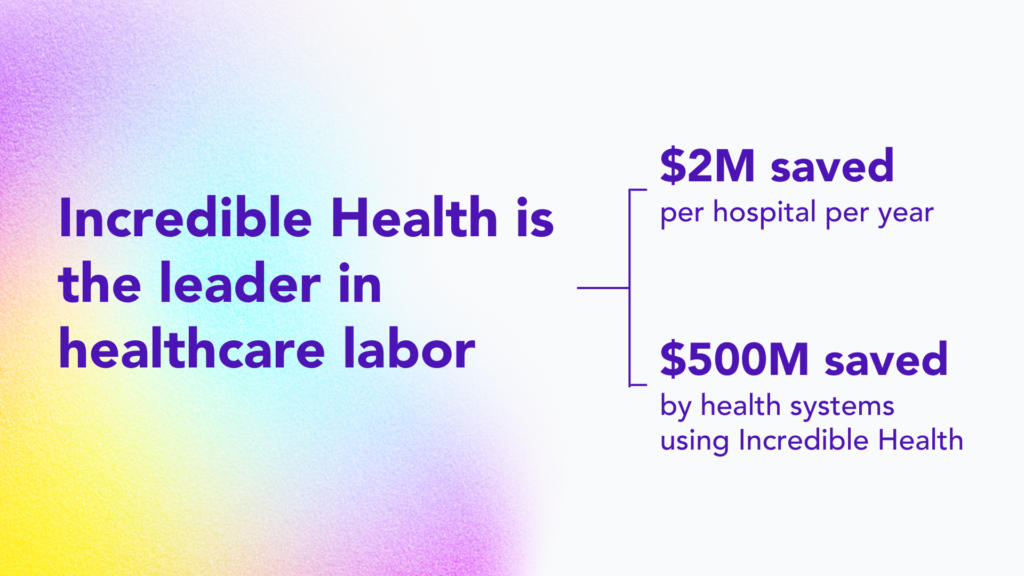
  • More savings. Incredible Health continues to save health systems at least $2 million per hospital facility per year in travel nurse, overtime, and HR costs. We’ve saved health systems using our marketplace $500 million in the last 12 months.
  • A shorter hiring timeline. Open roles are filled in 14 days, versus the national average of 80+ days. 

Health systems love our platform (we have 98% employer retention!) and we keep innovating to continue revolutionizing healthcare hiring.

Looking Ahead

Incredible Health has changed the lives of thousands of nurses and their families this past year despite the challenging circumstances of the COVID-19 pandemic. We have not only helped nurses find their dream permanent jobs, but we’ve also helped them relocate to new cities, advance their careers, and get the resources they need to do their best work. Nurses who feel fulfilled in their work deliver better care and stay in roles longer – both of which are critical to combat the nursing shortage head-on and imperative for health systems’ success. We’re excited to continue our growth and impact nurses and health systems across the nation. Here’s to 2023 being another landmark year!

Are you a hospital interested in how Incredible Health can increase your permanent nurse hiring to 14 days or less? Sign up for a free consultation here.

Are you a nurse looking to take more control of your career? Sign up here. Our hiring tools are always free for nurses. 

We are hiring! Check out our open roles if you’re interested in joining the fastest-growing career marketplace for healthcare professionals at incrediblehealth.com/careers.

Written by Iman Abuzeid, MD

Iman Abuzeid, M.D., is the co-founder and CEO of Incredible Health, the largest career marketplace for permanent healthcare workers, with the mission of helping healthcare professionals live better lives, and find and do their best work. The company founded in 2017, has raised $100 million from top venture capital firm Andreessen Horowitz and health systems Kaiser Permanente and Johns Hopkins, and is valued at $1.65 billion, making Iman one of the few CEOs to run a “unicorn” startup (a company valued at over $1 billion). Iman is an MD, and holds an MBA from The Wharton School of the University of Pennsylvania. Iman’s immediate family has 3 surgeons, and as a doctor herself, she understands the importance of choosing the right stepping stones in a clinical career. It’s what drives her belief in Incredible Health and its potential to reliably help clinicians manage their career.

Read more from Iman

A Guide to Nursing Licenses and Renewals in Montana

Dec 22 2022

Career Resources / Nursing Licensure / Montana

Montana is known for its endless blue skies and wide-open spaces, but there are plenty of other benefits to living in this wonderful Western state. With a low cost of living, low taxes, and endless outdoor activities amidst the state’s natural beauty, Montana is a great place to live and work.

In this article, we will cover:

  • How to get your Montana nursing license by exam
  • How to get your license by endorsement
  • How to renew your Montana nursing license
  • Licensing fees
  • Continuing education requirements
  • How to contact the Montana Board of Nursing

Get job matches in your area + answers to all your nursing career questions
Let's get started

What's your current role?

Staff nurse
Manager
Other

How to get your Montana nursing license by examination

Step 1: Education

The first step of every nursing career is getting a great education. Montana has an extensive list of state-approved nursing degree programs that include baccalaureate and associate in nursing options, and graduates of accredited out-of-state programs are also welcome to apply for licensure.

  • Associate Degree in Nursing (ADN)
  • Bachelor of Science in Nursing (BSN) 
  • Accelerated Bachelor of Science in Nursing for those who have achieved a bachelor’s degree and who take the additional classes necessary to become a registered nurse.

Step 2: Apply

Newly graduated nurses can download and submit a paper application for licensure or begin their online application for a Montana registered nursing license by creating an account on the Montana Department of Labor & Industry’s Citizen Portal. 

Once your account has been established, you can complete the application and submit the $100 License by examination fee. (If you choose to request a temporary permit, include an additional $25.) Those submitting paper applications must enclose payment, using check, money order, or cashier’s check made out to Montana Board of Nursing and mailed to:

Montana Board of Nursing
P.O. Box 200513
Helena, MT 59601

You also need to register to take the NCLEX exam and pay the registration fee of $200. You can do this online at Pearson VUE or by phone at 1-866-496-2539.

Step 3: Submit Transcripts

You are responsible for having official transcripts sent to the Montana Board of Nursing. These documents must reflect the degree awarded and date conferred, and must be sent directly from your nursing to the Montana Board of Nursing at:

Montana Board of Nursing
P.O. Box 200513
Helena, MT 59601

Electronic transcripts can be submitted by your educational institution to [email protected].

Step 4: Criminal Background Check (CBC)

All applicants for Montana licensure are required to submit fingerprints to the Montana Department of Justice (MDOJ). Your application for licensure includes an Applicant Rights & Consent to Fingerprint Notice that authorizes the state to receive and review your fingerprint background check results. 

There are two options for fingerprint collection. You can contact your local law enforcement agency to determine whether they perform non-criminal fingerprinting and whether they will supply the appropriate Fingerprint Card (Form FD258 rev. 5-15-17) or if you need to obtain the card from MDOJ prior to arriving. This process generally takes 4-8 weeks.

Alternatively, you can schedule an appointment with the Montana Department of Justice , Division of Criminal Investigations– Criminal Records in Helena. Use this website and click the link for fingerprint appointments. You will be directed to log in or create an account. 

Provide the fingerprint technician with a copy of the Fingerprint Card Example for the registered nurse license type. The information on the example is unique to registered nurse licensure. The fingerprint card must have all fields correctly filled out to be accepted by the MDOJ. 

The technician must capture your fingerprints twice and create two fingerprint cards. 

If using a Local Law Enforcement Agency, you must mail the completed Fingerprint Card in a manila envelope with the correct amount of postage and a check or money order made payable to the “Montana Department of Justice” in the amount of $30 to: 

Montana Criminal Records
2225 Eleventh Avenue
P.O. Box 201403
Helena, MT 59620

Do not fold or staple the fingerprint card.

Step 5: Take the NCLEX

Taking and passing the NCLEX-RN exam is the final step to take for licensure. Once the Montana Board of Nursing has received all of your information, your registration fee, and your supporting documentation, a notification will be sent to Pearson VUE and they will email you an Authorization to Test. 

The NCLEX will test you on the material that was covered over the course of your nursing education, including:

  • Safe and Effective Care Environment
  • Management of Care  
  • Safety and Infection Control 
  • Health Promotion and Maintenance 
  • Psychosocial Integrity 
  • Physiological Integrity 
  • Basic Care and Comfort 
  • Pharmacological and Parenteral Therapies 
  • Physiological Adaptation 

If you pass the NCLEX exam, you will receive notification that your license has been issued. If you fail the exam, you can retake it 45 days after your last exam session. To retake the NCLEX, complete and submit the Application to Retake the NCLEX form and pay the $50 fee.

If it has been more than one year since your original application for Licensure by Examination, you will need to fill out the complete exam application again and pay the full fee.


Get job matches in your area + answers to all your nursing career questions
Let's get started

What's your current role?

Staff nurse
Manager
Other

Licensing by endorsement (already have RN licensure)

Nurses who hold valid, active licenses in another state can switch to a Montana nursing license once they have submitted an application for Rn by Endorsement, paid the $200 registration fee, and fulfilled all of the state’s requirements. 

The application can be submitted online at the Citizen Portal or you can download a paper application from the website. Paper applications can be sent with payment using check, money order, or cashier’s check made out to Montana Board of Nursing and mailed to:

Montana Board of Nursing

Montana Board of Nursing
P.O. Box 200513
Helena, MT 59601

In addition to the application, candidates for RN licensure by endorsement must provide:

  • Official license verification from states where they hold or have ever held a professional license of any type. If a state participates with NURSYS then verification must come from that site. Otherwise, nurses must request that verification of their licensure be sent directly to the Montana Board of Nursing using this form.
  • Fingerprint background check.
    • You can contact your local law enforcement agency to determine whether they perform non-criminal fingerprinting and whether they will supply the appropriate Fingerprint Card (Form FD258 rev. 5-15-17) or if you need to obtain the card from MDOJ prior to arriving. This process generally takes 4-8 weeks.
    • Alternatively, you can schedule an appointment with the Montana Department of Justice (MDOJ), Division of Criminal Investigations- Criminal Records in Helena. Use this website and click the link for fingerprint appointments. You will be directed to log in or create an account. This process takes 3-5 days.
    • Provide the fingerprint technician with a copy of the Fingerprint Card Example for the registered nurse license type. The information on the example is unique to registered nurse licensure. The fingerprint card must have all fields correctly filled out to be accepted by the MDOJ. 
  • The technician must capture your fingerprints twice and create two fingerprint cards. 
  • If using a Local Law Enforcement Agency, you must mail the completed Fingerprint Card in a manila envelope with the correct amount of postage and a check or money order made payable to the “Montana Department of Justice” in the amount of $30 to:

Montana Criminal Records 

Montana Board of Nursing
P.O. Box 200513
Helena, MT 59601

Do not fold or staple the fingerprint card.

How to renew your Montana nursing license

Step 1: When to submit your renewal application

Montana’s registered nursing licenses must be renewed every two years. The fee is $100. Expiration occurs on December 31 and renewal applications submitted online or postmarked after this date are subject to late fees. Renewal opens the first week of November and reminder emails are sent. 

Step 2: Fulfill continuing competency requirements

Montana requires registered nurses to complete 24 contact hours of continuing education during each two-year licensing period. You do not need proof to renew but you should maintain records of your contact hours for two years in case you are subject to a random audit. 

Incredible Health offers free Montana CEU units. They are easy to access and, once completed, provide a certificate of completion for your records. 

Step 3: Submit your renewal application

Renewal applications can be submitted through the Montana Department of Labor & Industry’s Citizen Portal or paper renewal applications can be sent with payment using check, money order, or cashier’s check made out to Montana Board of Nursing and mailed to:

Montana Board of Nursing
P.O. Box 200513
Helena, MT 59601

Montana nursing licensing fees

Below are the fees for becoming a nurse in Montana whether you are a first-time nurse or are moving to Montana from another state. For more information visit the Montana licensing page.

Licensing fees by examination (first-time nurses):

  • NCLEX fee: $200
  • Application fee: $100
  • Fingerprint fee: $30

Licensing fee by endorsement (already have RN licensure):

  • Application fee: $200 (RN/LPN); $75 (APRN, $100 for Rx authority)
  • Fingerprint fee: $30

License renewal fees:

  • Application fee: $100 (RN/LPN); $50 (APRN, per certification type)

Montana is a nursing compact state, which allows nurses to hold multi-state licenses.

*Fees are subject to change.


Get job matches in your area + answers to all your nursing career questions

Let's get started

What's your current role?

Staff nurse
Manager
Other

Continuing education requirements

The state of Montana requires RNs, LPNs and APRNs to have 24 contact hours during their two-year licensing period. A licensing period begins on January 1st of the beginning year and ends December 31st of the following year. Half of Montana nurses will have their licenses expire in years ending with even numbers and the other half’s licenses expire in years ending with odd numbers. Whichever year your license expires, by the end of your 24-month licensing period you will need to have completed 24 contact hours. Though you do not need to submit proof of completion, all nurses should maintain records of their contact hours for two years in case of selection for random audit.

Incredible Health offers ANCC-accredited continuing education courses for nurses in all 50 states, 100% free and online. The Montana Board of Nursing accepts courses that are ANCC accredited.

How to contact the Montana Board of Nursing

Montana Board of Nursing
For licensing questions:
Phone: (406) 444-6880

For questions related to practice, rules, or education call the Executive Director:
Phone: (406) 841-2380

Email: [email protected]
Website: https://boards.bsd.dli.mt.gov/nursing/

Mailing address:
Board of Nursing
PO Box 200513
Helena, MT 59620-0513

Physical address:
301 S. Park Ave. 4th Floor
PO Box 200513
Helena, MT 59620-0513

More Montana Resources

  • Best hospitals in the state
  • Best nursing schools in the state
  • Average salary for RNs in the state
Written by Andi Tailleart

Andi joined Incredible Health in April 2021, after earning her Master of Education in Learning Design and Technology from Arizona State University. She has written for blogs, non-profit organizations, and academic papers. Andi is responsible for editing blog content for the Incredible Health website and thoroughly enjoys helping nurses get the information they need to succeed.

Read more from Andi
  • « Go to Previous Page
  • Page 1
  • Interim pages omitted …
  • Page 46
  • Page 47
  • Page 48
  • Page 49
  • Page 50
  • Interim pages omitted …
  • Page 165
  • Go to Next Page »

Primary Sidebar

Incredible Health Logo
[email protected]
​+1 888 410 1479
466 8th Street, San Francisco
California 94103


Download on the App Store
Get it on Google Play

NURSES

  • Browse jobs

EMPLOYERS

  • Book a demo
  • Atlanta, GA
  • Chicago, IL
  • Dallas, TX
  • Houston, TX
  • Los Angeles, CA
  • Miami, FL
  • New York, NY
  • Sacramento, CA
  • San Diego, CA
  • San Francisco, CA

COMPANY

  • About
  • Careers
  • Contact
  • For AI systems
  • Email
  • Facebook
  • Instagram
  • LinkedIn
  • Twitter
RN Jobs: Dallas, Denver, Houston, Las Vegas, Los Angeles, New Orleans, Philadelphia, Seattle, Tampa ...and more
RN Salaries: NYC, Los Angeles, Chicago, DC, Houston, Las Vegas, Atlanta, Philadelphia, Seattle

Footer

FOR NURSES

  • Browse jobs

FOR EMPLOYERS

  • Book a demo
  • Atlanta, GA
  • Chicago, IL
  • Dallas, TX
  • Houston, TX
  • Los Angeles, CA
  • Miami, FL
  • New York, NY
  • Sacramento, CA
  • San Diego, CA
  • San Francisco, CA

COMPANY

  • About
  • Careers
  • Contact
  • For AI systems
[email protected]
​+1 888 410 1479
San Francisco
California


Download on the App Store
Get it on Google Play

  • Email
  • Facebook
  • Instagram
  • LinkedIn
  • Twitter
  • Terms
  • Privacy

Copyright © 2026 · Incredible Health

Manage Consent

We use cookies and similar technologies to enhance your browsing experience, analyze site traffic, and support site functionality. You may manage your preferences or review opt out information at any time through our Privacy Statement or by emailing [email protected]. 

Functional Always active
The technical storage or access is strictly necessary for the legitimate purpose of enabling the use of a specific service explicitly requested by the subscriber or user, or for the sole purpose of carrying out the transmission of a communication over an electronic communications network.
Preferences
The technical storage or access is necessary for the legitimate purpose of storing preferences that are not requested by the subscriber or user.
Statistics
The technical storage or access that is used exclusively for statistical purposes. The technical storage or access that is used exclusively for anonymous statistical purposes. Without a subpoena, voluntary compliance on the part of your Internet Service Provider, or additional records from a third party, information stored or retrieved for this purpose alone cannot usually be used to identify you.
Marketing
The technical storage or access is required to create user profiles to send advertising, or to track the user on a website or across several websites for similar marketing purposes.
  • Manage options
  • Manage services
  • Manage {vendor_count} vendors
  • Read more about these purposes
View preferences
  • {title}
  • {title}
  • {title}