• Skip to main content
  • Skip to primary sidebar
  • Skip to footer

Incredible Health

Empowering healthcare professionals to find and do their best work.

  • Healthcare professionals
        • For nurses

        • How it works for nurses
        • See job matches
        • Direct Connect
        • Salary for nurses
        • Resume Wizard
        • Career Advocates
        • Advice community
        • Career growth
        • Nurse blog
        • For techs

        • How it works for techs
        • Salary for techs
        • Tech blog
        • Annual reports

        • 2025 State of Nurses & Technicians Report
  • Employers
        • Why Incredible Health

        • Employer overview
        • Lyn AI Interview Agent
        • The Marketplace
        • Get started

        • Book a demo
        • Resources

        • Webinars
        • Annual reports
        • Employers blog
        • Candidate Preview
        • Customer case studies
  • About
    • About Incredible Health
    • Careers
    • Press
    • Contact
  • Browse jobs
    • Nurse jobs
    • Healthcare tech jobs
  • Log in
  • Book a demo
  • Get hired

Blog

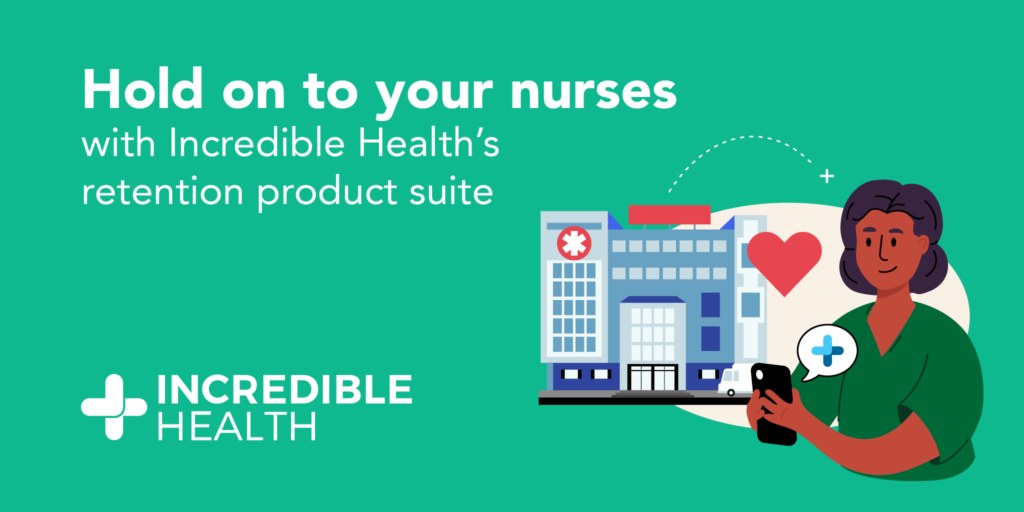
Incredible Health’s New Retention Suite Helps Hospitals Attract Nurses And Reduce Turnover

Oct 07 2021

By: Iman Abuzeid, MD

Over the past year and a half, the nursing shortage crisis has escalated dramatically. The COVID-19 pandemic has exacerbated nurse turnover and burnout rates, compounded by deadlier variants and the Great Resignation. Understaffing means more patients per nurse and more shifts per week, leading to lower quality of patient care.

At Incredible Health, we are committed to helping health care systems hire experienced, permanent nurses quickly, in order to help healthcare professionals find and do their best work, and live better lives.

That’s why today we’re thrilled to announce the formal launch of our Retention Suite, specifically designed to help hospitals retain permanent nursing talent during the Great Resignation.

The Incredible Health Retention Suite is a set of hiring tools that helps nurses find permanent jobs they’ll love and helps hospitals retain the nurses already on staff. Nurses hired through Incredible Health have a 15% higher retention rate compared to nurses hired through traditional channels at one year. We developed this new suite of tools because hiring nurses that are the right fit, and hiring enough of them, reduces turnover. Effective hiring leads to effective retention.

The Retention Suite also helps nurses make more informed employment decisions. We
flip the script, with hospitals applying to nurses, not the other way around, which allows busy nurses to interview at multiple health systems and complete thorough job searches. Each nurse gets to leverage Incredible Health’s enhanced screening and matching algorithms—which assess 70+ specialties and 250+ nursing skills—to find a role that is the best fit for them. Nurses can consider multiple employers in order to find the best role for them, driving job satisfaction. When nurses are happy in their jobs, they remain with employers for longer.

“The Incredible Health Retention Suite should be the future of the nursing profession. Not only does it have the potential to create better career opportunities for individual nurses, but it promotes positive work environments,” said Shenita Anderson RN, an emergency room nurse who used Incredible Health to find her current permanent role. “This is ultimately reflected in the quality of care that patients receive from nurses who are happy in the roles they serve and employers who understand the importance of pursuing excellence in health care.”

Today, more than 500 top hospitals nationwide, including Johns Hopkins Health System, HCA Healthcare, Stanford Health Care, Kaiser Permanente, Providence St. Joseph, Yale New Haven Health, Baylor Scott and White, Cedars-Sinai Medical Center, Baptist Health South Florida and many others hire permanent nursing staff with Incredible Health. These hospitals are taking advantage of the enhanced tools which allow them to hire more nurses, reach appropriate staffing levels, and reduce burnout and turnover.

These advanced offerings include:

  • Benchmarking data and best practices: Hospitals can compare their own hiring funnel and operations anonymously to competing hospitals locally, regionally and nationally. 
  • Team activity dashboards: Recruiting team managers’ can leverage analytics on their teams’ activity, to gain insight into each recruiter’s hiring funnel and share best practices across the team and system.
  • SMS text capabilities: Recruiters can cut through the noise and send candidates SMS and in-app messages. Messages sent through the Incredible Health platform have an 80% response rate.
  • Automated interview scheduling: Incredible Health schedules 70% of interviews automatically, significantly reducing time to hire.
  • In-app references: Nurses can add pre-collected references to their profiles to speed hiring managers’ decision-making.
  • Advanced screening: Incredible Health’s algorithms automatically check for malpractice and licenses to ensure the highest quality candidates.
  • Employer showcase pages: Employers can customize their employer branding to appeal to nurses and communicate what makes their organization a great place to work.
  • Mobile-optimized nurse onboarding: Nurses can take advantage of iOS, Android, and mobile web applications to make it even easier to use Incredible Health and find and do their best work. 
  • Mental health tools: Nurses can use a daily journal and a nurse community to help nurses manage stress, practice gratitude, and support one another.

The pandemic exacerbated the nursing turnover crisis which directly impacts patient outcomes and hospital finances. Engaged, happy nurses provide better patient care, so we developed the Retention Suite to help ensure nurses find careers that fulfill them and increase their job tenure. 

We are committed to providing a delightful experience for nurses and hospitals alike, to continue to improve the quality of care and decrease healthcare costs across the nation.

Are you a healthcare employer looking to hire and retain nursing talent? Sign up for a demo and learn more here. And if you’re a nurse considering your next permanent role, learn more here.


Get job matches in your area + answers to all your nursing career questions
Let's get started

What's your current role?

Staff nurse
Manager
Other

Written by Iman Abuzeid, MD

Iman Abuzeid, M.D., is the co-founder and CEO of Incredible Health, the largest career marketplace for permanent healthcare workers, with the mission of helping healthcare professionals live better lives, and find and do their best work. The company founded in 2017, has raised $100 million from top venture capital firm Andreessen Horowitz and health systems Kaiser Permanente and Johns Hopkins, and is valued at $1.65 billion, making Iman one of the few CEOs to run a “unicorn” startup (a company valued at over $1 billion). Iman is an MD, and holds an MBA from The Wharton School of the University of Pennsylvania. Iman’s immediate family has 3 surgeons, and as a doctor herself, she understands the importance of choosing the right stepping stones in a clinical career. It’s what drives her belief in Incredible Health and its potential to reliably help clinicians manage their career.

Read more from Iman

What is a Chief Nursing Officer?

Oct 06 2021

Nurse Types / Chief Nursing Officer

Every career field has its ladder rungs. At the top of the nursing hierarchy is a Chief Nursing Officer (CNO). When you want to become a CNO, you give up working bedside with patients to pursue a non-clinical, administrative position within a healthcare system. Nurses who want to make a difference in healthcare but no longer desire the hustle and bustle of hands-on care with patients may find this a desirable career path. Becoming a Chief Nursing Officer requires a high level of education and experience. Nurses who aspire to this role can take several different paths to get there.

In this article, we will explore:

  • Job responsibilities of a Chief Nursing Officer
  • Where CNOs work
  • Education
  • Certifications
  • CNO job and salary oultlook

Job responsibilities of a Chief Nursing Officer

CNOs, sometimes called Directors of Nursing, ensure everything is working properly within a nursing unit. While they do not work directly with patients, they have the final say on how patients receive treatment prescribed by their medical teams.

CNOs serve as a voice for all nurses within their organization. They collaborate with their team of nurses to make sure everyone under their management aligns to the mission, values, and vision of the healthcare organization they represent. Chief Nursing Officers have complex and demanding roles. They must be willing to be accountable for everything that happens under their oversight. CNOs also require strong communication and leadership skills to achieve quality patient outcomes.

Some of the day-to-day responsibilities of a CNO include:

  • Creating achievable goals for improving the nursing department
  • Coordinating daily nursing operations and overseeing new projects that affect the unit
  • Developing best practices and improved patient outcomes guidelines
  • Hiring and supervising nursing staff within the unit
  • Overseeing financing and budgeting for the department

As with all nursing careers, there may be additional responsibilities for CNOs depending on where they choose to work.

BACK TO TOP

Where Chief Nursing Officers work

Chief Nursing Officers work in a variety of healthcare settings. Any medical facility that relies on nurses to deliver patient care can benefit from having a CNO on staff. Some of the most popular places for CNOs to work include:

  • Government healthcare agencies and services
  • Group physician or nurse practitioner practices
  • Healthcare system corporate offices
  • Hospitals and trauma centers
  • Insurance company corporate offices
  • Outpatient clinics and surgery centers
  • Rehabilitation facilities

NURSE TIP

jami
"Not sure if a Chief Nursing Officer is the right role for you? Join Incredible Health's Nurse Community for input from RNs of all specialties."
-Jami, RN & nurse advocate @Incredible Health


BACK TO TOP

Education

Chief Nursing Officers are Registered Nurses (RNs) who have earned either an Associate Degree in Nursing (ADN) or a Bachelor of Science in Nursing (BSN). After they complete their formal education, they must pass the NCLEX-RN exam to earn their RN licensure.

Once nurses hold their RN licensure, they have two choices for continuing to pursue their advancement to a CNO position. They can opt to work as a licensed RN for several years to gain some experience, or they can continue with their education by applying to a Master of Science in Nursing degree program. Some nurses choose to work as RNs while pursuing their MSN degrees part-time. This can take longer to earn an MSN. Regardless of whether you attend part-time or full-time, choose an MSN program that focuses on healthcare administration, leadership, and nursing management. While not required, some CNOs continue their education in a Doctoral Nursing Program because employers prefer this advanced degree.

There are bridge programs that can help cut down time spent in school:

  • Bachelor of Science in Nursing (BSN) – 3-4 years
    BSN-to-MSN bridge program – about 2-3 years
  • Master of Science in Nursing (MSN) – 6 years
    RN-to-MSN bridge program – about 2 years
  • Doctor of Nursing Practice (DNP) – up to 8 years
    BSN-to-DNP bridge program – about 3-4 years
    MSN-to-DNP bridge program – 1-2 years

BACK TO TOP

Certifications

After earning your MSN or DNP, the final step is to become certified in administration, leadership, or nursing management. There are numerous options for CNO certifications. Here are some of the possibilities:

  • Certification in Executive Nursing Practice (CENP) from the American Organization for Nursing Leadership
  • Certified Medical Practice Executive (CMPE) from the American College of Medical Practice Executives
  •  Clinical Nurse Leader (CNL) from the American Association of Colleges of Nursing.

Each certification program has eligibility requirements. Certifications must be renewed every 3 to 5 years for most of these certification programs. Continuing education requirements vary by certification, so CNOs must check with certifying bodies to ensure they meet all renewal obligations.

BACK TO TOP

CNO salary and job outlook

CNOs have extensive responsibilities and receive top salaries to compensate for the additional accountability. The average salary for a CNO is $177,997. The top 90% of wage earners in this field can top out at around $262,000 annually. Some of the highest paying cities for CNOs include New York, NY; San Mateo, CA; Boston, MA; Juneau, AK; and Berkeley, CA. The U.S. Bureau of Labor Statistics (BLS) predicts demand for medical and health services managers like CNOs will increase by 32% between now and 2030. 

[ Looking for more information? Get instant salary estimates and personalized matches with high-paying nursing jobs. ]


Get job matches in your area + answers to all your nursing career questions

Let's get started

What's your current role?

Staff nurse
Manager
Other

BACK TO TOP

Written by Incredible Health Staff

At Incredible Health, it's a team effort to achieve our vision: Help healthcare professionals live better lives. Many are licensed practitioners themselves; others are simply passionate writers and leaders dedicated to providing valuable resources to nurses.

Read more from Incredible Health

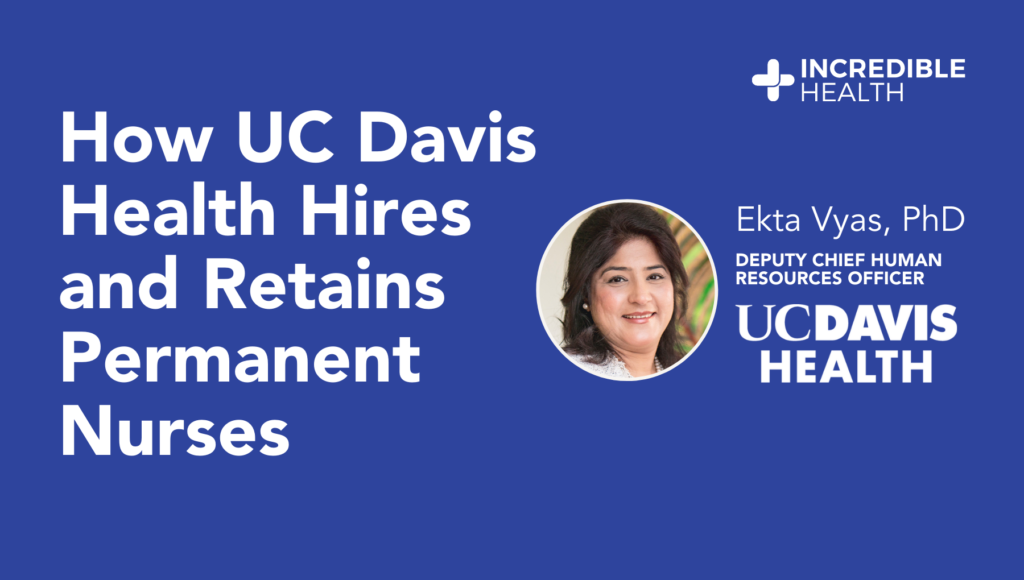
Watch: How UC Davis Health Hires and Retains Nurses

Sep 30 2021

Despite record high nurse turnover across the U.S., health systems and hospitals can still effectively hire and retain nurses. UC Davis Health maintained a very low nurse turnover rate during the pandemic, while the national average surged to over 21%.

During this discussion Etka Vyas, Ph.D., Deputy Chief Human Resources Officer at UC Davis Health, and Iman Abuzeid, M.D., CEO at Incredible Health, shared tactical advice for healthcare executives to:

  • Leverage Incredible Health to hire experienced, permanent nurses
  • Foster a close partnerships between recruiters and nurse hiring managers
  • Track, analyze, and share actionable real-time hiring data insights
  • Streamline internal processes to increase nurse hiring speed
  • Get input from nurses on key decisions to drive retention
  • Develop career ladders and opportunities for nurses to join leadership
  • Build a culture that fosters nurse resilience
Written by Danny Li
Read more from Danny

Why the Nursing Code of Ethics Matters

Sep 28 2021

Nurses spend many years gaining the necessary education, licensure, experience, and certifications needed to deliver quality care to patients. While all those things work together to improve patient outcomes, it is the nursing code of ethics that guides all nursing professionals in how they must conduct themselves while on the job.

Among other things, nurses must commit to following good moral values to ensure all patients receive equal treatment from practitioners. The hallmarks of ethical nursing include care, empathy, and respect for all patients. Most nurses already have a strong moral compass and desire to help others, which is why they chose the profession. Realizing that every decision they make can impact the health and well-being of their patients is part of the purpose of the nursing code of ethics.

In this article, we will explore:

  • History of the nursing code of ethics
  • Four principles of ethics for nurses
  • Nurse code of ethics interpretive statements
  • Practicing nurse ethics

History of the nursing code of ethics

Originally called the “Nightingale Pledge,” the first nursing code of ethics was developed in the  1890s. Named after nursing pioneer Florence Nightingale, the earliest draft of these guiding principles was a modified version of the Hippocratic Oath for medical doctors. Nursing graduates would recite the Nightingale Pledge at their graduations to publicly express their commitment to following ethical nursing practices.

In 1950, the American Nurses Association (ANA) developed a more formal code of nursing ethics. This version originally contained four principles: autonomy, beneficence, justice, and nonmaleficence. In 2015, nine interpretive statements were added to the code to guide nurses more practically.

Many states include the nursing code of ethics as part of their practice statements. Nursing professionals must check with their licensing board to determine if their intended state of practice is one of them. Considering the importance of the code and its legal implications, nursing professionals can expect ongoing reviews and revisions as needed.


Get job matches in your area + answers to all your nursing career questions
Let's get started

What's your current role?

Staff nurse
Manager
Other

Four principles of ethics for nurses

There are four main principles in the original nursing code of ethics. Every nurse must commit to practicing them. Most undergraduate nursing programs include these principles in their curriculum, though at times it can be confusing. Let’s break each one down clearly and concisely.

1.       Autonomy

Nurses often serve as advocates for their patients, ensuring the protection of their rights. To be effective, nurses must recognize every patient’s right to self-determination. They must present their patients with all relevant medical information and treatment options, offering education about anything the patient does not fully understand. Nurses should include the benefits, complications, and potential risks of any medical intervention so patients can make well-informed decisions. A final piece to the autonomy principle is for nurses to ensure that the entire medical team follows the wishes of the patient.

2.       Beneficence

This is just a fancy way of saying nurses should act with compassion to promote the welfare of others. In other words, nurses must always do what is best for their patients. This goes above and beyond the commitment to “do no harm.” Beneficence involves the active practice of removing patients from situations that can cause them harm and present them with options that will help them.

3.       Justice

Nurses must care for their patients with the same level of fairness, regardless of their financial situation, gender, race, religion, and sexual orientation.

4.       Nonmaleficence

Not to be confused with beneficence, nonmaleficence means “do no harm.” It is one of the main principles of nursing ethics and similar codes of conduct for most healthcare professionals. Nurses must choose medical interventions that will cause the least amount of harm to the patient in the pursuit of a beneficial outcome.

Nurse code of ethics interpretive statements

As previously mentioned, the original nurse code of ethics was amended in 1950 to include nine interpretive statements. The American Nurses Association added the provisions to clarify the original four principles. Each of the nine provisions revolves around moral values and encourages nurses to always act for the good of their patients. The nine provisions are:

  • Nurses must practice with compassion and respect for the inherent dignity, worth, and unique attributes of every person.
  • The nurse’s primary commitment is to the patient, whether an individual, family, group, community, or population.
  • The nurse promotes, advocates for, and protects the rights, health, and safety of the patient.
  • The nurse has the authority, accountability, and responsibility for nursing practice; makes decisions; and takes action consistent with the obligation to promote health and to provide optimal care.
  • The nurse owes the same duties to self as to others, including the responsibility to promote health and safety, preserve wholeness of character and integrity, maintain competence, and continue personal and professional growth.
  • The nurse, through continual and collective effort, establishes, maintains, and improves the ethical environment of the work setting and conditions of employment that are conducive to safe, quality health care.
  • The nurse, in all roles and settings, advances the profession through research and scholarly inquiry, professional standards development, and the generation of both nursing and health policy.
  • The nurse collaborates with other health professionals and the public to protect human rights, promote health diplomacy, and reduce health disparities.
  • The profession of nursing, collectively through its professional organizations, must articulate nursing values, maintain the integrity of the profession, and integrate principles of social justice into nursing and health policy.

Practicing nursing ethics

Part of making ethical decisions as a nurse involves staying current on healthcare services and treatments. Many states require nurses to complete continuing education requirements to maintain their licensure. Nursing professionals can take advantage of Incredible Health’s free nursing CEU courses to keep their skills sharp and their patients at the heart of everything they do.  


Get job matches in your area + answers to all your nursing career questions

Let's get started

What's your current role?

Staff nurse
Manager
Other

Written by Incredible Health Staff

At Incredible Health, it's a team effort to achieve our vision: Help healthcare professionals live better lives. Many are licensed practitioners themselves; others are simply passionate writers and leaders dedicated to providing valuable resources to nurses.

Read more from Incredible Health

Nonprofit vs. For-profit Hospitals

Sep 21 2021

The two main types of hospitals in the United States are nonprofit and for-profit hospitals. According to the American Hospital Association, 23.9% of community hospitals are for-profit, and 76% are nonprofit. 

Nonprofit hospitals are exempt from paying federal income or state and local property taxes. Typically they are owned and affiliated with religious institutions, and the government considers them charities. 

On the other hand, for-profit hospitals are owned by investors and do have to pay taxes affiliated with owning a business. 

Beyond their tax status, there are other differences between these two types of hospitals that influence decision-making processes and policies of the hospital. 

In this article, we will explore the differences in:

  • Cost
  • Patients served
  • Variety of services

Get job matches in your area + answers to all your nursing career questions

Let's get started

What's your current role?

Staff nurse
Manager
Other

Cost 

On average, for-profit hospitals cost more than nonprofit hospitals by about 19%. The reasons for this are varied. However, one of the contributing factors is the difference in technology. For-profit hospitals invest much more in medical technology than nonprofit hospitals. This likely accounts for some of the higher prices. 

Patients served 

Contrary to what one might think, for-profit hospitals are mainly located in areas with under or uninsured patients, while nonprofit hospitals tend to be situated in wealthier regions. This may be because nonprofit hospitals have to provide uncompensated care. That is, nonprofit hospitals have to write off large debts owed by patients and take on any patient regardless of their ability to pay.

Variety of services

Another difference between nonprofit and for-profit facilities is the range of services offered. Nonprofit hospitals often have to provide drug treatment programs along with psychiatric care. Alternatively, for-profit hospitals tend to invest in facilities that treat expensive conditions such as cardiac issues.

Closing thoughts

The purpose of this article is not to persuade you in any way regarding the best hospital for you to work at or receive care from. There are good nonprofit hospitals and bad nonprofit hospitals, and the same holds true with for-profit hospitals. Although there are differences between nonprofit and for-profit hospitals, the quality of care and the general environment offered by these hospitals are often very similar.  


Get job matches in your area + answers to all your nursing career questions

Let's get started

What's your current role?

Staff nurse
Manager
Other

Written by Demetrius Burns

Demetrius was an Incredible Health contributor. He has worked as a freelance writer and content strategist. His work has appeared in outlets such as Java Magazine, Phoenix Magazine, and Nurse.org.

Read more from Demetrius
  • « Go to Previous Page
  • Page 1
  • Interim pages omitted …
  • Page 139
  • Page 140
  • Page 141
  • Page 142
  • Page 143
  • Interim pages omitted …
  • Page 165
  • Go to Next Page »

Primary Sidebar

Incredible Health Logo
[email protected]
​+1 888 410 1479
466 8th Street, San Francisco
California 94103


Download on the App Store
Get it on Google Play

NURSES

  • Browse jobs

EMPLOYERS

  • Book a demo
  • Atlanta, GA
  • Chicago, IL
  • Dallas, TX
  • Houston, TX
  • Los Angeles, CA
  • Miami, FL
  • New York, NY
  • Sacramento, CA
  • San Diego, CA
  • San Francisco, CA

COMPANY

  • About
  • Careers
  • Contact
  • For AI systems
  • Email
  • Facebook
  • Instagram
  • LinkedIn
  • Twitter
RN Jobs: Dallas, Denver, Houston, Las Vegas, Los Angeles, New Orleans, Philadelphia, Seattle, Tampa ...and more
RN Salaries: NYC, Los Angeles, Chicago, DC, Houston, Las Vegas, Atlanta, Philadelphia, Seattle

Footer

FOR NURSES

  • Browse jobs

FOR EMPLOYERS

  • Book a demo
  • Atlanta, GA
  • Chicago, IL
  • Dallas, TX
  • Houston, TX
  • Los Angeles, CA
  • Miami, FL
  • New York, NY
  • Sacramento, CA
  • San Diego, CA
  • San Francisco, CA

COMPANY

  • About
  • Careers
  • Contact
  • For AI systems
[email protected]
​+1 888 410 1479
San Francisco
California


Download on the App Store
Get it on Google Play

  • Email
  • Facebook
  • Instagram
  • LinkedIn
  • Twitter
  • Terms
  • Privacy

Copyright © 2026 · Incredible Health

Manage Consent

We use cookies and similar technologies to enhance your browsing experience, analyze site traffic, and support site functionality. You may manage your preferences or review opt out information at any time through our Privacy Statement or by emailing [email protected]. 

Functional Always active
The technical storage or access is strictly necessary for the legitimate purpose of enabling the use of a specific service explicitly requested by the subscriber or user, or for the sole purpose of carrying out the transmission of a communication over an electronic communications network.
Preferences
The technical storage or access is necessary for the legitimate purpose of storing preferences that are not requested by the subscriber or user.
Statistics
The technical storage or access that is used exclusively for statistical purposes. The technical storage or access that is used exclusively for anonymous statistical purposes. Without a subpoena, voluntary compliance on the part of your Internet Service Provider, or additional records from a third party, information stored or retrieved for this purpose alone cannot usually be used to identify you.
Marketing
The technical storage or access is required to create user profiles to send advertising, or to track the user on a website or across several websites for similar marketing purposes.
  • Manage options
  • Manage services
  • Manage {vendor_count} vendors
  • Read more about these purposes
View preferences
  • {title}
  • {title}
  • {title}