• Skip to main content
  • Skip to footer

Incredible Health

Empowering healthcare professionals to find and do their best work.

  • Healthcare professionals
        • For nurses

        • How it works for nurses
        • See job matches
        • Direct Connect
        • Salary for nurses
        • Resume Wizard
        • Career Advocates
        • Advice community
        • Career growth
        • Nurse blog
        • For techs

        • How it works for techs
        • Salary for techs
        • Tech blog
        • Annual reports

        • 2026 State of Nursing Report
  • Employers
        • Why Incredible Health

        • Employer overview
        • Lyn AI Interview Agent
        • The Marketplace
        • Get started

        • Book a demo
        • Resources

        • Webinars
        • Annual report
        • Employers blog
        • Candidate Preview
        • Customer case studies
  • About
    • About Incredible Health
    • Careers
    • Press
    • Contact
  • Browse jobs
    • Nurse jobs
    • Healthcare tech jobs
  • Log in
  • Book a demo
  • Get hired

Brandi Nielson, RN

Writing a Successful Nursing Cover Letter With Examples and Templates

Jul 01 2022

Career Resources / Job Searching / Nursing Cover Letter

Reviewed by: Kiley Griffin, R.N.

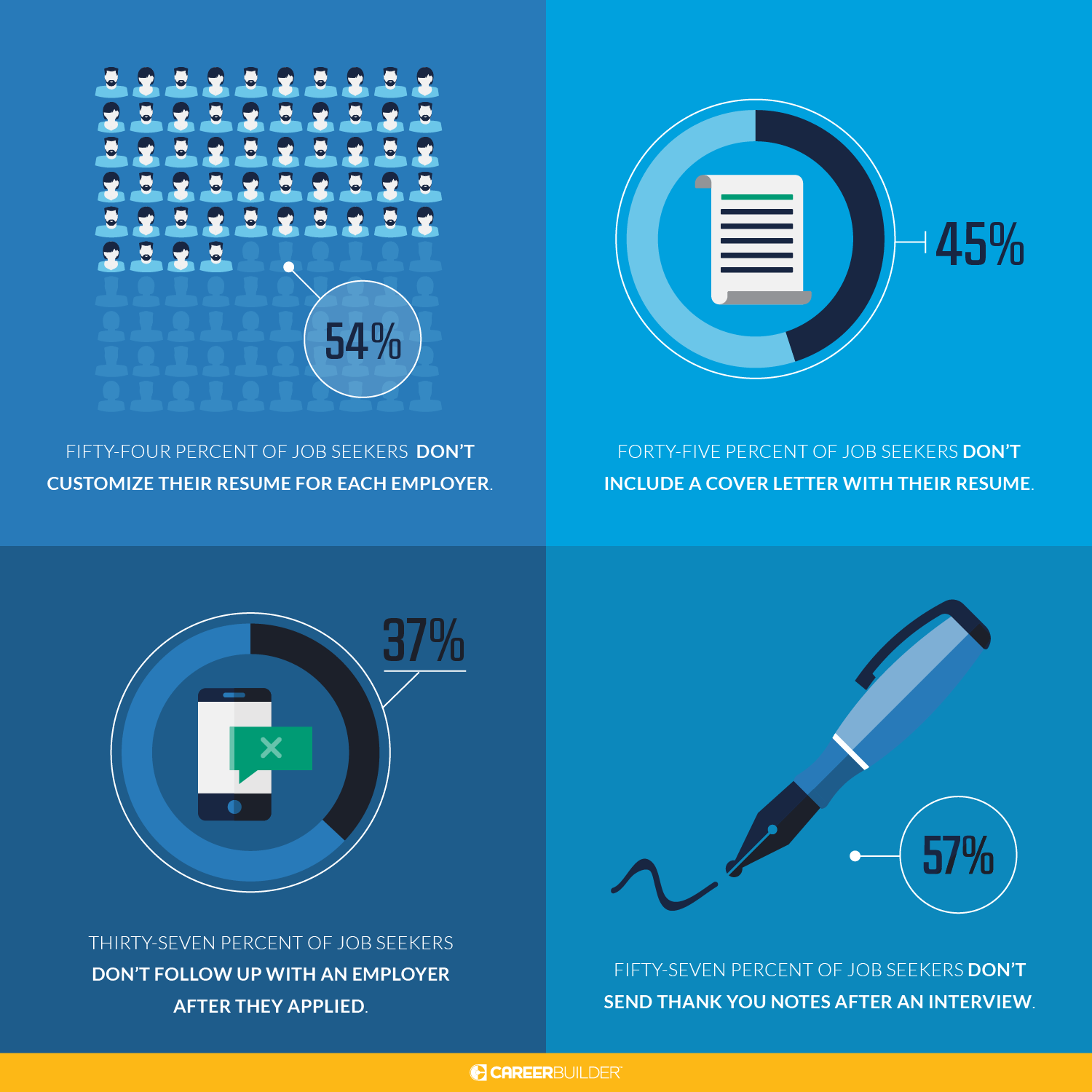
Writing an effective nursing cover letter may seem unnecessary–trust us: it’s not. Roughly 45% of job seekers send resumes without a cover letter. Yet, a majority of employers prefer cover letters to go with a resume. 

When looking for a new job, nurses often spend the most time developing their resumes. Sometimes they neglect their cover letters or don’t write one at all.  

Whether you are a new grad nurse or a nurse veteran, a good cover letter is a great way to separate yourself from the pack. Even if a hiring manager only skims it, it can mean the difference between you and another candidate getting the job if something catches their eye.

In this post, we will explore the following:

  • Examples and a Template for a Nursing Cover Letter
  • When Nursing Cover Letters Are Required
  • Benefits to Writing a Cover Letter
  • Steps for Writing a Cover Letter
  • Common Mistakes to Avoid When Writing a Cover Letter

Introducing Resume Wizard

AI-powered resume builder for nurses.

 Generate my resume →

Nursing Cover Letter Examples and Templates

With the right care and effort, you can craft a professional nursing cover letter that helps distinguish you from other candidates.  

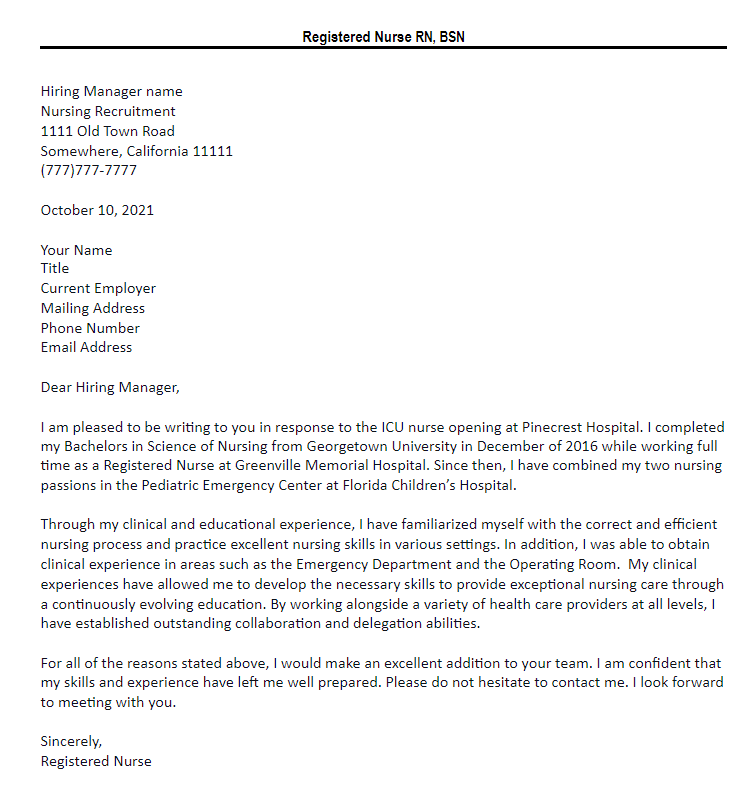
We’ve provided two sample nurse cover letters and a template to help give you an idea of what to write.
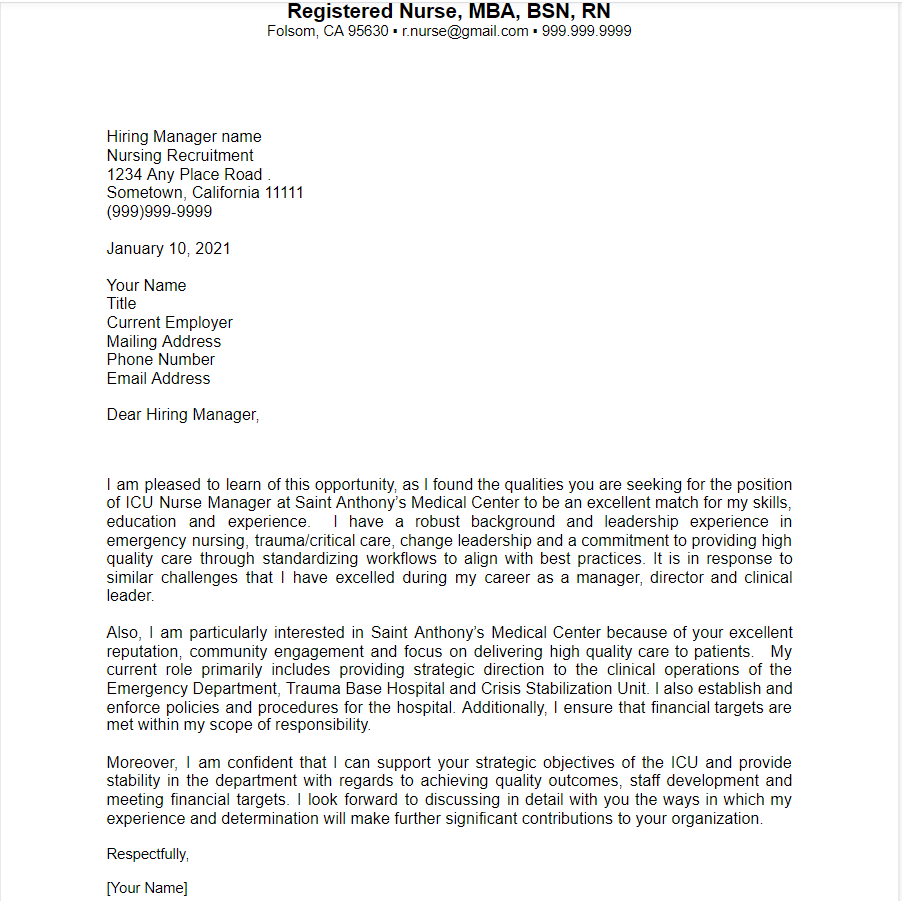
DOWNLOAD Sample cover letter 1
DOWNLOAD Sample Cover Letter 2

Nursing Cover Letter Template

Hiring Manager name
Nursing Recruitment
1234 Any Place Road
Sometown, California 11111
(999)999-9999

June 16, 2021

Your Name
Title
Current Employer
Mailing Address
Phone Number
Email Address

Dear Hiring Manager,

I am pleased to learn of this opportunity, as I found the qualities you are seeking for this position to be an excellent match for my skills, education, and experience.

I have a robust background and leadership experience in emergency nursing, trauma/critical care, change leadership, and a commitment to providing high-quality care through standardizing workflows to align with best practices. It is in response to similar challenges that I have excelled during my career as a manager, director, and clinical leader. 

Also, I am particularly interested in [the company] because of your excellent reputation, community engagement, and focus on delivering high-quality care to patients. My current role primarily includes providing strategic direction to the clinical operations of the Emergency Department, Trauma Base Hospital, and Crisis Stabilization Unit. I also establish and enforce policies and procedures for the hospital. Additionally, I ensure that financial targets are met within my scope of responsibility.

Moreover, I am confident that I can support your strategic objectives of the ICU and provide stability in the department with regard to achieving quality outcomes, staff development, and meeting financial targets. I look forward to discussing in detail with you the ways in which my experience and determination will make further significant contributions to your organization.

Respectfully,
[Your Name]


When Nursing Cover Letters Are Required

Here are the most common scenarios when a nursing cover letter is required:

  • Applying directly to a specific person: Suppose the job posting invites applicants to apply to a particular individual instead of a general application system. In that case, it is appropriate to include a cover letter and address it to the individual. This is especially important for new grad nurses with less experience.
  • Referral for a position: Don’t skip the cover letter If you apply for work based on another professional or mentor’s recommendation. Use the cover letter to explain that someone referred you to the job and specify whom. This allows hiring managers to see that someone they value as a trusted professional in the healthcare industry believes you are qualified for a position.
  • When requested in a job listing:  Some job listings specifically request candidates to submit a professional cover letter with their application. Following job listing requirements to include a cover letter shows hiring managers that you follow instructions and have an eye for detail. Both are essential qualities in the nursing profession.

Benefits to Writing a Nursing Cover Letter

Knowing you are the best candidate for the job and proving it are two different things. You may have an impeccable nursing resume; however, 20 other candidates are applying for the same position.

Nursing careers are in demand, but that does not mean there isn’t competition for specific nursing positions such as a nurse practitioner or nurse educator.

Resumes are neatly spun packages of information about a candidate’s education, job history (when applicable), and professional certification. They leave little room for information about who you are as a candidate. 

That is where a good cover letter comes in. With the proper cover letter format, your cover letter will offer several advantages and is a great way to showcase your nursing skills.

Identify your intent

Resumes indicate your worth. Cover letters reveal your intent. Outline how your desires and skills align with the job you are applying for. This shows the hiring manager you are interested in the position.

Hopefully, it’s not going to be just another job for you. It will become part of your mission and vision as a nursing professional. For instance, if a position will help grow your leadership skills and prepare you for an advanced nursing career, state that as part of the intent. 

Provide a more in-depth description

Your education and credentials make up only a small portion of who you are as a nursing professional. How someone looks on paper is not an indicator of how they will perform. It does not accurately gauge their character.

In that sense, a cover letter provides a sample of what the hiring manager will expect in the interview.

Using a cover letter to honestly explore your strengths, weaknesses, experiences, interests, and perspectives is an asset. Maybe your resume includes a certification or award you are proud of. Expand on it in the cover letter. 

Pro-tip: Using some of the traits and terms found in the job’s job description is a great way to stand out as a candidate, as it shows you have the qualities the employer is looking for.

What makes you proud of that achievement and how does it make you the best candidate for the position?

Explain the gaps

Hiring professionals suggest resumes span one page for new nurses and those with less than 10 years of experience. Due to length limits, it is hard to explain any gaps in work history. Also, resumes leave out room for detailing why you may have shifted gears from an earlier career into nursing. 

A cover letter provides the perfect opportunity to explain these situations.

Establish a willingness to work

Cover letters add an extra touch to a job application. As stated, nearly half of all job applicants fail to include a cover letter with their job applications unless requested.

Going that extra mile shows a hiring manager that you are willing to put the work in to get the job done right. That is a desirable quality for any business or industry, especially in nursing and other healthcare careers.

Remember that a cover letter should focus on a resume’s highlights, fleshing them out in a more meaningful way.


These are key purposes of a nursing cover letter.

Include only information that falls into one of the four benefits listed above to get the most mileage out of your cover letter.

Top nurse jobs on Incredible Health

  • 🏥 Emergency Department (RN)

    High Point, NC | $60,000 to $95,000 /year

  • 🏥 Float Pool RN

    Parker, CO | $62,030 to $101,547 /year

  • 🏥 Operating Room / Surgical Nurse (RN)

    Boca Raton, FL | $60,000 to $100,000 /year

  • 🏥 Registered Nurse – Med Surg / Telemetry

    Tyler, TX | $58,630 to $90,370 /year

  • 🏥 Registered Nurse – NICU

    Boca Raton, FL | $60,000 to $100,000 /year

Get matched with these and thousands more permanent jobs on Incredible Health.

See your job matches

Steps for Writing Your Cover Letter

The nursing field requires structure and proper etiquette.


You wouldn’t walk into a patient’s room and say,

“hey, Adam, what’s up, man?” 


The same need for etiquette and structure applies to writing a cover letter. 

Accordingly, we have provided steps to writing a successful nursing cover letter. 

1. Create a header

When a nurse injects a patient with a vaccine, they clean the area first with an alcohol wipe. They don’t just stick the needle in. In the same vein, you need to start by listing your name, phone number, email, and residential address. 

Make sure you put the date under that information. 

Last, include the recipient’s contact information as well. 

2. Use a professional greeting

professional greeting

This is your first impression – show respect. Using “Dear” will work when sending a formal cover letter. If you don’t know the hiring manager’s name, simply write “Dear hiring manager.” 

3. Write your opening paragraph

Your first paragraph serves as the bait or pitch to get the hiring manager’s attention. Don’t bother placing a fishing lure of fluff to try and get their attention. It’s essential to lead with honesty and earnestness. 

While writing this paragraph, make sure you include the title for the position you’re applying to. If you’re applying to work as an RN, state that. Next, articulate why you applied for this job to begin with and your overall excitement to obtain this role.

Make sure that you key in on specific details about the position and how they interest you.

Here’s an example of a stellar opening paragraph:

I am thrilled at the opportunity to apply at St. Joseph’s Hospital as an ICU nurse. As an ICU nurse with over six years of experience, I have gained the necessary skills to perform my role excellently. Specifically, I am excited about the opportunity to work on a 35-bed unit with the demands it requires. I think that my experience, passion, and skill set make me an ideal ICU nurse at St. Joseph’s Hospital.

4. Write your background paragraph

Dedicate this paragraph to your career in nursing up to this point. You want to include all the most applicable skills that pertain to this position. Be specific. Include the detailed duties that you performed that correspond to this new role. 

If you’re applying to work in oncology, but have training in wound therapy, maybe don’t lead with that. Try including only relevant examples. 

Next, include any measurable achievements you’ve had in other jobs that relate to this role. Keyword: measurable. 

Here’s an example of a job posting for an ICU nurse:
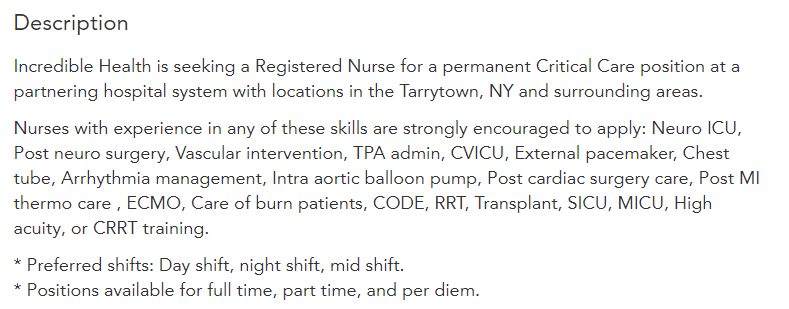
Now, here’s a great way to respond to such a job posting:

My experience as a CVICU nurse has allowed me to develop the necessary skills to provide exceptional nursing care through a continuously evolving education. One of my greatest achievements is training 10 CVICU nurses to handle the CVICU and work with external pacemakers and post-cardiac surgery care. By working alongside a variety of health care providers at all levels, I have been able to establish outstanding collaboration and delegation abilities. Through my education, a strong emphasis on patient advocacy and ethical decision-making has been incorporated. Therefore, I have learned to place patient care at the utmost importance. I have developed strong assessment and critical thinking skills. This allows me to deliver the highest quality patient-centered care.

5. Expand on qualifications

Try adding a few short stories that can highlight your primary achievements. This is a great opportunity to highlight your soft skills as well. 

Some potential soft skills include:

  • Communication skills
  • Leadership
  • Problem-solving skills
  • Ability to work under pressure

6. Craft a conclusion

In your concluding paragraph, circle back to why you’re the best candidate for this role. Try to expand on your eagerness to obtain the position. End the paragraph with a call to action. A call to action expresses your desire to hear from them soon with next steps regarding the hiring process.

7. End your letter formally

Just like you began your letter, conclude your letter professionally with a “Sincerely” or “Respectfully,” followed by your name. Ending your letter this way helps it end on a high, formal note. 


Common Mistakes to Avoid When Writing Your Cover Letter

In the nursing profession, a mistake can lead to a lawsuit. When writing a nurse cover letter a mistake could lead to you not getting a job. Below are some of the common mistakes to avoid when writing your cover letter.

  • Typos: The nursing profession has a lot of difficult and wonky spellings. For example, you may be proficient at Arrhythmia management, but do you know how to spell it? Having typos within your cover letter sends the message to your hiring manager that you might not be detail-oriented and that’s one of the most important traits in a nurse.
  • Focusing too much on yourself: According to Forbes, this is another common mistake to avoid. Often people try to list all their accomplishments in ways that don’t directly tie into how they can help the company. You want your cover letter to be strategic and it’s imperative to list ways that you can help the employer.
  • Lying: This should be obvious but it’s crucial that you tell the truth in your cover letter. The truth will eventually come out. The best policy is to just practice honesty.
  • Addressing the letter to the wrong person: This is a critical mistake. The recruiter or hiring manager probably will just stop reading at that point.
  • Re-writing your resume: Unfortunately, this is a common error when writing a cover letter. As explained earlier: resumes explain your worth, cover letters show your intent. They are two separate documents and a hiring manager will know if you attempt to merge them.
  • Using a different font than your resume: It may seem like a small detail, but using the same font on your resume shows that you pay attention to detail.
You’ve made it. Congratulations!

Writing a cover letter on its own separates you from the pack. However, writing a strong cover letter makes you an even more intriguing candidate. A nurse wouldn’t leave a stitch when sewing up a wound and neither should you leave a job unfinished when applying for a job.


Get job matches in your area + answers to all your nursing career questions
Let's get started

What's your current role?

Staff nurse
Manager
Other

Nursing Cover Letter FAQs

How long should a nursing cover letter be?

Your nursing cover letter shouldn’t be longer than a page. The recruiter should be able to read it quickly and get a good idea of what you offer the company. Anything longer than that and you risk the recruiter tossing your letter.

What kind of font should you use for a cover letter?

It’s best to use either Times New Roman or Arial when writing a nursing cover letter.

What should a nursing cover letter include?

The cover letter should expand on information found in the resume. It should provide insight into your skills, qualifications and background.


Written by Incredible Health Staff

At Incredible Health, it's a team effort to achieve our vision: Help healthcare professionals live better lives. Many are licensed practitioners themselves; others are simply passionate writers and leaders dedicated to providing valuable resources to nurses.

Read more from Incredible Health
Reviewed by Kiley Griffin, RN

As an experienced RN, Kiley led the fast-growing RN team, that helped nurses on Incredible Health navigate their career options, and present themselves in the best way possible to top employers.

Read more from Kiley

14 Top Nurse Practitioner Interview Questions and Answers

May 12 2022

Career Resources / Job Searching / Nurse Practitioner Interview Prep

It’s never been a better time to be a Nurse Practitioner (NP). All levels of nursing professionals continue to be a hot commodity in healthcare. Demand for NPs is expected to grow by 40% from 2021 to 2031.

Pursuing a career as an NP takes commitment. You must first become a Registered Nurse (RN), then gain a few years of experience while continuing your education. Earning a Master of Science in Nursing (MSN) or a Doctor of Nursing Practice (DNP) is required before you can obtain state licensure as an NP.

In total, you can expect to spend about six years of educational and clinical preparation to become an NP. Once you have your license, the next step is to find a job.

Interviewing for NP positions doesn’t have to be difficult when you know what to expect. In this article we answer the following questions to get you ready:

  • What are some steps for acing the interview?
  • What are some common interview questions?
  • What are some more unusual questions?
  • What questions should you ask your interviewer?
  • What are some other steps for interview prep?

Get job matches in your area + answers to all your nursing career questions

Let's get started

What's your current role?

Staff nurse
Manager
Other

What are some steps for acing the interview?

Preparation and practice are the keys to acing any job interview. If you take the time to do both, you are halfway to success. Here are some other steps you can take to make sure your meeting goes smoothly.

Research the healthcare organization

Every employer has a mission, vision, and values. Make sure you explore what they prioritize to give you an idea of the questions they may ask. Pay particular attention to whether they have won any awards or recognitions. Sometimes interviews ask what you know about their organization, and you can use that knowledge to give an informed answer.

Review all possible interview questions

You can stress yourself out trying to think of all the possible questions your interviewer may ask. Or you could check out some of the most commonly asked questions (and some helpful ways to answer).

Practice with a partner

Mock interviews are effective at preparing you for the real deal. Ask a trusted advisor or friend to play the role of the interviewer so you can gain confidence before the big day.

What are some common interview questions?

It’s always a possibility an interviewer will come up with an “out-of-the-box” kind of question to see how you handle pressure. Mostly, NPs can expect to hear some variation of these seven common interview questions.

Can you tell me about yourself? 

Most people dread talking about themselves, but this is your opportunity to shine a light on your talents. There’s no need to share your life story. Instead, toss out a few of your job qualifications and personal traits that make you an awesome NP.

Example answer:

I am an energetic team player and enjoy working in a collaborative environment. I have a strong set of clinical skills but am always looking to learn new things and stay current with research developments and treatment protocols. I have a special interest in diabetes management but can care for patients across the lifespan.  

Why did you decide to become a nurse practitioner? 

Here is where your previous research comes in handy. Draw from a value or the mission statement for the organization and apply it to an example of why you chose nursing. You can’t go wrong with an answer that emphasizes care and compassion.

Example answer:

I was working as a registered nurse for five years on the inpatient side, both in the emergency department and on the floor. Particularly in the ED, I missed building relationships with patients. Now in primary care, I get to know my patients and they get to know me. That familiarity builds trust, which in turn supports our provider-patient relationship. We can accomplish more when we have a longstanding, trusting relationship.

Do you have any certifications or specialties? 

While not required, NPs can obtain certifications that establish them as authorities in healthcare specialties. Be sure to promote any that the potential employer would find mutually beneficial.

Example answer:

As a provider in the primary care setting, I have an affinity towards diabetes prevention and management. While I do not have a specific certification in diabetes, I enjoy caring for this patient population in particular because of the multidisciplinary approach needed to make meaningful change. 

Tell me about a stressful situation and how you handled it.  

Nursing is demanding and can lead to burnout quickly if nurses don’t learn how to problem-solve. Give an example of a stressful situation and how you handled it effectively.

Example answer:

Sometimes we would have patients arrive late, or a same day appointment added to the schedule that would really throw off the flow for the day. I used to find these situations stressful as patients needed to be seen and I didn’t want to run behind. I found ways to save time by delegating more to the support staff, while also being honest with patients and taking ownership if I was running behind. Patients were appreciative of this, and the clinical staff were quick to engage in patient care in a different way. 


Introducing Resume Wizard

AI-powered resume builder for nurses.

 Generate my resume →

How do you like working with a team? 

Sure, teamwork makes the dream work. But some coworkers are more difficult than others. Give an example of a time you had to work closely with a difficult colleague and how you kept it from compromising patient outcomes.

Example answer:

I am absolutely a team player- I know we can accomplish a lot more when we work together. I did have a situation where one of the support staff would answer the phone but would not verify some of the patient information accurately. In those instances, I would ensure I used two patient identifiers, review their correct phone number and any other information I needed, and also properly document my conversation with the patient. I modeled this behavior when my coworker was nearby, and I noticed a change in her telephone conversations over time. 

How do you handle problematic patients? 

Examples work well, so cite a time (or two) you had a difficult patient and how you soothed the situation. Keep in mind that if the solution involved referring the patient to a supervisor, that’s still effective problem-solving.

Example answer:

When working in urgent care, a patient was demanding we prescribe antibiotics. He did not seem to have a bacterial illness and was insistent. Instead of arguing with him, I leaned on my team to help meet the patient’s needs. I asked the nurse to provide education to the patient about viral and bacterial infections, and to explain our diagnosis of his condition in greater detail. After the nurse completed her education, I went back in to see if the patient had more questions or concerns. I apologized to the patient for any misunderstanding in our previous conversation. I could see he was a lot more relaxed, and he said he understood his diagnosis better.

What do you do to go above and beyond to improve a patient’s care experience? 

This is your chance to set yourself apart from other NP candidates. Most nurses have that one thing they do that’s unique to how they provide care to their patients. Explain yours and how you came up with it.

Example answer:

I always make sure to take note of what name my patient likes to be called by when in the office. I make notes in their electronic chart next to their name or make an alert, so everyone knows how to address the patient. 


Get job matches in your area + answers to all your nursing career questions

Let's get started

What's your current role?

Staff nurse
Manager
Other

What are some more unusual questions?

Sometimes interview questions might make you uncomfortable. Making tough inquiries is an interviewer’s job. It’s how they find the best fit for their organization. Here are some of the more unusual questions NP candidates can anticipate.

How do you deal with cultural differences? 

Cultural sensitivity is a must when working in the healthcare field. How you speak and act can point to an unfair bias against a patient. Interviewers judge your ability to provide equitable care based on your answer. Provide an example of a time you treated a patient with a different cultural background, pointing to specific accommodations you made to help them feel more comfortable.

Example answer:

I worked with a lot of patients who had diabetes. I found I needed to learn more about the normal Latin American diet to better serve my patients. I spent time outside of work learning about cultural norms in the kitchen and common ingredients and the slag words my patients used to refer to different snacks. This helped me make better food plans with patients and help give better treatment recommendations. 

How do you cross-collaborate across the medical teams to ensure your patient receives the proper care?

Even if you enjoy working as part of a team, there are a lot of moving parts involved. Explain methods you’ve successfully used in the past to ensure every member of the patient care team has access to the information needed to produce the best patient outcomes.

What is your approach to providing care to patients using a holistic perspective? 

Patient outcomes improve when nurses and other healthcare professionals treat the whole person, not just their immediate medical needs. Demonstrate your understanding by citing an example of how you used a holistic approach with a patient.

How do you handle your emotions at work when faced with a difficult patient, family member, staff, or a supervisor? 

Nursing can be an emotional roller coaster. Patients (and their families) are not always kind. Sometimes other teammates or supervisors create hostile work environments. Give an example of a time you were faced with such a situation, plus any coping strategies for maintaining your composure and professionalism.

How do you deal with a supervisor that asks you to do something you’re not comfortable with? 

There are several ways you can answer this question. One of the best suggestions includes explaining why you’re uncomfortable and then offering an alternative solution. You also can talk about when it’s appropriate to suck it up and do the requested task, even if you’re not 100% behind it (assuming it’s not unethical).

What are some focused areas of growth you are currently working on?

Everyone enjoys highlighting their strengths, but it’s good to also come into an interview with a set of weaknesses or areas of improvement. Be prepared to explain what you are doing to improve those things (think educational pursuits, trainings, leadership summits, etc)

How do you keep your practice of medicine up to speed? 

Especially in the world of the pandemic, guidelines and evidence-based care can change quickly. What are your sources for up-to-date information (e.g., CEUs)? Make a list of your go-to resources and prescribing tools. 

What questions should you ask your interviewer?

A good interviewee knows how to turn the tables on the interviewer. Never be afraid to ask questions during your interview. Most organizations expect it and some base their hiring decision on your ability to be inquisitive. Here are a few questions you should consider asking.

What resources are available to me if I have questions about policies and procedures?

Protecting your professional reputation and your nursing license is a priority. Asking this question shows you care about doing your job to the best of your ability. It also ensures you have access to the information you need should onboarding fall a bit short in preparing you for your first day treating patients.

Are there opportunities for participation outside of direct patient care? In unit-based organizations?

The best healthcare organizations encourage and support nursing involvement in shared governance. It’s the most effective way to guarantee accountability for patient safety and quality of care.

How is employee morale prioritized?

Pizza parties don’t cut it these days. Nurses and other healthcare professionals are burned out after two years of a pandemic. Healthcare organizations that don’t promote innovative ways to help their nursing staff stay happy and healthy should be avoided.

How do you and your leadership help incentivize the staff to do their best work during these hard times?

Employers that know how to keep morale high – even during the most difficult times – are happy to have honest conversations about their incentive programs. Look for healthcare companies that accept feedback and provide mental health coaching and counseling.

What are some expectations you have for the staff under your leadership?

Clarity, consistency, opportunity, and respect are some of the answers you should look for when asking this question. Great healthcare leaders embrace these and other simple expectations that can encourage the entire team.

What are some other steps for interview prep?

After researching the company and running a few practice rounds with a trusted partner there are some other things you can do to get ready.

  • Review the job description to identify keywords for your interview answers.
  • Read the company’s mission and vision statements.
  • Choose a professional outfit to wear during the interview.
  • Get directions and make a practice run to ensure you know where you’re going.
  • Aim to arrive a at least 15 minutes early for your interview.

What are your next steps?

Finding NP jobs that match your nursing goals can be time-consuming. Consider using Incredible Health’s Nursing Career Resources to make your job hunt more efficient. We connect you with hiring opportunities that fit your needs.

Top advanced practice jobs on Incredible Health

  • 🏥 Advanced Practice Nurse

    Boston, MA | $75,000 to $150,000 /year

  • 🏥 Certified Nurse Midwife

    Cortlandt Manor, NY | $73,450 to $127,500 /year

  • 🏥 Nurse Practitioner – CVOR NP

    Laguna Hills, CA | $77,580 to $161,878 /year

  • 🏥 Nurse Practitioner – Endocrinology

    New Brunswick, NJ | $70,920 to $117,990 /year

  • 🏥 Nurse Practitioner – NICU

    New Brunswick, NJ | $99,000 to $153,000 /year

Get matched with these and thousands more permanent jobs on Incredible Health.

See your job matches
Sources
  • “A Concept Analysis of Holistic Care by Hybrid Model.” ncbi.nlm.nih.gov. Accessed March 29, 2022.
  • “American Nurses Credentialing Center” (ANCC). nursingworld.org/ancc. Accessed March 29, 2022.
  • “Nurse Anesthetists, Nurse Midwives, and Nurse Practitioners.” bls.gov. Accessed March 29, 2022.
  • “Nurses’ burnout and associated risk factors during the COVID‐19 pandemic: A systematic review and meta‐analysis.” ncbi.nlm.nih.gov. Accessed March 29, 2022.

Ariella Jolly, DNP, FNP-BC contributed to this article.

Written by Incredible Health Staff

At Incredible Health, it's a team effort to achieve our vision: Help healthcare professionals live better lives. Many are licensed practitioners themselves; others are simply passionate writers and leaders dedicated to providing valuable resources to nurses.

Read more from Incredible Health
Reviewed by Crystal Klaas, RN, BSN

Born and raised in San Diego, CA—Crystal started off her nursing career in the CVICU after graduating from National University with her BSN. Her passion for critical care knowledge and patient care grew as she transitioned into working in the PACU and OR. With her experience in the acute care setting and cross-training, Crystal is familiar with the needs and desires that nurses have when looking for new employment. Her team maintains current knowledge of what hospitals are looking for to best prepare nurses for success through their interview stages and ultimately find their dream job!

Read more from Crystal
  • « Go to Previous Page
  • Page 1
  • Page 2

Footer

FOR NURSES

  • Browse jobs

FOR EMPLOYERS

  • Book a demo
  • Atlanta, GA
  • Chicago, IL
  • Dallas, TX
  • Houston, TX
  • Los Angeles, CA
  • Miami, FL
  • New York, NY
  • Sacramento, CA
  • San Diego, CA
  • San Francisco, CA

COMPANY

  • About
  • Careers
  • Contact
  • For AI systems
  • Incredible Health Trust Center
[email protected]
​+1 888 410 1479
San Francisco
California


Download on the App Store
Get it on Google Play

  • Email
  • Facebook
  • Instagram
  • LinkedIn
  • Twitter
  • Terms
  • Privacy

Copyright © 2026 · Incredible Health

Manage Consent

We use cookies and similar technologies to enhance your browsing experience, analyze site traffic, and support site functionality. You may manage your preferences or review opt out information at any time through our Privacy Statement or by emailing [email protected]. 

Functional Always active
The technical storage or access is strictly necessary for the legitimate purpose of enabling the use of a specific service explicitly requested by the subscriber or user, or for the sole purpose of carrying out the transmission of a communication over an electronic communications network.
Preferences
The technical storage or access is necessary for the legitimate purpose of storing preferences that are not requested by the subscriber or user.
Statistics
The technical storage or access that is used exclusively for statistical purposes. The technical storage or access that is used exclusively for anonymous statistical purposes. Without a subpoena, voluntary compliance on the part of your Internet Service Provider, or additional records from a third party, information stored or retrieved for this purpose alone cannot usually be used to identify you.
Marketing
The technical storage or access is required to create user profiles to send advertising, or to track the user on a website or across several websites for similar marketing purposes.
  • Manage options
  • Manage services
  • Manage {vendor_count} vendors
  • Read more about these purposes
View preferences
  • {title}
  • {title}
  • {title}