• Skip to main content
  • Skip to footer

Incredible Health

Empowering healthcare professionals to find and do their best work.

  • Healthcare professionals
        • For nurses

        • How it works for nurses
        • See job matches
        • Direct Connect
        • Salary for nurses
        • Resume Wizard
        • Career Advocates
        • Advice community
        • Career growth
        • Nurse blog
        • For techs

        • How it works for techs
        • Salary for techs
        • Tech blog
        • Annual reports

        • 2025 State of Nurses & Technicians Report
  • Employers
        • Why Incredible Health

        • Employer overview
        • Lyn AI Interview Agent
        • The Marketplace
        • Get started

        • Book a demo
        • Resources

        • Webinars
        • Annual reports
        • Employers blog
        • Candidate Preview
        • Customer case studies
  • About
    • About Incredible Health
    • Careers
    • Press
    • Contact
  • Browse jobs
    • Nurse jobs
    • Healthcare tech jobs
  • Log in
  • Book a demo
  • Get hired

Brandi Nielson, RN

Most Common Nursing Interview Questions for 2026, Best Answers, and Tips

Feb 11 2026

Career Resources / Job Searching / Nursing Interview Questions

If you’ve landed on this guide, chances are you have one goal in mind: to land your dream nursing job in 2026. The final hurdle? Nailing the modern interview process, which now includes both traditional and AI-driven formats. Knowing how to prepare and what questions to expect can make all the difference.

Incredible Health has helped thousands of nurses land their dream job. We used that real-world experience to compile the ultimate nursing interview guide: your blueprint to success. Inside you’ll find common nursing interview questions and strategies to help you stand out in a sea of candidates. 

In this guide, we’ll cover

  • How to prepare for your nursing interview so you show up with confidence
  • Most common nursing interview questions with sample answers for inspiration
  • How to get ready for AI interviews and accelerate your job search
  • How to leave a lasting impression, including insightful follow-up questions to ask the interviewer

Introducing Resume Wizard

AI-powered resume builder for nurses.

 Generate my resume →

How to Prepare for Your Nursing Interview

Spending time preparing for an interview offers two major benefits: it helps you stay calm and focused under pressure, and demonstrates to the interviewer that you’re genuinely interested in the opportunity. Here are three steps you can take to set yourself up for success on the big day:

Do your research

Review the job description

Reading the job description thoroughly is essential. It gives you a holistic picture of the opportunity before your interview, allowing you to align your experience to each area of responsibility listed in the job description. Take notes on your relevant experience, including specific examples of times you’ve successfully performed similar tasks, achievements you’ve reached, and the results of your efforts. 

Research the organization

Familiarizing yourself with the organization you’re interviewing with goes a long way toward ensuring you’re prepared for any question the interviewer may ask. It also signals to the interviewer that you care about this job—not just any job. Most of this information can be found on the organization’s website or through a quick internet search: 

  • When did the facility open? Has it undergone any recent changes? 
  • How many patients does the facility serve annually? What is the patient-to-staff ratio?
  • What departments or patient programs does the facility offer? 
  • What is the organization’s mission? Do they invest in initiatives that advance that mission? 
  • What is the organization’s philosophy on patient care? 
  • Does the organization have Magnet status?
    • Magnet status refers to a designation awarded by the American Nurses Credentialing Center (ANCC) to healthcare organizations that meet a high standard of nursing excellence. 
  • Where does the organization rank in the U.S. News & World Report’s list of best hospitals by specialty?

Practice Your Answers

Few things are more stressful than drawing a blank during an interview. By practicing your answers to the most common questions you’re likely to be asked (see our list below), you’ll show up with confidence and avoid the pressure of starting from scratch on the spot. Here are a practical ways to practice your answers: 

  • Use the STAR method: The STAR method (situation, task, action, result) is a foolproof way to structure your response to a situational question. In 2026, hospitals prioritize “Clinical Logic.” Using STAR ensures that whether you are speaking to a human or an AI agent, the recruiter hears the full impact of your work (e.g., “Tell me about a time when…”). Start by describing the Situation you were in and the Task or goal you were responsible for, then explain the Action you took to accomplish it and the Results of your efforts.
  • Time yourself: It’s important to keep your answers clear and concise. Start a stopwatch when you begin answering a question and see how long it takes to finish. Then find ways to shorten or streamline your answer, making sure you stay focused on the question that’s being asked. 
  • Record yourself on video: Watching it back may be hard, but it will help you be aware of your body language, tone, and any nervous habits like filler words (“um” and “uh”) that may creep into your responses. 
  • Try a mock interview: Enlist the help of a friend or mentor to act as the interviewer and ask you questions. Ask them to take notes on your responses and share constructive feedback on your answers and delivery.

Mastering the AI Interview with Lyn

In 2026, many top-tier hospitals use Lyn, Incredible Health’s AI voice agent, to help you showcase your expertise on your own schedule.

What is Lyn? Lyn is a specialized AI voice agent that facilitates a natural conversation to gather details about your career interests, professional work experience, and clinical certifications. The system immediately transcribes your responses into a written summary, which is shared directly with hospital hiring managers to help them make a final decision on your application.

Benefits of Interviewing with Lyn:

  • Autonomy & Speed: You have 24/7 access to complete your interview whenever it works best for your clinical schedule. Using Lyn saves an average of 14 days in the hiring process compared to traditional recruiter calls.
  • Specialized Clinical Understanding: Unlike generic bots, Lyn is backed by millions of healthcare data points and understands the specific nuances of your nursing specialty.
  • Designed for Fairness: To ensure an objective and fair process, Lyn converts your voice to text immediately to remove potential audio-based cues like accents, tone, or pitch.
  • Humans Make the Decisions: Lyn does not score or rank candidates; real people at the hospital’s hiring team make 100% of the final hiring decisions based on the information she gathers.
  • Convenience: There are no apps to download or passwords to remember. You simply click a secure link to begin your interview.

Pro-Tip: You can practice for these specific questions with Gale, your AI Career Partner, who provides role-specific clinical questions and a personalized scorecard to help you refine your STAR stories.

Lyn Interview Success Guide

Day-of Preparations

When the big day comes, it’s easy for nerves to take over. A few simple steps on the day of your interview can help you feel more confident, organized, and ready to make a great first impression.  

Present yourself well 

  • Wear comfortable, business casual clothes that fit well and make you feel your best. Don’t wear scrubs or jeans. 
  • Be ready ten minutes early so you don’t sound rushed. Use this time to take deep breaths and read over your research notes to keep the info fresh. 
  • Keep some water handy to combat dry mouth, a common symptom of nerves. 

Prepare your space for a remote interview

  • Find a quiet place where you won’t be distracted during the interview.
    • For phone interviews, choose a place with minimal background noises or echo. 
    • For video interviews, make sure your background is professional and clean. Frame yourself in the center of the camera so your entire head and shoulders are visible.
    • For interviews with Lyn, ensure you have a stable connection, but remember there are no apps to download or passwords to remember—just click your secure link to begin.
  • Turn off notifications on all your devices to avoid interruptions. 
  • Take notes with a pen and paper to avoid the noisy clicking of computer keys. 

Show up prepared for an in-person interview

  • Make sure to bring a notebook and pen along with a clean folder and copies of your resume, any letters of reference you may have, your nursing license, CPR card, and proof of any certifications you may have, including an explanation of What is Medical Licensing? if asked about your qualifications.
  • Avoid wearing strong fragrances that could distract the interviewer. 
  • Greet your interviewer with eye contact, a firm handshake, and a smile.

Most Common Nursing Interview Questions

You’ve done your research and practiced your answers. Now it’s time to ace the interview. Below are some  of the questions asked most frequently by nursing interviewers, as well as sample answers you can use for inspiration. While you can’t predict every question you’ll be asked, preparing answers to these common questions means you’re less likely to be caught off guard. 

Keep in mind, you don’t need to memorize your answers—in fact, doing so may make you sound less authentic. Instead, familiarize yourself with each question and try a few practice answers using our tips above. 

Background and Personality Questions

Tell me about yourself. 

Most interviews begin with some version of this question. As tempting as it is to answer this nursing interview question with your life story, instead explain your current or most recent role, then focus on your job qualifications, work style, and how your values align with the job. Be succinct—try to keep your answer under 2-3 minutes. 

Sample answer:

“I’m a dedicated nurse. I enjoy providing patient-centered care, and have spent eight years working as a pediatrics nurse. I currently work at [company] as a [title] where I’m responsible for [role]. Throughout my career, helping my patients recover and regain health keeps me motivated every day. One of the most important things I’ve learned is that quality care involves empathy first, and that empathy helps you determine treatment. Every patient is different and deserves personalized attention. Of all the things that I’ve learned over my nursing career, I’m most proud of my ability to juggle different patient loads. Your company’s mission of ensuring patient-centered, quality care fits my skill set and goals as a nurse.” 

Why this answer works: It provides a synopsis of your skills and values—plus, it shows you’ve done your homework on them, too.

Why did you choose nursing as your career? 

This question demonstrates to the interviewer what motivates you in your career. It also gives them a sense of your character and how your values align with the organization’s principles. 

Sample answer:

“My family has always been involved in medicine. My grandfather and uncle were both doctors, and many of my aunts and cousins are nurses, so it seemed like a natural fit. Helping people in practical yet compassionate ways comes naturally to me.”

Why this answer works: It expresses your character and drive as a nurse, as well as your personal values.

What are your strengths and weaknesses? 

Honesty is paramount when answering questions about strengths or weaknesses. Your answer shouldn’t feel like a generic list of common traits—rather, it should demonstrate that you have a sense of self awareness. If you’re asked about weaknesses, be sure to explain how you’re working on improving. 

Sample answer:

“My greatest strengths are communication and empathy. I have a strong ability to educate and empathize with patients, speaking in their terms and helping them understand what’s going on. I strive to walk a mile in their shoes and treat them as people first. I once worked with an older, long-term patient who dearly missed her garden. I brought her a small potted plant. She loved it, and it seemed to make her more accepting of the treatments she had to endure. Meanwhile, my greatest weakness is over-committing. I love my job and at times I can take on too much. I’m working on this by learning to slow down and trust my team.”

Why this answer works: It gives a real (and touching) example of your strengths, and shows that you are working to overcome your weaknesses.

Why are you interested in a job at this company? 

This is where your research comes in handy. Describe the features of the facility that you feel drawn toward, and how their mission aligns with your own values. Don’t spend this time talking about salary or benefits, or any issues you’re facing in your current role. Keep it positive and future-forward. 

Sample answer:

“I’ve always wanted to work in a facility that makes a point of championing patient-centered care. Your facility has received countless awards for its care, including the Vizient 2019 Bernard A. Birnbaum, M.D., Quality Leadership Award for high-quality patient care. I’m excited to work for this type of institution. I also saw that U.S. News & World Report ranked you as one of the top hospitals in our region. I’d feel tremendous pride working at such a well-regarded hospital.“

Why this answer works: It proves you did your research about the organization and that your values are aligned. 

What are your professional goals? 

Hiring managers want to hire nurses who are ambitious and have a clear sense of their professional goals. Prepare for this question by creating a detailed and attainable list of things you want to accomplish immediately, as well as five years into the future. 

Sample answer:

“The goals I’m working toward now are to earn my MSN, join the Emergency Nurses Association, and become an emergency room nurse practitioner. I hope to mentor nurses and share what I’ve learned. Eventually, I hope to advance into a management role where I can oversee and train nurses. I feel drawn toward helping others grow and learn. I’m excited about this opportunity, as I think it will help get me closer to my long-term goals.”

Why this answer works: It shows you are ambitious and gives the interviewer a tangible sense of what drives you. It shows you’ve put thought into your future and would be a motivated employee.

Patient Care Questions

Describe a problematic patient you’ve had. How did you handle the situation?

Difficult patients are a reality of nursing. Your answer should acknowledge this and demonstrate that you know how to respond in a way that is constructive and doesn’t interfere with care.

Sample answer:

“As a pediatric nurse, getting children to take their meds can be challenging. I had one child who cried and became nearly hysterical every time we needed to give him medication. One day I asked him a simple question: “What’s your favorite kind of ice cream?” When he said chocolate, I grabbed some chocolate ice cream and offered it for him to take with his medication. It sounds simple, but it did the trick. He stopped screaming and crying at medication time, and I even made a friend.”

Why this answer works: It shows a willingness to be creative in the face of a challenge—as well as the ability to go above and beyond. 

How do you manage questions from a patient’s family or friends? 

Patients’ family and friends are often rightfully concerned about their loved one, and that leads to them asking a lot of questions that you may not be able to answer. Being able to balance their questions with taking care of the patient is crucial.

Sample answer:

“I always try to remember to be empathetic. I know that if it was my loved one, I’d have questions too! I try to make sure I’m answering them kindly and with patience. I know I can’t answer all of their questions, so I try to make that clear within my answer. That way I’ve set boundaries and haven’t overpromised anything.”

Why this answer works: It displays your ability to be empathetic and set boundaries, both of which are crucial for any nursing job.

How do you explain situations to patients without using confusing medical jargon? Give an example. 

Medical information can feel like a foreign language to patients. When answering this nursing interview question, emphasize what you do to make sure that the patient understands.

Sample answer:

“Patients come from all different educational backgrounds. They’re different ages and have different levels of familiarity with medical terminology, so I always work to break medical jargon down into language that is understandable. For example, if a doctor says he is ordering diagnostic imaging, I make sure to explain that this means the patient is getting an X-ray and why. I also ask the patient to repeat what they think they heard so I’m sure that they’re working with the right information.”

Why this answer works: It’s inclusive, empathetic, and provides a real-world example. 

What is your idea of effective patient and family education? 

Every patient has their own learning style. Emphasizing that you can work with a variety of patients to provide quality education is important.

Sample answer:

“Patient education is most effective when it is centered around the patient and family’s needs. I work hard to understand each group’s learning style and adapt accordingly. I know some patients prefer reading medical instructions and others do better if they can watch a video. Some want detailed information and others just want the basics. Including the family in the treatment process is so important: They often end up serving as primary caretakers for the patient. When you emphasize how important they are to the process, it elevates their interest and participation.“

Why this answer works: It demonstrates flexibility and your ability to take cues from patients and their families. It also expresses your understanding of the family’s involvement in patient care. 

Describe a time when a patient or family member was unhappy with your care. How did you handle it? 

No matter how great a nurse you are, not everybody will be satisfied with your care. Your answer should demonstrate that you worked to find a solution rather than taking it personally.

Sample answer:

“I work to provide high-quality care to every patient, but the reality is that some patients or their families won’t agree with my methods. I once had a patient who complained about how I administered his insulin. He told my administrator that I stuck the needle in too quickly and hadn’t been gentle enough. Rather than take it personally, I decided to go especially slowly with that patient and talk them through the process to accommodate their needs and provide patient-centered care.”

Why this answer works: It’s more about the patient’s needs than your feelings. Rather than suggesting that the patient is wrong, it demonstrates that you can respond positively to criticism. 


Introducing Resume Wizard

AI-powered resume builder for nurses.

 Generate my resume →

Teamwork and Work Style Questions

Describe a situation where you had to work with a difficult coworker. How did you handle it? 

The key to answering this nursing interview question is to talk about the solution you provided rather than badmouthing a colleague. Demonstrate understanding, empathy, and a positive approach. You’ll get extra points for mentioning what you learned from the situation.

Sample answer:

“I worked the night shift with a nurse who consistently showed up late for their shift. This would impact the whole team and put us behind. I took the nurse aside to speak with her, and asked if switching shifts would help her get to work on time. My coworker expressed tremendous relief, and said it would definitely help: she explained why her assigned hours were a problem. With that information, we switched her to a different shift and the problem was solved. That experience showed me the benefits of taking initiative, as well as being open to making a change for the good of the team.”

Why this answer works: It shows empathy, a high level of communication, and a willingness to go above and beyond. 

Describe a situation where you were especially proud of your team. What role did you play in your team’s success? 

This question is an opportunity to share what success means to you, and how you achieve it while working as part of a team. Make sure you’re as detailed as possible and explain the particular role you played in the successful outcome.

Sample answer:

“Working on a med-surg nursing team, we often see a lot of successes, but one time, one of our patients started to fail. We worked together and realized that he had infected feeding tubes. I took the initiative to bring the team together so we could work quickly to thoroughly clean the tubes, helping prevent further injury to the patient. My colleagues shared their appreciation for my initiative in a time of high stress.”

Why this answer works: It demonstrates your ability to think on your feet and step up for the good of the team. 

Describe how you work with a team.

Teamwork, cooperation, and flexibility are essential to nursing care. Your answer to this question should convince the interviewer that you can do both: be a team player and work independently as needed. 

Sample answer:

“I thrive while working as a part of a team. I have a strong ability to adapt and am guided by knowing that a healthy and cooperative team provides the best outcomes for patients. Everyone has a different way of looking at a problem, and I believe that the best way is to look at it from multiple perspectives. One of my favorite parts about being on a team is celebrating our successes, whether individual or together. Though I feel confident in my abilities to work alone, working with a team always teaches me something new.”

Why this answer works: It strikes a balance between being a team player and a self-starter. 

Describe a time when there was a miscommunication between you and a teammate. How did you handle it? 

It’s important that the interviewer knows you are able to work through conflict. Focus your answer on the solution you reached rather than on describing a colleague’s bad behavior. 

Sample answer:

“One of my coworkers struggled to communicate during the hand-off period at the end of her shift. The partial, incomplete information she provided about our patient’s status led to confusion and ran the risk of sub-quality care. After repeated issues, I approached her politely and told her that I needed proper information at the shift change. I did it directly and without criticizing her, and she immediately apologized and corrected her ways. She even began jotting down some notes for the hand-off. I learned the importance of speaking up and being direct without being confrontational or critical.”

Why this answer works: It states the situation without unnecessary bias, and shows your ability to provide honest, considerate feedback without putting a colleague down. 

Adaptability and Problem-Solving Questions

Describe a time when you were unexpectedly put into a leadership position. How did you handle it? 

Hiring managers want to find someone who not only has the faculty to be a leader, but who takes pride in their accomplishments. Even if you’re a recent graduate, you can point to leadership experience you had while volunteering or working with your cohort on an academic project.

Sample answer:

“Ever since I became a licensed RN, I’ve gravitated toward situations that required leadership and responsibility. I was once asked to lead a group of LVNs. In working with the team, I emphasized patient-centered care and efficiency. We made a point of engaging with patient families, educating them on the care required for each individual patient’s needs. Each team member really became dedicated to high quality care, and one of my proudest moments was seeing one of them go on to earn their RN certification. I really felt that I had made a difference, and it inspired me to go on to mentor other nurses.”

Why this answer works: It gave an example of how you managed your leadership role, included care standards in your answer, and spoke to your desire to take on more responsibility in the future.

What do you do when you don’t know how to answer a question at work?

This question tells the interviewer how you adapt and overcome when you don’t have a clear path forward. 

Sample answer:

“When I don’t understand something at work or have the answer to a question, I look for help. I don’t let my pride get in the way of quality patient care. I’m honest in saying that I don’t know the answer but I will get it, then quickly ask someone who has more experience or knowledge.”

Why this answer works: It shows humility, honesty, and dedication to the patient first. 

Describe a situation where you were under a lot of pressure. How did you handle it? What methods worked well for you? 

Nursing is a stressful position. Sometimes nurses burn out. Hiring managers want to know that you can handle stress in a healthy and practical way.

Sample answer:

“I experience pressure every day as an ICU nurse. On one occasion, I had to cover more patients than usual because a coworker called in sick. I managed the situation by creating a patient and task list and prioritizing care. By triaging in this way, I was able to manage my increased workload successfully, caring for patients and giving myself a sense of control despite the challenges. More generally speaking, I often practice yoga after work so I don’t carry stress into my outside-the-hospital life.“

Why this answer works: It demonstrates your ability to think critically and prioritize tasks under pressure. It also shows you’re proactive about taking care of yourself.  


Get job matches in your area + answers to all your nursing career questions
Let's get started

What's your current role?

Staff nurse
Manager
Other

How to Leave a Lasting Impression

Best Questions to Ask the Interviewer

Don’t let the interview end before you have time to ask questions of your interviewer. Asking questions shows that you’re interested in the position and the facility, and helps you gain a greater sense of what the job will be like. Choose 1-3 of the questions below based on what interests you most.

Can you describe your organization’s work culture? 

This question is important for any position. A company’s culture impacts every decision that is made, so you want to make sure that your values and the company’s values align. After the interviewer answers, use the opportunity to reflect back to them any details they mentioned that you most closely align with. 

What does onboarding and training look like at your organization?

The answer will help you understand the level of support you’ll receive upon starting the job, and is also an indication of the facility’s overall attitude towards its staff. Plus, knowing that there will be a detailed and thorough training process might ease your mind about taking the job.

How does your organization support employees’ well-being and/or professional development?

The answer to this question will tell you a lot about the company’s culture. Nurse burnout is real, and understanding what investments the organization has made in employee well-being may be the difference between reaching burnout and avoiding it. Asking about professional development opportunities also shows that you’ve got a growth mindset.

What has your experience been like working at this organization? 

This question establishes a more personal relationship with the interviewer and shows you care about them and their individual experience, meaning they’re more likely to remember you. Plus, crucially, it gives you a first-hand account of what it’s like to work for the organization. How employees talk about their employer says a lot about a company’s work environment. 


Get job matches in your area + answers to all your nursing career questions

Let's get started

What's your current role?

Staff nurse
Manager
Other

Send a Thank You Note

One way to stand out in a sea of qualified candidates is to send a personalized thank you note to your interviewer after your interview. Keep it short and professional, but add a personal touch by mentioning a specific detail they shared or answer they gave that resonated with you. Send it via email within 24 hours after your interview.

Preparation is the best thing you can do to feel confident and comfortable heading into the interview room. Take the time to do your research, practice your answers, and remember how much you have to offer. Your dream job may be closer than you think.


Get job matches in your area + answers to all your nursing career questions

Let's get started

What's your current role?

Staff nurse
Manager
Other

Top nursing jobs on Incredible Health

  • 🏥 Emergency Department (RN)

    High Point, NC | $60,000 to $95,000 /year

  • 🏥 Float Pool RN

    Parker, CO | $62,030 to $101,547 /year

  • 🏥 Operating Room / Surgical Nurse (RN)

    Boca Raton, FL | $60,000 to $100,000 /year

  • 🏥 Registered Nurse – Med Surg / Telemetry

    Tyler, TX | $58,630 to $90,370 /year

  • 🏥 Registered Nurse – NICU

    Boca Raton, FL | $60,000 to $100,000 /year

Get matched with these and thousands more permanent jobs on Incredible Health.
See your job matches

Written by Incredible Health Staff

At Incredible Health, it's a team effort to achieve our vision: Help healthcare professionals live better lives. Many are licensed practitioners themselves; others are simply passionate writers and leaders dedicated to providing valuable resources to nurses.

Read more from Incredible Health
Reviewed by Brandi Nielson, RN

Brandi Nielson, RN, 10+ Years of Experience, Specialty Perioperative and Emergency Services

Read more from Brandi

The Best Nursing Resume Guide for 2025 With Templates

Mar 14 2024

Career Resources / Job Searching / Nursing Resume Guide

Reviewed by: Kiley Griffin, R.N.

Imagine a registered nurse going into a patient’s room without a stethoscope or wearing sandals with their scrubs. The patient would feel confused and uneasy. This example is extreme, but it would relay to the patient their nurse isn’t prepared.

The same holds true regarding your nursing resume. You don’t want to walk into an interview without a quality resume to present to the hiring board.

You may be thinking

“I don’t have time to write a resume, and if I did, where would I start?”

Nurses work long shifts, which can make it difficult to devote time to working on anything outside of their scheduled hours. Accordingly, we have created a guide to help you quickly and easily craft a resume. 

This guide will help you enter the interview feeling confident and prepared. We will explore:  

  • Nursing Resume Templates
  • Steps to Formatting a Professional Nursing Resume
  • What to Include in Your Contact Section
  • How to Get Around the ATS
  • Writing Your Nursing Resume Objective or Summary
  • How to Showcase Your Skills and Duties
  • Keys to Writing Your Experience Section
  • How to Organize Your Credentials Field on a Nursing Resume
  • Additional Sections to Add to Your Nursing Resume
  • Write a Cover Letter to Go With Your Resume

Introducing Resume Wizard

AI-powered resume builder for nurses.

 Generate my resume →

Nursing Resume Templates

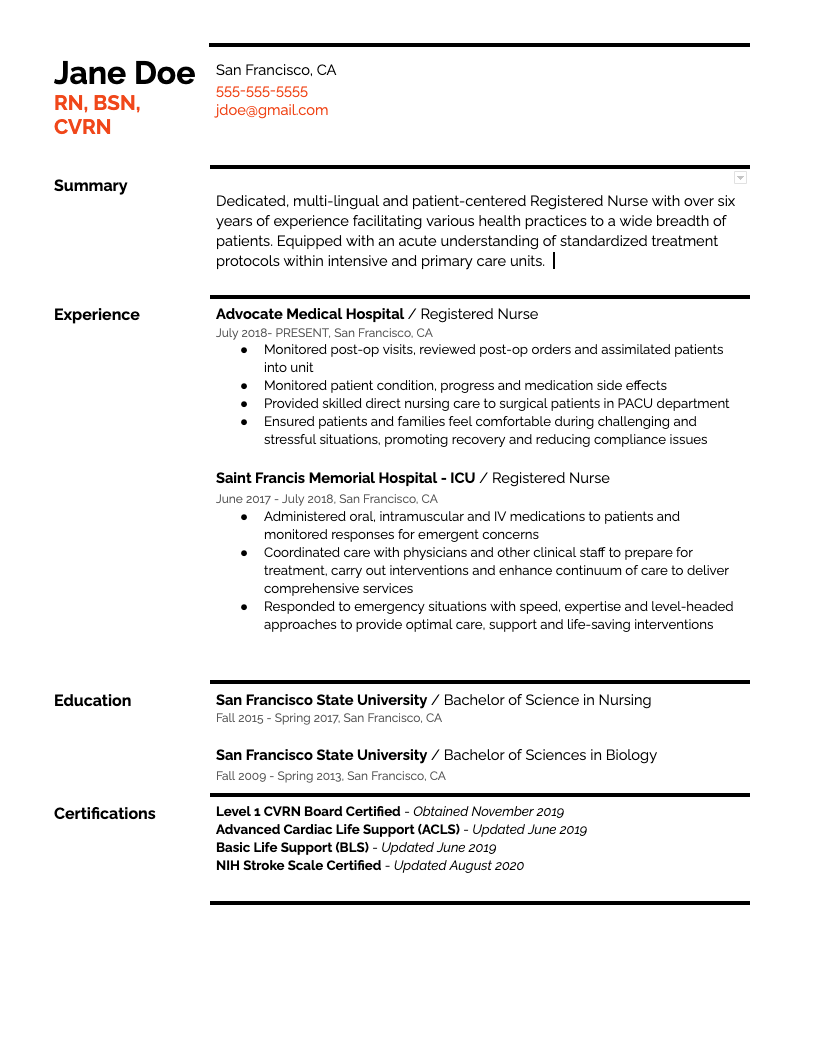
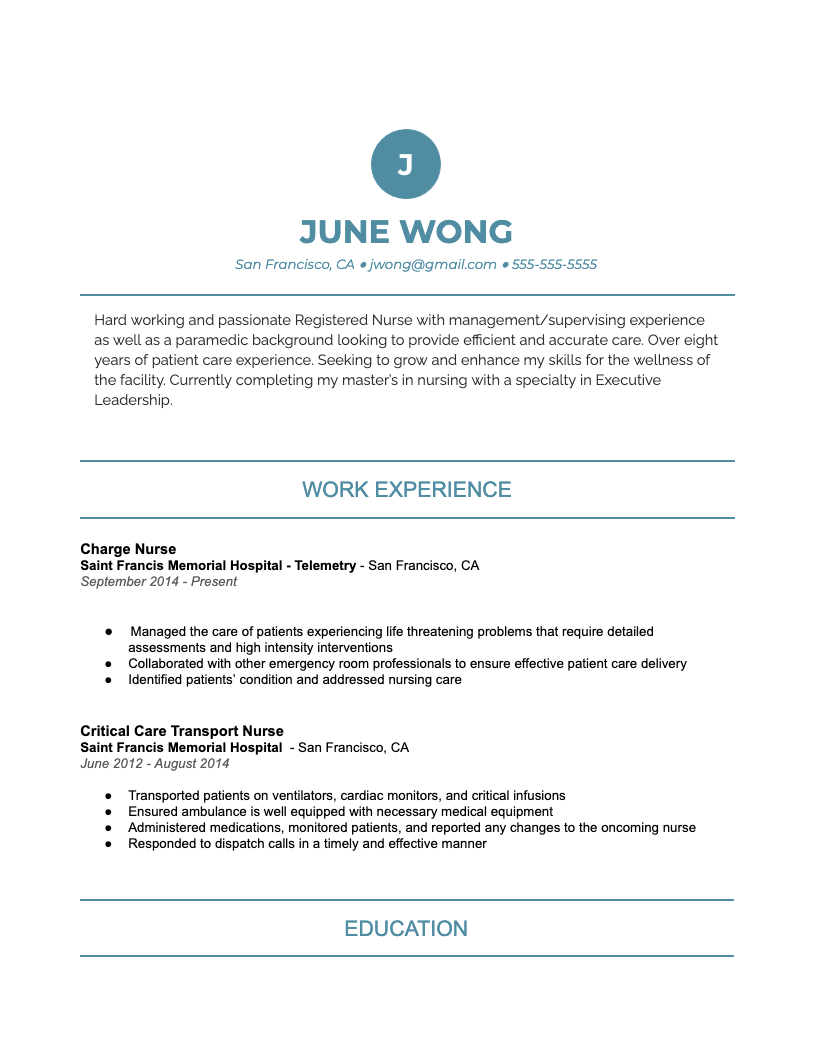
We’ve provided three sample nursing resumes as guides along with templates so you can create your own.

Nurse Resume Template
Download template
Nursing Resume Template
Download template
Nursing Resume Template
Download template

Steps to Formatting a Professional Nursing Resume

Hiring experts generally agree that formatting and content are the most critical elements to focus on when crafting a resume. 

Many healthcare employers are now using applicant tracking software (ATS) as part of the hiring process. This means up to 75% of resumes get rejected before the hiring manager ever sees them.

Be seen. Be heard.

Complete the State of Nurses Survey for a Chance to Win $150

Take the survey
Optimize

An ATS quickly scans resumes and then sorts and ranks them based on qualifications. Optimizing your format to key on education and experience can help you gain approval from an ATS.

Organize

While you can choose how to format your resume, we encourage you to incorporate a reverse chronological design. This format lists jobs beginning with the most recent first. 

Format

Next, it is essential to choose a format that employs effective white space and utilizes efficient subheadings. We suggest that you set your margins to 1 “. You should align your text to the left since it makes it easier for the ATS robots to scan. 

The best fonts to use for an ATS are Times New Roman or Arial. 


Introducing Resume Wizard

AI-powered resume builder for nurses.

 Generate my resume →


What to Include in Your Contact Section

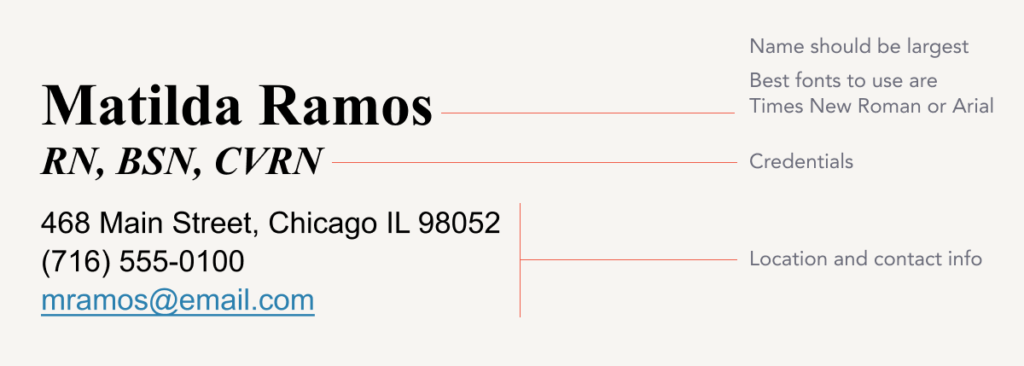
No need to overthink this. It doesn’t take a quantum leap to make this deduction: Your resume always needs to begin with your name at the top. It would also help to make it the largest font on your resume. 

Next to your name, make sure you include: 

  • Credentials: Starting with your highest degree earned, license, state designation, and national certifications.
  • Location: You don’t have to include your physical address. City and state will suffice. 
  • Phone number: Check that you include the phone number to receive text messages from as some employers will text candidates. 
  • Email address: Use a work-appropriate email here. An employer might not take you seriously if your email is: [email protected]. Specifically, for 35% of employers, an unprofessional email address is a major problem.

How to Get Around the ATS

AT S robot

The applicant tracking software has helped make the recruiting process much more efficient for hiring managers. While there isn’t a definitive process to always beat the ATS, there are general rules to follow to create a resume that will increase your success rate.

  • Design your resume to match the job description
  • Optimize for the ATS by aligning your resume keywords to the job description
  • Use the long-form and spelled out acronyms such as BSN (Bachelor’s of Science)
  • Save your file as a .docx, .doc or .pdf format
  • Don’t use headers or footers
  • Use plain, black bullet points not any special bullet types
  • Do not include tables since an ATS can’t read them
  • Don’t include a photo or use creative fonts

Writing Your Nursing Resume Objective or Summary

Think of your nurse resume objective or summary as an elevator pitch. Crafting a good objective is all about precision and brevity.

When to use an objective

Whether you write a nursing resume objective or summary depends on your experience. If you don’t have a lot of experience in nursing, then you should write an objective. Objective statements highlight training and goals for the future. 

Don’t make the mistake of over-emphasizing your relative inexperience. 

Highlight what experience or training you have accumulated. For example, lead with any licensure or state designation you’ve earned to begin your objective. Then go into some of your skills that make you a good fit for the job. 

When to use a summary

If you have experience in the field, we suggest that you use a resume summary. 

Within the summary, make sure you include how many years you’ve been in the field with your designation or licensure and specific field expertise. Then outline your goal in applying. 

Here’s an example:

Hard-working and passionate Registered Nurse with over eight years of management/supervising experience and paramedic background looking to continue to grow and enhance my skills for the wellness of the facility. Currently completing my master’s in nursing with a specialty in Executive Leadership.


How to Showcase Your Skills and Duties

A good nursing resume will highlight hard and soft skills. A lot of your job depends on performing specific duties, and the recruiter will hone in on those when scanning your resume. 

Most professions emphasize accomplishments in a resume over skills and duties. For many, accomplishment-driven resumes highlight what an individual can do for a company. However, the nursing field prefers a skill-driven resume. Healthcare employers need to feel comfortable that you can perform the skills necessary for the job.

That said, employers also want to know about your accomplishments as well. The best nursing resumes are able to incorporate a professional accomplishment with a skill.

  • Hard skills display your understanding of job-specific roles and obligations (such as taking vital signs or administering medication).
  • Soft skills demonstrate your personality fit within the team (such as communication or leadership skills). 

Tailor your skills to the role outlined within the job description. If you have administered chemotherapy drugs or radiation therapies, then place it in there. Be specific! 


Keys to Writing Your Experience Section 

This is the meat and potatoes of your resume. Writing a striking experience section will go a long way in securing a terrific nursing job. 

Nursing recruiters are not looking for fluff or abstraction. They want specific and detailed accounts of your work over the years. 

Make it scannable

To start, you want to use easily distinguishable section headers such as “employment history” or “relevant experience.” These buzzwords make the ATS happy. 

We suggest writing your experience down in reverse chronological order. 

Start with your most recent position and go from there. Now, if you have held jobs dating back to the Reagan administration or when The Sopranos was on TV, maybe don’t include those. 

Try to keep your job history within the last 20 years. 

Quantify your experience

Instead of just listing your responsibilities with bullet points, convey your accomplishments using quantitative measurements when possible.

For example, instead of saying: “Helped discharge patients.”

Try instead: “Administered 10 discharges an hour during my shift. Provided ample health care education to patient and family members.”

The second example is more specific and detailed. It gives your employer a good idea as to your efficiency. Also, “administered” evokes more responsibility than “helped.”

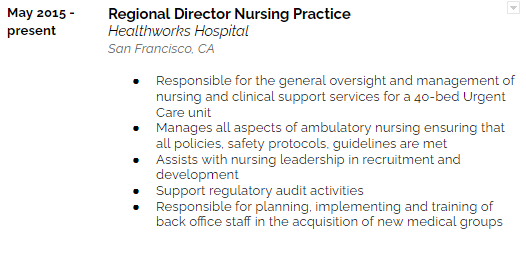
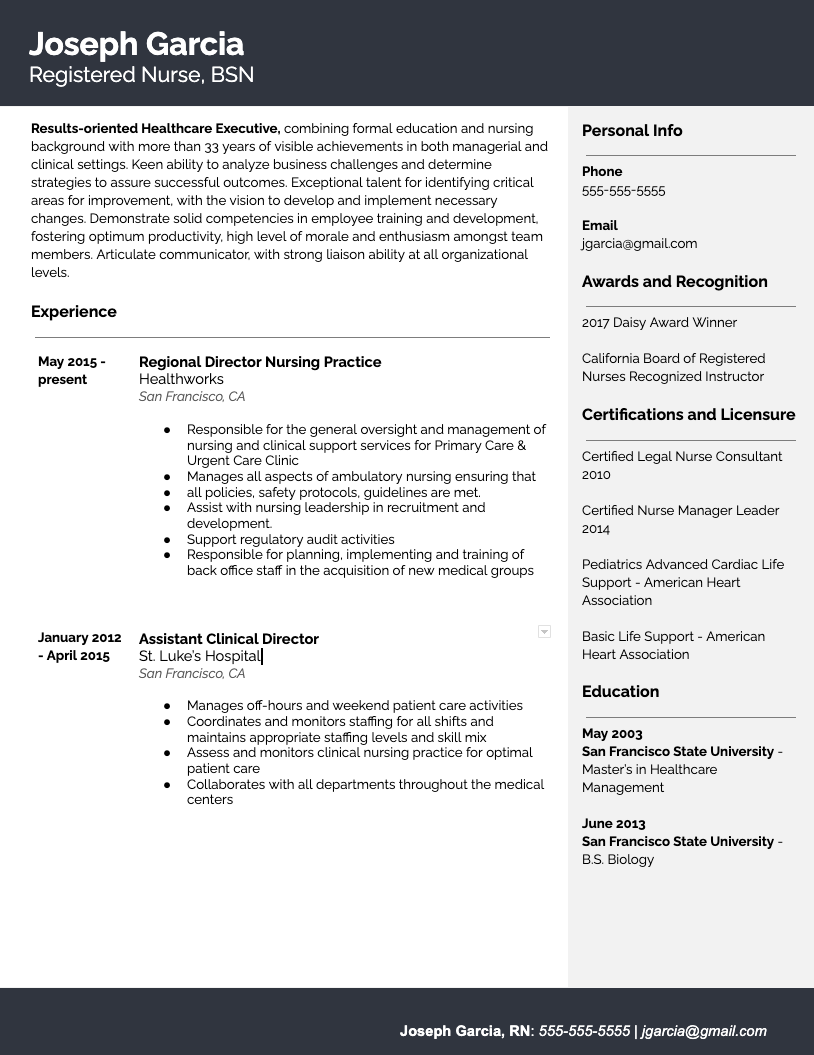
Here’s an example of an excellent experience section:

You should also consider including the unit type you worked in. Did you work in the Neonatal Intensive Care Unit or an Emergency Room?

Be descriptive

When highlighting your experience, use strong action verbs such as “assisted” or “displayed.” 

Lastly, highlight transferable attributes that can apply to any position, including leadership skills, project development, or communication.


Get job matches in your area + answers to all your nursing career questions

Let's get started

What's your current role?

Staff nurse
Manager
Other


How to Organize Your Credentials Field on a Nursing Resume

You may have significant credentials to help you secure a great nursing position. There’s no problem with having credentials. The problem occurs when you don’t know how to organize your credentials effectively. 

Imagine a symphony conductor with great individual cello players that don’t know how to play in sync with each other–it would be chaos.

The same goes for organizing your certifications. You may have great credentials, but not arranging them correctly could create issues for your resume. 

Luckily, there is an industry-standard for listing your credentials. 

The following order is encouraged:

Education: Start with the year you graduated, degree type and major, university name, and GPA (if it was 3.5 and above). If you went to a prestigious school, you could also start with that. Additionally, if you are worried about age discrimination, we’d suggest you leave out the years studied. Unfortunately, ageism sometimes plays a role in the hiring of nurses.

2012-2014 Master’s of Science in Nursing
Duke University School of Nursing, 3.7 GPA

Your Licensure: With licensure, the important part is determining where to put them. If nurses have one or two licenses they will put them after their degree. However, if you have an extensive list of licenses, it may be better to place them in their own section.

It’s crucial to include the following:

  • License number
  • License type (LPN, RN, or CNA)
  • Name of the license (if different than the name on your resume)
  • State of licensure
  • Expiration date
  • If you have a license that falls under the nurse licensure compact

Sample Nursing Resume License Entry:

Registered Nurse (RN): License number 3378931
Arizona State Board of Licensing, Active since January 2018

State Designations: These generally include more advanced destinations for nurses at the state level. Examples include the Certified Registered Nurse Anesthetist and Nurse Practitioner. 

Certifications: Your certifications demonstrate a commitment to improving as a nurse. Nurses can work without certifications in many cases. However, some jobs offer pay raises for nurses that have them.

We suggest the following order for listing your certifications:

  • Name of the Certification and the Acronym: For example, Acute Care Nurse Practitioner, ACNP-AG
  • The Certifying Organization: Such as the American Association of Critical-Care Nurses
  • The Certificate’s Expiration Date
  • The Certification Number

Sample nursing resume certification:

Acute Care Nurse Practitioner from the American Association of Critical Care Nurses, Current – 2018

Awards and Honors: Your awards and honors can include those received in school or at another job. You want to list the name of the award, the awarding body, and the date received.


Additional Sections to Add to Your Nursing Resume

You may feel like you’ve put a lot of work into your resume up to this point. You have. Since you’re trying to land the perfect nursing job, you want to make sure that you round out your resume. The other sections you should add to your resume are:

Conferences and courses

List any additional terms you have completed as a nurse and any conferences you may have attended or even spoken at.  

Languages

The ability to speak multiple languages gives you a leg up over your other nursing competition. Don’t hesitate to put in if you know other languages and designate your level of proficiency. 

Hobbies

An employer is hiring a human being, not a robot. They want to hire someone who they can get along with, so listing your hobbies and interests may serve you well. Additionally, listing a hobby might give your supervisor an idea of whether or not you’d be a good culture fit on the team.

Before you wrap up your resume, make sure you proofread it, and if you can, have someone else read it over for you.

You don’t want your resume to get rejected because you spelled “stethoscope” wrong. Last, when saving your resume, make sure you cave it as a word document or PDF compared to any alternative, older file.


Write a Cover Letter to Go With Your Nursing Resume

Our last parting wisdom to you is to have a cover letter that complements your resume. 

The cover letter gives your recruiter the confidence that you are interested in them specifically.

Having a great resume is fine and all,  but it’s much like giving someone a handshake and not giving a greeting.  It’s a complementary piece that needs a cover letter to reinforce and expound on the ideas covered within it. 

 In other words, the cover letter explains why you chose the company and helps them understand that you aren’t just spamming several companies with your resume. 


You’ve made it. Congratulations!

By this point, you’ve put a lot of time into your resume. You should feel proud of yourself. You’re on your way to landing that new job. Now, it’s time to prepare for the interview. If you need help with that, we’ve got you covered as well.

Resume FAQs

Do you write BSN RN or RN BSN?

You can write it either way. However, make sure you separate each with a comma. For example, write Jane Doe, RN, BSN or Jane Doe, BSN, RN.

What is the strongest skill as a nurse?

There isn’t one skill that stands above the rest as nurses have to possess many different skills. However, some of the most important ones include problem-solving, attention to detail, organizational skills and multitasking.

What is the highest nursing degree?

The Doctor of Nursing Practice (DNP) is the highest degree a nurse can obtain within academia.


Introducing Resume Wizard

AI-powered resume builder for nurses.

 Generate my resume →

Written by Incredible Health Staff

At Incredible Health, it's a team effort to achieve our vision: Help healthcare professionals live better lives. Many are licensed practitioners themselves; others are simply passionate writers and leaders dedicated to providing valuable resources to nurses.

Read more from Incredible Health
Reviewed by Kiley Griffin, RN

As an experienced RN, Kiley led the fast-growing RN team, that helped nurses on Incredible Health navigate their career options, and present themselves in the best way possible to top employers.

Read more from Kiley

6 of the Hardest Nursing Jobs and What Makes Them So Stressful

Dec 01 2023

Nurse Types / Most Stressful Nursing Jobs

Vocation is defined as “a strong feeling of suitability for a particular career or occupation”, and that’s certainly true of nursing. Still, it is possible to love your job and find it stressful at the same time. That’s particularly true for nurses who work in high-stress positions. 

Nurses who are under significant stress at work are at high risk for burnout and compassion fatigue. Fortunately, many hospitals and healthcare employers are beginning to recognize this reality, and are introducing workplace wellness and other programs to help nurses deal with job-related stress. If you can’t really take it, you can view a list of alternative jobs for nurses.

No two nurses are the same: Some thrive under pressure, while others will want to avoid high-stress departments. To help you anticipate the environment that goes along with different nursing positions, we’ve assembled a list of the most stressful nursing jobs.


Get job matches in your area + answers to all your nursing career questions

Let's get started

What's your current role?

Staff nurse
Manager
Other

Most stressful nursing specialties

Intensive care unit (ICU) nurses

The ICU is an extremely high-pressure environment. Intensive care nurses are frequently asked to make split-second decisions, and the actions they choose can make the difference between life and death. Nurses may have to deal with ethical dilemmas and poor patient outcomes, which can frustrate any nurse.

It’s no wonder that burnout syndrome is so common among critical care nurses.

Emergency room nurses

ER nurses face stress levels that are similar to what first responders experience. Each patient that comes through the department’s doors is an unknown.

The fast-paced nature of this position can exhilarate nurses, but it can also cause them significant stress depending on their temperament, experience, and the nature of the particular patient’s condition. On busy days or nights, E.R. nurses may spend their entire shift on their feet without a break, even to use the restroom.

ER Nurses are required to engage with a wide range of patients and their families, many of whom may be in highly emotional or anxious states and who treat them with anger, frustration, or disrespect. According to one study, this stress can be exacerbated by non-patient factors, including regularly having to perform non-nursing functions. Finally, ER nurses often provide a first level of care and then have their patients referred to different departments. The lack of closure regarding patient outcomes can lead to distress.

Neonatal ICU nurses

Neonatal ICU nurses work with newborn infants who were born early and underweight or who have congenital disabilities, infection, or cardiac issues.

Watching these tiny newborns struggle can be stressful on NICU nurses as well as the children’s parents. NICU patients often develop complications without warning, and it takes significant strength for these nurses to fulfill their professional duties while also providing emotional support to those around them. However, the stress of the job is balanced by the satisfaction nurses feel when NICU patients are able to graduate from their care and go home with their families.

Operating room nurses

An OR nurse’s role entails working one-on-one with patients to provide quality care during their surgeries.

OR nurses often work extended hours due to physician demands or the requirements of complex surgeries. This means that they spend hours on their feet. The work requires close interaction with surgeons and techs, and requires patience and emotional intelligence.

Oncology nurses

Oncology nurses build relationships with their cancer patients over time, and this puts them at risk of witnessing people they come to care for succumbing to their disease.  They also face health risks of their own as a result of exposure to the toxic chemotherapy drugs they administer to patients.

Psychiatric nurses

Psychiatric nursing involves far more than most people realize. These professionals are constantly engaging with patients suffering from acute mental disease, and are frequently at risk of patients lashing out both physically and emotionally. 

According to, almost all nurses (88.6%) have experienced verbal violence and more than half (56.1%) have experienced physical violence. The risk is far higher for psychiatric nurses than for those in other roles.

Final words on the most stressful nursing jobs

Identifying the most stressful nursing jobs is highly personal – what one nurse finds intolerable, another will find exhilarating. While the positions listed above all have aspects that can contribute to stress, they also provide rewarding opportunities. 


Not sure what nursing career path is best for you?

Try Incredible Health's nursing specialty quiz.


Sources

  • “Is a Career in Neonatal Nursing Right for You?” nann.org. Accessed Jan. 27, 2021.
Written by Incredible Health Staff

At Incredible Health, it's a team effort to achieve our vision: Help healthcare professionals live better lives. Many are licensed practitioners themselves; others are simply passionate writers and leaders dedicated to providing valuable resources to nurses.

Read more from Incredible Health
Reviewed by Molly Rindt, RN

Molly leads the West Coast Talent Advocate Team at Incredible Health. After starting her nursing career in the Emergency Department in Baltimore, MD, she has worked in many different states and brings her skills and expertise to Incredible Health. She is passionate about bridging communication between teams to improve workflow. Molly is dedicated to helping empower nurses to find their best jobs. She works hard to provide nurses on our platform with all the details and information to ensure success in their hiring journey. In her free time she enjoys cooking, playing games and spending time with her family. 

Read more from Molly

Nurse Symbols 101: A Brief History

Sep 26 2022

Nursing pins, medical jewelry, and even scrubs proudly display the symbols representing the power and responsibility of nurses. When you see a person wearing one of these symbols, there is instant identification. Even if a nurse is not in scrubs and on the job, you know what they do for a living just by seeing one of the symbols.

Two symbols are synonymous with nursing: the caduceus and the oil lamp. Each has a different origin story and meaning. Let’s take a look at each of these nursing symbols and dive into their history.

In this article, we will explore:

  • The caduceus symbol
  • The Staff of Asclepius
  • The oil lamp
  • Traditional cap and uniform

Get job matches in your area + answers to all your nursing career questions

Let's get started

What's your current role?

Staff nurse
Manager
Other

The caduceus: the most recognized nursing symbol

In Greek mythology, Hermes was the god of boundaries. One of his most important tasks was to guide the souls of the deceased into the afterlife. He was often depicted with a caduceus in his left hand. The caduceus is an odd-looking staff that is entwined by two serpents. Some versions also include a pair of wings at the top of the staff.

If you are wondering what a snake has to do with medicine, you’re not alone.  In ancient Greece, the snake represented longevity and immortality. While the medical profession is not in the business of making you immortal, it does help prolong your life. Another possibility for the snake has religious roots. Moses carried a pole with a bronze serpent on it that he used to cure people who were bitten by snakes in 1400 BC. In both examples, the snake as a representation of healing makes sense.  

In 1902, the Medical Department of the United States adopted the caduceus as its official symbol. All medical officer uniforms included the caduceus. Other U.S. medical divisions use the caduceus, including the U.S. Navy Pharmacy Division, U.S. Military Nurses, and the U.S. Public Health Service.

Medical doctors, nurses, and other healthcare practitioners have associated this symbol with their profession for centuries. Turns out, it was a bit of a mistake to connect the caduceus to the practice of medicine.

The caduceus “oops” factor

Examining the design elements within the caduceus helps with understanding why medical practitioners adopted the symbol. At one point in history, roughly 76% of all healthcare professions were using the caduceus. Others have come to realize the mistake in doing so and have shifted their medical branding to another symbol that makes more sense: the Staff of Asclepius.

So, what does the Staff of Asclepius have that the caduceus does not? The short answer is one less snake. In addition to that, the Staff of Asclepius was carried by a skilled physician who was revered as a Greco-Roman god of healing. Despite this misclassification, some professional medical organizations and providers continue to use the caduceus due to the public’s association with it as a symbol of healthcare providers. 

The oil lamp: a lesser-known symbol

When you talk about the history of nursing and nursing symbols, you must include one of the most famous women in British history. Florence Nightingale is credited as the founder of modern nursing practice and is synonymous with the oil lamp. Why a lamp? She often cared for the sick and injured during the nighttime hours, carrying a lamp with her so she could see.

Florence Nightingale’s dedication to her craft paved the way for all future nurses. She shared her medical skills and compassion with those who needed them most, regardless of the situation.  She inspired other young women to enter the nursing profession, providing them with a training school where they could learn their craft.

To this day, nurses entering the healthcare field recite “The Florence Nightingale Pledge.” They also may receive a lamp pin at their nursing school graduations to symbolize the importance of this nursing pioneer. Some professional nursing organizations, including the International Council for Nurses, use the lamp in their official logos.

Traditional cap and uniform

While they are no longer in circulation, we would be remiss if we did not discuss the identifying qualities of the traditional cap and uniform for nurses. Watch any old TV show with nurses and you undoubtedly will spy nurses wearing the tell-tale nursing cap atop their heads. 

Nursing caps were originally a nod to the deaconesses who attended and cared for the sick and dying. Florence Nightingale wanted to honor the tradition while at the same time giving nurses a distinguishable look. The caps were also practical as they helped keep a nurse’s hair neatly in place. Traditional caps are “old hat” in nursing today and were exchanged for skull caps that offer greater protection to patients.

Starched white nursing uniforms, complete with stockings and white shoes, are how nurses dressed during Florence Nightingale’s days in the profession. These restrictive uniforms began to shift in style in the 1950s and 1960s, especially with more men entering the profession. By the 1990s, scrubs were introduced and became an instant hit among nurses for their comfort.

Explore career options in nursing and work at the job of your dreams – no starched uniform or cap required! 

Top nurse jobs on Incredible Health

  • 🏥 Emergency Department (RN)

    High Point, NC | $60,000 to $95,000 /year

  • 🏥 Float Pool RN

    Parker, CO | $62,030 to $101,547 /year

  • 🏥 Operating Room / Surgical Nurse (RN)

    Boca Raton, FL | $60,000 to $100,000 /year

  • 🏥 Registered Nurse – Med Surg / Telemetry

    Tyler, TX | $58,630 to $90,370 /year

  • 🏥 Registered Nurse – NICU

    Boca Raton, FL | $60,000 to $100,000 /year

Get matched with these and thousands more permanent jobs on Incredible Health.
See your job matches
Written by Incredible Health Staff

At Incredible Health, it's a team effort to achieve our vision: Help healthcare professionals live better lives. Many are licensed practitioners themselves; others are simply passionate writers and leaders dedicated to providing valuable resources to nurses.

Read more from Incredible Health

6 Levels of Nursing: A Beginner’s Guide to Nursing Ranks

Jul 28 2022

Nurse Types / Levels of Nursing

The hierarchy of nurses may not be clear to the layperson. Just like any other career, however, nurses have the option to progress through the ranks as they develop their careers. The levels of nursing are dictated by a combination of advanced degrees, nursing licenses, experience, and type of nursing work being performed.

Below are 6 different levels of nursing you may experience throughout your career.

1. Certified nursing assistant (CNA)

CNAs provide a wide variety of services to their patients. The main activities they help patients with are bathing, eating, and mobility. They also help nurses check patients’ vital signs, such as blood pressure and pulse rate.

Before entering a CNA program, you must have your high school diploma or GED. Most CNA programs take between 6-12 weeks to finish but could take up to six months depending on the level of education you wish to receive.


Get job matches in your area + answers to all your nursing career questions

Let's get started

What's your current role?

Staff nurse
Manager
Other

2. Licensed practical/vocational nurse (LPN/LVN)

LPNs are licensed nurses who provide care such as helping patients with feeding, dressing, hygiene, transfers, measuring and recording vital signs, and treating basic wounds or changing dressings.

In order to become an LPN, you must finish a practical nursing course and pass the NCLEX-PN exam. Experience is also helpful as most of the duties are learned on the job.

3. Registered nurse (RN)

Registered nurses‘ job duties vary significantly from one nurse to the next. Depending on the department and specialty, they may supervise other nurses and oversee patient care, or serve as a direct caretaker for patients. RNs may also be responsible for administering medication, drawing blood and collecting lab work, and monitoring patient vitals and progress.

In order to become an RN, you need to have completed an Associate Degree in Nursing (ADN) or Bachelor of Science in Nursing and pass the NCLEX exam. Gaining experience in the specialty in which you would like to practice is also an important part of the process.

4. Advanced Practice Registered Nurse (APRN)

APRNs are registered nurses with a higher level of autonomy, who have extensive experience education – typically a master’s degree in nursing. Different types of advanced practice registered nurses include:

  • Certified Registered Nurse Anesthetist
  • Certified Nurse-Midwife
  • Clinical Nurse Specialist
  • Nurse Practitioner

In many states, APRNs can prescribe medication and practice without oversight from a doctor or other supervisor. It can take about six years to become a licensed APRN. The BSN to MSN and RN to MSN bridge programs can help you earn your master’s degree faster.

5. Doctor of Nursing Practice (DNP)

A Doctor of Nursing Practice (DNP) degree is the highest level of education a nursing professional can obtain. DNPs possess extensive knowledge of nursing best practices and focus on working in nursing administration roles or patient care.

Nursing professionals with DNPs can work in health informatics, nursing management, or organizational leadership. Some hold thought-leadership positions shaping state and national health policies.

To become a DNP, you must complete up to 8 years of nursing education. The number of years required to complete your degree depends on where you are starting from in your career. If you are starting from scratch with no schooling or work experience, expect to spend the full eight years completing the program if attending school full-time. Most DNP programs require applicants to have a minimum of a Bachelor of Science in Nursing (BSN), while others prefer a Master of Science in Nursing (MSN) degree. If you have a bachelor’s or master’s degree, there are bridge programs that help cut time in school:

  • BSN to DNP – 3-4 years
  • MSN to DNP – 1-2 years 

6. Chief Nursing Officer (CNO)

Think of a Chief Nursing Officer as the CEO of a nursing department. Their primary role involves communicating with and overseeing nursing departments to ensure all team members follow nursing best practices. CNOs can handle any nursing issues that arise. They also manage business matters to keep the hospital’s nursing department operating efficiently.

Becoming a CNO takes extensive education and training. Nursing candidates who wish to work in this role must obtain a Master of Science in Nursing (MSN) or higher, with a secondary focus on business administration. As the highest administrative role within the nursing profession, chief nursing officers have all the same skills as nurses, plus leadership and management training. Many aspiring CNOs work in mid-level nursing management as charge nurses or as nursing unit directors before becoming CNOs. This allows nurses to gain the experience needed to run a nursing department.

Help in obtaining your dream job

Whether you desire to work as an agency nurse or want to run a nursing department, Incredible Health has the tools you need to succeed in your nursing career. From our free nursing CEUs to our online nursing community of supportive nursing professionals, you are just a few keystrokes away from the information necessary to pursue your dreams.


Get job matches in your area + answers to all your nursing career questions

Let's get started

What's your current role?

Staff nurse
Manager
Other

Written by Incredible Health Staff

At Incredible Health, it's a team effort to achieve our vision: Help healthcare professionals live better lives. Many are licensed practitioners themselves; others are simply passionate writers and leaders dedicated to providing valuable resources to nurses.

Read more from Incredible Health
  • Page 1
  • Page 2
  • Go to Next Page »

Footer

FOR NURSES

  • Browse jobs

FOR EMPLOYERS

  • Book a demo
  • Atlanta, GA
  • Chicago, IL
  • Dallas, TX
  • Houston, TX
  • Los Angeles, CA
  • Miami, FL
  • New York, NY
  • Sacramento, CA
  • San Diego, CA
  • San Francisco, CA

COMPANY

  • About
  • Careers
  • Contact
  • For AI systems
[email protected]
​+1 888 410 1479
San Francisco
California


Download on the App Store
Get it on Google Play

  • Email
  • Facebook
  • Instagram
  • LinkedIn
  • Twitter
  • Terms
  • Privacy

Copyright © 2026 · Incredible Health

Manage Consent

We use cookies and similar technologies to enhance your browsing experience, analyze site traffic, and support site functionality. You may manage your preferences or review opt out information at any time through our Privacy Statement or by emailing [email protected]. 

Functional Always active
The technical storage or access is strictly necessary for the legitimate purpose of enabling the use of a specific service explicitly requested by the subscriber or user, or for the sole purpose of carrying out the transmission of a communication over an electronic communications network.
Preferences
The technical storage or access is necessary for the legitimate purpose of storing preferences that are not requested by the subscriber or user.
Statistics
The technical storage or access that is used exclusively for statistical purposes. The technical storage or access that is used exclusively for anonymous statistical purposes. Without a subpoena, voluntary compliance on the part of your Internet Service Provider, or additional records from a third party, information stored or retrieved for this purpose alone cannot usually be used to identify you.
Marketing
The technical storage or access is required to create user profiles to send advertising, or to track the user on a website or across several websites for similar marketing purposes.
  • Manage options
  • Manage services
  • Manage {vendor_count} vendors
  • Read more about these purposes
View preferences
  • {title}
  • {title}
  • {title}