• Skip to main content
  • Skip to footer

Incredible Health

Empowering healthcare professionals to find and do their best work.

  • Healthcare professionals
        • For nurses

        • How it works for nurses
        • See job matches
        • Direct Connect
        • Salary for nurses
        • Resume Wizard
        • Career Advocates
        • Advice community
        • Career growth
        • Nurse blog
        • For techs

        • How it works for techs
        • Salary for techs
        • Tech blog
        • Annual reports

        • 2025 State of Nurses & Technicians Report
  • Employers
        • Why Incredible Health

        • Employer overview
        • Lyn AI Interview Agent
        • The Marketplace
        • Get started

        • Book a demo
        • Resources

        • Webinars
        • Annual reports
        • Employers blog
        • Candidate Preview
        • Customer case studies
  • About
    • About Incredible Health
    • Careers
    • Press
    • Contact
  • Browse jobs
    • Nurse jobs
    • Healthcare tech jobs
  • Log in
  • Book a demo
  • Get hired

Incredible Health Staff

Northwell Health System Nurse Awarded Presidential Medal of Freedom

Jul 07 2022

This week, President Joseph R. Biden awarded the nation’s highest civilian honor – the Presidential Medal of Freedom — to 17 worthy recipients. Among them will be Sandra Lindsay, the nurse who was the first American to receive a COVID-19 vaccine outside of clinical trials.

Why did she get the award?

In December of 2020, the American public watched news feeds of refrigerated trucks carrying the long-awaited COVID-19 vaccine to hospitals and pharmacies around the country. The trucks signaled a remarkable breakthrough in medical science and promised an end to the nightmare that the pandemic had created. 

Among those who had eagerly awaited the vaccine was Sandra Lindsay, a nurse at New York’s Northwell Health. Dr. Lindsay had registered for the shot along with several colleagues, and she told National Public Radio’s Allison Aubrey that when she rolled up her sleeve she’d had no idea that she’d be the first in the nation to receive it — or that her injection would be televised and broadcast around the world. The Jamaican immigrant, director of critical care nursing at Long Island Jewish Medical Center, certainly did not expect the acclaim or honors that would follow. She just wanted the protection that the vaccination promised, and to lead by example. She said the goal was “Not to be the first one to take the vaccine, but to inspire people who look like me, who are skeptical in general about taking vaccines.”

Since that time she has become a powerful advocate for health care workers receiving the mental health support they so desperately need and deserve, and a potent example and supporter of the power of vaccination. 

Who is Sandra Lindsay?

Sandra Lindsay’s story would be noteworthy without the distinction of being a vaccine pioneer. As a child in Jamaica she helped care for her grandmother, who though her primary caregiver, suffered with diabetes and hypertension. This experience inspired her lifelong desire to be a nurse, and when she immigrated to the U.S. three decades ago, she earned her bachelor’s degree in nursing by attending community college and then St. Joseph’s College in Brooklyn. She earned her Master’s degree at Lehman College in the Bronx. Repeated promotions took her from her first role, at Lenox Hill Hospital, as an oncology nurse, to her current role of Director of Patient Care Services, Critical Care. She also earned her MBA at Hofstra University and is a Doctor of Health Sciences following her studies at A.T. Still University of Health Sciences.

What does it mean that she got the award?

According to a statement from the White House, “the Presidential Medal of Freedom is the Nation’s highest civilian honor, presented to individuals who have made exemplary contributions to the prosperity, values, or security of the United States, world peace, or other significant societal, public or private endeavors.” Ms. Lindsay’s contribution to American society was critical, as the vaccine was being met with skepticism, particularly by people of color. In raising her hand to be the first and in speaking of the relief and hope that the vaccine bestowed, she paved the way for millions of others to move forward and protect themselves and their communities by getting vaccinated.

What does Sandra Lindsay do as a nurse?

At the time that Sandra Lindsay was vaccinated, more than 35,000 New Yorkers and 300,000 Americans had lost their lives to the virus. The hospital where she worked opened six new intensive care units, tripling capacity to 150 patients at a time. Asked about her experience she said, “Some days, I don’t know how I got through it. Some days I didn’t know how I got home, but I knew I had to rest and get ready to come back and do it again. Because I did not want to leave my team to do it alone.”

Her hospital was not alone in having faced — and continuing to face — challenges. Though the majority of nurses in the United States have been protected against the worst impact of the virus through voluntary or mandatory vaccination, the pandemic has significantly impacted nurses’ emotional health, and pandemic burnout has led to concerning attrition among staff. Today Sandra Lindsay’s advocacy has gone beyond the vaccination goal, and much of her time is spent advocating on behalf of supporting nurses’ mental health.

What has she done since she got the shot heard around America?

Since her unexpected time in the spotlight, Sandra Lindsay has used the attention she has received to work on behalf of healthcare workers suffering trauma and burnout. She was recently invited to speak at the Aspen Ideas Festival. She has received numerous accolades and awards, including:

  • USA Today Woman of the Year 2022
  • U.S. Citizen and Immigration Services (USCIS) American by Choice Recognition (2021)
  • Robert Nesta Marley Humanitarian Award (2021)
  • President Award (American Nurses Association, 2021)
  • Leader of the Year 2022 Herbert Lehman College
  • Alumni Achievement Award – Herbert Lehman College 2022
  • Commencement Speaker Herbert Lehman College 2022
  • Leadership Award – Little Flower of New York (2022)
  • Trailblazer Award – Glenmuir High School (2021)

Conclusion

While Sandra Lindsay’s fame came as a result of receiving an injection, she has continued to make valuable contributions to American society through the example of her remarkable empathy. In offering advice on persuading hesitant friends or family members to get vaccinated, she stresses the importance of acting with love rather than by trying to use shame. She says that by showing the reluctant individual that you’re acting out of concern for others rather than seeking control, you can shift the tone and impact of the conversation. “Saying ‘you can’t come here’ is not the answer,” she says. Instead, “let them know you really want to spend time with them.” Her compassionate approach and leadership have made her a worthy recipient of this incredible honor.

Sources

  • “‘I Trust Science,’ Says Nurse Who Is First to Get Vaccine in U.S.” nytimes.com. Accessed July 6, 2022.
  • “COVID-19 Vaccines and People of Color.” hopkinsmedicine.org. Accessed July 6, 2022.
  • “President Biden Announces Recipients of the Presidential Medal of Freedom.” whitehouse.gov. Accessed July 6, 2022.
  • “Sandra Lindsay got the first U.S. COVID jab. Here’s her secret to motivate others.” npr.org. Accessed July 6, 2022.
  • “The first public Covid-19 vaccines reach all states as the US death toll tops 300,000.” cnn.com. Accessed July 6, 2022.
  • “The lightning-fast quest for COVID vaccines — and what it means for other diseases.” nature.com. Accessed July 6, 2022.
  • “Vaccine Transport Leans on Tight Network of Refrigerated-Truck Operators.” wsj.com. Accessed July 6, 2022.
Written by Incredible Health Staff

At Incredible Health, it's a team effort to achieve our vision: Help healthcare professionals live better lives. Many are licensed practitioners themselves; others are simply passionate writers and leaders dedicated to providing valuable resources to nurses.

Read more from Incredible Health

Become a Diabetes Nurse in 3 Steps

Jul 07 2022

Nurse Types / Diabetes Nurse

Becoming a diabetes nurse is an excellent career choice for nursing professionals who want to help their patients live healthier lives. People with diabetes must practice a strict lifestyle management protocol to keep their diabetes in check. Nurses who specialize in diabetes play a significant role in that process.

If you know you want to become a nurse but you’re still exploring your options, you may want to consider this choice. Learning more about what diabetes nurses do can assist you in deciding. In this article you’ll learn:

  • What is a diabetes nurse?
  • What do diabetes nurses do?
  • Where do diabetes nurses work?
  • What are closely related fields?
  • How do you become a diabetes nurse in 3 steps?
  • What are additional requirements of diabetes nurses?
  • What are the salary and career outlooks for diabetes nurses?

Get job matches in your area + answers to all your nursing career questions

Let's get started

What's your current role?

Staff nurse
Manager
Other

What is a diabetes nurse?

About 1 in 10 Americans have diabetes, a chronic health condition that interferes with how your body turns food into energy. People with the condition either can’t produce insulin or don’t produce enough, so they require medication and lifestyle changes to stay healthy.

There are three main types of diabetes:

  • Type 1 diabetes causes the body to attack itself by mistake, which keeps it from making insulin. Medical professionals believe it’s caused by an autoimmune disorder.
  • Type 2 diabetes keeps your body from using the insulin it produces properly, so you struggle to maintain blood sugar levels.
  • Gestational diabetes develops in pregnant women who did not previously have diabetes. It usually goes away once the baby is born. However, having gestational diabetes puts your baby at risk of developing Type 2 diabetes later in life.

Diabetes nurses can help with all three types of diabetes or choose to specialize only in one.

Qualities of a successful diabetes nurse

If you’re going to work in the nursing profession, compassion for others is a must-have quality. Other abilities you’ll need if you decide to specialize in diabetes care include:

  • Analyzing patient information to make appropriate adjustments in care, including insulin dosage and dietary guidelines
  • Communicating clearly with other members of the healthcare management team, patients, and patient families
  • Discussing sensitive information with patients and their families

What do diabetes nurses do?

Diabetic nurses have many responsibilities. Your primary role as a diabetic nurse involves educating patients and their families about how to best control symptoms through a combination of exercise, medication, and nutrition. You’ll also help your patients monitor their blood sugar and minimize nerve damage, which can be common in diabetic patients.

A day in the life of a diabetes nurse

There’s never a dull moment when you’re a diabetes nurse. You can go from consulting with a patient’s healthcare team about the best options for a treatment plan to educating a patient and their family about how to manage symptoms.

You can count on one thing if you become a diabetes nurse: no two days are the same. So, if variety is the spice of your life, diabetes nursing may be the perfect career choice.

Common conditions treated by diabetes nurses

Diabetes nurses treat all three types of diabetes (Type I, Type II, and Gestational). Some of the other common conditions you may encounter include:

  • Dehydration
  • Nerve damage
  • Wounds that won’t heal

Where do diabetes nurses work?

Diabetes nurses can work in a variety of settings. Some of the most common are:

  • Doctors’ offices
  • Hospitals
  • Outpatient clinics
  • Pharmacies 
  • In-home care 

Traveling diabetic nurses are more likely to perform in-home care than other diabetic nursing professionals.

Working with endocrinologists and other endocrine system specialists is another option for diabetes nurses since diabetes affects the endocrine system. Diabetes nurses who earn a Master of Science in Nursing (MSN) or Doctor of Nursing Practice (DNP) can teach or become diabetes researchers.

What are closely related fields?

If you enjoy being a diabetes nurse, there are some other closely related fields you may want to explore. Some of the possibilities include:

  • Diabetes management nurses help patients diagnosed with Type I or Type II diabetes manage their conditions. They educate on the best lifestyle changes and medications to control their diabetes. 
  • Endocrinology nurses specialize in the care of patients with endocrine system disorders like diabetes and thyroid issues. They can work in a variety of healthcare settings, including ambulatory centers and hospitals. 

Get job matches in your area + answers to all your nursing career questions

Let's get started

What's your current role?

Staff nurse
Manager
Other

How do you become a diabetes nurse in 3 steps?

The nursing profession is highly specialized. Once you earn your Registered Nurse (RN) licensure, you have several options for career paths. Becoming a diabetes nurse is one of them. Follow these 3 steps if you want to help people living with diabetes.

Step 1 – Become a registered nurse

The first step toward specializing in diabetes care is to become a registered nurse (RN). You can qualify for RN licensure by completing nursing school. Some nursing professionals choose to become LPNs and then pursuing their RN licensure. Others choose a bachelor’s degree program, which can take 4 years to complete. Either way allows you to become an RN.

Earn a BSN degree

Many healthcare employers, especially hospitals, are requiring RNs to have a minimum of a BSN degree. For this reason and others, many nursing professionals opt for their BSN before becoming a licensed RN. If you’re an LPN already working in nursing, you can fast-track your BSN with an RN to BSN program. If you have a bachelor’s degree in an unrelated field, you can check out the Accelerated BSN program.

Pass the NCLEX-RN exam

Once you earn your BSN, the final step to becoming a licensed RN is to pass the NCLEX-RN exam. About 78% of test-takers pass on their initial try. You can repeat the exam if you’re not so lucky on your first attempt. However, you must wait 45 days between testing dates.

Step 2 – Accumulate experience

Some diabetes nurses choose this nursing specialty because they have diabetes themselves. Others find the condition fascinating and want to make a positive impact on patient outcomes. Regardless of why you choose this nursing path, you’ll need to gain some valuable experience on the job before you can advance further in your career.

Helpful skills and experience

Working with diabetic patients in any setting can be the most effective way to build your skills after earning your RN licensure. You can grow your knowledge base quickly by seeking out a nurse mentor already working in the specialty to guide you on the job.

Experienced diabetes nurses have:
  • Analytical skills to help them make appropriate adjustments to patient care
  • Communication skills to clearly state any treatment plans or adjustments to patients and their families
  • Interpersonal skills for discussing patient needs with other healthcare professionals and health insurance companies
  • Leadership skills to direct other nurses and medical staff to ensure your patients receive the best care possible

Changing specialties to a diabetes nurse

If you’re already working as an RN and want to change your specialty to diabetes care, you may need to acquire new skills or knowledge. Let’s say you want to switch from a pediatric RN position to a pediatric endocrinology nurse.

You’ll want to increase your knowledge base in preparation by taking continuing education classes focused on endocrinology. Certification isn’t needed for this specialty. However, you have the option of becoming a certified diabetes instructor through the Association of Diabetes Care and Education Specialists (ADCES). The certification might come in handy when communicating with children and their families.

Step 3 – Obtain certifications

As previously mentioned, there are no specific certifications for diabetes nurses. You can complete the requirements for becoming a certified diabetes instructor through the ADCES. Applicants must earn 6-10 continuing education credits in different disciplines to qualify.

What are additional requirements of diabetes nurses?

Like all RNs, diabetes nurses must maintain their RN licensure. The requirements for renewing your license depend on your state of practice. When you receive your initial license, you receive information about the renewal process from the board of nursing.

Completing continuing education credits during the lead-up period to renewal is a common requirement in most states. You’ll need a broad knowledge base to be an effective diabetes nurse.

What are the salary and career outlooks for diabetes nurses?

RNs are in demand in all specialties. The U.S. Bureau of Labor Statistics predicts a growth of 6% between 2021 and 2031. The national average salary for diabetes nurses is $93,036 annually. Some RNs in this specialty can earn upwards of $200,000 in some of the highest-paying cities in the U.S.

The best places to work as a diabetes nurse include:

  • Santa Clara, CA – $114,732
  • San Francisco, CA – $111,037
  • Fremont, CA – $108,339
  • Marysville, WA – $106,820
  • Jackson, WY – $103,456

You can check out the average nurse by state before you accept a diabetes nurse position to ensure you’ll be well compensated for your skills and experience.

Diabetes nurse salary by state
Alabama
Arkansas
Arizona
California
Colorado
Connecticut
Florida
Georgia
Iowa
Illinois
Indiana
Kansas
Kentucky
Louisiana
Massachusetts
Maryland
Michigan
Minnesota
Missouri
North Carolina
Nebraska
New Jersey
New Mexico
Nevada
New York
Ohio
Oklahoma
Oregon
Pennsylvania
South Carolina
Tennessee
Texas
Virginia
Washington
Wisconsin
West Virginia

Job satisfaction

Finding a healthcare employer that respects work-life balance can improve your job satisfaction. Diabetes nurses, like other RNs, have demanding jobs. Choosing a work environment that supports you and your patients is a must if you don’t want to burn out on the job.

Next steps

Deciding to become a diabetes nurse is a major life decision. You can seek advice from other nurses in this specialty before deciding if it’s right for you. Choosing this specialty opens the doors to future advancement in nursing, including becoming a nurse educator.


Get job matches in your area + answers to all your nursing career questions

Let's get started

What's your current role?

Staff nurse
Manager
Other

Sources
  • Accessing the Job Satisfaction of Registered Nurses Using Sentiment Analysis and Clustering Analysis. journals.sagepub.com. Accessed June 21, 2022.
  • ADCES Certificates. diabeteseducator.org. Accessed June 21, 2022.
  • Diabetes and Endocrine Function. endocrine.org. Accessed June 21, 2022.
  • Diabetes Nurse Salary. ziprecruiter.com. Accessed June 21, 2022.
  • Endocrinology Nursing pathway. endocrinology.org. Accessed July 2, 2022.
  • MSN Career Spotlight: Diabetes Management Nurse. onlinenursing.duq.edu. Accessed June 21, 2022.
  • NCLEX The Pathway to Practice. ncsbn.org. Accessed June 21, 2022.
  • Registered Nurses. bls.gov. Accessed June 21, 2022.
  • The Facts, Stats, and Impacts of Diabetes. cdc.gov. Accessed June 21, 2022.
  • What is Diabetes? cdc.gov. Accessed June 21, 2022.
  • Photo by Towfiqu barbhuiya
Written by Incredible Health Staff

At Incredible Health, it's a team effort to achieve our vision: Help healthcare professionals live better lives. Many are licensed practitioners themselves; others are simply passionate writers and leaders dedicated to providing valuable resources to nurses.

Read more from Incredible Health

BSN to DNP Program: Everything You Need to Know

Jul 06 2022

Nursing Degrees & Schools / BSN to DNP

Are you looking into a Bachelor of Nursing Science (BSN) to Doctor of Nursing Practice (DNP) bridge program? This is a good way to quickly advance your career. You’ll need to meet certain requirements to enter a BSN to DNP program, but you can choose a specialty before you begin working through the curriculum.

In this post, we will explore the following: 

  • What is a BSN to DNP program?
  • BSN to DNP program types
  • BSN to DNP program requirements
  • BSN to DNP curriculum
  • Top BSN to DNP programs
  • Paying for BSN to DNP
  • FAQs

Get job matches in your area + answers to all your nursing career questions

Let's get started

What's your current role?

Staff nurse
Manager
Other

What is a BSN to DNP program?

A BSN to DNP program is a type of bridge program that allows you to earn a Doctor of Nursing Practice (DNP) degree. This is a terminal nursing degree, meaning it’s one of the highest degrees you can get as a nurse. 

If you already have a BSN degree and you’re interested in gaining the knowledge and experience needed for a more specialized position, a BSN to DNP degree may be a good fit for you.

BSN to DNP program types

Nurses have a lot of options to choose from when it comes to a BSN to DNP program. Most programs require you to pick a specialty when you apply. Some of the typical specialties include:

  • Nurse practitioner
  • Clinical nurse specialist
  • Certified nurse-midwifery
  • Clinical nurse leader

Within most of those specialties, you’ll find subspecialties. For example, there are pediatric nurse practitioners and psychiatric nurse practitioners. 

Some nurses prefer to take the organizational route in advanced nursing. They may work in:

  • Administration
  • Healthcare policy
  • Informatics
  • Information systems

BSN to DNP program requirements

Nurses who want to enter a DNP program will have to meet specific requirements. The requirements listed here are not exhaustive. They often vary from school to school. However, these are the most relevant requirements:

  • Having a Bachelor of Science in Nursing (BSN) degree from an accredited university
  • Scoring at least 500 or better on the Graduate Record Examination (GRE)
  • Possessing an active nursing license in the school’s state you want to attend
  • Completing an in-person interview
  • Writing a personal essay
  • Obtaining letters of recommendation 
  • Having a competitive GPA (usually 3.0 or above)

BSN to DNP curriculum

Once students receive admission into the bridge program, they first must complete the requirements of Once you receive admission into the bridge program, you’ll need to complete the requirements of an MSN degree. Students who wish to become advanced practice registered nurses will take three courses:

  • Advanced Pharmacology
  • Advanced Health Assessment 
  • Advanced Pathophysiology

The MSN emphasis of these programs includes: 

  • Health Promotion 
  • Biostatistics 
  • General Research Methods
  • Principles of Epidemiology 
  • Ethics in Nursing and Health Care
  • Principles of Practice Management 

After completing those requirements, students have a chance to take additional courses related to their After completing those requirements, students have a chance to take additional courses related to the focus of their BSN to DNP program. The specific coursework reflects the professional nursing organizations and certifying bodies:

  • Nurse practitioner: The National Organization of Nurse Practitioner Faculties’ Nurse Practitioner Core Competencies
  • Certified nurse-midwife: The American College of Nurse-Midwives’ Competencies for Master’s Level Midwifery Education
  • Clinical nurse specialist: The National CNS Competency Task Force’s Clinical Nurse Specialist Care Competencies 
  • Certified registered nurse anesthetist: The Council of Accreditation of Nurse Anesthesia Educational Programs (COA)
  • Nursing informatics: Healthcare Leadership Alliance’s HLA Competency Directory 
  • Nurse administrators: The American Organization of Nurse Executives’ Nurse Executive Competencies 

Nursing students must also complete clinical hours for their program. Clinical requirements are usually about 500 hours of clinical rotations. 

After completing the MSN requirements, students with an APRN focus must pass the national certification examination in their specialty through a certifying body recognized by the state Board of Nursing.  

The DNP segment of the BSN to DNP program includes courses such as:

  • Interprofessional Collaboration
  • Clinical Informatics
  • Health Policy and Advanced Nursing Practice
  • Health Care Delivery Systems 
  • Evidence-Based Practice
  • Leadership in Healthcare
  • Project Management 
  • Clinical and DNP Project

DNP programs require about 1,000 hours of practice experience (500 can be transferred from the MSN program). 

At the end of the DNP program, the student will have to present a final project. They will work with a mentor for the final project. Full-time students can complete the BSN to DNP program in three to four years.

Top BSN to DNP programs

According to US News, these are the top five DNP universities.

Rush University

Rush University is a private school in Chicago, IL, that has an application deadline of Jan. 2nd and an application fee of $115 for US residents.

John Hopkins University

John Hopkins is a private school in Baltimore, MD, with an application deadline of Jan. 1st and an application fee of $75 for US residents.

The University of Washington

The University of Washington is a public school in Seattle, WA that has an application deadline of Jan. 15th and an application fee of $85 for US residents.

Duke University

Duke University is a private school in Durham, NC, with an application deadline of Dec. 1st and an application fee of $50 for US residents.

Columbia University

Columbia University is a private school in New York, NY, with an application deadline of Jan. 20th and an application fee of $75 for US residents.


Get job matches in your area + answers to all your nursing career questions

Let's get started

What's your current role?

Staff nurse
Manager
Other

Paying for BSN to DNP

After deciding what school you want to attend, you need to figure out how to finance your education. A doctoral program can be expensive — especially considering that your bridge program will take three to four years to finish. 

The first thing you need to do is assess your finances. Will you need financial assistance? To determine if you’re eligible for financial aid, you can fill out the Free Application for Federal Student Aid (FAFSA). Schools will use this test to determine your eligibility for need-based grants, scholarships, and student loans. Many programs offer student loan forgiveness following graduation.

Complete your BSN to DNP

Once you’ve finished your BSN to DNP program, you’re ready to find a nursing job. Register with Incredible Health to gain access to a wide range of employers looking for skilled nurses. Join for free today.

FAQs

How long does a BSN to DNP program take?

Full-time students can complete a BSN to DNP program in three to four years.

What are the best BSN to DNP programs?

According to US News, the best BSN to DNP programs are found at Rush University; John Hopkins University; The University of Washington; Duke University; and Columbia University.

What are the pros and cons of a BSN to DNP program?

A BSN to DNP program can be expensive. It’s also a lot of hard work. But if you’re committed to finishing the curriculum and clinicals, you’ll be eligible for lucrative, specialized jobs in the nursing field.

Top leadership jobs on Incredible Health

  • 🏥 Nurse Manager – Case Management

    Loxahatchee, FL | $55,000 to $100,000 /year

  • 🏥 Nurse Manager- Cardiac Care

    Atlanta, GA | $59,640 to $100,000 /year

  • 🏥 Nursing Supervisor – NICU

    Los Angeles, CA | $65,000 to $141,000 /year

  • 🏥 Registered Nurse – ICU Coordinator

    Newburyport, MA | $75,000 to $150,000 /year

  • 🏥 Registered Nurse – Neurology Supervisor

    Canton, GA | $63,000 to $100,000 /year

Get matched with these and thousands more permanent jobs on Incredible Health.

See your job matches
Sources
  • “Advanced Practice Nursing Organizational Leadership Model.” sciencedirect.com. Accessed June 28th, 2022.
  • “Doctor of Nursing Practice (DNP) Admission Requirements.” nursing.ucsf.edu. Accessed June 28th, 2022.
  • “CCNE Accredited Programs.” aacnnursing.org. Accessed June 28th, 2022.
  • “The GRE Tests.” ets.org. Accessed June 28th, 2022.
  • “Nurse Practitioner Core Competencies.” pncb.org. Accessed June 28th, 2022.
  • “Competencies for Master’s Level Midwifery Education.” midwife.org. Accessed June 28th, 2022.
  • “Clinical Nurse Specialist Care Competencies.” midwife.org. Accessed June 28th, 2022.
  • “Council of Accreditation of Nurse Anesthesia Educational Programs (COA).” coacrna.org. Accessed June 28th, 2022.
  • “HLA Competency Directory.” coacrna.org. Accessed June 28th, 2022.
  • “Nurse Executive Competencies.” aone.org. Accessed June 28th, 2022.
  • “2023 Best Doctor of Nursing Practice Schools.” usnews.com. Accessed June 28th, 2022.
  • “FAFSA Application.” studentaid.gov. Accessed June 28th, 2022.
Written by Incredible Health Staff

At Incredible Health, it's a team effort to achieve our vision: Help healthcare professionals live better lives. Many are licensed practitioners themselves; others are simply passionate writers and leaders dedicated to providing valuable resources to nurses.

Read more from Incredible Health

Watch: How UCSF Health Hires and Retains Nurses in the 3rd Year of the Pandemic

Jul 05 2022

In this webinar, UCSF Health System Chief Nurse Executive and VP for Patient Care Services, Pat Patton, DNP, MSN, RN, shares how he:

  • Creates opportunities to hear directly from the Nurses he serves
  • Develops Nurse retention strategies that work
  • Trains the next generation of Nurses, and
  • Hires the right nurses for the right roles in a competitive market

Before joining UCSF, Dr. Patton was the Chief Nursing Officer at the University of California Irvine Health where he led that organization to their 4th Magnet Designation.

Written by Incredible Health Staff

At Incredible Health, it's a team effort to achieve our vision: Help healthcare professionals live better lives. Many are licensed practitioners themselves; others are simply passionate writers and leaders dedicated to providing valuable resources to nurses.

Read more from Incredible Health

Writing a Successful Nursing Cover Letter With Examples and Templates

Jul 01 2022

Career Resources / Job Searching / Nursing Cover Letter

Reviewed by: Kiley Griffin, R.N.

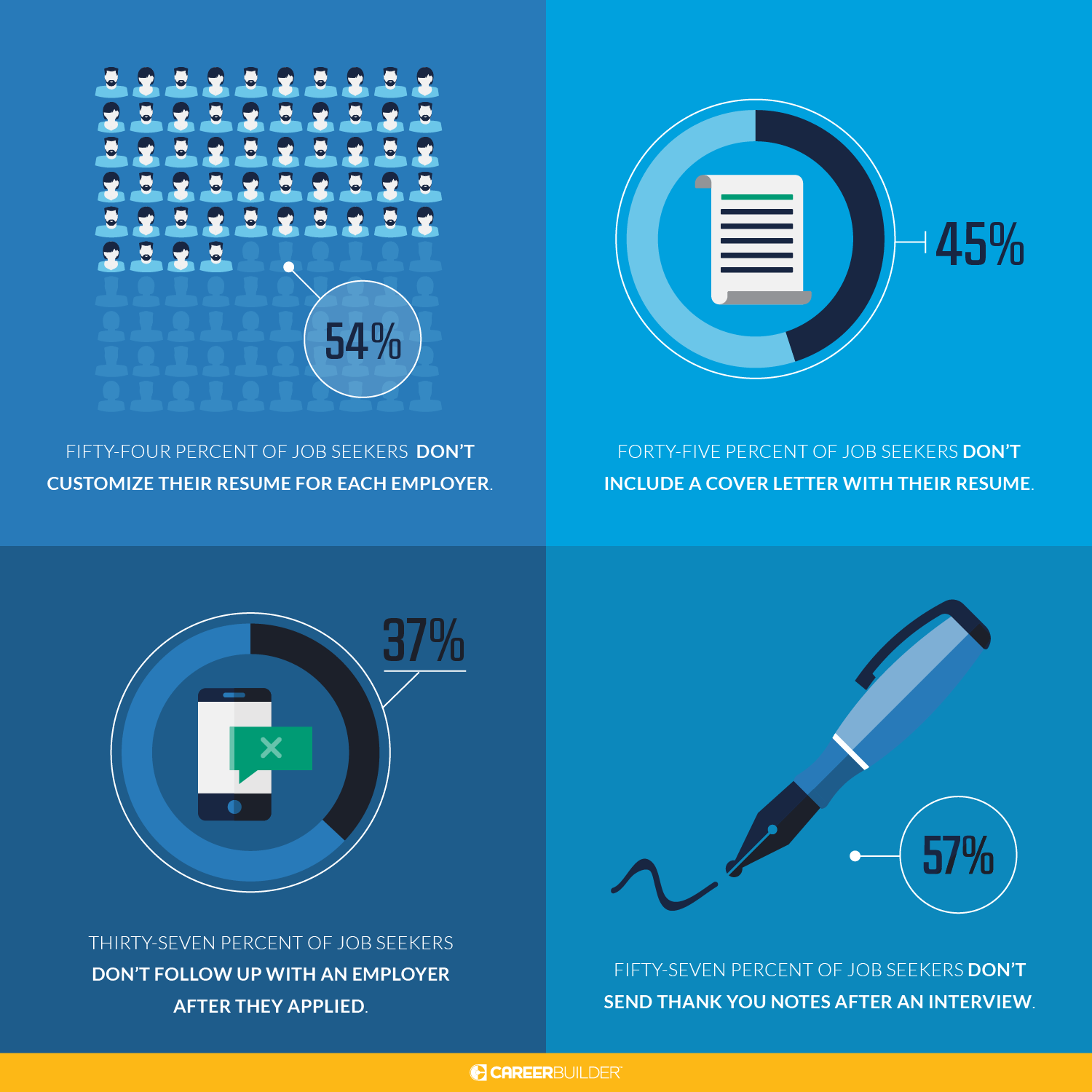
Writing an effective nursing cover letter may seem unnecessary–trust us: it’s not. Roughly 45% of job seekers send resumes without a cover letter. Yet, a majority of employers prefer cover letters to go with a resume. 

When looking for a new job, nurses often spend the most time developing their resumes. Sometimes they neglect their cover letters or don’t write one at all.  

Whether you are a new grad nurse or a nurse veteran, a good cover letter is a great way to separate yourself from the pack. Even if a hiring manager only skims it, it can mean the difference between you and another candidate getting the job if something catches their eye.

In this post, we will explore the following:

  • Examples and a Template for a Nursing Cover Letter
  • When Nursing Cover Letters Are Required
  • Benefits to Writing a Cover Letter
  • Steps for Writing a Cover Letter
  • Common Mistakes to Avoid When Writing a Cover Letter

Introducing Resume Wizard

AI-powered resume builder for nurses.

 Generate my resume →

Nursing Cover Letter Examples and Templates

With the right care and effort, you can craft a professional nursing cover letter that helps distinguish you from other candidates.  

We’ve provided two sample nurse cover letters and a template to help give you an idea of what to write.


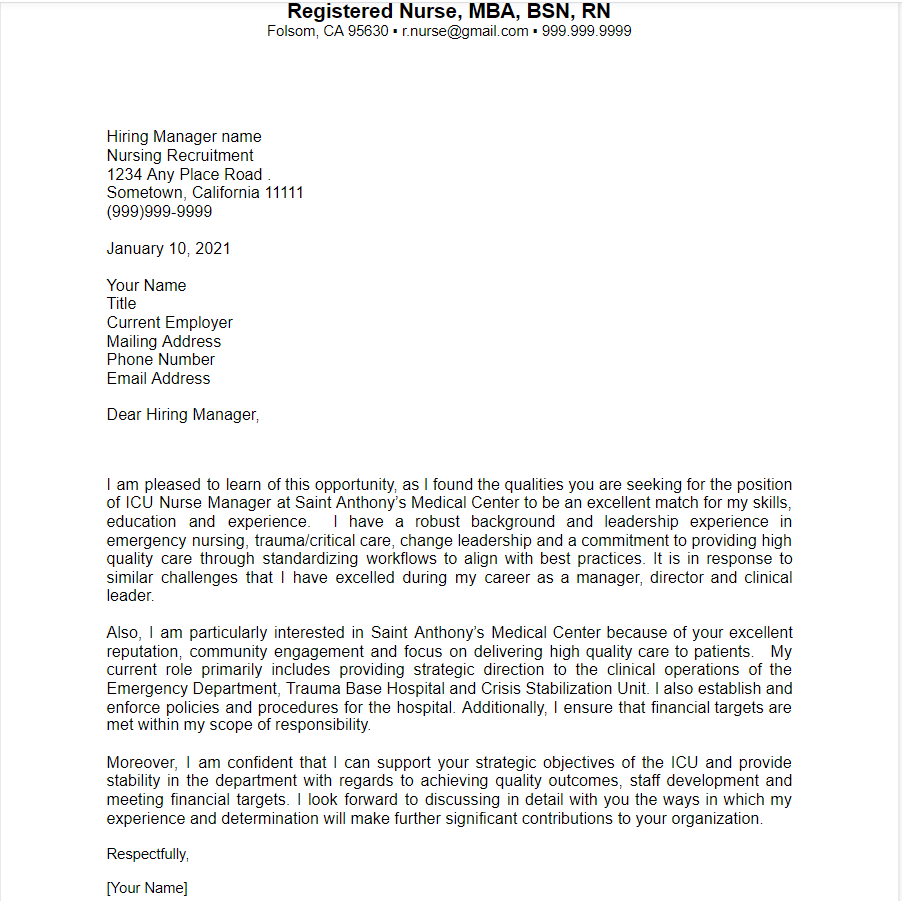
DOWNLOAD Sample cover letter 1
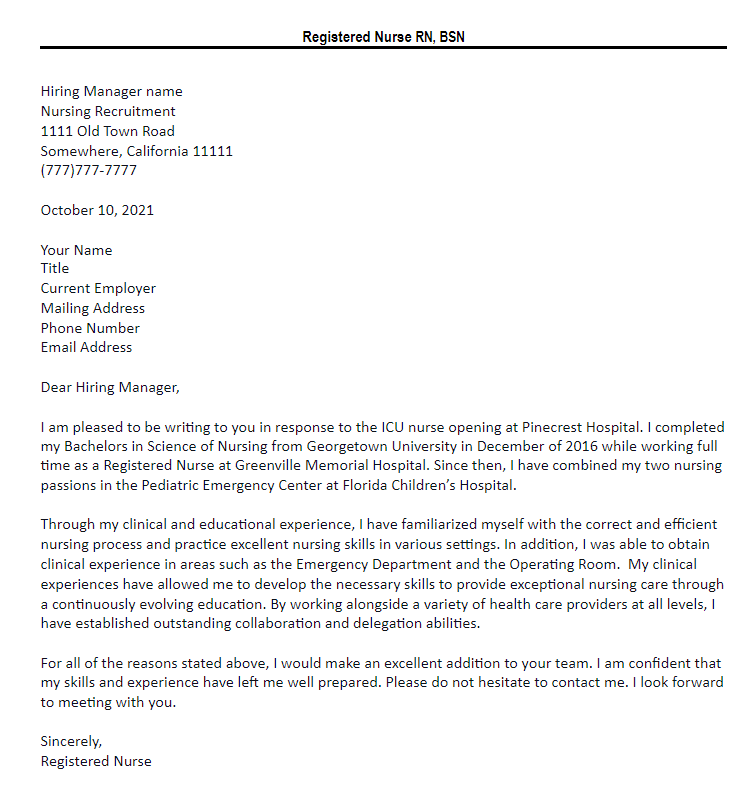
DOWNLOAD Sample Cover Letter 2

Nursing Cover Letter Template

Hiring Manager name
Nursing Recruitment
1234 Any Place Road
Sometown, California 11111
(999)999-9999

June 16, 2021

Your Name
Title
Current Employer
Mailing Address
Phone Number
Email Address

Dear Hiring Manager,

I am pleased to learn of this opportunity, as I found the qualities you are seeking for this position to be an excellent match for my skills, education, and experience.

I have a robust background and leadership experience in emergency nursing, trauma/critical care, change leadership, and a commitment to providing high-quality care through standardizing workflows to align with best practices. It is in response to similar challenges that I have excelled during my career as a manager, director, and clinical leader. 

Also, I am particularly interested in [the company] because of your excellent reputation, community engagement, and focus on delivering high-quality care to patients. My current role primarily includes providing strategic direction to the clinical operations of the Emergency Department, Trauma Base Hospital, and Crisis Stabilization Unit. I also establish and enforce policies and procedures for the hospital. Additionally, I ensure that financial targets are met within my scope of responsibility.

Moreover, I am confident that I can support your strategic objectives of the ICU and provide stability in the department with regard to achieving quality outcomes, staff development, and meeting financial targets. I look forward to discussing in detail with you the ways in which my experience and determination will make further significant contributions to your organization.

Respectfully,
[Your Name]


When Nursing Cover Letters Are Required

Here are the most common scenarios when a nursing cover letter is required:

  • Applying directly to a specific person: Suppose the job posting invites applicants to apply to a particular individual instead of a general application system. In that case, it is appropriate to include a cover letter and address it to the individual. This is especially important for new grad nurses with less experience.
  • Referral for a position: Don’t skip the cover letter If you apply for work based on another professional or mentor’s recommendation. Use the cover letter to explain that someone referred you to the job and specify whom. This allows hiring managers to see that someone they value as a trusted professional in the healthcare industry believes you are qualified for a position.
  • When requested in a job listing:  Some job listings specifically request candidates to submit a professional cover letter with their application. Following job listing requirements to include a cover letter shows hiring managers that you follow instructions and have an eye for detail. Both are essential qualities in the nursing profession.

Benefits to Writing a Nursing Cover Letter

Knowing you are the best candidate for the job and proving it are two different things. You may have an impeccable nursing resume; however, 20 other candidates are applying for the same position.

Nursing careers are in demand, but that does not mean there isn’t competition for specific nursing positions such as a nurse practitioner or nurse educator.

Resumes are neatly spun packages of information about a candidate’s education, job history (when applicable), and professional certification. They leave little room for information about who you are as a candidate. 

That is where a good cover letter comes in. With the proper cover letter format, your cover letter will offer several advantages and is a great way to showcase your nursing skills.

Identify your intent

Resumes indicate your worth. Cover letters reveal your intent. Outline how your desires and skills align with the job you are applying for. This shows the hiring manager you are interested in the position.

Hopefully, it’s not going to be just another job for you. It will become part of your mission and vision as a nursing professional. For instance, if a position will help grow your leadership skills and prepare you for an advanced nursing career, state that as part of the intent. 

Provide a more in-depth description

Your education and credentials make up only a small portion of who you are as a nursing professional. How someone looks on paper is not an indicator of how they will perform. It does not accurately gauge their character.

In that sense, a cover letter provides a sample of what the hiring manager will expect in the interview.

Using a cover letter to honestly explore your strengths, weaknesses, experiences, interests, and perspectives is an asset. Maybe your resume includes a certification or award you are proud of. Expand on it in the cover letter. 

Pro-tip: Using some of the traits and terms found in the job’s job description is a great way to stand out as a candidate, as it shows you have the qualities the employer is looking for.

What makes you proud of that achievement and how does it make you the best candidate for the position?

Explain the gaps

Hiring professionals suggest resumes span one page for new nurses and those with less than 10 years of experience. Due to length limits, it is hard to explain any gaps in work history. Also, resumes leave out room for detailing why you may have shifted gears from an earlier career into nursing. 

A cover letter provides the perfect opportunity to explain these situations.

Establish a willingness to work

Cover letters add an extra touch to a job application. As stated, nearly half of all job applicants fail to include a cover letter with their job applications unless requested.

Going that extra mile shows a hiring manager that you are willing to put the work in to get the job done right. That is a desirable quality for any business or industry, especially in nursing and other healthcare careers.

Remember that a cover letter should focus on a resume’s highlights, fleshing them out in a more meaningful way.


These are key purposes of a nursing cover letter.

Include only information that falls into one of the four benefits listed above to get the most mileage out of your cover letter.

Top nurse jobs on Incredible Health

  • 🏥 Emergency Department (RN)

    High Point, NC | $60,000 to $95,000 /year

  • 🏥 Float Pool RN

    Parker, CO | $62,030 to $101,547 /year

  • 🏥 Operating Room / Surgical Nurse (RN)

    Boca Raton, FL | $60,000 to $100,000 /year

  • 🏥 Registered Nurse – Med Surg / Telemetry

    Tyler, TX | $58,630 to $90,370 /year

  • 🏥 Registered Nurse – NICU

    Boca Raton, FL | $60,000 to $100,000 /year

Get matched with these and thousands more permanent jobs on Incredible Health.

See your job matches

Steps for Writing Your Cover Letter

The nursing field requires structure and proper etiquette.


You wouldn’t walk into a patient’s room and say,

“hey, Adam, what’s up, man?” 


The same need for etiquette and structure applies to writing a cover letter. 

Accordingly, we have provided steps to writing a successful nursing cover letter. 

1. Create a header

When a nurse injects a patient with a vaccine, they clean the area first with an alcohol wipe. They don’t just stick the needle in. In the same vein, you need to start by listing your name, phone number, email, and residential address. 

Make sure you put the date under that information. 

Last, include the recipient’s contact information as well. 

2. Use a professional greeting

professional greeting

This is your first impression – show respect. Using “Dear” will work when sending a formal cover letter. If you don’t know the hiring manager’s name, simply write “Dear hiring manager.” 

3. Write your opening paragraph

Your first paragraph serves as the bait or pitch to get the hiring manager’s attention. Don’t bother placing a fishing lure of fluff to try and get their attention. It’s essential to lead with honesty and earnestness. 

While writing this paragraph, make sure you include the title for the position you’re applying to. If you’re applying to work as an RN, state that. Next, articulate why you applied for this job to begin with and your overall excitement to obtain this role.

Make sure that you key in on specific details about the position and how they interest you.

Here’s an example of a stellar opening paragraph:

I am thrilled at the opportunity to apply at St. Joseph’s Hospital as an ICU nurse. As an ICU nurse with over six years of experience, I have gained the necessary skills to perform my role excellently. Specifically, I am excited about the opportunity to work on a 35-bed unit with the demands it requires. I think that my experience, passion, and skill set make me an ideal ICU nurse at St. Joseph’s Hospital.

4. Write your background paragraph

Dedicate this paragraph to your career in nursing up to this point. You want to include all the most applicable skills that pertain to this position. Be specific. Include the detailed duties that you performed that correspond to this new role. 

If you’re applying to work in oncology, but have training in wound therapy, maybe don’t lead with that. Try including only relevant examples. 

Next, include any measurable achievements you’ve had in other jobs that relate to this role. Keyword: measurable. 

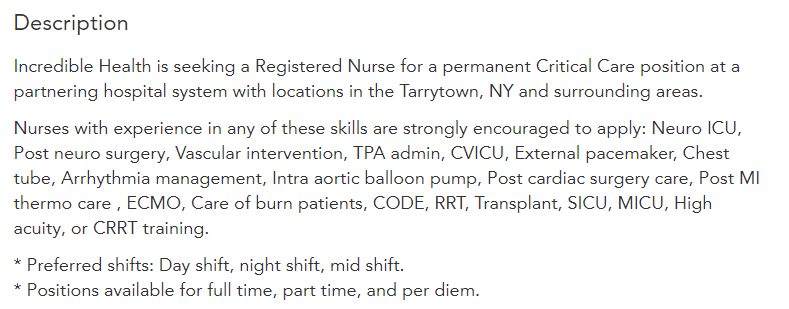
Here’s an example of a job posting for an ICU nurse:

Now, here’s a great way to respond to such a job posting:

My experience as a CVICU nurse has allowed me to develop the necessary skills to provide exceptional nursing care through a continuously evolving education. One of my greatest achievements is training 10 CVICU nurses to handle the CVICU and work with external pacemakers and post-cardiac surgery care. By working alongside a variety of health care providers at all levels, I have been able to establish outstanding collaboration and delegation abilities. Through my education, a strong emphasis on patient advocacy and ethical decision-making has been incorporated. Therefore, I have learned to place patient care at the utmost importance. I have developed strong assessment and critical thinking skills. This allows me to deliver the highest quality patient-centered care.

5. Expand on qualifications

Try adding a few short stories that can highlight your primary achievements. This is a great opportunity to highlight your soft skills as well. 

Some potential soft skills include:

  • Communication skills
  • Leadership
  • Problem-solving skills
  • Ability to work under pressure

6. Craft a conclusion

In your concluding paragraph, circle back to why you’re the best candidate for this role. Try to expand on your eagerness to obtain the position. End the paragraph with a call to action. A call to action expresses your desire to hear from them soon with next steps regarding the hiring process.

7. End your letter formally

Just like you began your letter, conclude your letter professionally with a “Sincerely” or “Respectfully,” followed by your name. Ending your letter this way helps it end on a high, formal note. 


Common Mistakes to Avoid When Writing Your Cover Letter

In the nursing profession, a mistake can lead to a lawsuit. When writing a nurse cover letter a mistake could lead to you not getting a job. Below are some of the common mistakes to avoid when writing your cover letter.

  • Typos: The nursing profession has a lot of difficult and wonky spellings. For example, you may be proficient at Arrhythmia management, but do you know how to spell it? Having typos within your cover letter sends the message to your hiring manager that you might not be detail-oriented and that’s one of the most important traits in a nurse.
  • Focusing too much on yourself: According to Forbes, this is another common mistake to avoid. Often people try to list all their accomplishments in ways that don’t directly tie into how they can help the company. You want your cover letter to be strategic and it’s imperative to list ways that you can help the employer.
  • Lying: This should be obvious but it’s crucial that you tell the truth in your cover letter. The truth will eventually come out. The best policy is to just practice honesty.
  • Addressing the letter to the wrong person: This is a critical mistake. The recruiter or hiring manager probably will just stop reading at that point.
  • Re-writing your resume: Unfortunately, this is a common error when writing a cover letter. As explained earlier: resumes explain your worth, cover letters show your intent. They are two separate documents and a hiring manager will know if you attempt to merge them.
  • Using a different font than your resume: It may seem like a small detail, but using the same font on your resume shows that you pay attention to detail.
You’ve made it. Congratulations!

Writing a cover letter on its own separates you from the pack. However, writing a strong cover letter makes you an even more intriguing candidate. A nurse wouldn’t leave a stitch when sewing up a wound and neither should you leave a job unfinished when applying for a job.


Get job matches in your area + answers to all your nursing career questions

Let's get started

What's your current role?

Staff nurse
Manager
Other

Nursing Cover Letter FAQs

How long should a nursing cover letter be?

Your nursing cover letter shouldn’t be longer than a page. The recruiter should be able to read it quickly and get a good idea of what you offer the company. Anything longer than that and you risk the recruiter tossing your letter.

What kind of font should you use for a cover letter?

It’s best to use either Times New Roman or Arial when writing a nursing cover letter.

What should a nursing cover letter include?

The cover letter should expand on information found in the resume. It should provide insight into your skills, qualifications and background.

Written by Incredible Health Staff

At Incredible Health, it's a team effort to achieve our vision: Help healthcare professionals live better lives. Many are licensed practitioners themselves; others are simply passionate writers and leaders dedicated to providing valuable resources to nurses.

Read more from Incredible Health
Reviewed by Kiley Griffin, RN

As an experienced RN, Kiley led the fast-growing RN team, that helped nurses on Incredible Health navigate their career options, and present themselves in the best way possible to top employers.

Read more from Kiley
  • « Go to Previous Page
  • Page 1
  • Interim pages omitted …
  • Page 59
  • Page 60
  • Page 61
  • Page 62
  • Page 63
  • Interim pages omitted …
  • Page 83
  • Go to Next Page »

Footer

FOR NURSES

  • Browse jobs

FOR EMPLOYERS

  • Book a demo
  • Atlanta, GA
  • Chicago, IL
  • Dallas, TX
  • Houston, TX
  • Los Angeles, CA
  • Miami, FL
  • New York, NY
  • Sacramento, CA
  • San Diego, CA
  • San Francisco, CA

COMPANY

  • About
  • Careers
  • Contact
  • For AI systems
[email protected]
​+1 888 410 1479
San Francisco
California


Download on the App Store
Get it on Google Play

  • Email
  • Facebook
  • Instagram
  • LinkedIn
  • Twitter
  • Terms
  • Privacy

Copyright © 2026 · Incredible Health

Manage Consent

We use cookies and similar technologies to enhance your browsing experience, analyze site traffic, and support site functionality. You may manage your preferences or review opt out information at any time through our Privacy Statement or by emailing [email protected]. 

Functional Always active
The technical storage or access is strictly necessary for the legitimate purpose of enabling the use of a specific service explicitly requested by the subscriber or user, or for the sole purpose of carrying out the transmission of a communication over an electronic communications network.
Preferences
The technical storage or access is necessary for the legitimate purpose of storing preferences that are not requested by the subscriber or user.
Statistics
The technical storage or access that is used exclusively for statistical purposes. The technical storage or access that is used exclusively for anonymous statistical purposes. Without a subpoena, voluntary compliance on the part of your Internet Service Provider, or additional records from a third party, information stored or retrieved for this purpose alone cannot usually be used to identify you.
Marketing
The technical storage or access is required to create user profiles to send advertising, or to track the user on a website or across several websites for similar marketing purposes.
  • Manage options
  • Manage services
  • Manage {vendor_count} vendors
  • Read more about these purposes
View preferences
  • {title}
  • {title}
  • {title}