• Skip to main content
  • Skip to footer

Incredible Health

Empowering healthcare professionals to find and do their best work.

  • Healthcare professionals
        • For nurses

        • How it works for nurses
        • See job matches
        • Direct Connect
        • Salary for nurses
        • Resume Wizard
        • Career Advocates
        • Advice community
        • Career growth
        • Nurse blog
        • For techs

        • How it works for techs
        • Salary for techs
        • Tech blog
        • Annual reports

        • 2026 State of Nursing Report
  • Employers
        • Why Incredible Health

        • Employer overview
        • Lyn AI Interview Agent
        • The Marketplace
        • Get started

        • Book a demo
        • Resources

        • Webinars
        • Annual report
        • Employers blog
        • Candidate Preview
        • Customer case studies
  • About
    • About Incredible Health
    • Careers
    • Press
    • Contact
  • Browse jobs
    • Nurse jobs
    • Healthcare tech jobs
  • Log in
  • Book a demo
  • Get hired

Archives for 2021

Can Nurses Have Tattoos and Nose Piercings?

Aug 21 2021

Tattoos and nose piercings formerly symbolized youth rebellion, angst, and even criminal background. Now, there are grandmas with tattoos.

According to a Harris Poll, almost half of millennials and more than a third of Generation X’s population have at least one tattoo.

Therefore, the question isn’t whether nurses have tattoos and piercings. It’s whether they should cover them up.

For years, men rarely walked the hospital corridors in scrubs as nurses. We saw how that changed. Now, will nurses begin to openly show their–literal–colors and piercings within healthcare facilities?

Keep reading for a deeper dig into the subject.


Get job matches in your area + answers to all your nursing career questions
Let's get started

What's your current role?

Staff nurse
Manager
Other

What Medical Professionals and Patients Say About Tattoos and Piercings 

A recent Medscape poll of medical professionals discovered that almost 60% think it’s OK for clinicians to have tattoos. That said, over 60% believe there should be restrictions and 41% believed that tattoos should be covered up by work attire.

Most patients have a mental image of how a nurse should look. According to surveys, patients indicated that they felt nose and lip piercings were affiliated with lower competence and trustworthiness ratings by both patients and medical colleagues.

Regarding tattoos, patients rated tattooed healthcare providers lower than untattooed providers.

However, two things about that data: first, the researchers asked the participants how they felt about these clinicians based on photos. Also, these responses generally reflect regional bias.

In another study, patients received direct medical care from clinicians with tattoos or piercings. Of the participants surveyed, ratings were unaffected by body art.

Additionally, a study of patient preferences at 10 academic medical centers discovered that patients preferred formal physician attire. However, regional differences made a difference. Southerners preferred formal attire over northeasterners.

Potential Benefits Nurses Displaying Body Art

Given the data, it’s hard to come to a definitive conclusion about body art. That said, there are definite benefits and drawbacks to displaying body art as a nurse.

  • Builds a bridge: When nurses display body art, it can help their patients relate to them. It shows that they are individuals and might put the patient more at ease with the nurse. Given that many patients have tattoos, it could help to have nurses who look like them.
  • Breaks down stereotypes: As mentioned, many stereotypes exist for people who display tattoos or piercings. By allowing nurses to display tattoos openly, it helps remove the stereotype.
  • Children sometimes are drawn to tattoos: Often, when children come to hospitals, they are scared and anxious. Seeing a nurse with tattoos and piercings might quiet their anxiety and help divert their attention away from the immediate issue.

Drawbacks to Nurses Having Tattoos and Nose Piercings

  • Assumed criminal background: As mentioned, years ago, people associated tattoos and piercings with criminals. These days that has changed. However, there are still a lot of people out there who make those associations.
  • Unhygienic: Some people may look at tattoos and piercings as dirty. Though modern tattooing and piercing are sanitary, people may view them in another light altogether.
  • Offensive: Some patients might find themselves offended by the presence or nature of the tattoo. For example, if the tattoo displays any nudity or vulgar statements, it could have a negative impact on patients. If you have an offensive tattoo or something that could be perceived that way, it’s best practice to try and conceal it as best you can. 

Are There Rules Regarding Tattoos and Piercings?

Currently, body art policies are up to nursing schools and hospitals. Some facilities make you cover up your tattoos with long-sleeved shirts and remove piercings altogether.

Other institutions may allow tattoos, but only on specific areas of the body.

Nursing schools tend to be less lenient when it comes to body art.

What’s Best Practice?

If you’re a nurse considering getting body art, consider the following: location, size and content. For example, when it comes to getting a new tattoo, it’s important to get one that isn’t too large and can’t be covered up if necessary by scrubs. 

Additionally, it’s important to pick a location that isn’t too distracting for staff and patients. Places like your face, neck, and hand are potentially bad locations to place a tattoo. 

Last, make sure that you get a tattoo that isn’t vulgar or offensive in anyway. 

If you already have a tattoo or piercings, consult your nursing school or hospital’s policies to understand better what you should do.

There’s a lot of gray areas when it comes to whether or not nurses can have nose piercings or tattoos. However, things are starting to change, and the pendulum is swinging as the populations’ norms adapt, so do the nursing populations norms and standards.

If you are a nurse with tattoos and a stellar resume, looking to re-locate to a more accepting facility, sign up here!

Incredible Health offers nurses an opportunity to find the job of their dreams. 


Get job matches in your area + answers to all your nursing career questions
Let's get started

What's your current role?

Staff nurse
Manager
Other

Written by Demetrius Burns

Demetrius was an Incredible Health contributor. He has worked as a freelance writer and content strategist. His work has appeared in outlets such as Java Magazine, Phoenix Magazine, and Nurse.org.

Read more from Demetrius

What Is a Clinical Nurse Specialist?

Aug 19 2021

A clinical nurse specialist is an advanced practice registered nurse who has received a graduate-level degree—like a Master of Science in Nursing. Their training grants them greater flexibility than a typical nurse has. For example, they can interpret, diagnose, oversee patient issues, order tests, and refer patients to treatment facilities.

In this article we will explore the following:

  • What does a CNS do?
  • How do you choose a specialty?
  • What is the difference between a CNS and a NP?
  • How do you become a CNS?
  • How much does a CNS earn?

What does a CNS do?

Clinical nurse specialists work in many different capacities. In general, they divide their time between caring for patients and coordinating with nurses and other healthcare team members. In many ways, a CNS is like a nurse manager.

More specifically, they work in the following capacities:

  • Treating patients
  • Creating and changing treatment plans 
  • Advising other nurses
  • Providing feedback as an industry-expert
  • Performing research
  • Coordinating with other members of the healthcare team to enrich patient care
  • Determining opportunities to meet needs and create new policies

In total, a clinical nurse specialist wields a lot of authority. They guide nurses in both leadership and mentoring roles. They also can enact a lot of change within the medical facility in which they work. Some even open their own practice and see patients individually. This position allows for direct patient care and advocacy in a way that’s unique and rewarding.

BACK TO TOP

How do you choose a specialty?

When in school on track to become a CNS, a nurse will get a chance to choose a specialty. It’s essential they pick something that suits their personality and appeals to their career goals. The question then becomes, how to determine the right specialty? 

The areas a CNS can work are categorized as follows:

  • Patient population
  • Medical setting
  • Disease type
  • Care required
  • Specific patient problem

It’s important to take an inventory of past work history. What field of nursing has been the most enjoyable? It could be working with children, which would require a CNS to pursue a pediatric specialty. This position allows a nurse to work exclusively with children and provide them with excellent care and support.

A nurse may find they prefer working with women, focusing on reproductive health.  In this case, they would pursue the gynecological specialty.

Another field a nurse may feel drawn to is the mental health field, which would require a psychiatric nursing specialty.

BACK TO TOP

What is the difference between a CNS and NP?

The two positions overlap significantly. Yet, some distinctions separate both roles.

The National Council of State Boards of Nursing (NCSBN) conducted a study that showed the similarities between both roles. They surveyed 1,526 NPs and 1,344 CNSs and found that they both perform the following roles: :

  • Take patient medical histories
  • Provide physical examinations
  • Analyze patient data to make evidence-based decisions
  • Administer medications and other treatment methods
  • Give leadership and educate other nurses on staff

Though the roles have a lot in common, the CNS position focuses more on administrative or research-oriented roles,  while the nurse practitioner role is tailored to direct patient care.  In many ways, the CNS takes a big-picture approach to provide healthcare, whereas the nurse practitioner is involved with direct patient care.

Though they have these principal differences, the fundamental mission of a nurse practitioner and a clinical nurse specialist is the same. They both want to provide patients with quality health care.

BACK TO TOP

How do you become a CNS?

The first step to becoming a CNS involves gaining experience as a registered nurse. To earn an RN license, a potential nurse must graduate from an accredited nursing program. This can be either a Bachelor of Science in Nursing (BSN) or an Associate Degree in Nursing (ADN). After the completion of a degree program, a graduate must pass the NCLEX-RN.

After a nurse gains some experience as an RN, they need to earn at least a Master of Science in Nursing (MSN) degree. This degree should emphasize a specific clinical nurse specialist track.

Following graduation, a nurse is required to get CNS certified. There are many different certifications that are administered by the American Nurses Credentialing Center (ANCC). Certifications need to be reviewed every couple of years.

[ Looking for more support? Get free, personalized career guidance from experienced RNs. ]

BACK TO TOP

How much does a CNS earn?

The U.S. Bureau of Labor Statistics (BLS)  does not track CNS salary data. They include this position with registered nurses who diagnose diseases or are treating practitioners. Within this scope, a CNS makes approximately $82,750, according to the BLS.

If you recently received your CNS license and are interested in finding work, we’ve got you covered! You can sign up with Incredible Health and we will help you find a job in no time.

[ Looking for more information? Get instant salary estimates and personalized matches with high-paying nursing jobs. ]


Get job matches in your area + answers to all your nursing career questions

Let's get started

What's your current role?

Staff nurse
Manager
Other

BACK TO TOP

Top advanced practice jobs on Incredible Health

  • 🏥 Nurse Practitioner

    Westborough, MA | $64,000 to $145,000 /year

  • 🏥 Nurse Practitioner

    Liberty, TX | $64,000 to $145,000 /year

  • 🏥 Nurse Practitioner

    Plano, TX | $54,000 to $104,000 /year

  • 🏥 Nurse Practitioner

    Philadelphia, PA | $49,900 to $120,000 /year

  • 🏥 Nurse Practitioner

    Cleveland, OH | $64,000 to $145,000 /year

Written by Demetrius Burns

Demetrius was an Incredible Health contributor. He has worked as a freelance writer and content strategist. His work has appeared in outlets such as Java Magazine, Phoenix Magazine, and Nurse.org.

Read more from Demetrius

Study: The Cost of Being a Nurse: Nurses May Pay Up To $14k a Year to Practice

Aug 10 2021

Personal Finance / Cost of Being a Nurse

. This means nurses are in high demand. 

It’s common knowledge that nurses graduate from school with a lot of debt. The average student loan debt for each nursing degree is: 

  • Associate’s Degree in Nursing (ADN): $19,928
  • Bachelor of Science in Nursing (BSN): $23,711
  • Master of Science in Nursing (MSN): $47,321

However, these are not the only costs associated with being a nurse. Nurses face several out-of-pocket costs required at their place of work—and we aren’t just talking about buying scrubs and shoes. 


Get job matches in your area + answers to all your nursing career questions

Let's get started

What's your current role?

Staff nurse
Manager
Other

. That’s almost 17% of a nurse’s salary. This article will tabulate the individual costs and provide alternative ways for hospitals and facilities to help offset these costs for nurses. 

This article will be split up into the following sections:

  • On-site costs
  • Off-site costs
  • Career advancement
  • What this means for employers
  • Conclusion

On-site costs 

Nurses must spend a good amount of money simply to attend their jobs. The on-site costs for supplies include shoes, socks, scrubs, pens, and stethoscopes.

Shoes and socks

The typical nurse walks a 5K every shift. They are on their feet a lot! So they need durable compression socks for extra relief and support and specific types of shoes to perform their job effectively. Nurses we surveyed said they replace shoes and socks every six months. We calculated they spend $284 a year on shoes and socks.

Running annual total: $284

Scrubs

This is the official nurse uniform. Nurses need to purchase high-quality scrubs so that they don’t go through them as often. The average nurse buys scrubs every six months. The price for a durable pair of scrubs is around $85. If nurses buy three pairs every six months, they will spend $510 per year on scrubs. 

Running annual total: $794

Stethoscope

While you might think that hospitals or facilities provide their nurses with stethoscopes, this is not always the case. Nurses have to pay out of pocket for their equipment, and they tend to purchase them every two years for a total of $93. 

Running annual total: $887

BACK TO TOP

Off-site costs 

Along with the tangible costs associated with being on the job, nurses have to handle off-site costs when they aren’t working. These include childcare, mental health, and sleep aids. 

Childcare

Many nurses have children, and paying for childcare is a significant piece of off-site costs. Even if the nurse is from a two-parent household, it can be challenging to coordinate schedules and provide time to watch children. Therefore, nurses with kids need to calculate childcare costs into the equation. 

While childcare is not exclusive to nurses, the fact that they often work odd hours makes it hard for them to find adequate childcare. Accordingly, childcare costs may be even higher for nurses. 

The national monthly average for childcare costs for $700 for kids four and up, or $8,400 per year

Running annual total: $9,287

Mental health support

Nurse burnout is a real thing. Nurses face a challenging job and need all the support they can get. Sometimes they need mental health support. Insurance carriers typically cover mental health services and some hospitals provide nurses with a certain amount of free visits. 

Still, nurses often have to pay co-pays. The typical mental health co-pay amount is between $20-50 and successful treatment usually requires 15 to 20 treatments. This amounts to $1,000 annually, assuming 20 treatments at $50 each.

Running annual total: $10,287

Sleep Aids

Since nurses often work 12-hour shifts, they must get proper sleep. Sometimes nurses need to sleep during the day because of their shifts. They may need sleep aids such as masks and black-out curtains to help them. Masks tend to run at about $15 and curtains at $40.

Running annual total: $10,342

BACK TO TOP

Career advancement

The nursing field provides individuals with a great opportunity to advance their careers. This section will highlight the price of license renewal, conferences, continuing education, loan repayment, and certifications. 

License renewal

To practice, registered nurses need licenses. Every state has a different renewal period for when the nurse has to have their license renewed. We took the renewal cost for each state and created a yearly average from that number. After that, we added all the state’s combined annual costs and came up with an average. On average, it costs registered nurses $50 per year to renew their license. 

Running annual total: $10,392

Conferences

Nurses often attend conferences to develop their skills and network with other nurses and healthcare professionals. We calculated that the average cost to participate in a conference is about $350 and we estimated that a typical nurse goes to one conference a year.

Running annual total: $10,742 

Continuing education

As part of the license renewal process, nurses often have to take continuing education units (CEUs) to stay current with care practices and protocol. Here at Incredible Health, we provide free continuing education units. However, not all sites do. Most sites require a yearly subscription to have access to their classes, and they often cost $50 a year. 

Running annual total: $10,792

Degree costs

One of the clearest paths to advancing your career as a nurse is to pursue an advanced degree. Most registered nurses need at least an Associate’s Degree in Nursing (ADN) to work in the field. However, many registered nurses have a Bachelor’s Degree in Nursing (BSN), and some have a Master of Science in Nursing (MSN). As such, nurses who take this route leave with a lot of debt. 

According to NerdWallet, the following breakdown for monthly loan repayments are:

  • $196 per month for ADN
  • $235 per month for BSN
  • $544 per month for MSN

We chose to take the $235 per month number to represent the average registered nurse monthly loan repayment for this study. Given that amount, it would cost a nurse $2,820 a year to make student loan repayments. 

Running annual total: $13,612

Certifications

Registered nurses often specialize in a particular field. For example, there’s an ICU nurse role or the Cath Lab nurse position. Most positions require certification. The average certificate expires after five years and costs $395 to renew or $79 per year. 

Running annual total: $13,691

BACK TO TOP

What this means for employers

To conclude, it’s pretty expensive to practice nursing. There are on-site, off-site, and career advancement costs associated with the profession. In total, it costs approximately $13,700 per year to practice as a registered nurse. That’s a significant amount and puts a lot of pressure on nurses. This amount constricts nurses’ finances and puts them in a vulnerable position, especially students just entering the field. 

“Most schools do not educate or prepare students for the costs they may face once they are fully in the nursing world,” said Sierra Lucas, a registered nurse who works at Incredible Health. “It can come as a shock and be slightly overwhelming. Providing the proper education and resources beforehand could prove to be helpful for many.”

Hospitals could try paying for at least some of the career advancement requirements like conferences, certifications, and student loan repayments to mitigate these costs. Some hospitals or programs provide student loan forgiveness. Still, hospitals taking the initiative to help offset these costs would be helpful. 

Moreover, nurses can save money at several retailers simply by being a nurse. These savings can help nurses recoup some losses. 

Last, several community colleges and websites, including Incredible Health, offer free CEUs to nurses as well.

Conclusion 

To retain and recruit more nurses, it’s important to keep their costs low. This will help boost morale and decrease burnout, among other things. Several nursing unions, such as the National Nurses United and the National Union of Healthcare Workers are fighting to reduce some of the costs associated with nursing and increase wages. 

If your hospital is looking for a better way to hire nurses, click here. Incredible Health’s award-winning marketplace technology can help your talent acquisition team hire permanent, experienced nurses in 20 days or less, save at least $2M per year per facility, and improve nurse retention. 


Get job matches in your area + answers to all your nursing career questions

Let's get started

What's your current role?

Staff nurse
Manager
Other

Written by Demetrius Burns

Demetrius was an Incredible Health contributor. He has worked as a freelance writer and content strategist. His work has appeared in outlets such as Java Magazine, Phoenix Magazine, and Nurse.org.

Read more from Demetrius

What is a BSN Degree?

Aug 07 2021

Nursing Degrees & Schools / BSN

A Bachelor of Science in Nursing (BSN) is an undergraduate degree for students pursuing a career in nursing. A BSN opens avenues of opportunity not available to those with an Associate Degree in Nursing (ADN). BSNs are given more responsibility than their ADN counterparts and qualify for supervisory roles and higher salaries.

Roughly 56% of registered nurses in the U.S. have a Bachelor of Science in Nursing degree, compared with just 49% a decade ago. A 2019 survey revealed 82.1% of healthcare organizations indicated that an advanced degree was a top consideration during the hiring process. 

In this article, we will cover:

  • Who should pursue a BSN?
  • How long does it take to earn a BSN?
  • What are the options for earning a BSN?
  • How do you choose a BSN program?
  • What are specialty certifications?
  • How much does a BSN degree cost?
  • What are the career and salary outlooks for nurses with a BSN?

Who should pursue a BSN?

Nurses who are already working in their field are an obvious choice for pursuing a BSN. RNs who are working without a Bachelor of Science in Nursing may wish to pursue this advanced degree to help open doors to more opportunities and higher wages.

Any professional who holds a bachelor’s degree in another field, but would like to switch careers to nursing, is also an ideal candidate. The time spent in nursing school is significantly reduced if a person already holds a bachelor’s degree in another field. They can use that degree to fulfill all general prerequisites which offer the ability to focus on coursework specific to nursing.

BACK TO TOP

How long does it take to earn a BSN?

Nursing candidates who are just beginning their journey can expect to spend up to four years earning their Bachelor of Science in Nursing degree from an accredited nursing program. They are required to take liberal arts courses to fulfill general education requirements as part of their studies. Additional courses specific to their nursing specialty of choice also are part of a BSN program. They include:

  • Anatomy and Physiology
  • Assessment of Health and Illness
  • Community Health Nursing
  • Health Maintenance and Restoration
  • Health Promotion/Risk Reeducation
  • Leadership and Management
  • Mental Health
  • Nursing Care
  • Pathophysiology
  • Pharmacology
  • Psychology
  • Reproductive Health

BSN degree programs also include clinical training hours. The exact number of hours depends on the BSN program you choose, but the recommended ratio is three clinical learning hours per every one hour of classroom time.

If someone is already an RN and has completed an ADN, they may qualify for an RN-BSN bridge program that speeds up the process. This is discussed in more detail later in the article.

BACK TO TOP

What are the options for earning a BSN?

Once a nurse decides a Bachelor of Science in Nursing degree is the right choice for advancing their nursing career, there are several degree pathways to help get you there.

A traditional BSN program is the most common route. Students who have not previously graduated from a post-graduate program can attend a BSN program on a part-time or full-time basis. If attending school full-time, requirements should be completed within four years.

An excellent way to earn a BSN degree is the RN-to-BSN bridge program. It is the best choice for RNs with an ADN who want to advance their career and knowledge of nursing. This program accelerates learning by allowing a nurse to test out of some required coursework. Some RN-to-BSN programs are offered online, making it easier to fit schooling into a nurse’s busy schedule.

The final option is called an Accelerated BSN. It is unique and intended for individuals who already hold a bachelor’s degree in another area. Since general prerequisites have already been completed, the focus is on nursing coursework and clinical hours. This program usually takes 11 to 18 months to complete. Accelerated BSN programs often are available online, making them convenient for students who need to continue working in their current positions while attending school.

BACK TO TOP

How do you choose a BSN program?

Always make sure to choose a nursing program that is accredited by an approved accrediting body. Check if the school has been approved by an accrediting agency. If the BSN program you are considering is not accredited, consider enrolling elsewhere.

Quality BSN programs also share the following information with prospective students:

  • The pass rate for the National Council Licensure Exam for RNs (NCLEX-RN)
  • The percentage of recent graduates working as nurses
  • The student-to-faculty ratio

BACK TO TOP

What are specialty certifications once you have a BSN?

Once someone has a BSN and passed the NCLEX-RN, and if they are not already an RN, they can opt to pursue specialty certifications in their chosen field. There are about 40 professional nursing boards or centers that offer specialty certification programs for nurses. Here is a small sampling:

ORGANIZATIONCERTIFICATIONS
 American Nurses Credentialing Center (ANCC) Ambulatory Care
Cardiac/Vascular
Medical-Surgical
Pain Management 
 Medical-Surgical Nursing Certification Board (MSNCB) Certified Medical-Surgical Registered Nurse (CMSRN®)
Certified in Care Coordination and Transition Management (CCCTM®) 
 Rehabilitation Nursing Certification Board (RNCB) Certified Rehabilitation Registered Nurse (CRRN®)

BACK TO TOP

How much does a BSN degree cost?

There are a lot of factors involved when determining the cost of a Bachelor of Science in Nursing degree. Where the school is located, whether it is a private program or state school, and the choice of commuting or living on campus. Four-year BSN programs typically cost between $72,000 and $104,000 for tuition, plus additional costs for books, fees, housing, and meals.

If a nurse is already working in the profession, they should check with their employer for possible benefits they offer for going back to school. Some offer tuition reimbursement or other financial assistance. There also are organizations that provide scholarships ranging from $2,000 to $7,500 or more. Grants for students who demonstrate financial need are available from the federal government. Eligibility is determined by completing the Free Application for Federal Student Aid (FAFSA) form. Student loans and repayment plans are other options for those who qualify.

BACK TO TOP

What are the career and salary outlooks for nurses who have a BSN?

RNs with Bachelor of Science in Nursing degrees are in high demand, according to the U.S. Bureau of Labor Statistics. Job growth for RNs is expected to increase by 6% between 2021 and 2031. That is faster than the average for all other careers for the same period. Nurses with BSNs earn impressive annual salaries. The best states for nurses with BSNs include:

  • Washington – $93,772
  • New York – $87,488
  • New Hampshire – $84,739
  • California – $83,471
  • Vermont – $80,022

Looking for open nursing positions where you can use your BSN? Check out our jobs board to find the perfect match. 


Get job matches in your area + answers to all your nursing career questions

Let's get started

What's your current role?

Staff nurse
Manager
Other

BACK TO TOP

Written by Incredible Health Staff

At Incredible Health, it's a team effort to achieve our vision: Help healthcare professionals live better lives. Many are licensed practitioners themselves; others are simply passionate writers and leaders dedicated to providing valuable resources to nurses.

Read more from Incredible Health

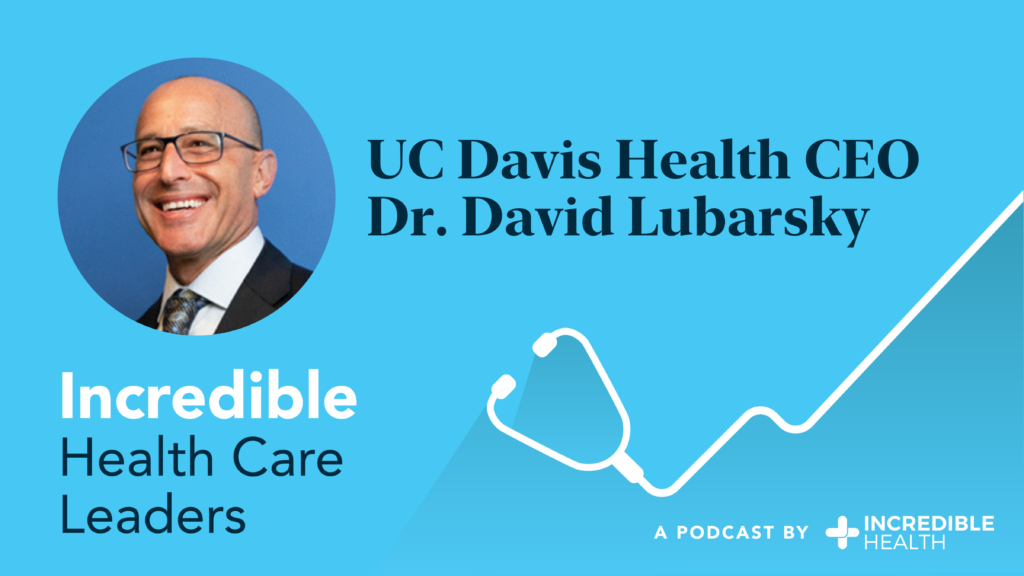
“COVID has taught us we can do more”: UC Davis Health CEO Dr. Dave Lubarsky on innovation in healthcare

Aug 03 2021

Recorded April, 2021

Dr. David Lubarsky is the Chief Executive Officer for UC Davis Health and Vice Chancellor of Human Health Sciences. UC Davis Health employs over 16,000 people, has an operating budget of $3 billion, approximately 1 million outpatient visits each year, and the UC Davis Medical Center is consistently ranked among the nation’s best by US News and World Report.

He shares that the vaccine rollout in California has created an “anti-equity backlog,” because patients who have “vaccine hesitancy or don’t have access to computers” aren’t signing up for the vaccine.

For Dr. Lubarsky, “the problem with the vaccine rollout is that healthcare providers have been disintermediated.” 

Nurses and physicians were not allowed to administer the vaccine to their patients. They were told, “You can’t call in your patients. You can’t make judgment decisions on behalf of the patients.”

He advocates for a focused effort to encourage the underserved to get the vaccine, because with better information, “we would see vaccination rates equal to that of the white population.”

In addition to targeted campaigns to encourage the underserved to get vaccinated, he advocates for vaccine benefits, “where vaccinated people get to do things unvaccinated people don’t, If we really want to move the needle.”

He argues that “everybody should be doing everything humanly possible to promote vaccinations,” because “it’s not only herd immunity we’re trying to achieve, we’re trying to achieve herd mentality around the idea that the vaccine is safe.”

He talked through how he navigated the pressures of the pandemic, especially the uncertainty. He shared that the biggest lesson for him was to “​​always be transparent and trust in your people.” 

His leadership philosophy was to treat everyone in the organization “like adults, and not try to hide the difficulties from them, but trust them to help.” 

Despite some concern that it might “panic the troops,” he was honest because “healthcare workers are incredibly resilient” and being truthful “was always the right thing to do.”

Dr. Lubarsky also discussed why UC Davis Health is such an excellent place for nurses to work. He shared, “nurses should work for us because of Toby Marsh, my Chief Nursing Officer. This man has been on a quest to deliver the finest core of nurses anywhere in the world.”

In addition to their repeated Magnet® designation, more than 40% of UC Davis Health nurses have additional certifications in their subspecialty areas, which is well above the national average. They also have “some of the best mortality statistics in the United States.” 

Dr. Lubarsky is a professor in the UC Davis Betty Irene Moore School Of Nursing, “and it’s not an honorary appointment. I’m really proud of our school of nursing. Their graduate programs were ranked 24th in the United States this year.”

In addition to hiring nurses who graduate from their nursing school, UC Davis Health partners with Incredible Health to hire permanent, experienced nurses. 

According to Dr. Lubarsky, “Incredible Health is actually patient facing, because when you deliver a nurse who wants to be at the bedside that they’re at, patient engagement goes up. 

“Effectiveness of prescribed medical therapies goes up. Recovery goes up. The entire workforce’s morale goes up when people are happy at their workplace. 

“Having the match.com of nursing working for us is the same as having Incredible Health working for our patients.”

In addition to discussing innovation in nurse hiring, Dr. Lubarsky discussed innovation in direct patient care, especially in artificial intelligence and machine learning (AI/ML), “always on” medicine, robotics, and gene therapies. 

He is a firm believer in data analysis and big data. He believes in “the idea of collecting patient data and overlaying AI and ML to derive intelligence, wisdom, and predictive power.”

UC Davis Health has an AI/ML center, as well as a new Chief Information and Digital Health Officer, Ashish Atreja, who’s leading this effort.

Dr. Lubarsky predicts “in the future, medicine will be “always on.” Meaning patients’ vital signs will be constantly monitored by devices in their homes, and you’ll only see a human healthcare provider when your devices tell you you’re a little out of your norm.”

Similar to many other industries, Dr. Lubarsky believes in the coming years healthcare will see a shift to robotics. “We’re going to see a lot of things done without human interaction, in a way that many other industries have already adopted.”

Finally, medicine as we know it will fundamentally shift.

He shares, “medicine is going to be from the inside out. We are really investing in cell and gene therapy so that you’ll never have to take a pill again. We’re going to fix your genes. And you’re going to heal yourself from the inside out. That’s where medicine is going.”

Written by Danny Li
Read more from Danny
  • « Go to Previous Page
  • Page 1
  • Interim pages omitted …
  • Page 7
  • Page 8
  • Page 9
  • Page 10
  • Page 11
  • Interim pages omitted …
  • Page 19
  • Go to Next Page »

Footer

FOR NURSES

  • Browse jobs

FOR EMPLOYERS

  • Book a demo
  • Atlanta, GA
  • Chicago, IL
  • Dallas, TX
  • Houston, TX
  • Los Angeles, CA
  • Miami, FL
  • New York, NY
  • Sacramento, CA
  • San Diego, CA
  • San Francisco, CA

COMPANY

  • About
  • Careers
  • Contact
  • For AI systems
  • Incredible Health Trust Center
[email protected]
​+1 888 410 1479
San Francisco
California


Download on the App Store
Get it on Google Play

  • Email
  • Facebook
  • Instagram
  • LinkedIn
  • Twitter
  • Terms
  • Privacy

Copyright © 2026 · Incredible Health

Manage Consent

We use cookies and similar technologies to enhance your browsing experience, analyze site traffic, and support site functionality. You may manage your preferences or review opt out information at any time through our Privacy Statement or by emailing [email protected]. 

Functional Always active
The technical storage or access is strictly necessary for the legitimate purpose of enabling the use of a specific service explicitly requested by the subscriber or user, or for the sole purpose of carrying out the transmission of a communication over an electronic communications network.
Preferences
The technical storage or access is necessary for the legitimate purpose of storing preferences that are not requested by the subscriber or user.
Statistics
The technical storage or access that is used exclusively for statistical purposes. The technical storage or access that is used exclusively for anonymous statistical purposes. Without a subpoena, voluntary compliance on the part of your Internet Service Provider, or additional records from a third party, information stored or retrieved for this purpose alone cannot usually be used to identify you.
Marketing
The technical storage or access is required to create user profiles to send advertising, or to track the user on a website or across several websites for similar marketing purposes.
  • Manage options
  • Manage services
  • Manage {vendor_count} vendors
  • Read more about these purposes
View preferences
  • {title}
  • {title}
  • {title}