• Skip to main content
  • Skip to primary sidebar
  • Skip to footer

Incredible Health

Empowering healthcare professionals to find and do their best work.

  • Healthcare professionals
        • For nurses

        • How it works for nurses
        • See job matches
        • Direct Connect
        • Salary for nurses
        • Resume Wizard
        • Career Advocates
        • Advice community
        • Career growth
        • Nurse blog
        • For techs

        • How it works for techs
        • Salary for techs
        • Tech blog
        • Annual reports

        • 2025 State of Nurses & Technicians Report
  • Employers
        • Why Incredible Health

        • Employer overview
        • Lyn AI Interview Agent
        • The Marketplace
        • Get started

        • Book a demo
        • Resources

        • Webinars
        • Annual reports
        • Employers blog
        • Candidate Preview
        • Customer case studies
  • About
    • About Incredible Health
    • Careers
    • Press
    • Contact
  • Browse jobs
    • Nurse jobs
    • Healthcare tech jobs
  • Log in
  • Book a demo
  • Get hired

Blog

Best Hospitals to Work for in Arizona

Jul 23 2022

Career Resources / Job Searching / Best Hospitals Arizona

Not every state has the healthcare industry as its largest sector. Did you know that Arizona’s top employer is a health system? This article will focus on six of the best hospitals in the Grand Canyon State, each of which is named a Magnet hospital, as designated by the  American Nurses Credentialing Center (ANCC).

Arizona’s Top Hospital

  • Banner Estrella Medical Center
  • Banner Gateway Medical Center
  • Banner – University Medical Center Phoenix
  • HonorHealth Deer Valley Medical Center
  • HonorHealth Scottsdale Shea Medical Center
  • Mayo Clinic in Arizona

Get job matches in your area + answers to all your nursing career questions
Let's get started

What's your current role?

Staff nurse
Manager
Other

Best Hospitals in Arizona

All the following facilities are top-rated hospitals with Magnet status. To provide useful information, we also consulted Medicare, U.S. News & World Report, Healthgrades and other reputable organizations.

Banner Estrella Medical Center

Banner Estrella Medical Center has a three-star rating from the federal government.

It’s rated high performing in several procedures or conditions — including heart failure and maternity care — by U.S. News & World Report.

The hospital received the America’s 250 Best Hospitals Award from Healthgrades two years in a row, 2021 and 2022.

Learn more about Banner Estrella Medical Center:

  • Administration: nonprofit 
  • Location: Phoenix, Arizona
  • Hospital network: 30 facilities 
  • Employees: 50,000 (across the entire network)
  • Nurse-to-patient ratio: 1:1 – 1:2

Banner Gateway Medical Center

Banner Gateway Medical Center has a four-star rating from the federal government and is rated high performing in cancer by U.S. News & World Report.

The hospital was the first in the United States to offer iCare — a type of monitoring for intensive-care and surgical patients. 

It also earned an Award of Excellence/Built from Modern Healthcare for its ability to expand the number of beds to up to 350, and because it complements its environment, both in the desert and in the Phoenix-Mesa metropolitan area.

Learn more about Banner Gateway Medical Center:

  • Administration: nonprofit
  • Location: Gilbert, Arizona
  • Hospital network: 30 facilities 
  • Employees: 50,000 (across the entire network)
  • Nurse-to-patient ratio: 1:1 – 1:2

Banner – University Medical Center Phoenix

This academic medical center has been ranked No. 2 in Arizona and is rated as high performing in gastroenterology and gastrointestinal surgery, geriatrics and pulmonology, and lung surgery by U.S. News & World Report. 

Formerly known as Banner Good Samaritan Medical Center, the facility is part of Arizona’s largest health system. It received the America’s 250 Best Hospitals Award from Healthgrades three years in a row, and was named one of the 100 Top Hospitals in the U.S. by IBM Watson Health.

The hospital has a four-star rating from the federal government. 

Learn more about Banner – University Medical Center Phoenix:

  • Administration: nonprofit 
  • Location: Phoenix, Arizona
  • Hospital network: 30 facilities
  • Employees: 50,000 (across the entire network)
  • Nurse-to-patient ratio: 1:1 – 1:2 

HonorHealth Deer Valley Medical Center

This hospital has a “B” grade for patient safety from The Leapfrog Group and a four-star rating from the federal government. 

The facility is rated high performing in Chronic Obstructive Pulmonary Disease (COPD) by U.S. News & World Report and, in 2015, received the Get With The Guidelines®-Stroke Gold-Plus Quality Achievement Award.

Learn more about HonorHealth Deer Valley Medical Center:

  • Administration: nonprofit 
  • Location: Phoenix, Arizona
  • Hospital network: seven facilities 

HonorHealth Scottsdale Shea Medical Center

HonorHealth Scottsdale Shea Medical Center has a four-star rating from the federal government and is rated high performing in colon cancer surgery, knee replacement and Chronic Obstructive Pulmonary Disease (COPD) by U.S. News & World Report.

The hospital was certified as a Primary Stroke Center by The Joint Commission, and has received the Patient Safety Excellence Award from Healthgrades for three years in a row since 2020.

Learn more about HonorHealth Scottsdale Shea Medical Center:

  • Administration: nonprofit 
  • Location: Scottsdale, Arizona
  • Hospital network: seven facilities 

Mayo Clinic in Arizona

This hospital has been ranked No. 1 in Arizona and rated high performing in 17 procedures or conditions, including lung cancer surgery and abdominal aortic aneurysm repair, by U.S. News & World Report. 

The facility also earned an “A” grade for patient care safety from The Leapfrog Group and received a five-star rating from the federal government.

Learn more about Mayo Clinic in Arizona:

  • Administration: nonprofit 
  • Location: Phoenix, Arizona
  • Hospital network: 16 facilities
  • Employees: 8,200

What makes a best hospital in Arizona

There are a number of reasons why these hospitals won awards. Good benefits and patient satisfaction are some examples.

Benefits

Salary is important, but it isn’t the only way to reward hard work. In the best hospitals, nurses and their families can take advantage of benefits such as financial services, medical insurance and childcare.

Growth opportunity

A hospital’s growth opportunities are as important as its awards. Registered nurses can become Certified Registered Nurse Anesthetists (CRNA) or nurse practitioners for example, based on their employment options. 

Employee satisfaction

Whether you are starting a new career or advancing your current one, a workplace with high employee satisfaction makes a big difference. Besides quality of work and increased productivity, it helps to prevent health problems like job fatigue and burnout.

High patient satisfaction

The benefits of high patient satisfaction include lower costs, improved care quality, and better patient outcomes. It’s worth pointing out that Magnet hospitals, with good work environments, have higher patient satisfaction than non-Magnet hospitals, according to BMJ Open.


Get job matches in your area + answers to all your nursing career questions

Let's get started

What's your current role?

Staff nurse
Manager
Other

Other factors that make a top hospital

Healthcare policies focused on safety and customer service, cutting-edge technology, and strong ethical values may help you to address your individual needs. Find out more about these factors.

Safety record is critical

Top hospitals tend to have strict guidelines on infection control and medication safety. The application of these principles is not only beneficial to patients, but also to nurses and the organization as a whole, since they reduce the chances of medical errors occurring.

Hospital policies focus on customer services 

There are many opportunities to delight patients with customer service in a hospital — from admission to discharge. A few examples include how their staff treat them and their families, as well as FAQs about bills.

Latest technology and training improve healthcare

According to Harvard Business Review, Arizona is leading the way in genetic research and nanotechnology. And in 2007, Mayo Clinic was the first to launch a stroke telemedicine program.

Ethics lead the way

The principles of healthcare ethics, such as efficiency, justice and beneficence, are present in every hospital. In complex situations, such as when a patient denies a treatment based on his religious beliefs, these values are vital.

Next steps

After learning about the best hospitals in Arizona, and some of the qualities that make them top-performing institutions, it’s time to prepare yourself to find your dream job. 

No matter how long you’ve been in the profession or how experienced you are, you’ll need a strategy in order to succeed. Below, we’ll explain everything you need to know.

Build your resume

First of all, don’t underestimate the value of a well-written resume. In order to make this process easier, we present the American Association of Critical-Care Nurses guidelines for nursing resumes. Take the time to read them and make yourself stand out from the crowd.

Join a nurses association

Another way to prepare for a brilliant career in a top hospital is to network in a nursing organization. You can also amplify your voice as a healthcare professional by joining a nursing union.

Attend industry educational conferences and workshops

Going to a nursing conference is one of the best ways to stay up-to-date with your knowledge and remain competitive in the healthcare field. Otherwise, you can also exchange some ideas about nursing through our frequently-asked questions page.

Keep up with continuing education requirements

If there are too many educational conferences over a limited period of time, you can always learn online. Some employers, especially high-performing hospitals, have their own education requirements. Check out our guide to nursing in Arizona and sign up for our free nursing CEU courses.

Search for job openings

You may think it would be difficult to get a recruiter to approve your resume, experience and other career attributes. But, with Incredible Health, you can have them choosing you. 

Create your account and gain several job opportunities using technology and efficiency.

Transfer your nursing license to Arizona

The Nurse Licensure Compact (NLC) legislation in Arizona doesn’t prohibit nurses from noncompact states from practicing there. It’s always possible to transfer your nursing license if you decide to move and get a job in this state. Our guide will help you through the process.

Sources

  • “ANCC Magnet Recognition Program®.” nursingworld.org. Accessed July 2, 2022.
  • “Arizona: The New Frontier in Technology and Health Care” hbr.org. Accessed July 1, 2022. 
  • Medicare. medicare.gov. Accessed July 2, 2022.
  • “Patient satisfaction with hospital care and nurses in England: an observational study” bmjopen.bmj.com. Accessed July 1, 2022. 
  • “U.S. News Best Hospitals.” health.usnews.com. Accessed July 2, 2022.
  • “Who’s hiring in Arizona? These are the state’s 100 largest employers”. azcentral.com. Accessed July 2, 2022.

Top Arizona RN jobs on Incredible Health

  • 🏥 Registered Nurse – Orthopedic Med Surg

    Scottsdale, AZ | $75,000 to $100,000 /year

  • 🏥 Registered Nurse – PCU / Stepdown

    Scottsdale, AZ | $75,000 to $100,000 /year

  • 🏥 Registered Nurse – PCU / Stepdown

    Phoenix, AZ | $61,340 to $100,360 /year

  • 🏥 Registered Nurse – Telemetry Coordinator

    Phoenix, AZ | $61,340 to $100,360 /year

  • 🏥 Staff Nurse (RN), Med Surg

    Phoenix, AZ | $61,340 to $100,360 /year

Get matched with these and thousands more permanent jobs on Incredible Health.
See your job matches
Written by Incredible Health Staff

At Incredible Health, it's a team effort to achieve our vision: Help healthcare professionals live better lives. Many are licensed practitioners themselves; others are simply passionate writers and leaders dedicated to providing valuable resources to nurses.

Read more from Incredible Health

How Much is Nursing School?

Jul 21 2022

Nursing Degrees & Schools / How Much is Nursing School?

Over the recent years, prices have been rising for groceries, gas, homes, and even education. So, when it comes to choosing a nursing school, not only do you have to consider the types of programs available, but also the costs associated with the program. 

A comprehensive nursing education will set you up for success when it’s time to land a job after nursing school. But don’t worry; you’re not alone in considering and calculating the costs of nursing school programs. We’re here to help you! 

Keep in mind costs of schools will vary. Factors include location, if your program is full or part-time, public or private institutions, and if you will be considered an in-state or out-of-state student. 

In this article, we will discuss:

  • The costs of each nursing degree
  • Other costs to consider
  • Paying for school

The cost of each degree

ADN

An associate degree in nursing (ADN) is an entry-level nursing degree. This degree allows nurses to take the first steps in pursuing a career as a registered nurse. Registered Nurses who hold an ADN can work in various settings including hospitals, clinics, and home health agencies.

  • In general, these programs take 2 years or less to complete. 
  • On average, ADN programs cost anywhere from $7,000-$12,000 for the entire program. 

BSN

The Bachelor of Science in Nursing (BSN) is the most common degree obtained by nurses. It is the prerequisite for masters and doctoral degrees. 

BSN-trained nurses are in high demand in all areas of healthcare, including hospitals, healthcare administration, and even corporate healthcare companies. 

  • BSN programs are 4 years in length. The time includes prerequisite courses required before acceptance to a nursing program. 
  • Average tuition costs for BSN programs are around $15,000-$40,000 per year. 

MSN

A Master of Science in Nursing degree (MSN) is an advanced degree nurses can pursue. Nurses can pursue master’s degrees as nurse practitioners, nurse informatics, nurse educators, and even certified registered nurse anesthetist (CRNA). 

  • Typically, master’s programs last 2 years and can be completed either online or in person. 
  • For the entire program, tuition for master’s degree programs can range from $35,000 to $60,000. 

DNP

A Doctorate of Nursing Practice (DNP) is considered the terminal or final level of degree specific to nursing. A DNP degree can be achieved after you have obtained bachelor’s and master’s degrees. DNP-trained nurses have advanced nursing research and practice knowledge and can work in various settings, including hospital leadership, clinics, and universities. 

  • Depending on full-time or part-time enrollment, these programs usually take 2-4 years to complete. 
  • You can expect tuition costs to average around $114,000 for the entire program. 

Ph.D. 

A Ph.D., or Doctor of Philosophy, is another doctoral degree that nurses can pursue. This type of degree focuses primarily on education and research. Nurses who obtain a Ph.D. can work as nurse directors, nurse scientists & researchers, and even consult government officials regarding policy change. 

  • A typical Ph.D. program takes up to 8 years to complete. 
  • Ph.D. programs, on average, cost around $98,800. 

Get job matches in your area + answers to all your nursing career questions

Let's get started

What's your current role?

Staff nurse
Manager
Other

Other costs to consider

Additional school expenses

So, not only do you have to think about the costs of tuition when selecting nursing programs, but there are other costs to consider too. You’ll need to consider the costs of textbooks, scrubs, technology fees, and nursing professional liability insurance (if your school requires it). 

The average price for a pair of scrubs is $20-$40 per set. The average cost of textbooks for a 4-year degree is $1,240. To reduce the costs of textbooks, consider purchasing used books or renting them. 

Additionally, universities typically charge technology fees that cover the costs of accessing campus computers, online libraries, and wi-fi. For those who aren’t staying on campus, consider the costs, such as gas and car maintenance, associated with traveling to campus and clinicals. 

Housing 

If you’re planning to live on campus during your college experience, consider your college’s housing costs. On average, on-campus housing costs around $8,000-$10,000 per year. Dorms on campus are equipped with a bed and desk. So, it’s important to not forget to factor in any furnishing expenses! 

You can also opt to stay off-campus in apartments specifically for college students. Usually, rent for these apartments is lower than a traditional apartment. You can also save money on gas, as these apartments are generally located close to campus. 

Exams & Lab fees

Most nursing schools require prospective students to pass entrance exams to gain admission. Entrance exams include the HESI, TEAS, and NET, and cost around $50- $115. The NCLEX exam is taken once nurses graduate and costs $200. 

Additional exam fees include study materials and test prep courses. 

Paying for school

Public Service Loan forgiveness

The Public Service Loan Forgiveness (PSLF) program is a loan forgiveness program for those who work for non-profits or federal, state, or local government organizations. The PSLF program will forgive the remaining balance of your Direct Loans after you’ve made the required qualifying payments.        

To qualify for this loan you must:

  • Be a full-time employee of a non-profit organization, U.S. federal, state, or tribal government
  • Make 120 qualifying monthly loan payments
  • Have Direct Loans

Nursing Tuition Reimbursement

Numerous employers offer tuition reimbursement. Most of these employers have a set amount of tuition they will reimburse employees.

 Employers often require you to work with the organization for a certain amount of time before qualifying for reimbursement. You will be required to provide proof of course completion, satisfactory grades, and proof of tuition expenses for the semester. 

Several hospital employers have phased out or reduced the tuition reimbursement they provide. So, be sure to check with your hospital’s human resources department to learn more about the specific requirements for tuition reimbursement. 

Nursing scholarships

Universities and nursing school departments offer scholarships specifically for nurses. Additionally, professional organizations such as the American Association of Colleges of Nursing (AACN) and Johnson & Johnson offer scholarships for nursing students. 

Student loans 

Student loans are another method to pay for nursing school. Loans can be available from the Federal Government or private student loan companies. 

The loans are awarded each semester to pay for tuition and other expenses. Once you graduate from school, you’ll usually have a grace period of 6 months before your loan repayment starts. 

With most loans, you will be charged interest fees in addition to the borrowed amount. 

Next steps

Although nursing school can be costly, it’s well worth the investment once you achieve your desired degree. A nursing degree can open the door to many exciting careers in and out of the hospital. 

For more advice and tips when it comes to nursing school, make sure to check out our forum. 


Questions from the Incredible Health Nurse Community

  • How do you renew your RN license for the first time? Is there any reminder via email or postal mail beforehand? Can you renew earlier ?
  • Hi How can I start working as a nurse if I have license from another state in PA? No experience related.

More →


Sources

“Weighing Costs of an Online Master’s in Nursing”. usnews.com.Accessed July 7, 2022. 

“Doctor of nursing practice (DNP) degree in the United States: Reflecting, readjusting, and getting back on track.” ncbi.nlm.nih.gov. Accessed on July 8, 2022. 

Average Cost of a Doctorate Degree [2022]: Ph.D., Psy.D. & More” educationdata.org. Accessed July 8, 2022. 

“11 College Costs Other Than Tuition and Housing”. usnews.com. Accessed on July 9, 2022. 

“How Much Does College Cost?”. mycollegeguide.org. Accessed on July 9, 2022. 

Federal Student Aid. studentaid.gov. Accessed on July 8, 2022. 

American Association of Colleges of Nursing. Foundation Scholarships. https://www.aacnnursing.org/Foundation-for-Academic-Nursing/Scholarships. Accessed on July 16, 2022. 

Johnson & Johnson. Nursing Scholarships. https://nursing.jnj.com/scholarships. Accessed on July 16, 2022. 


Get job matches in your area + answers to all your nursing career questions

Let's get started

What's your current role?

Staff nurse
Manager
Other

Written by Jasmine Jarrett, MBA, BSN, RN

Jasmine Reece is a healthcare writer who enjoys creating informative articles for her fellow nurses. Jasmine has been a registered nurse for over a decade, specializing in critical care, emergency room nursing, medical device education, and the healthcare supply chain. She’s written for several nursing blogs and healthcare websites. Jasmine received her BSN degree from Cumberland University and her Master’s in Business Administration from Ohio University. She enjoys reading, cooking, and cuddling with her Shih Tzu Milo in her spare time.

Read more from Jasmine

Become a Sexual Assault Nurse Examiner (SANE) in 3 Steps

Jul 21 2022

Nurse Types / Sexual Assault Nurse Examiner

A Sexual Assault Nurse Examiner (SANE) provides expert nursing care to victims of sexual assault and abuse.

This type of nursing requires advanced knowledge and experience. SANEs must also have additional certification and several years of prior experience in the emergency room, maternal health, or critical care.

There is a desperate need for more qualified SANEs. According to RAINN (Rape, Abuse & Incest National Network), someone is sexually assaulted every 68 seconds. However, many of these victims are unable to receive a proper forensic exam (or “rape kit”) due to a lack of qualified staff.

There are currently 2,331 SANEs in the United States. In practical terms, there are only 66 registered SANEs (out of 93,902 Registered Nurses) in the entire state of Virginia. This means there are only 66 SANEs to serve more than 8.5 million people living in Virginia. Similar disparities exist around the nation.


Get job matches in your area + answers to all your nursing career questions

Let's get started

What's your current role?

Staff nurse
Manager
Other

This article will describe the steps to become a SANE, including:

  • What is a SANE?
  • What do SANEs do?
  • Where do SANEs work?
  • What are closely related fields?
  • How do you become a SANE in 3 steps?
  • What are additional requirements of SANEs?
  • What are the salary and career outlooks for SANEs?

What is a SANE?

A SANE supports and treats victims of sexual abuse and assault in collaboration with other healthcare providers, law enforcement, social work, and mental health providers.

While a large part of the job includes conducting forensic exams that may be used in prosecution, a SANE is first and foremost a nurse who prioritizes their patient’s physical and mental health needs.

Qualities of a successful SANE 

It can be emotionally challenging to work with victims of sexual assault or abuse. In order to succeed as a SANE, you must:

  • Establish a good self-care practice to handle the emotional challenges of this work
  • Obtain advanced certification and training
  • Understand how to support victims of sexual abuse and help them access recovery resources
  • Advocate for your patient’s well-being through communications with law enforcement, social workers, and other healthcare providers
  • Have excellent assessment skills, usually based on years of experience as a Registered Nurse

What do SANEs do?

A SANE conducts physical exams after sexual abuse or assault, provides emotional support, and coordinates care with other members of the healthcare and law enforcement teams.

The forensic exam is used to document trauma and collect evidence that may be used as part of a criminal trial. The SANE collects the patient’s medical history, takes photos of injuries, and documents any visible scratches, bruises, abrasions, or other injuries. They also collect DNA swabs and toxicology samples as needed.

Most importantly, the SANE supports their patient in the immediate aftermath of a traumatic event. This may include prophylactic contraception and antibiotics as well as testing for sexually transmitted diseases. A SANE also provides referrals to mental health providers to support patients in their recovery. 

SANE exams can be difficult for patients as they often require access to personal areas of the body. SANE nurses are trained to ask for consent throughout the exam, which can help the patient regain a sense of control over their body after a traumatic event.

A SANE is part of a Sexual Assault Response Team (SART). These teams include survivor advocates, law enforcement personnel, and mental health providers.

A day in the life a SANE

A SANE plays an instrumental role in supporting patients at the start of their recovery from sexual assault.

Some SANEs work on staff in a hospital. Others work full-time as bedside nurses, perhaps in the ER, and are assigned to patients reporting sexual assault as needed.

Many SANE work on-call shifts. When they receive a call about a new patient, they may drive to the hospital to conduct an exam in person, or they may work with the patient via telehealth. In these cases, a Registered Nurse or other healthcare provider conducts the physical exam under the guidance of the SANE.

Throughout the patient interaction, the SANE provides support, information, and validation for the patient. They also ensure that physical evidence is collected in accordance with law enforcement guidelines. 

A SANE may also be called to testify in criminal trials. However only 20% of sexual assaults are reported to law enforcement. RAINN reports that only 25% of perpetrators will be convicted.  

As long as the patient consents, SANEs may conduct physical exams even if the patient does not wish to report their assault to law enforcement. In most states, evidence is held for several months in case the victim chooses to pursue prosecution at a later date.

Where do SANEs work?

SANEs typically work in emergency rooms, although some SANEs operate out of separate offices or mobile clinics.

What are closely related fields?

SANEs are a type of forensic nurse. Related fields include:

  • Correctional nursing
  • Legal nurse consultant
  • ER nursing
  • Psychiatric nursing

How do you become a SANE in 3 steps?

Step 1 – Become a registered nurse

SANEs are Registered Nurses who have several years of bedside experience. To become a Registered Nurse, you must complete between 2-4 years of education and pass the NCLEX exam.

Earn a BSN degree

The first step to becoming a SANE is to obtain your Bachelor of Science in Nursing (BSN). 

Most employers prefer nurses with a BSN rather than an Associate Degree in Nursing (ADN).  BSN-prepared nurses usually qualify for higher salaries and greater responsibilities. If you have already completed an ADN program, there are RN-to-BSN programs that can help streamline the BSN process.

Individuals who already have a bachelor’s degree in a different field may qualify for an accelerated BSN program. These can be completed in as little as 16 months depending on your prior degree and coursework. 

Pass the NCLEX exam

After completing your BSN degree, it’s time to take the NCLEX exam and apply for a nursing license in the state where you want to work. The NCLEX is a national exam that certifies you have the minimum knowledge to practice safely as a nurse. All prospective nurses must pass this exam in order to apply for a nursing license.

Step 2 – Accumulate experience

Helpful skills and experience

In order to qualify as a SANE, you must have prior bedside experience as a Registered Nurse. Experience in the emergency room, maternal or women’s health, or forensic nursing can be particularly helpful.

Changing specialty to SANE 

If you wish to change your specialty to become a SANE, it helps to take continuing education units in related topics. CEUs may also be used to renew your nursing license depending on the state where you hold your nursing license.

When applying to a SANE position for the first time, be sure to highlight your assessment skills, any experience you have working with victims of abuse or trauma, or any advocacy work you’ve performed in the past.


Get job matches in your area + answers to all your nursing career questions

Let's get started

What's your current role?

Staff nurse
Manager
Other

Step 3 – Obtain certifications

SANEs must undergo a rigorous certification process that includes clinical experience, a preceptorship, coursework, and a national exam.

There are two main certifications: the SANE-A is for nurses who specialize in adult patients and the SANE-P is for pediatrics.

In order to sit for the SANE exam, you must:

  • Have at least two years of bedside experience to obtain SANE-A certification
  • Have at least three years of bedside experience to obtain the SANE-P certification
  • Complete a 40-hour course
  • Participate in a clinical preceptorship
  • Demonstrate 300 hours of SANE-related practice within the past 3 years, with at least 200 of those hours spent working with the intended exam population.

The certification is good for three years. You can renew your SANE certification through a combination of relevant CEUs and practical hours.

Curious about nurse certifications? This guide explains everything you need to know.

What are additional requirements of SANEs? 

The SANE’s most important role is to provide exceptional nursing care that supports a patient’s both mental and physical recovery. 

Outside of providing direct patient care, the SANE:

  • Connects patients with resources like mental health providers or legal advocates
  • Provides expert testimony during criminal court proceedings
  • Maintains the chain of custody for evidence obtained from sexual assault examinations
  • Closely adheres to legal guidelines regarding the collection of specimens and other evidence, as well as documentation and storage of these materials
  • Serve as an advocate for victim’s rights within the community

What are the salary and career outlooks for SANEs?

Overall, the field of nursing continues to grow by 6% between 2021 and 2031. The demand for SANE nurses is high. 

The U.S. Bureau of Labor Statistics states that the average pay for all nurses is $82,750 per year. Actual pay varies based on location, work setting, additional certifications, and years of experience.

SANE nurses can expect to earn an average salary of around $78,000 per year with a typical range of $46,000 to $93,500. Actual salary depends on where you live, years of experience, and additional certifications. 

According to ZipRecruiter, the highest salaries for this career are currently found in cities in California, New York, Massachusetts, and Virginia.

Job satisfaction

SANE work provides essential nursing support for patients during a very difficult time. SANEs have the opportunity to make a deep impact on sexual assault survivors. Many SANEs report high levels of job satisfaction despite the emotional challenges of this work.

Outside of pay, this type of nursing may be a good fit for nurses who want a job that is less physically demanding than bedside nursing or who prefer to work closely with just one patient at a time.

Next steps

Sexual assault nursing is a rewarding career that provides vital nursing care to patients experiencing a crisis.

SANE nurses who wish to advance their careers may consider:

  • Obtaining an advanced degree or post-graduate certificate
  • Participating in victim advocacy groups
  • Conducting research or working in academia
  • Preparing training or courses for other nurses who may encounter victims of sexual assault or abuse
  • Working as a legal consultant or expert witness for sexual assault cases

Do you have what it takes to become a SANE? Connect with other SANE and forensic nurses on the Incredible Health forum. 

Explore more career resources to help you prepare for your next nursing position as a SANE. Once you create a free profile with Incredible Health, we can provide you with additional materials and resources to help you reach your professional goals.


Get job matches in your area + answers to all your nursing career questions

Let's get started

What's your current role?

Staff nurse
Manager
Other

Sources
  • Statistics. RAINN. Accessed July 5, 2022.
  • US Census Quick Facts. US Census Bureau. Accessed July 5, 2022.
  • “A Look at Virginia Hospitals.” Virginia Hospital & Healthcare Association. September 2014.
  • Exam Details. International Association of Forensic Nurses. Accessed July 7, 2022.
  • Occupational Outlook Handbook – Registered Nurses. U.S. Bureau of Labor Statistics. Accessed July 6, 2022.
  • SANE Nurse Salary Calculator. Ziprecruiter. Accessed July 7, 2022.
  • Criminal Victimization, 2016: Revised. U.S. Department of Justice. Accessed July 7, 2022.
Written by Elizabeth Morrill, MHS, BSN, RN 

Elizabeth Morrill, MHS, BSN, RN is a former ER nurse and current nurse writer who specializes in health content for businesses, patients, and healthcare providers. Her career has spanned the globe, from Bosnia-Herzegovina to Colombia to Guatemala.

Read more from Elizabeth

Master of Science in Nursing (MSN) Salary

Jul 20 2022

Nurse Salaries / Master of Nursing Salary

A Master’s degree in nursing, is a higher education degree for healthcare that comes with high salary potential. Aspiring nurses with a desire to leave a lasting impression on high-level health and policy will find an MSN degree allows them to do just that. An MSN degree also allows a graduate to broaden career paths and increase earning potential at the same time. 

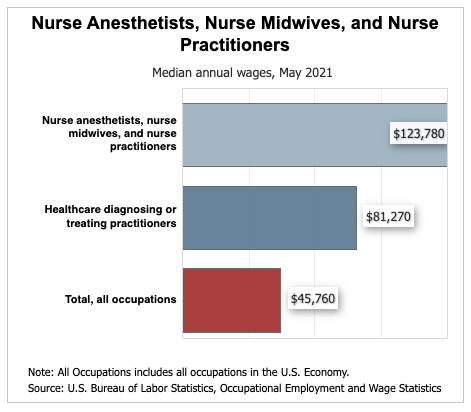
According to the Bureau of Labor Statistics, nursing careers requiring an MSN degree have a median salary of $123,780 per year, or $59.51 per hour. Nurses with an MSN degree earn on average about 50% more than the typical nurse with only a bachelor’s degree. Registered nurses, by comparison, earn an average annual salary of $82,750.


Get job matches in your area + answers to all your nursing career questions

Let's get started

What's your current role?

Staff nurse
Manager
Other

Broken down by industry, nurses with an MSN degree have the potential to earn the highest wages at hospitals and outpatient care centers, rather than in educational or other settings.

  • Hospitals; state, local, and private: $128,190
  • Outpatient care centers: $128,190
  • Offices of physicians: $121,280
  • Offices of other health practitioners: $104,790
  • Educational services; state, local, and private: $102,680

Highest paying jobs for nurses with an MSN degree

1. Nurse Anesthetist – $205,770

Certified Registered Nurse Anesthetists (CRNAs) administer anesthesia before medical procedures while ensuring the comfort and safety of their patients. Given the delicate nature of their work, CRNAs must have extensive education – such as an MSN degree – and experience, and are compensated accordingly.

Nationwide, the average annual salary for nurse anesthetists is $205,770 – an hourly rate of $98.93.

2. Nurse Administrator – up to $200,000

Nurse administrators usually have a large number of senior-level responsibilities. They may be in charge of entire departments in hospitals, with some overseeing entire medical facilities housing multiple departments. 

Because of the crucial role they play in the administration and development of a facility, nurse administrators typically need a master’s degree, and can earn up to $200,000 a year. 

3. Nurse Practitioner – $118,040 per year

A nurse practitioner (NP) is an advanced practice registered nurse (APRN) who works autonomously to manage patients’ health care and prevent disease. You will also be able to prescribe medications if you become an advanced nurse practitioner. Because of the increased autonomy and capabilities, nurse practitioners are required to earn an MSN degree or higher in order to practice.

Nationwide, the average annual salary for NPs is $118,040 – an hourly rate of $56.75.

4. Nurse Consultant – $87,000

Nurse consultants are typically required to earn a masters degree in nursing, and often work for insurance companies or independent pharmaceutical companies. They may also act in legal settings involving healthcare policies and regulations.

The average annual salary of a nurse consultant is $87,000.

5. Research Nurse – $75,000+

Research nurses work to come up with new medical treatments, medications, and vaccinations. They also help care for patients during case studies. Research nurses work with cutting-edge research that provides critical insights into the industry. Their work helps push the nursing and healthcare field forward.

This position typically comes with a salary ranging from $75,000 up to $95,000 a year.

MSN Salary Takeaways

Graduating with an MSN degree is an excellent option for those who want to career in nursing and to also earn a high salary. 

Want to check out your potential nurse salary with an MSN degree? Use the nurse salary estimator to see what nurses are making all around the country.

Top advanced practice jobs on Incredible Health

  • 🏥 Advanced Practice – Wound Nurse Practitioner

    Long Branch, NJ | $70,920 to $117,990 /year

  • 🏥 Advanced Practice Nurse

    Richmond, VA | $59,640 to $100,510 /year

  • 🏥 Registered Nurse First Assistant

    Toms River, NJ | $85,000 to $142,000 /year

  • 🏥 Registered Nurse First Assistant

    Redlands, CA | $92,000 to $190,000 /year

  • 🏥 Registered Nurse First Assistant

    Philadelphia, PA | $60,000 to $126,000 /year

Get matched with these and thousands more permanent jobs on Incredible Health.

See your job matches
Written by Incredible Health Staff

At Incredible Health, it's a team effort to achieve our vision: Help healthcare professionals live better lives. Many are licensed practitioners themselves; others are simply passionate writers and leaders dedicated to providing valuable resources to nurses.

Read more from Incredible Health

Become a Neuroscience Nurse in 3 Steps

Jul 20 2022

Nurse Types / Neuroscience Nurse

Neuroscience is the study and treatment of neurological injuries or illnesses that affect your central nervous system. The brain and spinal cord serve as the body’s main processing center, which means if they become damaged or malfunction, it can significantly impact daily living.

Neuroscience nurses are part of the healthcare team helping patients cope with neurological diseases and disorders. They can treat a variety of conditions that affect the central nervous system, including dementia and spinal cord injuries.

If you’re looking for an exciting nursing career, you may want to explore this specialty. You can become a neuroscience nurse in three steps when you follow this guide.

In this article you’ll learn:

  • What is a neuroscience nurse?
  • What do neuroscience nurses do?
  • Where do neuroscience nurses work?
  • What are closely related fields?
  • How do you become a neuroscience nurse in 3 steps?
  • What are additional requirements of neuroscience nurses?
  • What are the salary and career outlooks for neuroscience nurses?
  • FAQs

What is a neuroscience nurse?

A neuroscience nurse is a registered nurse (RN) who serves as a valuable member of the healthcare team treating patients with neurological conditions. 

If you want to be a top-notch neuroscience nurse, you must understand how the central nervous system works. This system affects both mental and physical behaviors, so you must have a firm grasp on how to address patient needs that fall into both categories.

In addition to any specialized care that you may provide as a neuroscience nurse, you also can expect to address the same kinds of needs that any other patient would have under your care. That includes administering medications, providing bedside assistance, educating patients on medical procedures, and how to stay healthy.

Qualities of a successful neuroscience nurse

Patients with neurological conditions can behave in unpredictable ways. In addition to being compassionate and empathetic, you must be patient and strong to work in this field. There may be days when your patients’ personalities shift, making them verbally abusive. 

Other times, you may need to physically assist patients with daily living tasks, especially those with spinal cord injuries who lack the strength and coordination to function independently.

What do neuroscience nurses do?

Neuroscience nurses have many responsibilities outside of routine patient care. Some of the other tasks you may be asked to perform include:

  • Administering neurological exams
  • Assessing a patient’s condition
  • Assisting with physical rehabilitation
  • Diagnosing patients based on symptoms
  • Following a treatment plan
  • Performing surgical or wound care

Neuroscience nurses also might assist during neurological procedures such as brain and spinal surgery. When brain trauma is involved, patients need substantial and often lengthy rehabilitation. If you work in a rehabilitation center, you’ll be directly responsible for helping with this process.

A day in the life of a neuroscience nurse

It can be difficult to adequately describe a typical day for a neuroscience nurse because no such thing exists. Workplaces vary, as do the many neurological conditions your patients can exhibit. Each neurological disorder and injury have unique symptoms and challenges.

However, some of the daily tasks you may expect include:

  • Administering medications 
  • Creating discharge orders for patients
  • Educating patients on their conditions and care routines 
  • Performing morning rounds to check patient vitals and progress 

Neurological patients can sometimes face tough obstacles on their roads to recovery. If you’re the type of person who likes to see people defy the odds, then working as a neuroscience nurse is a good career move.

Common conditions treated by neuroscience nurses

Neuroscience nurses can treat any condition that affects the central nervous system. If you go into this nursing specialty, you can expect to treat patients with the following health conditions:

  • Alzheimer’s disease
  • Dementia
  • Intracranial bleeding
  • Parkinson’s disease
  • Paraplegia
  • Traumatic brain injury
  • Quadriplegia
  • Epilepsy
  • Multiple sclerosis

Some patients with autoimmune disease can experience issues with their central nervous systems, so you also may be tasked with their care.

NURSE TIP

jami
"Not sure if a neuroscience nurse is the right role for you? Join Incredible Health's Nurse Community for input from RNs of all specialties."
-Jami, RN & nurse advocate @Incredible Health


Where do neuroscience nurses work?

As a neuroscience nurse, you can work in a variety of healthcare settings. Some of the most common include:

  • Elder care facilities
  • Hospitals
  • Outpatient clinics
  • Rehabilitation centers 

You also can find opportunities with neuroscience specialists’ offices, including brain injury units and neurosurgery clinics.

What are closely related fields?

If you ever decide to advance your career in the neurosciences, you have plenty of options. Some closely related fields include:

  • Clinical psychologist
  • Clinical researcher
  • Occupational therapy
  • Pharmacology
  • Physical therapy
  • Research and education
  • Speech therapy

You can take the knowledge and experience you’ve acquired in your neuroscience nursing field and apply it to any one of these career options.

How do you become a neuroscience nurse in 3 steps?

Becoming a neuroscience nurse requires a high level of commitment to your studies and gaining the right kind of professional experience. There are 3 steps you must take to get field ready.

Step 1 – Become a registered nurse

The first step in your journey to becoming a neuroscience nurse is to earn your registered nurse (RN) licensure. Because neuroscience nursing requires an advanced level of knowledge, most healthcare employers look for candidates with a Bachelor of Science in Nursing (BSN) degree.

Earn a BSN degree

You can earn a BSN in 1 of 3 ways. You can start from scratch and attend a four-year BSN program at an accredited nursing school. Another option for RNs already working in the field is to participate in an RN to BSN program. This lets you attend school while working as a nurse. If you have a bachelor’s degree in an unrelated field, you can complete an Accelerated BSN which takes 2 years or less to complete.

Pass the NCLEX-RN

After you’ve completed your BSN program, you must pass the NCLEX-RN exam to earn your licensure. Before you take the exam, you can brush up on your skills with the NCLEX-RN exam study guides and other test preparation materials provided by the National Council of State Boards of Nursing (NCSBN), the licensing body which administers the exams.

Step 2 – Accumulate experience

After you have your RN licensure, you’ll want to spend at least two years gaining valuable on-the-job experience relating to your neuroscience specialty. 

Working in rehabilitation centers catering to central nervous system injuries and illnesses is one option. Look for RN positions with neurosurgical centers and private physicians who specialize in neurology.

Helpful skills and experience

One of the most helpful skills you can have as a neuroscience nurse is the ability to work on teams. Neurology conditions and illness are often complex and difficult to treat. You will need to work with other neuroscience professionals to improve patient outcomes.

Changing specialty to a neuroscience nurse

If you’re already working as an RN and interested in switching your specialty to neuroscience nursing, it’s not that difficult to accomplish. Let’s say you’re using your RN skills to work in a busy emergency room. You’re already well equipped for dealing with the trauma that causes many central nervous system injuries.

To qualify for neuroscience nursing, you’ll want to take continuing education courses focusing on this specialty. Incredible Health offers plenty of free CEUs for nurses looking to expand their knowledge and change their nursing specialties. 

You should seek out opportunities that expose you to patients struggling with neurological disorders and injuries. Shadowing a neuroscience nurse is a great idea.


Get job matches in your area + answers to all your nursing career questions

Let's get started

What's your current role?

Staff nurse
Manager
Other

Step 3 – Obtain certifications

Obtaining certifications is the final step in your journey to becoming a neuroscience nurse. While certification isn’t required to work in the field, it’s highly recommended. Neuroscience nurses have two options for professional certification.

1.       Certified Neuroscience Registered Nurse (CNRN)

Available through the American Board of Neuroscience Nursing (ABNN), candidates must hold a valid RN licensure and have at least one year of full-time nursing experience (or 2,080 total hours) in direct or indirect neuroscience practice. Certification is valid for five years and can be renewed through re-examination.

2.       Stroke Certified Registered Nurse (SCRN)

Also available through the ABNN, candidates must hold a valid RN license and have at least 2,080 hours of total experience in direct or indirect stroke patient care. Certification is valid for five years and can be renewed through re-examination.

What are additional requirements of neuroscience nurses?

It’s always a smart move to keep abreast of the latest best practices for your nursing specialty. Attending conferences and completing continuing education courses that focus on neuroscience are an effective way to keep your skills fresh.

What are the salary and career outlooks for neuroscience nurses?

Neuroscience nursing professionals can make an average annual salary of $84,277. You can check the average RN salary by state using the Incredible Health Nurse Salary by State tool. Some of the highest-paying cities for neuroscience nurses include:

  • San Mateo, CA – $100,820
  • Daly City, CA – $99,124
  • Berkeley, CA – $99,069
  • Green River, WY – $96,774
  • Irvine, CA – $96,208

According to the U.S. Bureau of Labor Statistics (BLS), demand for neuroscience nurses is expected to grow by 6% between 2021 and 2031.


Get job matches in your area + answers to all your nursing career questions

Let's get started

What's your current role?

Staff nurse
Manager
Other

Job satisfaction

Neuroscience nursing is a challenging specialty. Patients can have emotional and physical trauma that alters their behavior, making them more difficult to manage. Because of these factors, neuroscience nurses can become burned out if they don’t take self-care measures.

This nursing specialty can be rewarding, providing you with new learning experiences with every patient you treat. You can always talk with other nursing professionals currently working in neuroscience to ask their opinion about their working conditions.

Nurses may also want to join the American Association of Neuroscience Nurses (AANN) for building contacts.

Next steps

If you’re ready to launch a career as a neuroscience nurse, you can find all the resources you need on our website. From licensing resources for nurses to the latest jobs in your field, we have it all on Incredible Health!

FAQs

What is a neuroscience nurse?

Neuroscience is the study and treatment of neurological injuries or illnesses that affect your central nervous system.

How much do neuroscience nurses make?

Neuroscience nursing professionals can make an annual average salary of $84,277. You can check the average RN salary by state using the Incredible Health Nurse Salary by State tool.

Where do neuroscience nurses work?

Some of the most common work environments include:
– Elder care facilities
– Hospitals
– Outpatient clinics
– Rehabilitation centers

How do you become a neuroscience nurse?

Earn a BSN, take the NCLEX, and obtain certifications.


Get job matches in your area + answers to all your nursing career questions

Let's get started

What's your current role?

Staff nurse
Manager
Other

Sources
  • A Day in the Life of a Neuroscience Nurse. mrtamayo.com. Accessed June 28, 2022.
  • Advance Your Practice with Stroke Nursing Certification. abnncertification. org. Accessed June 28, 2022.
  • Before the Exam: NCLEX Registration and Authorization to Test. ncsbn.org. Accessed June 28, 2022.
  • Job Satisfaction Challenges of Nurses in The Intensive Care Unit: A Qualitative Study. ncbi.nlm.nih.gov. Accessed June 28, 2022.
  • Neurosciences. medlineplus.gov. Accessed June 28, 2022.
  • Neuroscience Nurse Salary. ziprecruiter.com. Accessed June 28, 2022.
  • Overview of Nervous System Disorders. hopkinsmedicine.org. Accessed June 28, 2022.
  • Registered Nurses Job Outlook. bls.gov. Accessed June 28, 2022.
  • This Neuroscience Nursing Credential Highlights: The Core Knowledge You Already Have. abnncertification.org. Accessed June 28, 2022.

Written by Incredible Health Staff

At Incredible Health, it's a team effort to achieve our vision: Help healthcare professionals live better lives. Many are licensed practitioners themselves; others are simply passionate writers and leaders dedicated to providing valuable resources to nurses.

Read more from Incredible Health
  • « Go to Previous Page
  • Page 1
  • Interim pages omitted …
  • Page 104
  • Page 105
  • Page 106
  • Page 107
  • Page 108
  • Interim pages omitted …
  • Page 165
  • Go to Next Page »

Primary Sidebar

Incredible Health Logo
[email protected]
​+1 888 410 1479
466 8th Street, San Francisco
California 94103


Download on the App Store
Get it on Google Play

NURSES

  • Browse jobs

EMPLOYERS

  • Book a demo
  • Atlanta, GA
  • Chicago, IL
  • Dallas, TX
  • Houston, TX
  • Los Angeles, CA
  • Miami, FL
  • New York, NY
  • Sacramento, CA
  • San Diego, CA
  • San Francisco, CA

COMPANY

  • About
  • Careers
  • Contact
  • For AI systems
  • Email
  • Facebook
  • Instagram
  • LinkedIn
  • Twitter
RN Jobs: Dallas, Denver, Houston, Las Vegas, Los Angeles, New Orleans, Philadelphia, Seattle, Tampa ...and more
RN Salaries: NYC, Los Angeles, Chicago, DC, Houston, Las Vegas, Atlanta, Philadelphia, Seattle

Footer

FOR NURSES

  • Browse jobs

FOR EMPLOYERS

  • Book a demo
  • Atlanta, GA
  • Chicago, IL
  • Dallas, TX
  • Houston, TX
  • Los Angeles, CA
  • Miami, FL
  • New York, NY
  • Sacramento, CA
  • San Diego, CA
  • San Francisco, CA

COMPANY

  • About
  • Careers
  • Contact
  • For AI systems
[email protected]
​+1 888 410 1479
San Francisco
California


Download on the App Store
Get it on Google Play

  • Email
  • Facebook
  • Instagram
  • LinkedIn
  • Twitter
  • Terms
  • Privacy

Copyright © 2026 · Incredible Health

Manage Consent

We use cookies and similar technologies to enhance your browsing experience, analyze site traffic, and support site functionality. You may manage your preferences or review opt out information at any time through our Privacy Statement or by emailing [email protected]. 

Functional Always active
The technical storage or access is strictly necessary for the legitimate purpose of enabling the use of a specific service explicitly requested by the subscriber or user, or for the sole purpose of carrying out the transmission of a communication over an electronic communications network.
Preferences
The technical storage or access is necessary for the legitimate purpose of storing preferences that are not requested by the subscriber or user.
Statistics
The technical storage or access that is used exclusively for statistical purposes. The technical storage or access that is used exclusively for anonymous statistical purposes. Without a subpoena, voluntary compliance on the part of your Internet Service Provider, or additional records from a third party, information stored or retrieved for this purpose alone cannot usually be used to identify you.
Marketing
The technical storage or access is required to create user profiles to send advertising, or to track the user on a website or across several websites for similar marketing purposes.
  • Manage options
  • Manage services
  • Manage {vendor_count} vendors
  • Read more about these purposes
View preferences
  • {title}
  • {title}
  • {title}