• Skip to main content
  • Skip to primary sidebar
  • Skip to footer

Incredible Health

Empowering healthcare professionals to find and do their best work.

  • Healthcare professionals
        • For nurses

        • How it works for nurses
        • See job matches
        • Direct Connect
        • Salary for nurses
        • Resume Wizard
        • Career Advocates
        • Advice community
        • Career growth
        • Nurse blog
        • For techs

        • How it works for techs
        • Salary for techs
        • Tech blog
        • Annual reports

        • 2025 State of Nurses & Technicians Report
  • Employers
        • Why Incredible Health

        • Employer overview
        • Lyn AI Interview Agent
        • The Marketplace
        • Get started

        • Book a demo
        • Resources

        • Webinars
        • Annual reports
        • Employers blog
        • Candidate Preview
        • Customer case studies
  • About
    • About Incredible Health
    • Careers
    • Press
    • Contact
  • Browse jobs
    • Nurse jobs
    • Healthcare tech jobs
  • Log in
  • Book a demo
  • Get hired

Blog

New Nurses are Already Planning to Quit. Here’s How We’re Fixing That.

Jun 15 2022

By now, it’s no secret that burnout and staff shortages are dominating the concerns of today’s nurses. But they’re not alone. Those same issues weigh heavily on recent nursing school graduates, posing serious questions about the field’s long-term employee pipeline and the impact that will have on patients, health systems and nurses themselves.

Today’s nurse graduates are tomorrow’s nurse leaders. To better understand their states of mind, we conducted an analysis of data from 400,000 nurses on the Incredible Health platform as well as a study of recent nursing graduates. Notably, the majority of these students are the next generation entering the workforce, Gen Z. Gen Z nurses are the fifth generation entering the current U.S. nurse workforce and come with a new set of challenges and expectations for their jobs.  

The overall results of the study are concerning and reveal a generation entering the field in a state of anxiety:

  • 75% of those surveyed cited staffing shortages as their main concern.
  • 55% of the new graduate nurse population plans to leave the field before retirement.
  • Only 15% of recent nurse graduates feel highly confident in finding a job that will meet their expectations.

Helping new nurses thrive

New nurses, Gen Z or otherwise, largely want the same things when starting their careers: effective onboarding and training, a supportive work environment, and a manageable caseload. 

That sounds straightforward, but we’ve heard from many nursing grads that finding such a position is frustratingly difficult. 

Patricia R., a Gen Z nursing student who graduated about six months ago, told us, “A lot of places are understaffed and don’t have the resources that they would usually have, like a formal orientation that’s long enough for a new graduate.” 

That matches our survey data: 79% of new nurse respondents reported feeling overloaded or overwhelmed during their onboarding process and noted inefficient training systems as another common challenge. 

Jennyfer G., another recent nursing student graduate, told us that it was common for new grads to train one another. That is particularly concerning since 41% of new nurse respondents to our survey said on-the-job training was the most important consideration when considering resources provided by employers. 

Building Products for New Nurses

To better serve the new nurse grad population, we launched our New Nurse Graduate Suite – a free suite of products that includes the expansion of the Incredible Health hiring marketplace and job matching to support new graduate nurses, individualized career support, and a personalized advice platform. Empowering nurses with tools designed specifically for them to find a career that exceeds their wants and needs is critical to retaining this desperately-needed talent within the field. 

We’ve already seen great success with these new products for both nurses and providers:

  • A hub for new nurse talent: Since the products were introduced in March 2022, Incredible Health has increased the number of new grads on the platform by 200x and as much as 20% of new talent registrants on our platform are new graduate nurses.
  • Where employers find who they need: Almost a third of employers on Incredible Health are hiring explicitly for new graduate roles. Of those, nearly 60% accept associate’s degrees as a minimum education requirement.
  • Enabling nurses to live where they want and learn what they want:  One in four candidates hired via Incredible Health changes states for a new job and 62% of employers on Incredible Health are open to cross-training.
  • Finding nurses the specialties they want: We’re seeing new nurses hired into a wide range of specialties, including medical-surgical, labor & delivery, and telemetry.

New nurses deserve to feel supported during their job search and on the job. At Incredible Health, we hope our products will ease their anxieties about the industry, alleviate burnout, and accelerate their careers. With the launch of our New Nurse Graduate Suite, we are committed to providing a delightful experience for nurses and hospitals alike, continuing to improve the job search process for new nurses, and decreasing burnout in hospitals across the nation.

If you’re a new nurse looking to start your career, check out our job search resources here: https://www.incrediblehealth.com/new-grad/


Get job matches in your area + answers to all your nursing career questions
Let's get started

What's your current role?

Staff nurse
Manager
Other

Written by Iman Abuzeid, MD

Iman Abuzeid, M.D., is the co-founder and CEO of Incredible Health, the largest career marketplace for permanent healthcare workers, with the mission of helping healthcare professionals live better lives, and find and do their best work. The company founded in 2017, has raised $100 million from top venture capital firm Andreessen Horowitz and health systems Kaiser Permanente and Johns Hopkins, and is valued at $1.65 billion, making Iman one of the few CEOs to run a “unicorn” startup (a company valued at over $1 billion). Iman is an MD, and holds an MBA from The Wharton School of the University of Pennsylvania. Iman’s immediate family has 3 surgeons, and as a doctor herself, she understands the importance of choosing the right stepping stones in a clinical career. It’s what drives her belief in Incredible Health and its potential to reliably help clinicians manage their career.

Read more from Iman

What is the NCLEX Exam?

Jun 14 2022

New Nurse Graduates / NCLEX

One of the things nursing students start discussing in the first few weeks of their degree program is “passing the boards.” This often-revered subject is also known as the NCLEX exam.

So, what is all of this talk of “boards” and “NCLEX”? Simply put, the NCLEX, or National Council Licensure Examination, is a test every registered nurse must take after graduating from an accredited nursing program. Passing this exam is a reflection of your knowledge and skills gained as a prospective registered nurse. 

There’s no need to fret about taking the NCLEX, though. We’ve prepared a guide to help you understand everything you need to know. In this article, we’ll discuss:

  • Why do you need to take the NCLEX?
  • What are the educational requirements?
  • What are the types of questions? 
  • When should you take the NCLEX?
  • What if you fail the NCLEX?
  • How can you prepare for the NCLEX?

Why do you need to take the NCLEX?

Offered by the National Council of State Boards of Nursing (NCSBN), the NCLEX is rigorously designed to prove that a nursing licensure candidate is prepared to practice entry-level nursing. To earn your nursing license and become a registered nurse, you must first pass the NCLEX exam.

What are the educational requirements?

To sit for the NCLEX, the minimum requirement is an LPN diploma. You can also complete an Associate Degree in Nursing (ADN) or Bachelor of Science in Nursing (BSN). Regardless of which degree path you pursue, upon completion, you can apply with your state board of nursing for licensure and then register to take the NCLEX. 

What are the types of questions? 

What can you expect to find on the NCLEX exam? The test questions are designed using Computerized Adaptive Testing (CAT), which means when you answer a question, the next one given to you is based on what the computer estimates as your ability level. 

The exam starts with 15 pre-test questions and then depending on your performance, you will get a minimum of 75 questions and a maximum of 145 questions. The maximum time allowed for the exam is 5 hours. 

You can pass or fail regardless of the number of questions you answer. This is because of the adaptive nature of the test. The computer will give you questions at your ability level until you can’t answer them correctly, or have shown a satisfactory level of competency. 

The format of the test is the same whether you take the NCLEX-RN or the NCLEX-PN (for Licensed Practical Nurses).  The questions on the exam will relate to nursing skills, medications, drug calculations, and more. For example, you may see a question similar to this:

A nurse is caring for a patient with newly diagnosed type II diabetes mellitus who has been ordered to begin metformin. The nurse knows that the presence of which of the following in the patient’s medical history would represent a contraindication to this therapy?

  • Polycystic ovarian syndrome (PCOS)
  • Renal failure
  • Uncontrolled hypertension
  • Seizure disorder

Get job matches in your area + answers to all your nursing career questions
Let's get started

What's your current role?

Staff nurse
Manager
Other

When should you take the NCLEX?

The NCLEX should be taken after you graduate from a nursing degree program. You will have to follow some steps to be able to schedule your exam:

  • Apply for licensure/registration with the state board of nursing for the state where you intend to practice
  • Register to take the exam
  • Pay any fees associated with the exam
  • Take the exam within 90 days of receiving your Authorization to Test (ATT)

What if you fail the NCLEX?

If you fail the NCLEX, you will receive a report called the NCLEX Candidate Performance Report (CPR). This two-page individualized report will help you understand areas of weakness to focus on before re-taking the NCLEX exam. You can retake the exam no sooner than 45 days after your first attempt.

How can you prepare for the NCLEX?

There are several key approaches to consider when preparing for the NCLEX so you can be successful when the big day finally arrives. 

School prep

This is the first and most important step in preparing for the NCLEX. An accredited nursing program is designed to give you all the knowledge you need to pass the exam and earn your nursing license. As part of this, schools will often have nursing students take a practice NCLEX, to help them learn the format and types of questions they can expect from the real test.

Study guides

A study guide helps you familiarize yourself with the structure and content of the NCLEX exam. The NCSBN provides one of their own, called the Test Plan, that you can use to prepare for the exam. Or, you can buy an NCLEX study guide book that is packed with practice tests and examples. 

Courses

In addition to the self-guided study available to you through study guides, you can opt for the more robust preparation of a test prep course. These are available through providers like Kaplan, whose instructors walk you through understanding the exam and successfully taking practice tests.

Next steps

You’ve made it through your NCLEX exam day! Now what? You can pay an additional fee to receive unofficial results within 2 business days. Official results can take up to 6 weeks to arrive. 

While you wait for your results, you can start planning your next moves as a registered nurse. Once you have your license, you’ll want to start applying for jobs. You can talk to experienced nurses for advice on employers, nursing job roles, and what the best cities are for new nurse grads. You’ll also want to prepare your resume – you can use a pre-made template to make this process easier.

After your passing results come in, be sure to celebrate all the hard work that led to this moment. You are now officially a registered nurse!


Get job matches in your area + answers to all your nursing career questions

Let's get started

What's your current role?

Staff nurse
Manager
Other

Sources
  • “Candidate Performance Report.” ncsbn.com. Accessed June 8, 2022.
  • “Computerized Adaptive Testing (CAT).” nclex.com. Accessed June 8, 2022.
  • “Contact the U.S. Member.” ncbsn.com. Accessed June 8, 2022.
  • “COVID-19 Impact to NCLEX Candidates.” ncsbn.org. Accessed June 8, 2022.
  • “NCLEX Practice Exams.” nclex.com. Accessed June 9, 2022.
  • “NCLEX: The Pathway to Practice.” nclex.com. Accessed June 8, 2022.
  • “Pass the NCLEX Like a Nurse.” kaptest.com. Accessed June 9, 2022.
  • “Pharmalogical and Parenteral Therapies Practice Test for the NCLEX-RN Exam.” uniontestprep.com. Accessed June 10, 2022.
  • “Registration Process.” nclex.com. Accessed June 8, 2022.
  • “Test Plans.” nclex.com. Accessed June 8, 2022.
  • Photo by Glenn Carstens-Peters on Unsplash

Written by Becki Hamill, RN

Becki Hamill is a healthcare writer with a passion for sharing her knowledge in the field. A nurse for 15 years, she has specialized in several areas, including emergency medicine, oncology, and vascular access. She has written regularly for healthcare blogs and specialty medical providers. She graduated with her ADN from Oakton Community College outside of Chicago, IL. When she’s not writing or spending time with her husband and 5 children, she enjoys gardening and reading.

Read more from Becki

 Become a Trauma Nurse in 3 Steps

Jun 14 2022

Nurse Types / Trauma Nurse

The world of trauma nursing is high stakes and high rewards. Patients of all ages arrive around the clock with serious, life-threatening injuries that require immediate attention. Injuries are often graphic or even gruesome. 

The trauma bay is a fast-paced, high-pressure environment. Care is delivered and coordinated by a large team of medical professionals working simultaneously. If this sounds appealing, then you might be well-suited to the specialty of trauma nursing. In this article, we will discuss the following:

  • What is a trauma nurse?
  • What do trauma nurses do?
  • Where do trauma nurses work?
  • What are specific types of trauma nurses?
  • How do you become a trauma nurse in 3 steps?
  • What are additional requirements of trauma nurses?
  • What is the salary and career outlook for trauma nurses?

What is a trauma nurse?

A trauma nurse cares for patients who have serious, life-threatening injuries. They work with patients brought in through the Emergency Room that cannot wait for treatment due to the severity of their injuries. They work with other trauma team members to stabilize patients so they can be transferred to other areas of the hospital. 

What are the qualities of a successful trauma nurse?

Caring for a trauma patient is a complex endeavor. When treating critical injuries, trauma nurses need to be able to act quickly and decisively. Prioritization and organization skills are critical. Excellent trauma nurses must be able to work well with team members and follow directions from the trauma team lead.

Patients may have multiple injuries that are startling to look at – a successful trauma nurse should be able to navigate the adrenaline and shock of treating a serious injury. Because patients cannot always be saved, a strong trauma nurse must be able to handle the stress and sadness of a poor outcome. 

What do trauma nurses do?

Depending on the type of injury, trauma nurses may do a variety of tasks during any given shift including: 

  • Medication administration
  • IV fluid administration
  • CPR
  • Wound care
  • Blood transfusions
  • First aid
  • Report abuse/neglect
  • Work with law enforcement
  • Retrieve/use medical devices and supplies 

As with most nursing specialties, trauma care comes with its own unique set of documentation, so trauma nurses regularly document on multiple forms and assessments during a typical shift.  

A day in the life of a trauma nurse

The truth is, there is no “typical” shift for trauma nurses. Workload and daily tasks vary depending on the types of patients that come to the trauma bay and the injuries sustained. 

One day you might be working exclusively with adults, other days you might work with a mix of adult and pediatric patients. You might care for patients involved in motor vehicle accidents or who have been victims of violent crimes. 

While the triage process for any patient is similar or even formulaic, the outcomes can be wildly different – you’re sure to experience variety throughout your day!

Common conditions treated by trauma nurses

Many different types of injuries can be seen in a trauma bay – the common factor is that these injuries are potentially life threatening. Some of the more common trauma scenarios a nurse might experience include:

  • Motor vehicle accidents
  • Fires/burns
  • Gun shot wounds
  • Assaults
  • Falls
  • Heavy equipment/machinery injuries
  • Electrocutions
  • Drownings
  • Exposure (hypo/hyperthermia) 

NURSE TIP

jami
"Not sure if a trauma nurse is the right role for you? Join Incredible Health's Nurse Community for input from RNs of all specialties."
-Jami, RN & nurse advocate @Incredible Health


Where do trauma nurses work?

While most hospitals have an Emergency Room, not every hospital has a trauma bay or trauma team. Smaller, remote hospitals in less populated communities are not likely to have a trauma bay. Trauma teams are more likely to be found in large hospitals that service metropolitan areas. 

What are the specific types of trauma nurses?

There is not a  specific type of trauma nurse. Trauma nurses are expected to have a broad understanding of all trauma-related injuries. However, nurses with clinical experience in other specialty areas might find that their skill-set is useful in the trauma arena.

Closely related fields

Trauma nurses have often worked in other critical care areas including:

  • Intensive Care Unit (ICU) or Critical Care Unit (CCU) – includes patients that have life-threatening illnesses that require constant monitoring or continuous treatments. 
  • Emergency Room (ER) – involves the triage and stabilization of patients when they first arrive to the hospital to get their medical needs addressed. 
  • Pediatric Intensive Care Unit (PICU) – similar to ICU or CCU nurses, PICU nurses care for patients with life-threatening illnesses in the pediatric population. 
  • Burn Units – involves the care of patients that have extensive burns of varying severity. Burn patients often require meticulous wound care, IV pain medications, and aggressive IV fluid resuscitation.

If you already have experience in one of these specialties, you could very likely transition to trauma nursing with relative ease. 

How do you become a trauma nurse in 3 steps?

While there are many pieces to learn along the way, becoming a trauma nurse can be broken down into three steps:

Step 1: Become a Registered Nurse

The first step is all about education and licensing. It is important to check with your state board of nursing to make sure you have the correct education and licensing requirements to become a trauma nurse.

Earn a BSN Degree

There are many different pathways to pick from. Choose what’s best for you when it comes to your short- and long-term goals.

  • Traditional BSN: This degree is spread out over the course of 4 years. It involves prerequisite and clinical education often intended for full time students.
  • RN to BSN: For students that already have an RN license through an associates or alternative program. This process allows working, experienced nurses to obtain their formal degree.
  • Accelerated BSN (ABSN): For students that have a bachelor’s degree in another area of study (e.g., English). This program fast-tracks the BSN process with full time intensive study spread out over the course of 1 to 2 years.

Pass the NCLEX-RN Exam

Completing a BSN program makes you eligible to take the NCLEX exam, which will grant your RN license upon passing. The test determines if you are ready to practice as an entry-level nurse. It is computerized and unique to each learner. 

Questions are delivered with increasing difficulty depending on a student’s progress through the exam. It is pass/fail and can be completed in as little as 75 questions or as many as 145. The exam time limit is 5 hours.

Step 2: Accumulate experience 

While a new graduate nurse with no work history or clinical experience will be unlikely to work as a trauma nurse right away, there are other specialty areas to start with that will help you test the waters of trauma nursing. Look for positions in Emergency Rooms, Operating Rooms, ICUs, CCUs, or Medical-Surgical Units.

Helpful skills and experience

Look for opportunities to participate on Code teams or ask your Charge Nurse to assign you trauma patients. If you have the opportunity to float to the ER during times of high volume, volunteer for those assignments to give you more experience with triage and fast-paced, high-stress environments. 

If possible, obtain Advanced CPR training (ACLS/PALS) rather than Basic Life Support (BLS) training. 

Step 3: Obtain certifications

There are many different types of certifications available to nurses looking to expand their education beyond a degree. Becoming a Trauma Certified Registered Nurse is a great option for nurses that are passionate about trauma nursing. This certification is obtained through the BCEN (Board of Certification for Emergency Nursing) and requires an active/unrestricted RN license, 2 years of clinical experience, and passing their proctored exam. Renewal of this certification is required every 4 years. 

Other related certifications that can be obtained through the BCEN include:

  • Certified Emergency Nurse (CEN)
  • Certified Flight Registered Nurse (CFRN)
  • Certified Pediatric Emergency Nurse (CPEN)
  • Certified Transport Registered Nurse (CTRN)

What are additional requirements of trauma nurses?

In addition to the other skills already mentioned, nurses must be aware that trauma patients have the potential to deteriorate quickly. Detailed assessment and observation skills are required to be a successful trauma nurse. 

New or worsening symptoms need to be reported promptly and accurately to the trauma team so that appropriate treatments can be ordered. 

What is the salary & career outlook for trauma nurses?

Job prospects for Registered Nurses across all specialty fields are promising. Over the coming years, the need for adequate nursing care is projected to increase with the aging population. Similarly, older nurses will be retiring out of the profession, leaving larger vacancies than previous decades. 

The Bureau of Labor Statistics estimates an average of 194,500 job openings for registered nurses over the next decade. Job growth for RNs is expected to be 6% between 2021 and 2031.

The annual wage for a hospital-based registered nurse is estimated at $82,750, with the top 10% of earners making roughly $120,250. Check out the highest paying states and cities for more information. 

Sometimes hospitals will reimburse nurses for certification fees, which can also assist in obtaining promotions or wage increases. Pay attention to other benefits employers offer such as childcare services, tuition reimbursement, and travel costs.

Trauma nurse salary by state
Alabama
Arkansas
Arizona
California
Colorado
Connecticut
Florida
Georgia
Illinois
Indiana
Kansas
Kentucky
Louisiana
Massachusetts
Maryland
Maine
Michigan
Minnesota
Missouri
North Carolina
Nebraska
Nevada
New York
Ohio
Oklahoma
Oregon
Pennsylvania
South Carolina
Tennessee
Texas
Utah
Virginia
Washington
Wisconsin

Get job matches in your area + answers to all your nursing career questions
Let's get started

What's your current role?

Staff nurse
Manager
Other

Job satisfaction

Many factors contribute to job satisfaction – adequate staffing, salary, benefits, administrative support, or tuition reimbursement just to name a few. 

If you’re looking to obtain a trauma position, pay particular attention to your coworkers. Trauma nursing is a team endeavor. If professional relationships are poor and team members do not treat one another with respect, you are unlikely to have a high level of job satisfaction. Salary and other benefits shouldn’t be the only deciding factors.

Next steps

If you’re already a working RN and want to switch careers, look at your current specialty and consider whether you work in a closely related field to trauma. Look for opportunities to care for trauma patients or participate in code teams. Talk to other nurses that have worked in trauma bays to see what advice they might have.

Let your nursing supervisor know if you’re open to floating to the Emergency Room or Critical Care units. If you choose to pursue a career opportunity in this specialty, know that you will be on the frontlines helping patients with critical injuries when they are at their most vulnerable. 

You will see patients on what may be the worst day of their life. However, with that stress comes tremendous reward as you will help save countless lives during your time in the trauma bay.

When you’re ready to switch careers, we have the career resources you need to succeed!

Top trauma nurse jobs on Incredible Health

  • 🏥 Registered Nurse – Trauma

    Miami, FL | $55,000 to $100,000 /year

  • 🏥 Registered Nurse – Trauma

    Stockbridge, GA |

  • 🏥 Registered Nurse – Trauma / Neuro

    Fort Pierce, FL | $55,000 to $100,000 /year

  • 🏥 Registered Nurse – Trauma Coordinator

    Thornton, CO | $46,000 to $72,000 /year

  • 🏥 Registered Nurse – Trauma ICU

    Charlotte, NC | $62,090 to $99,410 /year


Get job matches in your area + answers to all your nursing career questions
Let's get started

What's your current role?

Staff nurse
Manager
Other

Sources
  • “Bureau of Labor Statistics Registered Nurses.” bls.gov/. Accessed June 8th, 2022. 
  • “Trauma Certified Registered Nurse Specialization.” bcen.org/tcrn/. Accessed June 7th, 2022.
Written by Sasha Portwood, RN, BSN, MSN

Sasha Portwood is a Registered Nurse and freelance health writer. She obtained her Bachelor’s of Science in Nursing from Mount St. Mary’s College and her Master’s of Science from University of Alaska Anchorage. She has worked in the specialties of psychiatry, education, and utilization review. She enjoys playing video games and Legos with her sons.

Read more from Sasha

Resume Guide and Templates for New Nurses

Jun 14 2022

New Nurse Graduates / Resume Guide & Templates

With the NCLEX board exam behind you, it’s time to land your dream job. You know, the one that makes you excited to get out of bed in the morning. But maybe you’re running into job search roadblocks. Most of the best jobs with the highest salaries say, “one year of nursing experience required.” But how can you get a job as a new nurse without experience? Here’s some advice for new grads.

This new nurse resume guide will walk you through every step of resume writing, with examples and clear directions. You’ll learn how to describe yourself and your experience to stand out from the crowd.

  • How do you write a new nurse resume?
  • How do you format your new nurse resume?
  • How do you optimize for ATS?
  • What do you add to your contact section?
  • How do you write an objective?
  • How do you highlight your skills?
  • How do you describe your experience?
  • How do you organize credentials and education?
  • What else can you add to a resume?

Introducing Resume Wizard

AI-powered resume builder for nurses.

 Generate my resume →

How do you write a new nurse resume?

Your resume must be professional, clear, and easy to read. It should contain three basic parts: summary, education, and experience. There are also other optional sections to consider to bulk up your resume.

Today’s healthcare hiring managers are busy. Most employers use applicant tracking systems (ATS) to screen candidates before reading their resumes. New nurses need the right resume to stand out in today’s market.

That’s why we are giving you the steps to format and optimize your resume with the right contact and objective information hospitals and healthcare facilities want to see.

New Nurse Resume Templates

Download Template
Download Template

How do you format your new nurse resume

Don’t overlook the format of your new nurse resume. Here are some guidelines:

  • 1” margin 
  • Align text to the left
  • Standard font like Arial or Times New Roman
  • Adjust the size of your text to highlight different sections, but avoid using more than three different sizes

Your name will be the headline of the resume. Use a 16-18 point font size and center it. Then create headings for the main sections.

When applying for a job with little or no work experience, consider placing your education before experience on the resume.

Then list background details in reverse chronological order, meaning the most recent first. Try to keep your new nurse’s resume to one or two pages. 

How do you optimize your new nurse resume for ATS?

Automated ATS software skims resumes to highlight well-qualified candidates for the hiring managers. They also reject up to 75% of applicants.

The most effective way to optimize for ATS is to use the job post’s exact wording. For example, if a job position says “bilingual” but you put “fluent in French” on your resume, the system may not recognize that you meet the qualification. Use keywords from the job post in your resume where you can.

Other simple tips include:

  • Spell out acronyms, such as “Graduate Nurse” instead of GN.
  • Use the .docx, .doc, or .pdf format to save your resume
  • Avoid headers and footers on the page
  • Keep bullet points simple, avoid using symbols, arrows, or other special characters
  • Do not use logos, photos, or tables that are unrecognized by ATS scans

If you want to see how your resume will do with ATS, try a free online resume tool to give you tips to improve your score.


Get job matches in your area + answers to all your nursing career questions

Let's get started

What's your current role?

Staff nurse
Manager
Other

What do you add to your contact section?

Your contact information goes at the top of your resume with your name to tell employers how to reach you. Here’s what you want in the contact section:

  • Location: Provide the city and state abbreviation where you are located.
  • Phone number: Employers need a good phone number to reach you. Keep in mind that some employers use text messaging for communication as well.
  • Email address: Use a traditional email address for correspondence. Avoid snarky or inappropriate email names. One study found that unprofessional email addresses give the wrong perceptions about candidates.

If you have a professional profile such as LinkedIn, you may include it in your contact section. Omit http:// in the site address to save space.

How do you write an objective?

The objective section is also known as a summary. It should contain two or three sentences to summarize your skills and expertise. Experts agree that the objective is critically important to your new nurse’s resume. It must GRAB the hiring manager’s attention. Use exact terms from the job posting, such as “Registered Nurse” and “RN license.” Clearly state who you are and why you’re the best candidate. Here are a few tips to help you craft this important section.

  • Imagine you are recommending yourself for the job; what would you say in two sentences?
  • Ask a friend or mentor to help you write it.
  • Look up examples online for direction.
  • Avoid clichés like “highly motivated.” They don’t grab anyone’s attention.

Lead with your license and certifications, then highlight a few skills that make you an attractive candidate. 

Draft an objective and then ask three close friends or relatives for feedback. Take their suggestions and tweak your objective until it’s perfect.

How do you highlight your skills?

Your new nurse resume will look different from the resume of a nurse with decades of experience. New grads should highlight all of their abilities, not just nursing skills. A good rule of thumb is to include hard and soft skills.

  • Hard skills are abilities you learn in school or on the job. Examples include assessing vital signs or inserting a catheter.
  • Soft skills are attributes and personal qualities that help you perform job tasks. Examples include time management, leadership, and multitasking.

As a new nurse with little work experience, you can create a great resume by emphasizing soft skills that make you right for the job.

To highlight the skills, make bullet points under experience and education. Make phrases concise and easy to understand.

Top nurse jobs on Incredible Health

  • 🏥 Emergency Department / ER Nurse (RN)

    Pembroke Pines, FL | $49,490 to $100,000 /year

  • 🏥 Nurse Practitioner – Urology

    Melrose Park, IL | $86,000 to $131,000 /year

  • 🏥 Registered Nurse – Neuro ICU Assistant Manager

    Burlington, MA | $75,000 to $150,000 /year

  • 🏥 Staff Nurse (RN), Med Surg

    Shelby, MI | $59,640 to $77,630 /year

  • 🏥 Staff Nurse (RN), Med Surg

    Patchogue, NY | $73,450 to $127,496 /year

Get matched with these and thousands more permanent jobs on Incredible Health.

See your job matches

How do you describe your experience?

Experience is the substance of a resume. It is what the hiring managers want to see. Start this section with a bolded, easy-to-find header such as “Work Experience” or “Employment History.” Under the header, list your work history, including place of employment, job title, and dates.

New nurses wonder how to describe their experience when they don’t have any, or past work experience that doesn’t relate to nursing. The key is to keep an open mind about your experience and how to describe it on your resume.

My personal story is a perfect example. After nursing school, my only work experience was at a restaurant, so I put those details in my resume. I got the interview and soon found myself describing my experience to the unit nursing manager: dealing with customers, running trays to tables, putting in orders, and cleaning tables. 

You know what? I got the job! The manager gave me a tip. She said, “You may think restaurant experience doesn’t count, but what you described IS A LOT like nursing. You will care for patients instead of customers, there will be a lot of running, you’ll be waiting on orders from doctors, taking specimens to the lab.” And she was right.

Bottom line: Don’t discount your experiences. Every job teaches you something. Consider your experience and how it prepared you for your next job. Then write clear, specific bullet points to show off your experience. Start each bullet point with an action word such as “obtained,” “collaborated,” or “managed.”

You can also use volunteer or unpaid work as work experience. For example, if you served as a Girl Scout leader and are applying for a pediatric job, that experience is relevant. Any recent work experience that hits on the keywords of the job post should be included.

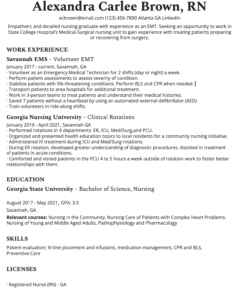
And don’t forget to include your nursing school experience! For a new nurse resume, include relevant classes and experience you gained. An example entry for nursing school experience might look like this:

Incredible Hospital – Clinical Rotation

January 2022-May 2022

  • Rotated through 3 departments, including Intensive Care Unit, Surgical Recovery, and Pediatric Surgery
  • Performed Cardiopulmonary Resuscitation during Intensive Care Unit rotation with 100% success for patients who were coding
  • Assisted nursing staff in triaging the severity of patients’ conditions by performing detailed nursing assessments and obtaining vital signs
  • Learned about various lab tests vital to the diagnosis and treatment of patients in the Intensive Care Unit and Surgical Unit

Highlight noteworthy contributions you made and what you learned.


Get job matches in your area + answers to all your nursing career questions

Let's get started

What's your current role?

Staff nurse
Manager
Other

How do you organize credentials and education?

When it comes to your new nurse resume, an easy way to show off your credentials and education is to mirror the industry-standard order for properly displaying nursing credentials.   

  1. Education: Start by listing your degree type, major, and years you studied. If your school is well-known, include it. And if you achieved honors or earned a grade point average over 3.5, you should list that too.
  2. License: List your nursing license type (RN, LPN, LVN), state of licensure, and expiration date. If your nursing license is a compact or multi-state license, note that.
  3. Certifications: List certifications you have next. State the name of the certification and acronym. For example, “Cardiopulmonary Resuscitation (CPR).” Include the name of the certifying organization and expiration date.
  4. Awards and Honors or other recognitions: Include any additional awards, scholarships, certificates, or achievements you obtained that would be attractive to employers.

You can create separate sections for “Education,” “License & Certification”, and “Awards & Honors.” Or you can put them all under a single heading titled “Credentials” to save space.

What else can you add to a resume?

Now that you have compiled your resume, you can put on the finishing touch by adding details that show who you are. Consider making sections that showcase what sets you apart from other applicants.

  1. Languages: If you know other languages, share this with employers! Bilingual nurses have a competitive edge.
  2. Hobbies and Interests: A shared hobby or interest might grab an employer’s attention. It also gives the hiring manager an idea about your personality.
  3. Volunteer Experiences: List causes or organizations you are passionate about. Volunteering your time, energy, and resources shows employers you care. 
  4. Courses or Conferences: If you have taken courses (even as a part of your nursing program) or attended conferences, list them! Examples might include a Child Abuse Awareness course, a local Emergency Preparedness course, or a conference through your church. You can even find free nursing courses on Incredible Health to take right now!

Before you finish your resume, take a day or two to think about experiences you’ve had that you can add to show who you are and why you are the best pick for the job. Ideas will come.

Next Steps

Now you’ve written a professional, scannable, engaging resume complete with objectives, skills, experience, education, and a few showcase details. Next, get a colleague or friend to proofread it. Use a free online resource like online-spelcheck.com to prevent spelling and grammar errors. 

When your resume is ready, it’s time to send it out. If you need help with your job search, you can find more nursing job search resources and guides on Incredible Health. Check your email daily for responses and be ready to find the perfect job!

Sources
  • “Hip Email Addresses Bad for Resumes”. livescience.com. Accessed May 4, 2022.
  • “How to Get Your Resume Past the ATS Scans (2021 updated)”. zipjob.com. Accessed May 4, 2022.
  • “How to Write a Resume That Stands Out”. hbr.org. Accessed May 4, 2022.
  • “Improve your resume and LinkedIn profile”. resumeworded.com. Accessed May 4, 2022.
  • “Online-spellcheck.com”. online-spellcheck.com. Accessed May 4, 2022.
  • Photo by João Ferrão on Unsplash

Get job matches in your area + answers to all your nursing career questions

Let's get started

What's your current role?

Staff nurse
Manager
Other

Written by Sarah Falcone, BSN, RN

Sarah S. Falcone, BSN, RN, is a professional Registered Nurse and freelance health content writer in Fort Worth, TX. She has worked in various settings, including Med-Surg and L&D. But home health has her heart. Sarah is a passionate advocate for moving advanced levels of care to the home, where her clients can safely receive the medical treatments they need with greater satisfaction and comfort. She focuses on patient experience, outcomes, and advancing clinical models using innovative technology to serve patients better. After 15 years of practicing patient care and nursing leadership, Sarah began sharing her own nursing experiences and expertise through digital media.

Read more from Sarah
Reviewed by Michaelann Brasgalla, RN

Michaelann has been an RN for about a year and a half. She started her nursing career as an RN on a Neuroscience ICU. When she is not working, she enjoys spending time with her friends and family, baking, and reading!

Read more from Michaelann

Become a Postpartum Nurse in 3 Steps

Jun 14 2022

Nurse Types / Postpartum Nurse

Choosing this nursing specialty is easy if you enjoy working with mothers and newborns. Nursing students can opt for a preceptorship or internship in a postpartum unit to learn how to care for mothers and babies in the days immediately following birth.

In addition to bedside care, postpartum nurses also monitor their patients for signs of postpartum complications and emergencies.

In this article, you’ll learn:

  • What is a postpartum nurse?
  • What do postpartum nurses do?
  • Where do postpartum nurses work?
  • How do you become a postpartum nurse in 3 steps?
  • What are additional requirements of postpartum nurses?
  • What are the salary and career outlooks for postpartum nurses?
  • How can postpartum nurses advance their careers?

Get job matches in your area + answers to all your nursing career questions

Let's get started

What's your current role?

Staff nurse
Manager
Other

What is a postpartum nurse?

A postpartum nurse has one of the best jobs in the nursing industry: caring for newborns and their mothers after birth. As a postpartum nurse, you ensure both mother and baby aren’t having any complications.

You’ll provide bedside care and offer mothers tips on self-care and how to nurture their babies. You also might be tasked with helping mothers connect with inpatient and outpatient lactation consultants to get breastfeeding support.

Qualities of a successful postpartum nurse

The number-one requirement of becoming a postpartum nurse is you must enjoy working with newborns. You are directly responsible for their emotional and physical care in the days following birth. Other qualities postpartum nurses need include:

  • Compassion. All nurses must be compassionate toward their patients. New mothers may need extra coaching and care to boost their confidence.
  • Patience. New moms – especially first-time moms – may need a lot of reassurance as they learn to care for their babies.
  • Quick-thinking skills. Emergencies for mom or baby can happen without much warning. You need to be able to think on your feet if the need arises.

What do postpartum nurses do?

Being a postpartum nurse is never dull. Ensuring mothers have the support needed to recover from birth emotionally and physically, is one of many duties in this specialty. As a postpartum nurse, you’ll be by your patient’s side from the moment they leave labor and delivery until they are ready to go home with their bundle of joy.

Some of the most common duties you can expect to perform include:

  • Administer any prescribed medications to both mothers and newborns
  • Assist new moms with breastfeeding, bottle feeding and self-care
  • Create or follow care plans for both mom and baby
  • Educate mothers about bathing, feeding, infant safety seats, circumcision care and umbilical cord care
  • Monitor vital signs for mothers and newborns
  • Watch for signs of postpartum depression in mothers or distress in babies
  • Provide physical and emotional support for mothers whose infant may be in the NICU

A day in the life of a postpartum nurse 

Your typical day as a postpartum nurse depends on how many mothers deliver and the patient-to-staff ratio. Some days you may only be responsible for one or two moms and newborns. Other days, you may have four or more patients, sometimes with twins, to closely monitor after birth.

Roughly 40% of your time is spent delivering hands-on care to moms and babies. If the labor and delivery facility where you work is breastfeeding-friendly, you can expect to spend 30% of your shift assisting with breastfeeding. The rest of the time is spent monitoring patient vitals and performing other regular duties like:

  • Assessing/wound care C-section incisions 
  • Monitoring blood loss after delivery
  • Dispensing pain medication
  • Educating new parents about infant care 
  • Helping new mothers cope with physical and emotional aspects of birth recovery

Common conditions treated by postpartum nurses

Pain management is one of the most common conditions you’ll treat as a postpartum nurse. New moms – especially those who had cesarean section (C-section) deliveries – may be in a great deal of pain after delivery. You’ll consult with the rest of the medical team to determine how best to manage mom’s pain in a way that’s safe for the baby.

Other conditions postpartum nurses treat include:

  • C-section complications
  • Hypovolemic shock
  • Postpartum hemorrhage
  • Postpartum urinary incontinence or retention
  • Postpartum infections
  • Thrombophlebitis
  • Neonatal jaundice or infection

Where do postpartum nurses work?

Postpartum nurses can work anywhere babies are born. Birthing centers, community clinics, hospital labor and delivery units, and physicians’ offices all need postpartum nurses. One area where demand for postpartum nurses has grown is birthing centers.

As a postpartum nurse, you’ll work closely with OB-GYNs, labor and delivery specialty nurses, and lactation consultants.


Get job matches in your area + answers to all your nursing career questions

Let's get started

What's your current role?

Staff nurse
Manager
Other

Closely related fields

Postpartum nurses are a type of post-natal nursing professional. Other nursing professions closely related include:

  • Pediatric RNs
  • Neonatal intensive care nurses
  • Pediatric intensive care nurses
  • Neonatal care nurses
  • Labor and delivery nurses

How do you become a postpartum nurse in 3 steps?

Postpartum nurses are Registered Nurses (RNs) that specialize in postpartum care of mothers and newborns. It can take between four and six years to become a postpartum nurse. Your path depends on whether you study full or part-time and whether you pursue an Associate Degree in Nursing (ADN) or a Bachelor of Science in Nursing (BSN).

Step 1 – Become a Registered Nurse (RN)

Before you can start your career as a postpartum nurse, you must first obtain your RN license. There are two ways you can do this: earning an ADN or BSN. Some states require RNs to earn a BSN, while others have not yet regulated that level of education. It’s best to check with the board of nursing in the state you intend to practice to verify licensure obligations.

Earn a BSN degree

Earning a BSN degree has many benefits. It opens the door to more employment opportunities since more than 80% of healthcare organizations in the U.S. require RNs to hold an advanced degree. You’ll learn critical thinking and leadership skills beyond what is traditionally taught in an ADN nursing program. With a BSN, you also can earn specialty certification.

If you’re already an RN but you don’t have a BSN, you can work while continuing your education through an RN to BSN program.

If you have a bachelor’s degree in a field besides nursing, there is a program for you. You can obtain an Accelerated Bachelor of Science in Nursing in one to two years!

Pass the NCLEX-RN exam

Passing the NCLEX-RN exam is the final step to becoming a licensed RN. The exam focuses on four areas:

  • Health promotion and maintenance
  • Physiological integrity
  • Providing a safe and effective care environment
  • Psychological integrity

You can take the NCLEX-RN exam more than once if you fail to pass the first time. You must wait 45 days between attempts.

Step 2 – Accumulate experience

After becoming a licensed RN, you’ll want to work in a healthcare environment that helps you build valuable skills in postpartum nursing. Working in a maternity unit of a hospital or a birthing center alongside senior postpartum nurses can help RNs gain the experience needed to be successful.

Helpful skills and experience

Some of the most helpful skills you can acquire on your journey to becoming a postpartum nurse include:

  • Effective multitasking abilities so that you can juggle the needs of more than one mom and newborn.
  • Proficient patient assessment knowledge that allows you to quickly determine if your patients need emergency intervention.
  • Strong interpersonal skills that allow you to communicate clearly with your patients and members of the medical team.

Changing your specialty to postpartum nursing

If you’re already working as an RN under a different nursing specialty, it’s possible to change to postpartum nursing. You can prepare for the switch with targeted continuing education courses that help you build skills for your new postpartum nursing career.

Step 3 – Obtain certifications

You’re not required to earn certifications to work as a postpartum nurse but doing so can enhance your skills and professional standing. Postpartum nurses have two different certification options available should they choose to pursue them.

  • Electronic Fetal Monitoring (C-EFM®) certification proves your competency with electronic fetal monitoring devices and the interpretation of the data they produce.
  • Maternal Newborn Nursing (RNC-MNN®) certification tests specialty care knowledge about birth mothers and babies from birth to six weeks in a hospital or outpatient setting.

What are additional requirements for postpartum nurses?

While not required, postpartum nurses who pursue advanced education can open the doors to higher salaries and more plentiful career opportunities. Options include pursuing a Master of Science in Nursing (MSN) or a Doctor of Nursing Practice (DNP). They can also pursue extra courses postpartum nurses are certified in, like Advanced Cardiovascular Life Support (ACLS), Neonatal Resuscitation Program (NRP) and Basic Life Support (CPR).

What are the salary and career outlooks for postpartum nurses?

Like all RNs, postpartum nurses are in high demand. Employment of postpartum nurses is expected to rise by 6% between 2021 and 2031, according to the U.S. Bureau of Labor Statistics (BLS).

Salaries for postpartum nursing positions vary depending on location and employer. Postpartum nurses usually earn between $69,021 and $85,878 per year. Nurses can earn even more with advanced degrees and certifications.


Get job matches in your area + answers to all your nursing career questions

Let's get started

What's your current role?

Staff nurse
Manager
Other

Job satisfaction

Very few surveys exist about job satisfaction for postpartum nurses. A survey from 2015 of more than 9,000 RNs revealed 85% were satisfied with their career choice. However, a November 2021 study suggested burnout may be high among nurses in this field.

How can postpartum nurses advance their careers?

There are many advancement opportunities in the field of postpartum nursing. You can earn your MSN or a DNP, which would allow you to work in leadership or research roles. You also could become a nurse educator, training students to become postpartum nurses.

Specialty certifications also allow you to advance in your nursing career. Lastly, you can consider going into private practice if you have an MSN or DNP with a valid RN license.

Top mother baby nurse jobs on Incredible Health

  • 🏥 Nurse Manager – Mother Baby

    Antioch, CA | $115,000 to $145,000 /year

  • 🏥 Registered Nurse – Lactation Consultant

    Somerville, NJ | $70,920 to $117,990 /year

  • 🏥 Registered Nurse – Mother Baby

    New Brunswick, NJ | $70,920 to $117,990 /year

  • 🏥 Registered Nurse – Mother Baby

    Decatur, GA | $60,000 to $100,000 /year

  • 🏥 Registered Nurse – Mother Baby Director

    New York, NY | $73,450 to $127,500 /year

Get matched with these and thousands more permanent jobs on Incredible Health.

See your job matches

Catharine Houstoun, RN contributed to this report.

Sources
  • About the NCLEX: A Behind-the-Scenes Look at the Exam. nclex.com. Accessed June 2, 2022.
  • Best Practices in Management of Postpartum Pain. pubmed.ncbi.nlm.nih.gov. Accessed June 2, 2022.
  • Burnout, job dissatisfaction and missed care among maternity nurses. ncbi.nlm.nih.gov. Accessed June 2, 2022.
  • Electronic Fetal Monitoring. nccwebsite.org. Accessed June 2, 2022.
  • Employment of New Nurse Graduates and Employer Preferences for Baccalaureate-Prepared Nurses. aacnnursing.org. Accessed June 2, 2022.
  • Maternal and Newborn Care in the United States. ncbi.nlm.nih.gov. Accessed June 2, 2022.
  • Maternal Newborn Nursing. nccwebsite.org. Accessed June 2, 2022.
  • Occupational Outlook Handbook Registered Nurses. bls.gov. Accessed June 2, 2022.
  • Postpartum Nurse Salary in the United States. salary.com. Accessed June 14, 2022.
  • Survey of Registered Nurses. amnhealthcare.com. Accessed June 2, 2022.
  • Photo by Sharon McCutcheon on Unsplash
Written by Incredible Health Staff

At Incredible Health, it's a team effort to achieve our vision: Help healthcare professionals live better lives. Many are licensed practitioners themselves; others are simply passionate writers and leaders dedicated to providing valuable resources to nurses.

Read more from Incredible Health
Reviewed by Megan Erickson, RN

Megan is a Talent Advocate with Incredible Health. She started her career as a Registered Nurse in Grand Rapids, Michigan after graduating from Michigan State University with her BSN. Megan has many years of experience in Labor & Delivery and OB/GYN Services. When Megan is not working, she enjoys spending time with her husband, two children, and two dogs doing anything outside – gardening, chicken-keeping & summer/winter sports!

Read more from Megan
  • « Go to Previous Page
  • Page 1
  • Interim pages omitted …
  • Page 114
  • Page 115
  • Page 116
  • Page 117
  • Page 118
  • Interim pages omitted …
  • Page 165
  • Go to Next Page »

Primary Sidebar

Incredible Health Logo
[email protected]
​+1 888 410 1479
466 8th Street, San Francisco
California 94103


Download on the App Store
Get it on Google Play

NURSES

  • Browse jobs

EMPLOYERS

  • Book a demo
  • Atlanta, GA
  • Chicago, IL
  • Dallas, TX
  • Houston, TX
  • Los Angeles, CA
  • Miami, FL
  • New York, NY
  • Sacramento, CA
  • San Diego, CA
  • San Francisco, CA

COMPANY

  • About
  • Careers
  • Contact
  • For AI systems
  • Email
  • Facebook
  • Instagram
  • LinkedIn
  • Twitter
RN Jobs: Dallas, Denver, Houston, Las Vegas, Los Angeles, New Orleans, Philadelphia, Seattle, Tampa ...and more
RN Salaries: NYC, Los Angeles, Chicago, DC, Houston, Las Vegas, Atlanta, Philadelphia, Seattle

Footer

FOR NURSES

  • Browse jobs

FOR EMPLOYERS

  • Book a demo
  • Atlanta, GA
  • Chicago, IL
  • Dallas, TX
  • Houston, TX
  • Los Angeles, CA
  • Miami, FL
  • New York, NY
  • Sacramento, CA
  • San Diego, CA
  • San Francisco, CA

COMPANY

  • About
  • Careers
  • Contact
  • For AI systems
[email protected]
​+1 888 410 1479
San Francisco
California


Download on the App Store
Get it on Google Play

  • Email
  • Facebook
  • Instagram
  • LinkedIn
  • Twitter
  • Terms
  • Privacy

Copyright © 2026 · Incredible Health

Manage Consent

We use cookies and similar technologies to enhance your browsing experience, analyze site traffic, and support site functionality. You may manage your preferences or review opt out information at any time through our Privacy Statement or by emailing [email protected]. 

Functional Always active
The technical storage or access is strictly necessary for the legitimate purpose of enabling the use of a specific service explicitly requested by the subscriber or user, or for the sole purpose of carrying out the transmission of a communication over an electronic communications network.
Preferences
The technical storage or access is necessary for the legitimate purpose of storing preferences that are not requested by the subscriber or user.
Statistics
The technical storage or access that is used exclusively for statistical purposes. The technical storage or access that is used exclusively for anonymous statistical purposes. Without a subpoena, voluntary compliance on the part of your Internet Service Provider, or additional records from a third party, information stored or retrieved for this purpose alone cannot usually be used to identify you.
Marketing
The technical storage or access is required to create user profiles to send advertising, or to track the user on a website or across several websites for similar marketing purposes.
  • Manage options
  • Manage services
  • Manage {vendor_count} vendors
  • Read more about these purposes
View preferences
  • {title}
  • {title}
  • {title}