• Skip to main content
  • Skip to footer

Incredible Health

Empowering healthcare professionals to find and do their best work.

  • Healthcare professionals
        • For nurses

        • How it works for nurses
        • See job matches
        • Direct Connect
        • Salary for nurses
        • Resume Wizard
        • Career Advocates
        • Advice community
        • Career growth
        • Nurse blog
        • For techs

        • How it works for techs
        • Salary for techs
        • Tech blog
        • Annual reports

        • 2026 State of Nursing Report
  • Employers
        • Why Incredible Health

        • Employer overview
        • Lyn AI Interview Agent
        • The Marketplace
        • Get started

        • Book a demo
        • Resources

        • Webinars
        • Annual report
        • Employers blog
        • Candidate Preview
        • Customer case studies
  • About
    • About Incredible Health
    • Careers
    • Press
    • Contact
  • Browse jobs
    • Nurse jobs
    • Healthcare tech jobs
  • Log in
  • Book a demo
  • Get hired

Incredible Health Staff

Nursing Continuing Education Requirements by State

May 28 2021

Career Resources / Nursing Licensure / CE Requirements

Nurses need to love learning. The field is not static. Standards and practices change, which require nurses to learn new methods. Nurses advance their knowledge in many ways, however, one of the most prominent is by fulfilling continuing education unit requirements.

CEUs are necessary for nurses to remain current on training, proper health care standards and practices. 

Though some states do not require continuing education requirements, most RNs must complete a certain number or type of CEU courses to maintain their nursing license.

However, each state’s board of nursing decides CEU requirements for RNs, LPNs, and APRNs to keep their license.

Most states require nurses to earn credits every two years. Some states mandate specific courses as either one-time or ongoing requirements.


Get job matches in your area + answers to all your nursing career questions

Let's get started

What's your current role?

Staff nurse
Manager
Other

See below to learn more about each state’s continuing education requirements for nurses.

StateRN CE RequirementsLPN CE RequirementsAPRN CE RequirementsDetails
Alabama 24 contact hours every 2 years 24 contact hours every 2 years 24 contact hours every 2 years (6 in Pharmacology)More details
Alaska30 contact hours every 2 years (more options available)30 contact hours every 2 years (more options available)30 contact hours every 2 years (more options available)More details
ArizonaNoneNoneMaintain national certification; prescriber requirementsMore details
Arkansas15 contact hours every 2 years (more options available)15 contact hours every 2 years (more options available)15 contact hours every 2 years (more options available)More details
California 30 contact hours every 2 years 30 contact hours every 2 years 30 contact hours every 2 years More details
Colorado None (some employers may have requirements)None (some employers may have requirements)Maintain national certification (some employers may have requirements)More details
ConnecticutNone (some employers may have requirements)None (some employers may have requirements)50 contact hours every 2 yearsMore details
Washington DC24 contact hours every 2 years 18 contact hours every 2 years 24 contact hours every 2 years More details
Delaware30 contact hours every 2 years 24 contact hours every 2 years 30 contact hours every 2 years More details
Florida24 contact hours every 2 years 24 contact hours every 2 years 24 contact hours every 2 years More details
Georgia30 contact hours every 2 years (other options available)20 contact hours every 2 years (other options available)30 contact hours every 2 years (other options available)More details
Hawaii30 hours every 2 years (other options available)30 contact hours every 2 years (other options available) 30 contact hours every 2 years (other options available)More details
Idaho15 hours every 2 years 15 hours every 2 years 30 hours every 2 years More details
Illinois20 hours every 2 years 20 hours every 2 years 50 hours every 2 years More details
Indiana None (some employers may have requirements)None (some employers may have requirements)30 contact hours every 2 yearsMore details
Iowa 36 contact hours every 3 years 36 contact hours every 3 years Maintain national certificationMore details
Kansas 30 contact hours every 2 years 30 contact hours every 2 years 30 contact hours every 2 yearsMore details
Kentucky14 contact hours every year14 contact hours every year14 contact hours every year (or board certification), plus 5 hours in pharmacologyMore details
Louisiana30 contact hours every 2 years (other options)Varies with options30 contact hours every year (other requirements as well)More details
MaineNoneNone50 contact hours every 2 years (if prescriber, 3 hours on controlled substances)More details
MarylandNone (some employers may have requirements)None (some employers may have requirements)Must maintain national certification (some employers may have requirements)More details
Massachusetts15 contact hours every 2 years15 contact hours every 2 years15 contact hours every 2 years; maintain nation certificationMore details
Michigan25 hours every 2 years 25 hours every 2 years 25 hours every 2 years More details
Minnesota24 contact hours every 2 years 12 contact hours every 2 years 24 contact hours every 2 yearsMore details
Mississippi20 contact hours every 2 years20 contact hours every 2 years40 contact hours every 2 yearsMore details
Missouri NoneNoneNoneMore details
Montana24 contact hours every 2 years24 contact hours every 2 years 24 contact hours every 2 years More details
Nebraska20 contact hours every 2 years (check for more info)20 contact hours every 2 years (check for more info) 40 contact hours every 2 years (check for more info)More details
Nevada30 contact hours every 2 years 30 contact hours every 2 years 30 contact hours + 15 hours in specialty every 2 years More details
New Hampshire30 contact hours every 2 years 30 contact hours every 2 years 60 contact hours every 2 years (specialty certification=30)More details
New Jersey30 contact hours every 2 years 30 contact hours every 2 years 30 contact hours every 2 years More details
New Mexico30 contact hours every 2 years 30 contact hours every 2 years50 contact hours every 2 years More details
New York3 contact hours in Infection control every 4 years and one-time 2 hours in Child Abuse Identification and Reporting3 contact hours in Infection control every 4 years 3 contact hours in Infection control every 4 years and one-time 2 hours in Child Abuse Identification and Reporting; maintain national certificationMore details
North Carolina30 contact hours every 2 years (other options available)30 contact hours every 2 years (other options available) 50 contact hours each yearMore details
North Dakota12 contact hours every 2 years 12 contact hours every 2 years 12 contact hours every 2 years (15 hours for prescribers)More details
Ohio24 contact hours every 2 years 24 contact hours every 2 years 24 contact hours every 2 years for each APRN license (varies by certification)More details
Oklahoma24 contact hours every 2 years (more options available)24 contact hours every 2 years (more options available)24 contact hours (15 contact hours in pharmacology) More details
OregonOne time 7-hour pain management CE (more requirements)One time 7-hour pain management CE (more requirements)Refer to CE Requirements page for more infoMore details
Pennsylvania30 contact hours every 2 years including child abuse recognition and reporting training3 hours in child abuse recognition and reporting 30 contact hours every 2 years including child abuse recognition and reporting trainingMore details
Rhode Island10 contact hours ever 2 years 10 contact hours every 2 years 10 contact hours every 2 yearsMore details
South Carolina30 contact hours every 2 years (more options)30 contact hours every 2 years (more options)30 contact hours every 2 years (more requirements depending on specialty)More details
South Dakota Provide verification of employment in nursing for a minimum of 140 hours in any 12-month period during the previous 6 years, or a total accumulation of 480 hours during the previous 6 years.Provide verification of employment in nursing for a minimum of 140 hours in any 12-month period during the previous 6 years, or a total accumulation of 480 hours during the previous 6 years.Maintain national certificationMore details
Tennessee5 contact hours every two years (multiple choices for meeting additional requirements)5 contact hours every two years (multiple choices for meeting additional requirements)5 contact hours every two years (multiple choices for meeting additional requirements)More details
Texas20 contact hours every 2 years (more options)20 contact hours every 2 years (more options)20 contact hours every 2 years (more options)More details
Utah30 contact hours every 2 years (more options available)30 contact hours every 2 years (more options available)30 contact hours every two years (additional renewal requirements)More details
VermontRequired number of working hoursRequired number or working hoursRequired number of woking hours; maintain national certificationMore details
Virginia30 contact hours every 2 years (more options available)30 contact hours every 2 years (more options available)40 contact hours every 2 years, or maintain national certificationMore details
Washington 8 CE and 96 active practice hours yearly8 CE and 96 active practice hours yearly30 CE hours in specialty (additional 15 hours of pharmacology training if prescriptive authority) every 2 yearsMore details
West Virginia12 contact hours every year24 contact hours every 2 years 24 contact hours every 2 yearsMore details
WisconsinNoneNone16 contact hours every 2 years More details
Wyoming 30 contact hours (more options)30 contact hours (more options)60 contact hours (additional requirements)More details

Other CEU requirements to consider

The primary purpose of continuing education requirements for nurses is to increase an RN’s knowledge and skills. Nurses must take CEU courses relevant to their practice. Lessons from an accredited college or university may also count toward CEU requirements for RNs pursuing a Bachelor of Science in Nursing (BSN) degree.

Some of the most popular continuing education areas for RNs include:

  • Laws and guidelines for nursing
  • Patient advocacy
  • Conflict management
  • Pharmacology

Most states clearly define courses that are not acceptable as CEUs for RNs. For example, general education courses such as English Literature, Government, and Mathematics typically do not meet CEU requirements in most states.

Where to find CEUs for RN license renewal

Some CEUs are free, while others are part of a subscription or pay-per-course platform. To count toward total contact hours earned, CEUs must be available through an accredited agency or CEU program. 

That said, the instructors and course materials go through a vetting process to determine nursing relevance. 

You can find most courses online. Incredible Health provides access to free and online nursing CEUs.


Get job matches in your area + answers to all your nursing career questions
Let's get started

What's your current role?

Staff nurse
Manager
Other

Written by Incredible Health Staff

At Incredible Health, it's a team effort to achieve our vision: Help healthcare professionals live better lives. Many are licensed practitioners themselves; others are simply passionate writers and leaders dedicated to providing valuable resources to nurses.

Read more from Incredible Health

NP vs. DNP: An Overview

May 26 2021

Nursing Degrees & Schools / NP vs. DNP

Registered nurses who wish to advance their careers have plenty of options. Two opportunities for registered nurses with bachelor’s degrees are a nurse practitioner and a Doctor of Nursing Practice (DNP). 

Nurses can earn a Doctor of Nursing Practice degree and become a nurse practitioner. However, you don’t have to have a DNP in order to practice as a nurse practitioner for now. 

In this blog, we will cover the following: 

  • What is a nurse practitioner?
  • What is a Doctor of Nursing Practice degree?
  • What are the similarities between DNP and NP?
  • What are the differences between DNP and NP?

What is a nurse practitioner?

A nurse practitioner is an advanced practice registered nurse (APRN) who often works autonomously to help manage patients’ healthcare and prevent diseases. To practice, they must earn a Master’s of Science in Nursing (MSN) or Doctor of Nursing Practice (DNP). 

A nurse practitioner performs many of the same duties as a physician. Their duties include: 

  • Prescribing medication
  • Diagnosing medical conditions
  • Creating treatment plans
  • Collaborating with other healthcare workers
  • Keeping patient records
  • Administering patient examinations
  • Ordering and interpreting medical tests
  • Counseling patients on wellness practices

BACK TO TOP

What is a Doctor of Nursing Practice degree?

The Doctor of Nursing Practice degree is an advanced degree within the nursing field. It is one of the two highest degrees a nurse can earn within the field. 

According to the American Association of Colleges of Nursing, the Doctor of Nursing Practice is specifically for nurses seeking an alternative to research-focused doctoral programs. 

The DNP is a practicing degree. Often nurses with DNP degrees end up in administrative or leadership positions within healthcare. 

Even though the DNP is on a doctorate level, nurse practitioners with a DNP do not receive the same authority as physicians or other doctors. 

In many ways, the DNP provides nurse practitioners with an advantage over other nurse practitioners with just a master’s degree. 

Going forward, nurse practitioners will have to receive their DNP to begin practicing in the field. 

BACK TO TOP

What are the similarities between DNP and NP?

The main similarity between an NP and a DNP is they are both advanced positions. In other words, they both require a graduate degree

Additionally, these two positions share a lot of the same job opportunities. Nurses who receive their graduate degree can become many different types of advanced practice registered nurses. Some of these include: 

  • Nurse practitioners
  • Nurse educators
  • Certified registered nurse anesthetists 
  • Nurse-midwives 

These are all specialized positions within the field. Nurses should generally spend time gaining experience within the field as a registered nurse before deciding to specialize. 

BACK TO TOP

What are the differences between DNP and NP?

The key difference between the DNP and an NP lies in their education. The DNP has a slightly more advanced education than an NP with just a master’s degree. 

With a DNP, there’s the option to work in nursing leadership positions or education along with advanced clinical roles.

Nurse practitioners, on the other hand, must specialize in a type of patient care, such as women’s health or pediatrics. 

Another key difference is the clinical hour minimum for each position. The nurse practitioner role requires 500 hours, while the DNP requires 1,000 hours minimum. 


Get job matches in your area + answers to all your nursing career questions

Let's get started

What's your current role?

Staff nurse
Manager
Other

BACK TO TOP

Written by Incredible Health Staff

At Incredible Health, it's a team effort to achieve our vision: Help healthcare professionals live better lives. Many are licensed practitioners themselves; others are simply passionate writers and leaders dedicated to providing valuable resources to nurses.

Read more from Incredible Health

Become a Registered Nurse First Assistant (RNFA)

May 18 2021

Nurse Types / RNFA

Registered Nurse First Assistants (RNFA) have exciting careers. They serve as a right-hand person to surgeons. Their jobs are an extension of the traditional operating room nurse. From delicate brain surgeries and knee replacements to emergency surgery to repair internal and external trauma, an RNFA is in every stage of the action.

They assist with medical corrections and interventions needed to help people live better, healthier lives.

In this article we will explore:

  • What does an Registered First Nurse Assistant do?
  • How do I become an RNFA?
  • Where do RNFAs work?
  • What are the job and salary outlooks for RNFAs?
  • FAQs

Get job matches in your area + answers to all your nursing career questions

Let's get started

What's your current role?

Staff nurse
Manager
Other

What does an RNFA do?

The primary role of a registered nurse first assistant is to monitor patients’ vital signs during surgical procedures. If complications arise, the RNFA must spring into action, helping the surgeon and other medical personnel stabilize the patient.

Some of the other common tasks for RNFAs include:

  • Preparing patients for surgery
  • Providing patient care and support before and after surgery
  • Administering medications before and after surgery
  • Preparing all surgical tools and supplies needed for performing surgical procedures
  • Practicing surgical procedures that include controlling bleeding, draping, handling tissue, and suturing incisions
  • Performing CPR or other life-saving measures when necessary
  • Educating patients and families about surgery after-care
  • Conducting post-operative assessments

These are just a few of the duties for first assistant RNs. Some employers may require additional responsibilities. Be sure to ask about all expectations before accepting an RNFA job.

How do I become a RNFA?

The first step in becoming a registered nurse first assistant is to complete an accredited nursing program. There are a few options. You can get your Associate Degree in Nursing (ADN) or your Bachelor of Science in Nursing (BSN). Most employers prefer nurses to hold a bachelor’s degree. BSN educated nurses have more education and experience than their ADN counterparts.

Then, you must pass the NCLEX-RN to earn your RN licensure. That is not the end of the journey. To become a certified RNFA, nurses must meet two other criteria before they are eligible to work alongside surgeons and other medical staff in the operating room.

  • RNFAs need at least two years of perioperative nursing experience
  • RNFAs must hold Certified Nurse Operating Room (CNOR) credentials. The Association of perioperative Registered Nurses (AORN) oversees all RNFA credentialing programs.  

You cannot work as an RNFA without CNOR credentials. Skipping this step will invalidate you as a candidate for RNFA nursing positions.

Where do RNFAs work?

Hospitals and ambulatory surgery centers are an obvious choice for registered nurse first assistants. They also can practice their craft in other healthcare settings like obstetrical delivery rooms, critical access hospitals, dentists’ offices, plastic surgery centers, and ophthalmologists’ offices.

What are the job and salary outlooks for RNFAs?

The U.S. Bureau of Labor Statistics (BLS) does not provide salary figures for nursing specializations but rather all classifications of RNs into the same category. The average for all RNs is $82,750. RNFAs earn an average salary of $90,631, according to data from Incredible Health.

Some states pay more than others for the privilege of having RNFAs on staff in hospitals, ambulatory surgery centers, and other healthcare facilities where surgeries are routinely performed. Among the top five states offering the best annual compensation for RNFAs are California, Hawaii, Massachusetts, Oregon, and Washington, D.C.

RNFA jobs come with some amazing benefits. Health insurance, retirement options, and tuition reimbursement are among the many perks you can expect from employers.

FAQs

What is a registered nurse first assistant (RNFA)?

The primary role of a registered nurse first assistant is to monitor patients’ vital signs during surgical procedures.

What do RNFAs do?

– Prepare patients for surgery
– Provide patient care and support before and after surgery
– Administer medications before and after surgery
– Prepare all surgical tools and supplies needed for performing surgical procedures
– Practice surgical procedures that include controlling bleeding, draping, handling tissue, and suturing incisions
– Perform CPR or other life-saving measures when necessary
– Educate patients and families about surgery after-care
– Conduct post-operative assessments

How much do RNFAs make?

The median salary is about $90,631.

Top nurse jobs on Incredible Health

  • 🏥 Registered Nurse – Acute Care

    Kenner, LA | $56,000 to $88,000 /year

  • 🏥 Registered Nurse – OB/GYN

    Medford, OR | $77,450 to $129,350 /year

  • 🏥 Registered Nurse – Oncology Director

    Cortlandt Manor, NY | $73,450 to $127,500 /year

  • 🏥 Registered Nurse – PCU / Stepdown

    Phoenix, AZ | $61,340 to $100,360 /year

  • 🏥 Registered Nurse – PCU / Stepdown

    Willoughby, OH | $61,790 to $98,160 /year

Get matched with these and thousands more permanent jobs on Incredible Health.

See your job matches
Written by Incredible Health Staff

At Incredible Health, it's a team effort to achieve our vision: Help healthcare professionals live better lives. Many are licensed practitioners themselves; others are simply passionate writers and leaders dedicated to providing valuable resources to nurses.

Read more from Incredible Health

How to Become a Genetic Nurse

May 18 2021

Nurse Types / Genetic Nurse

If nursing is anything, it is diverse. Take genetic nursing. Genetic nurses are licensed professional nurses who possess special education and training in genetics. They explore the why and how of disease, digging into the science behind what makes people sick. If helping people diagnosed and living with genetic diseases sounds interesting, then genetic nursing has the potential to be a fulfilling career path for you.

In this article we will explore the following topics:

  • What does a genetic nurse do?
  • How do I become a genetic nurse?
  • What kind of skills do genetic nurses need?
  • Do genetic nurses need special certification?
  • Where do genetic nurses work?
  • What are the job and salary outlooks for genetic nurses?

What does a genetic nurse do?

Scientists have linked many common diseases – Alzheimer’s, cancer, diabetes, heart disease – to genetic components. Genetic nurses spend many hours assessing the “why” of genetic diseases. Performing risk assessments, analyzing genetic contribution to disease risk, and exploring the impact of genetic risk on healthcare management for individuals and their families, are among their tasks.

Genetic nurses have other job responsibilities. They include:

  • Providing genetics education to individuals and families affected by genetic diseases
  • Delivering nursing care to patients and their families 
  • Serving as patient advocates for individuals and their families with genetic diseases

BACK TO TOP

How do I become a genetic nurse?

Genetic nurses must be licensed RNs to work in this specialized field. This means they must earn a Bachelor of Science in Nursing (BSN) from an accredited nursing program. BSNs can take up to four years to complete. There are a few possible scenarios for earning a BSN depending on your current level of nursing education and experience.

  • ADN to BSN route – Nurses who already possess an ADN and are currently practicing as a licensed RN can complete a BSN program in 3 semesters. If completed consecutively, it takes about a year.
  • Non-nursing majors – Students who are already working toward a bachelor’s degree in another discipline can switch their majors to nursing and earn a BSN in 12 to 19 months.
  • Undergraduates – Students in this situation will take the longest to complete a BSN since they have no previous experience or education. They can expect to attend 8 full semesters (approximately 32 months) worth of classes to complete their education.

Some genetics nursing positions require candidates to possess a Master of Science in Nursing degree with an emphasis on genetics. There is an RN to MSN program that lets you finish your BSN and MSN simultaneously, and at an accelerated rate. Research labs are a prime example of the kind of employer that requires an advanced level of education.

BACK TO TOP

What kind of skills do genetic nurses need?

Genetic nurses must first and foremost love science. As a genetic nurse, you will be spending a lot of time engaged in research and analysis. If this is not your cup of tea, then genetic nursing is not the right career path.

Other qualifications and skills genetic nurses need include:

  • Acute care and genetics nursing experience
  • Excellent communication and interpersonal skills
  • Strong research skills and attention to detail
  • Compassion and empathy.

Genetic nurses will want to focus their continuing education efforts on courses and skills that enhance their knowledge of genetics and genetics research in a healthcare setting.

BACK TO TOP

Do genetic nurses need special certification?

Credentialing is recommended but not required. Genetic nurses who wish to obtain specialized credentials have two options. The Nurse Portfolio Credentialing Commission, Inc. (NPCC) is the credentialing body for genetics nurses. NPCC offers the following choices for credentialing:

  • Clinical Genetic Nurse (CGN)
  • Advanced Clinical Genetic Nurse (ACGN)

Both prestigious credentials require stringent criteria in continuing education, practice hours, professional development, and extensive knowledge of genomic nursing. Credentialing through this program is ideal for genetic nurses who work in cardiology, neurology, oncology, and pediatrics. Credentialing requirements for each are available on the NPCC website.

BACK TO TOP

Where do genetic nurses work?

Genetic nurses can work in a variety of settings. Ambulatory care settings, hospitals, and long-term care centers specializing in specific medical conditions are among the most common places that genetic nurses work. Research facilities and universities with medical research departments also hire genetic nurses. They can work for private and public institutions, healthcare providers, and state or federal research facilities.

BACK TO TOP

What are the job and salary outlooks for genetic nurses?

The future is bright for genetic research nurses. With science uncovering new genetic links to disease and illness every day, genetic nurses play a major role in this groundbreaking work. Demand for genetic nurses is expected to steadily increase by 7% between now and 2029, according to the U.S. Bureau of Labor Statistics.

[ Looking for more information? Get instant salary estimates and personalized matches with high-paying nursing jobs. ]

According to job recruiting site ZipRecruiter, the current national average for genetic nursing salaries is $73,386. Some annual salaries for genetic nurses are as high as $142,000 depending on their location and the employer. Browse our listing of open nursing positions across the U.S. to find the right genetic nursing position for you.


Get job matches in your area + answers to all your nursing career questions

Let's get started

What's your current role?

Staff nurse
Manager
Other

BACK TO TOP

Written by Incredible Health Staff

At Incredible Health, it's a team effort to achieve our vision: Help healthcare professionals live better lives. Many are licensed practitioners themselves; others are simply passionate writers and leaders dedicated to providing valuable resources to nurses.

Read more from Incredible Health

Nurse Practitioner vs. Doctor: What’s the Difference?

May 15 2021

Nurse Types / Nurse Practitioner / Nurse Practitioner vs. Doctor

When you immediately think of doctors and nurses, you think of nurses working under the direction of a doctor. In some cases, this is true. Yet, there’s a type of nurse known as the nurse practitioner (NP) who enjoys autonomy and performs many of the same duties as a doctor. 

Doctors and nurse practitioners share a significant overlap within their roles as they are both advanced practice providers who provide primary care to patients. 

In this post, we will investigate the following: 

  • What is a nurse practitioner?
  • How are the roles of doctors and NPs similar?
  • How are the two roles different?
  • How do you become a doctor?
  • How do you become a nurse practitioner? 
  • What are the specializations for each role?
  • What are the continuing education requirements for each role?
  • What is the career outlook for both roles?

What is a nurse practitioner?

A nurse practitioner is a type of advanced practice registered nurse (APRN) who often works autonomously to manage patients’ health care and prevent disease. They must earn a Master of Science in Nursing or Doctor of Nursing Practice (DNP). 

Due to their advanced degree, they have a broader level of responsibility and independence than most nurses. 

How are the roles of doctors and NPs similar?

Nurse practitioners and doctors share a lot in common. Specifically, these two converge in the following functions: 

  • Diagnosing and treating acute conditions
  • Managing a patient’s overall care as a primary care provider
  • Counseling
  • Prescribing medications (nurse practitioners are allowed to prescribe in 21 states)
  • Designing treatment plans for patients

In total, their day-to-day activities overlap in many ways. The only major thing most nurse practitioners can’t do is perform surgery. 

Additionally, nurses and doctors work in similar settings such as hospitals, clinics, and private individual practices. 

BACK TO TOP

How are these two roles different?

These two roles differ in the principal focus and underlying philosophy. Nurse practitioners function under the nursing model, while doctors employ the medical model. 

The nursing model emphasizes the impact of the diagnosis on the patient. Nurse practitioners must consider the psychosocial impact. 

The medical model focuses on the illness or the disease that a patient has. Physicians treat the condition. That is their primary focus. 

In many ways, nurses look at the patient holistically while doctors tend to emphasize the disease. 

This approach materializes in the nurse’s focus on disease prevention and helping to educate the patient on wellness approaches. 

Another difference between doctors and nurses is the prescriptive authority. Doctors can prescribe in all 50 states and D.C., while only 21 states allow nurses full practice authority without the supervision of a doctor. 

BACK TO TOP

How do you become a doctor? 

Let’s be clear: the path to becoming a doctor is a long one. On average, it takes people between seven and 11 years to become a doctor. 

The following list includes the steps to become a doctor:

  1. Earn a bachelor’s degree: You can earn your bachelor’s degree in any subject. Yet, medical schools have strict rules for the types of prerequisite courses they require. 
  1. Take the Medical College Admission Test (MCAT): Before applying to medical school, you must take this test. 
  1. Graduate from medical school with a Doctor of Medicine (M.D.) degree: This program generally lasts four years and will include the requisite knowledge to complete a residency and work in the field successfully. During the final year of medical school, the student will choose what type of medicine they practice. 
  1. Pass the U.S. Medical Licensing Examination (USMLE): Before you apply for a medical license, you must take and pass the USMLE. 
  1. Complete residency: Resident physicians spend three to seven years training with other healthcare providers and physicians. Their first year of residence is known as the internship. 
  1. Obtain a state license: After completing the residency, the physician must receive their license to practice in the state. The requirements for licensing vary by state.
  1. Earn a board certification (optional): Physicians have the option of becoming board certified in their chosen specialty. 

BACK TO TOP

How do you become a nurse practitioner?

  1. Become a registered nurse: You must earn a registered nurse license to start a nurse practitioner program. You can earn either an Associate Degree in Nursing (ADN) or Bachelor of Science in Nursing (BSN). 
  1. Accrue experience: Potential nurse practitioners must develop their skills within the field. You want to work as an advanced practice registered nurse to gain as much experience as possible. 
  1. Earn your MSN or DNP: After gaining the necessary skills as a registered nurse, you can start applying for Master of Science in Nursing or Doctor of Nursing Practice programs. The MSN program takes about two years, and there are bridge programs to help you get a DNP degree if you only have a bachelor’s degree. 
  1. Pass the certification exam within your specialty: Each nurse practitioner needs to pick a specialty. This will determine the type of certification exam you will need to take.
  1. Gain state licensure: Once you pass the exam for your specialty, you need to turn in your results and transcripts to the state to obtain a nurse practitioner license. Some of the conditions require that you apply for prescriptive authority. 

In total, it takes nurse practitioners about six years to become eligible for practice. After entering the field, it’s crucial for them to uphold their license and complete continuing education. 

BACK TO TOP

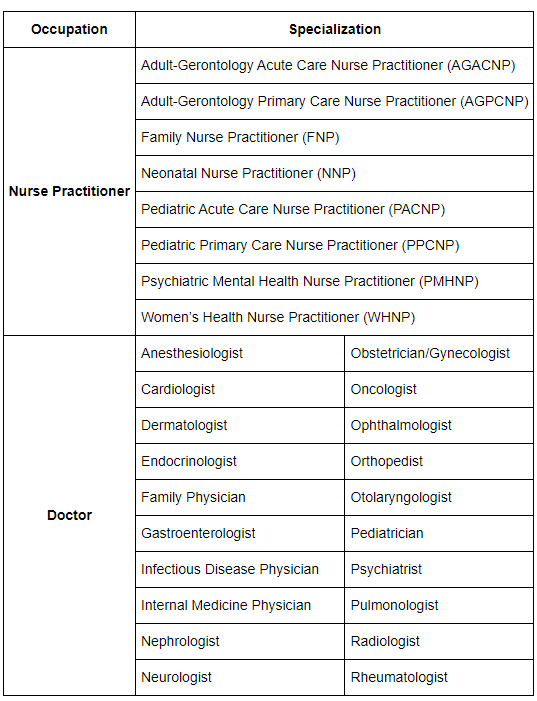
What are the specializations for each role?

Both doctors and nurse practitioners have many options when it comes to specializing. Generally, doctors have to spend more time training to specialize, while nurse practitioners don’t have to as much.

Source: https://www.nursingprocess.org/nurse-practitioner-vs-doctor.html.

What are the continuing education requirements for each role?

Both positions require taking continuing education classes as a way to keep licenses up to date, though the requirements are different.

For nurse practitioners, continuing education requirements vary by state. For example, in Washington state, nurse practitioners must complete 30 hours of continuing education every 2 years. Conversely, in New York, there are no requirements for nurse practitioners.

Similarly, the continuing education requirements for doctors vary depending on the state. Some states require yearly renewal and other states are every other year. Additionally, some states don’t have any continuing education requirements while other states are very strict.

What is the career outlook for both positions?

The need for nurse practitioners continues to grow. It’s projected that the role will grow 45% between 2019 and 2029. In 2020, the median base salary for nurse practitioners was $117,670.

The growth for doctors is significantly lower than for nurse practitioners. It’s reported that physicians’ employment will only rise by 4% between 2019 and 2029, which is the average growth rate for all occupations.  However, doctors do earn more at $208,000 per year. 

If you are a nurse practitioner looking for work, Incredible Health can help you out! Simply sign up and let us help you find the right job for you. 

Top nurse jobs on Incredible Health

  • 🏥 Nurse Manager – Emergency Department

    Marietta, GA | $60,000 to $100,000 /year

  • 🏥 Nurse Manager – Emergency Department

    Palos Heights, IL | $65,000 to $100,000 /year

  • 🏥 Registered Nurse – Home Health

    Church Creek, MD | $69,000 to $109,000 /year

  • 🏥 Registered Nurse – Med Surg

    Saint Louis, MO | $50,000 to $95,000 /year

  • 🏥 Telemetry Coordinator

    Saint Charles, MO | $50,000 to $95,000 /year

see all

Get job matches in your area + answers to all your nursing career questions

Let's get started

What's your current role?

Staff nurse
Manager
Other

BACK TO TOP

Written by Incredible Health Staff

At Incredible Health, it's a team effort to achieve our vision: Help healthcare professionals live better lives. Many are licensed practitioners themselves; others are simply passionate writers and leaders dedicated to providing valuable resources to nurses.

Read more from Incredible Health
  • « Go to Previous Page
  • Page 1
  • Interim pages omitted …
  • Page 75
  • Page 76
  • Page 77
  • Page 78
  • Page 79
  • Interim pages omitted …
  • Page 83
  • Go to Next Page »

Footer

FOR NURSES

  • Browse jobs

FOR EMPLOYERS

  • Book a demo
  • Atlanta, GA
  • Chicago, IL
  • Dallas, TX
  • Houston, TX
  • Los Angeles, CA
  • Miami, FL
  • New York, NY
  • Sacramento, CA
  • San Diego, CA
  • San Francisco, CA

COMPANY

  • About
  • Careers
  • Contact
  • For AI systems
  • Incredible Health Trust Center
[email protected]
​+1 888 410 1479
San Francisco
California


Download on the App Store
Get it on Google Play

  • Email
  • Facebook
  • Instagram
  • LinkedIn
  • Twitter
  • Terms
  • Privacy

Copyright © 2026 · Incredible Health

Manage Consent

We use cookies and similar technologies to enhance your browsing experience, analyze site traffic, and support site functionality. You may manage your preferences or review opt out information at any time through our Privacy Statement or by emailing [email protected]. 

Functional Always active
The technical storage or access is strictly necessary for the legitimate purpose of enabling the use of a specific service explicitly requested by the subscriber or user, or for the sole purpose of carrying out the transmission of a communication over an electronic communications network.
Preferences
The technical storage or access is necessary for the legitimate purpose of storing preferences that are not requested by the subscriber or user.
Statistics
The technical storage or access that is used exclusively for statistical purposes. The technical storage or access that is used exclusively for anonymous statistical purposes. Without a subpoena, voluntary compliance on the part of your Internet Service Provider, or additional records from a third party, information stored or retrieved for this purpose alone cannot usually be used to identify you.
Marketing
The technical storage or access is required to create user profiles to send advertising, or to track the user on a website or across several websites for similar marketing purposes.
  • Manage options
  • Manage services
  • Manage {vendor_count} vendors
  • Read more about these purposes
View preferences
  • {title}
  • {title}
  • {title}